
September 24, 2026 U.S. Stock Market Analysis: Wall Street Stays Cautious as Yields and Oil Rise
By Dr. Abhishek BhattNewYorkFinanceThink.com
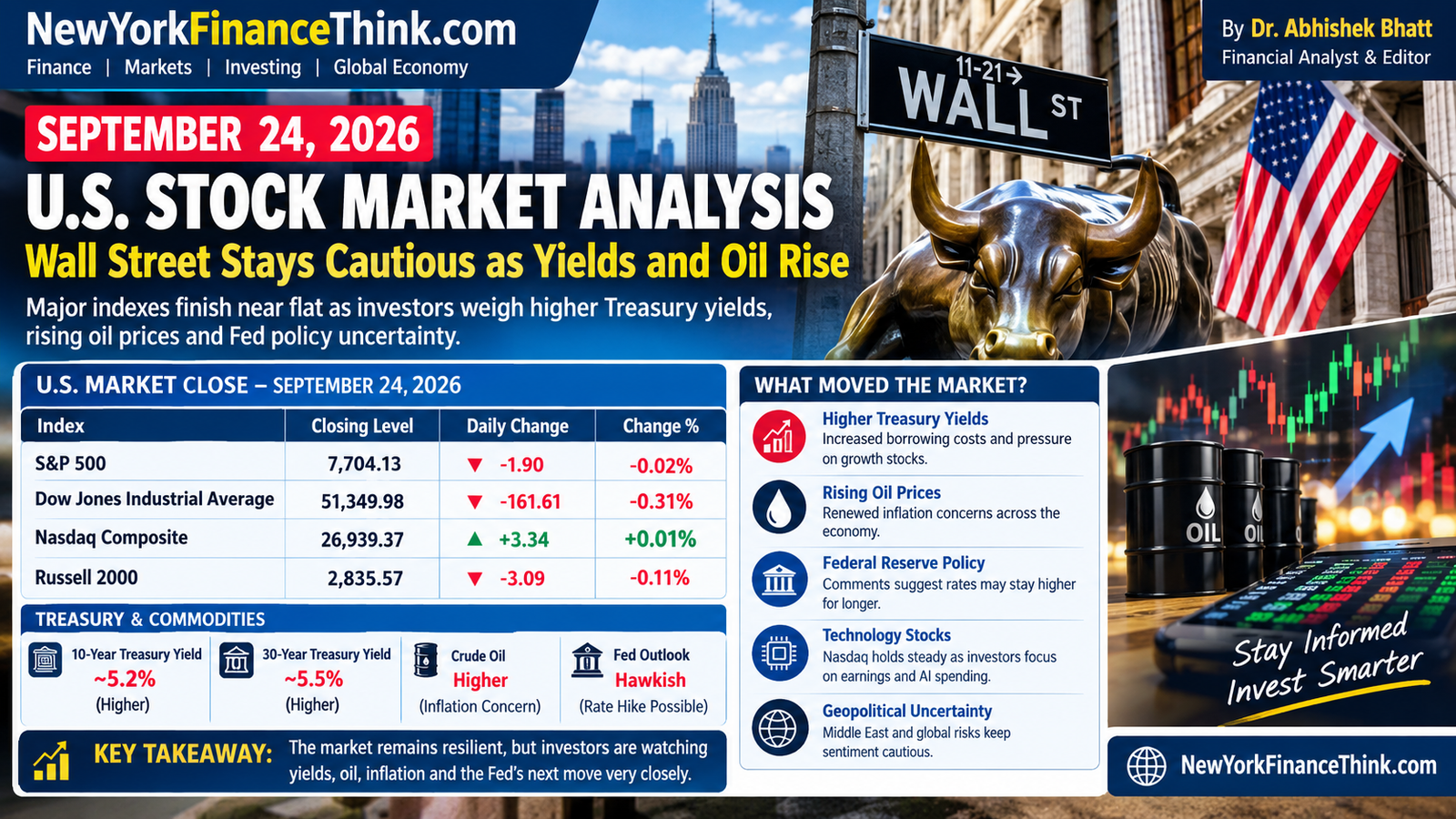
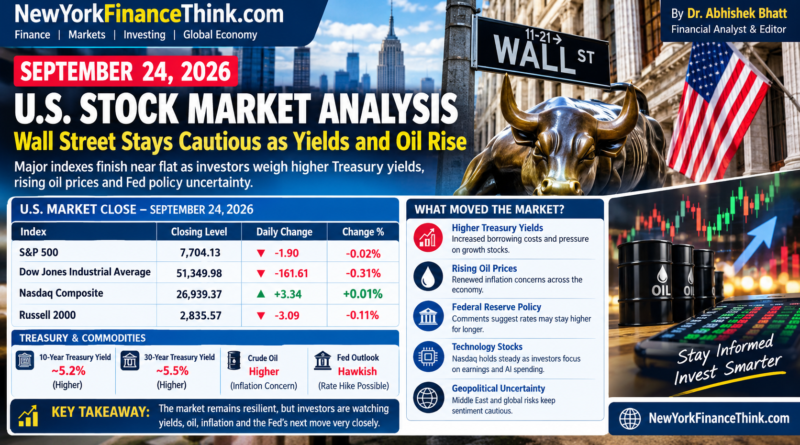
September 24, 2026 U.S. Stock Market Analysis: Wall Street Stays Cautious as Yields and Oil Rise By Dr. Abhishek BhattNewYorkFinanceThink.comWall Street finished Thursday, September 24, with little movement in the major stock indexes. The quiet closing numbers, however, did not tell the whole story.Investors were dealing with several important market pressures at the same time, including higher Treasury yields, elevated oil prices, Federal Reserve policy uncertainty and continuing geopolitical risks.The S&P 500 closed at 7,704.13, down 0.02%, while the Dow Jones Industrial Average fell 161.61 points, or 0.31%, to 51,349.98. The Nasdaq Composite finished almost unchanged at 26,939.37, gaining 0.01%.For investors, Thursday was less about a dramatic move in stocks and more about what was happening underneath the market.U.S. Market Data — September 24Index| Closing Level| Daily ChangeS&P 500| 7,704.13| -0.02%Dow Jones| 51,349.98| -0.31%Nasdaq Composite| 26,939.37| +0.01%Russell 2000| 2,835.57| -0.11%The market remained relatively stable, but the bond market was sending a more important signal.Treasury Yields Put Pressure on StocksU.S. Treasury yields remained elevated during Thursday’s trading session.The 10-year Treasury yield moved above the 5% level, while the 30-year yield approached 5.5%.Higher Treasury yields matter for Wall Street because they influence borrowing costs across the economy. They also affect how investors value future corporate earnings.When bond yields rise, some investors may become more cautious about paying very high prices for stocks, particularly companies whose expected profits are far into the future.That is one reason the relationship between the Treasury market and technology stocks remains important.Oil Prices Keep Inflation Concerns AliveCrude oil was another major factor for investors.Higher oil prices can eventually increase costs for transportation, manufacturing and businesses that depend heavily on energy.For consumers, expensive gasoline and other energy costs can also reduce the amount of money available for discretionary spending.The bigger concern for financial markets is inflation.If energy prices remain elevated for an extended period, investors may worry that inflation could prove harder to control. That could make the Federal Reserve more cautious about cutting interest rates.Federal Reserve Remains at the Center of the MarketFederal Reserve policy continues to be one of Wall Street’s biggest concerns.Recent comments from Fed officials have kept investors focused on the possibility that interest rates could remain high for longer, while the possibility of another rate increase has also been discussed.Markets are therefore watching inflation, employment and economic-growth data very closely.A stronger-than-expected economic report can sometimes be positive for corporate earnings, but it can also make investors worry that the Federal Reserve will have less reason to lower interest rates.That creates a difficult balance for Wall Street.Nasdaq Holds SteadyThe Nasdaq Composite finished Thursday almost unchanged.Technology stocks remain closely connected to interest-rate expectations because many technology companies trade at valuations based heavily on future earnings growth.The technology sector is also facing another major question: how much companies will spend on artificial intelligence infrastructure and how quickly those investments will translate into revenue and profits.Investors are increasingly looking at individual company results rather than simply buying the entire technology sector.Dow Finishes LowerThe Dow Jones Industrial Average was weaker than the Nasdaq, falling 0.31%.The Dow’s performance reflected the more cautious tone across parts of the broader market.With Treasury yields elevated and oil prices creating additional inflation concerns, investors continued to balance corporate earnings opportunities against macroeconomic risks.Russell 2000 Also Under PressureSmall-cap stocks also finished lower.The Russell 2000 fell 0.11%.Small companies can be particularly sensitive to borrowing costs because many smaller businesses rely more heavily on bank financing and other forms of credit.Therefore, a prolonged period of higher interest rates can become an important issue for small-cap investors.What September 24 Really Told InvestorsThursday’s session was not a major market sell-off.It was also not a powerful rally.Instead, it showed a market that remains cautious.The major indexes stayed relatively close to their previous levels while investors continued to watch several competing forces:- Treasury yields remain high.- Oil prices are creating inflation concerns.- Federal Reserve policy remains uncertain.- Technology stocks are sensitive to interest rates.- Geopolitical developments continue to influence sentiment.- Investors remain focused on incoming economic data.This combination is keeping Wall Street highly sensitive to new information.Key Market Signals to Watch1. The 10-Year Treasury YieldThe 10-year Treasury is one of the most important indicators for the U.S. financial system.A sustained move higher could put additional pressure on equity valuations.2. Crude OilOil prices remain important because energy costs can influence inflation and consumer spending.A significant move in crude could quickly change expectations for inflation and Federal Reserve policy.3. Federal Reserve CommentsEvery major statement from Federal Reserve officials is likely to receive close attention.Investors want to know whether policymakers are becoming more concerned about inflation or economic weakness.4. Inflation DataThe next major inflation reports could have a significant influence on expectations for interest rates.5. Corporate EarningsUltimately, stock prices depend heavily on corporate profits.Investors will continue to examine whether companies can maintain earnings growth while facing higher financing costs and potentially higher input prices.September 24 Market ConclusionThe U.S. stock market ended September 24 almost flat, but the session highlighted several issues that could remain important for the rest of the month.The S&P 500 remained above 7,700, the Nasdaq stayed near 26,940, while the Dow moved lower.The bigger story was the combination of elevated Treasury yields and oil-related inflation concerns.For investors, the current market environment is less about one day’s movement and more about the direction of interest rates, inflation and corporate earnings.Wall Street remains open to further gains, but investors are also paying close attention to the risks that could change market sentiment quickly.NewYorkFinanceThink.com will continue tracking the S&P 500, Nasdaq, Dow Jones, Treasury yields, crude oil, Federal Reserve policy and major U.S. economic data as the September market develops.DisclaimerThis article is for general financial information and market analysis only. It is not investment advice or a recommendation to buy or sell any security. Investors should conduct their own research and consider their individual financial circumstances before making investment decisions.
