
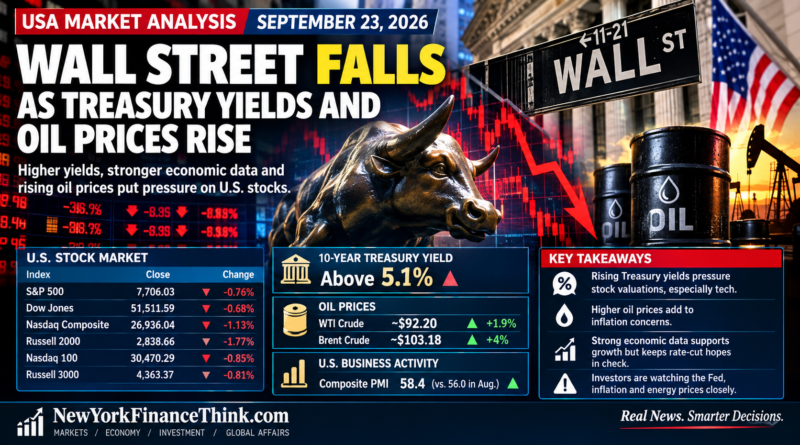
Wall Street Falls as Treasury Yields and Oil Prices Rise
September 23, 2026
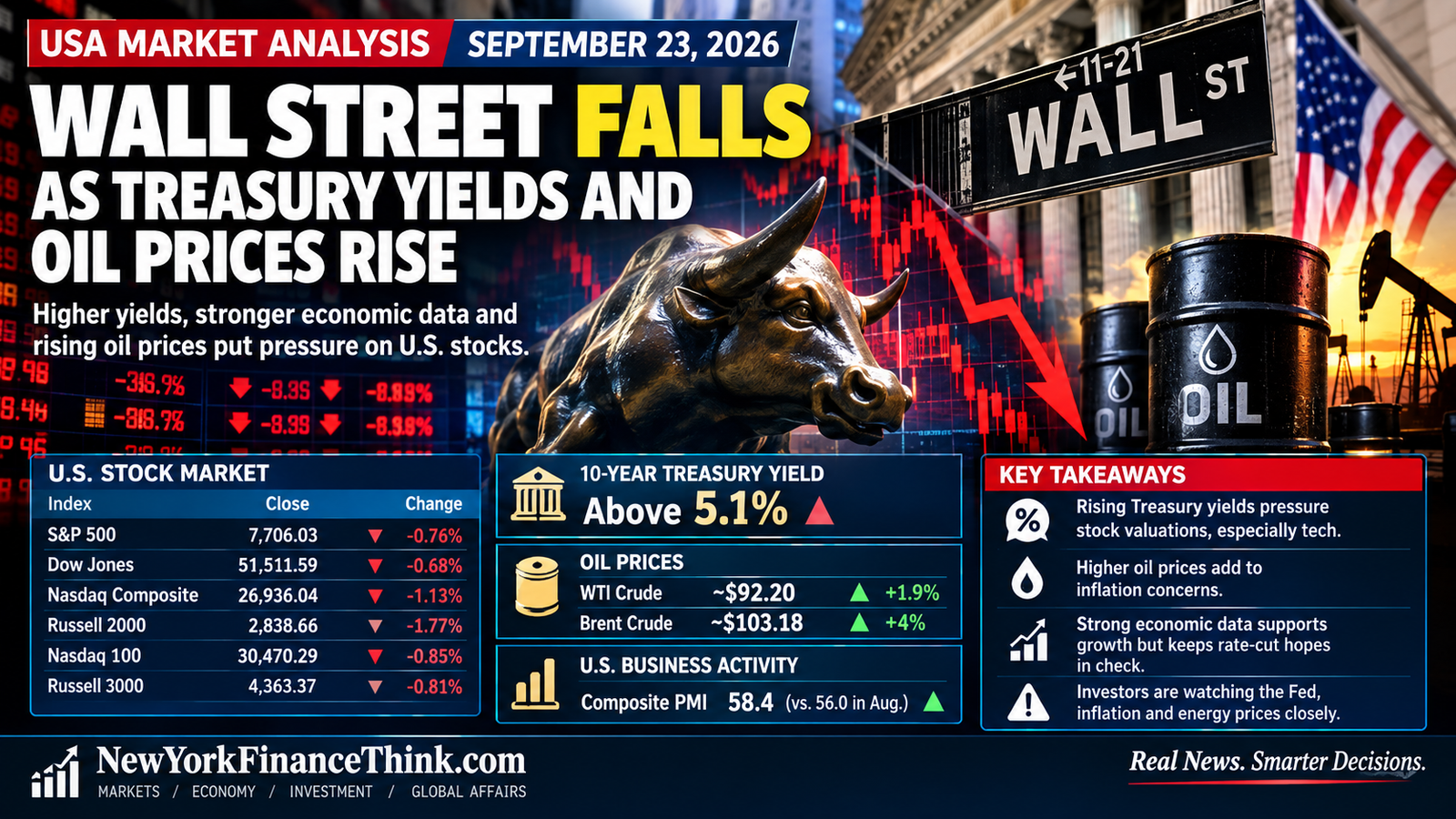
Wall Street ended lower on Wednesday as investors dealt with a combination of rising Treasury yields, higher oil prices and fresh economic data showing that U.S. business activity remains strong.
The decline was broad. The technology-heavy Nasdaq Composite fell more than 1%, while the S&P 500 and Dow Jones Industrial Average also moved lower. Smaller companies were hit harder, with the Russell 2000 falling nearly 1.8%.
The market’s attention was not focused on one single piece of news. Instead, investors were weighing several factors at the same time: the direction of interest rates, inflation risks, energy prices and the strength of the U.S. economy.
U.S. Stock Market: September 23 Close
| Index | Closing Level | Daily Change |
|---|---|---|
| S&P 500 | 7,706.03 | -0.76% |
| Dow Jones Industrial Average | 51,511.59 | -0.68% |
| Nasdaq Composite | 26,936.04 | -1.13% |
| Russell 2000 | 2,838.66 | -1.77% |
| Nasdaq 100 | 30,470.29 | -0.85% |
| Russell 3000 | 4,363.37 | -0.81% |
The numbers show that Wednesday’s selling was not limited to one corner of the market. Large-cap stocks declined, technology stocks declined more sharply, and small-cap stocks experienced an even larger pullback.
Treasury Yields Move Above 5%
One of the biggest developments for investors was the rise in Treasury yields.
The 10-year U.S. Treasury yield moved above 5.1%, putting renewed pressure on stocks.
Treasury yields matter because they influence borrowing costs across the economy and provide investors with an important benchmark for determining the relative value of stocks and other assets.
When government bond yields rise, investors may demand a higher potential return from stocks. Higher yields can also put additional pressure on companies whose valuations depend heavily on expectations of future growth.
That was particularly important for technology and growth stocks on Wednesday.
Nasdaq Takes the Bigger Hit
The Nasdaq Composite dropped 1.13% to 26,936.04.
The decline came after the index had recently reached record territory, leaving investors more sensitive to changes in interest rates and bond yields.
Technology companies have benefited from strong investor demand and expectations surrounding artificial intelligence, cloud computing, semiconductors and other growth areas. But many of these companies also trade at valuations that can be more sensitive to changes in interest rates.
Wednesday’s move showed how quickly sentiment can change when the bond market becomes a major focus.
Oil Prices Add Another Inflation Concern
Oil was another major part of the market story.
WTI crude traded around $92.20 a barrel, while Brent crude moved to roughly $103.18 a barrel.
Brent’s move above $100 is particularly important for investors because energy prices affect transportation, manufacturing, consumer costs and corporate expenses.
Higher oil prices do not automatically mean higher inflation across the entire economy. However, a sustained rise in energy prices can make the Federal Reserve’s inflation fight more complicated.
For investors, the question is whether higher energy prices represent a temporary move or the beginning of a longer period of elevated costs.
U.S. Business Activity Remains Strong
The latest economic data provided another important signal.
The preliminary S&P Global U.S. Composite PMI rose to 58.4 in September from 56.0 in August, according to data reported Wednesday.
A reading above 50 indicates expansion.
The strong number suggests that private-sector economic activity remained solid. That is positive for economic growth, but strong activity can also create a difficult environment for investors if it keeps price pressures elevated.
For the Federal Reserve, the challenge is balancing economic growth against inflation.
For Wall Street, the question is how that balance will affect interest rates.
Why Strong Economic Data Can Pressure Stocks
At first glance, strong economic data should be good news for the stock market.
A stronger economy can mean higher consumer spending, stronger corporate revenue and better employment conditions.
But financial markets also look ahead.
If economic growth remains unusually strong while inflation pressures remain elevated, investors may expect interest rates to remain higher for longer.
That can push Treasury yields higher.
And when Treasury yields rise, stock valuations can come under pressure.
This is one reason investors were paying close attention to Wednesday’s economic data rather than simply celebrating stronger business activity.
Small-Cap Stocks Face Heavy Selling
The Russell 2000 fell 1.77%, considerably more than the Dow Jones and S&P 500.
Small-cap companies can be particularly sensitive to financing conditions because many smaller businesses rely more heavily on borrowing and have less financial flexibility than the largest U.S. corporations.
When interest rates rise, financing becomes more expensive.
That makes the Russell 2000 an important market indicator to watch when investors are concerned about interest rates and credit conditions.
Dow Jones Declines Less Than Nasdaq
The Dow Jones Industrial Average fell 0.68% to 51,511.59.
The Dow contains many large, established companies across different industries, so its daily performance can differ significantly from the technology-heavy Nasdaq.
On September 23, the Nasdaq’s larger decline showed that technology and growth stocks were under greater pressure than the Dow’s blue-chip group.
The difference between the indexes is important because the stock market is not one single trade. Different sectors and companies can react very differently to the same economic news.
The Market’s Main Risk: Higher for Longer
For investors, the central issue remains interest rates.
The Federal Reserve’s policy decisions depend heavily on incoming economic and inflation data. A strong economy can give policymakers less reason to move quickly toward lower rates, particularly if inflation remains above the Fed’s preferred level.
At the same time, higher borrowing costs can eventually affect consumers and businesses.
That leaves investors watching several numbers at once:
- Treasury yields
- Oil prices
- Inflation data
- Employment reports
- Consumer spending
- Corporate earnings
- Federal Reserve policy
The interaction between these factors may be more important than any single day’s market move.
What Investors Should Watch Next
After Wednesday’s sell-off, several market indicators will remain in focus.
1. The 10-Year Treasury Yield
A sustained move above 5% would remain an important signal for equity investors.
2. Oil Prices
Brent crude around or above $100 would keep energy prices firmly on the market’s radar.
3. Technology Stocks
Investors will continue watching major technology and semiconductor companies because of their large influence on the Nasdaq and S&P 500.
4. Inflation Data
Future inflation reports will help investors assess whether higher energy prices are feeding into broader price pressures.
5. Federal Reserve Policy
Markets will continue adjusting expectations for the path of U.S. interest rates as new economic data arrive.
September 23 Market Summary
Wednesday’s session was a reminder that Wall Street can react sharply when several market forces move in the same direction.
The S&P 500 declined 0.76%, the Dow fell 0.68%, and the Nasdaq Composite dropped 1.13%.
The Russell 2000’s 1.77% decline showed that smaller companies faced even greater pressure.
At the same time, the 10-year Treasury yield moved above 5.1% and Brent crude traded above $100.
The combination created a difficult environment for stocks.
The bigger question for the market is not simply whether stocks fall for one session. Investors will be watching whether higher Treasury yields and elevated oil prices continue to influence markets in the sessions ahead.
For now, Wall Street is balancing two competing messages: the U.S. economy remains strong, but stronger growth and higher energy prices can make the path for inflation and interest rates more complicated.
September 23 Key Numbers
S&P 500: 7,706.03
Dow Jones: 51,511.59
Nasdaq Composite: 26,936.04
Russell 2000: 2,838.66
10-Year Treasury: Above 5.1%
WTI Crude: About $92.20
Brent Crude: About $103.18
U.S. Composite PMI: 58.4
For NewYorkFinanceThink.com
Market data and economic figures reflect the September 23, 2026 U.S. trading session. Figures may vary slightly among market-data providers because of timing and rounding.
