
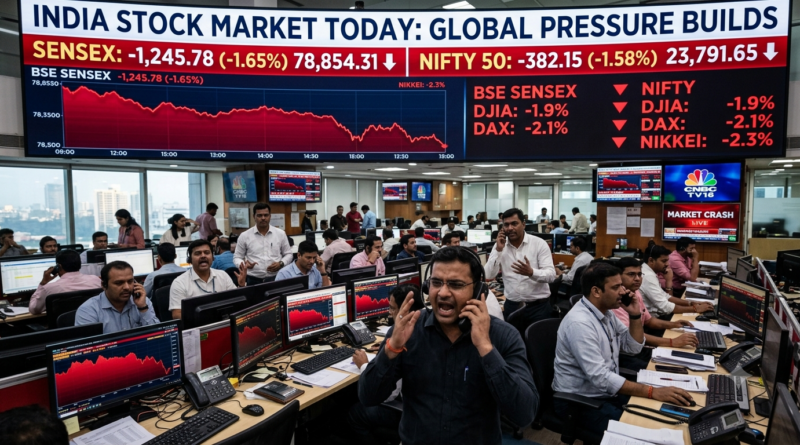
India Stock Market Today: Sensex and Nifty Fall Sharply as Global Market Pressure Builds
September 24, 2026 | India Stock Market Analysis
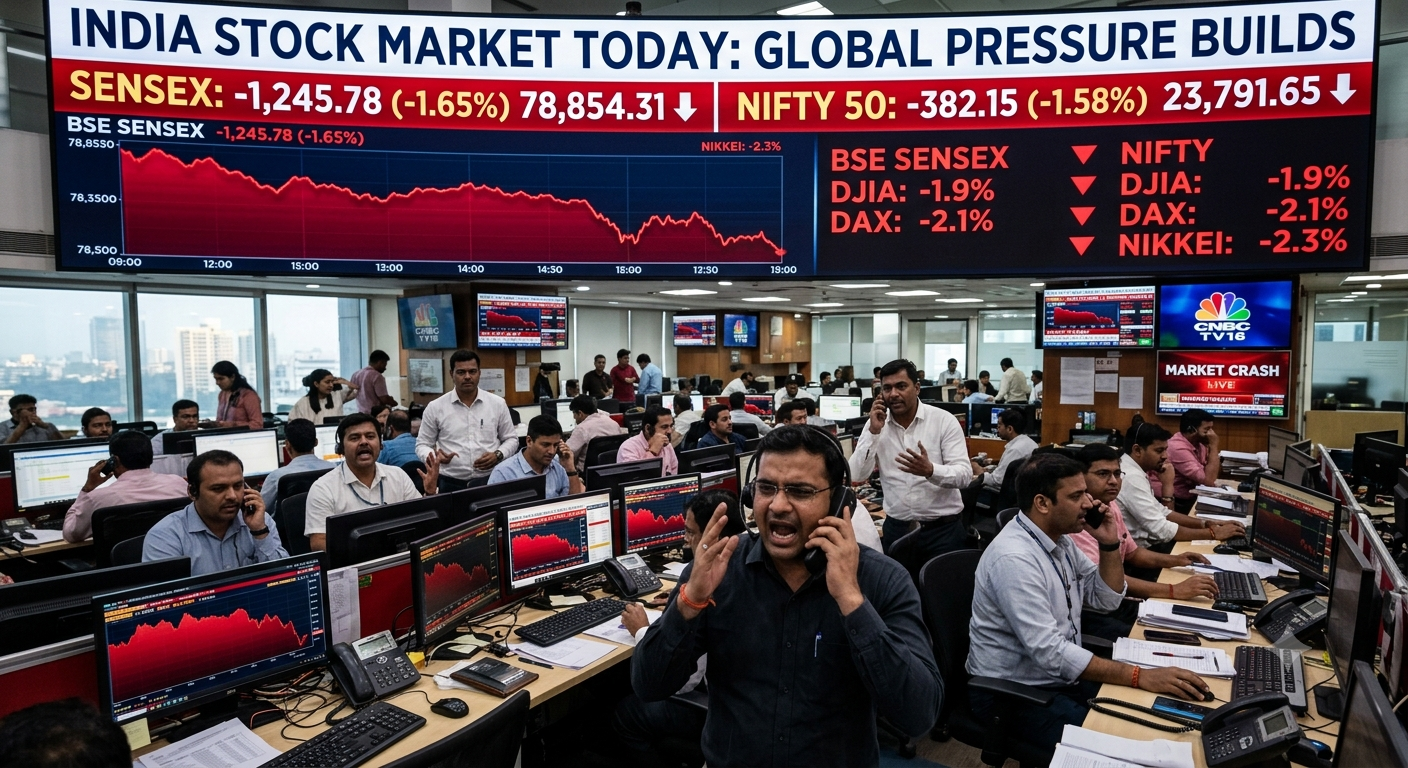
India Stock Market Analysis indian stocks came under heavy selling pressure on Thursday as investors reacted to a combination of global market weakness, elevated crude oil prices, rising U.S. Treasury yields and concerns about foreign capital flows.The Sensex fell more than 1,200 points during the session, while the Nifty 50 moved below the 23,100 level.The selling was broad-based, with weakness visible across large-cap, mid-cap and small-cap stocks.India Stock Market Today: Key Market DataMarket Indicator| September 24, 2026Nifty 50| Below 23,100 intradaySensex| Down more than 1,200 points intradayNifty Midcap| LowerNifty Smallcap| LowerMarket Breadth| Strongly negativeCrude Oil| Above $100 per barrelU.S. Treasury Yields| ElevatedMarket Mood| Risk-offWhy Is the Indian Stock Market Falling Today?Today’s decline is being driven by several factors rather than one single domestic event.Global investors are increasingly focused on the direction of interest rates, bond yields, crude oil and geopolitical risks.For India, the combination is particularly important because higher oil prices can increase the country’s import bill, while higher global yields can affect capital flows toward emerging markets.1. Rising U.S. Treasury YieldsU.S. Treasury yields remain an important factor for global markets.When U.S. bond yields rise, investors reassess the relative attractiveness of equities and emerging-market assets.Higher yields can also strengthen the U.S. dollar and increase financial pressure on countries that depend heavily on foreign capital.Indian equities are therefore sensitive to major moves in U.S. bond markets.2. Crude Oil Remains Above $100Crude oil is another major concern for Indian investors.India imports a significant portion of its crude oil requirements. A sustained rise in international oil prices can increase the country’s import bill and create pressure on inflation and the Indian rupee.Higher energy costs can also affect companies that depend heavily on transportation, fuel or other petroleum-related inputs.This makes crude oil one of the most important variables for the Indian market at present.3. Broad-Based Selling Across Indian StocksThe weakness is not restricted to the Sensex and Nifty.A large number of NSE-listed stocks were trading lower during the session, indicating broad market selling.Mid-cap and small-cap stocks also came under pressure.When market breadth becomes strongly negative, it indicates that the selling is spreading beyond a few heavyweight companies.Banking and Financial Stocks Face PressureBanking and financial stocks were among the areas facing significant selling pressure.Large financial companies have substantial weight in India’s benchmark indexes. Therefore, weakness in banking and financial stocks can have a significant impact on both the Sensex and Nifty.Investors are also watching whether pressure in financial stocks remains temporary or spreads further across the sector.Nifty 50 Technical Levels to WatchThe 23,100–23,150 area is an important short-term zone for the Nifty 50.If the index continues to remain below this area, traders may watch for additional downside support.On the upside, the 23,600–23,650 region remains an important resistance zone.A recovery above resistance could indicate improving short-term sentiment, while continued weakness below support could keep volatility elevated.These levels should be treated as market reference points rather than guaranteed turning points.Sensex: What Investors Are WatchingThe Sensex experienced a sharp intraday decline of more than 1,200 points.The magnitude of the move shows how quickly sentiment can change when domestic equities face pressure from global markets.Investors are now watching whether buying interest returns after the sharp decline or whether sellers continue to dominate the session.Impact of the Indian RupeeThe movement of the Indian rupee is another important factor.Higher crude prices can increase demand for dollars because India needs to pay for imported energy.At the same time, strong U.S. Treasury yields can support the dollar internationally.A weaker rupee can increase the domestic cost of imported commodities and therefore remains an important consideration for investors.Foreign Investor FlowsForeign institutional and portfolio flows can have a significant short-term influence on Indian equities.When global investors reduce exposure to emerging markets, large Indian stocks can experience additional selling pressure.Investors will therefore be watching upcoming foreign-investor flow data closely.Which Sectors Could Remain Sensitive?Several sectors could remain particularly sensitive to the current market environment.Banks and FinancialsHigher volatility and pressure on large financial stocks can influence the benchmark indexes significantly.Oil and EnergyHigher crude prices can benefit some upstream energy businesses but create cost pressure for companies that consume large quantities of fuel.Aviation and TransportationHigher fuel prices can increase operating costs for airlines and transportation businesses.Consumer CompaniesPersistent energy and commodity inflation can eventually affect input costs and consumer spending.TechnologyIndian technology companies remain sensitive to global economic conditions, the U.S. economy and currency movements.Global Markets Matter for IndiaIndia’s stock market does not trade in isolation.Investors are simultaneously watching Wall Street, U.S. Treasury yields, crude oil, the U.S. dollar and geopolitical developments.A significant move in any of these markets can quickly affect sentiment in Mumbai.This is particularly important during periods of elevated global uncertainty.What Investors Should Watch NextThe following factors are likely to remain important for the Indian market:1. Nifty 50 support around 23,100–23,1502. Resistance around 23,600–23,6503. Crude oil prices4. U.S. 10-year Treasury yield5. Indian rupee against the U.S. dollar6. Foreign investor buying and selling7. Global equity markets8. Banking-sector performance9. Inflation expectations10. Geopolitical developmentsIndia Stock Market OutlookThursday’s selloff demonstrates how quickly Indian equities can react to changes in global financial conditions.The combination of elevated crude oil prices, higher U.S. Treasury yields and broad-based selling has created a difficult short-term environment.However, one trading session does not by itself determine the long-term direction of the Indian economy or individual companies.Investors should separate short-term market volatility from the underlying fundamentals of individual businesses.Corporate earnings, debt levels, cash flows, valuations and long-term growth prospects remain important when assessing individual stocks.The Bigger PictureIndia remains one of the world’s major emerging economies, and its stock market is closely followed by international investors.But India’s dependence on imported crude oil means that energy prices remain an important macroeconomic variable.At the same time, global interest rates influence the flow of international capital.That combination means Indian investors need to monitor both domestic economic data and global financial markets.For the remainder of the session, the most important signals will come from the Nifty’s ability to hold important support levels, movements in crude oil and U.S. Treasury yields, and the direction of global equity markets.Final TakeawayThe Indian stock market is facing a broad-based selloff on September 24, 2026.Nifty 50: Under pressureSensex: Sharp intraday declineBanking stocks: WeakMarket breadth: NegativeCrude oil: Above $100U.S. Treasury yields: ElevatedShort-term sentiment: CautiousThe market’s next direction will depend heavily on whether buyers return around key support levels and whether global risk pressure begins to ease.For now, volatility remains the central theme for Indian equities.—Market DisclaimerThis article is for informational and educational purposes only. It is not investment advice, financial advice or a recommendation to buy or sell any stock, index or other security. Investors should conduct their own research and consider their financial circumstances and risk tolerance before making investment decisions.Author: Dr. Abhishek BhattNew York Finance Think
