
India Stock Market June 2026: Nifty and Sensex Rise as Banks Lead a Major Sector Rotation
June 2026 Market Analysis Report
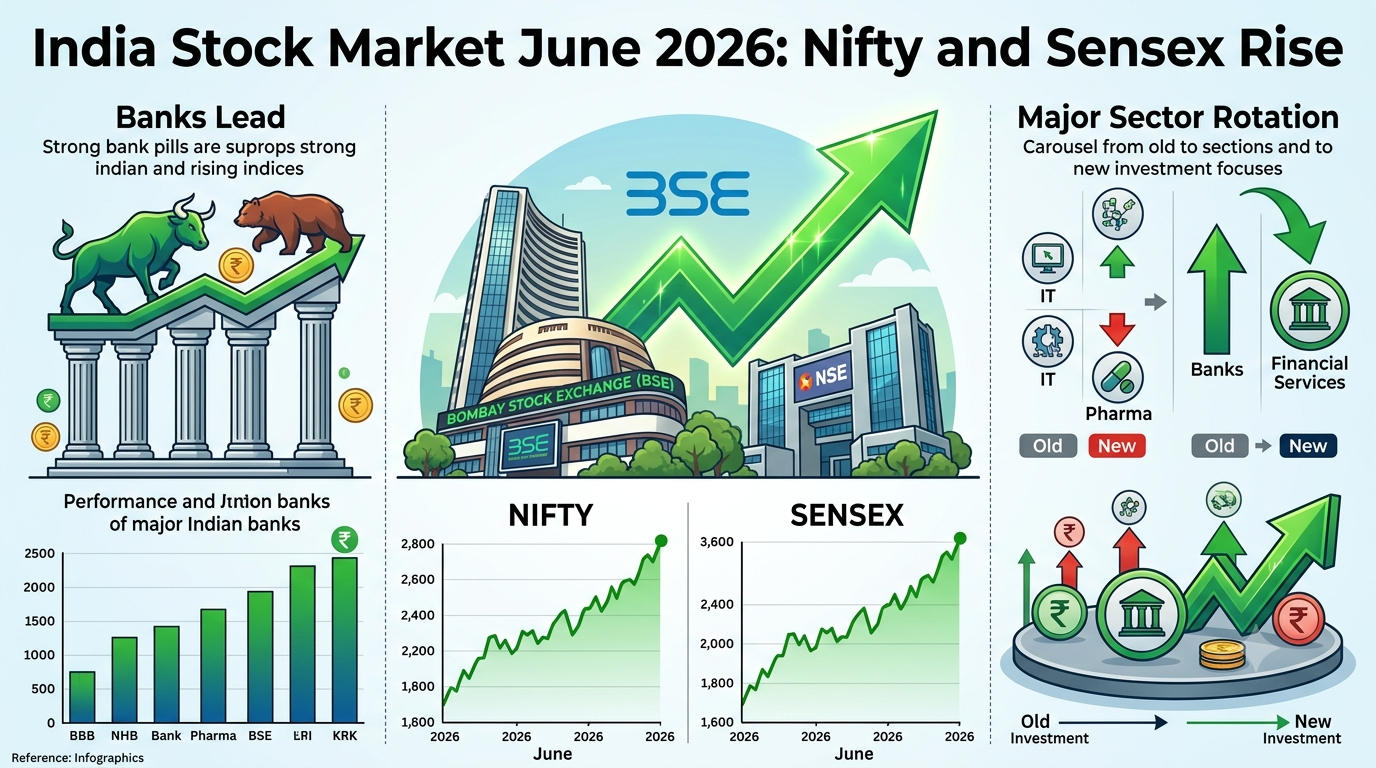
India Stock Market June 2026: Nifty and Sensex Rise as Banks Lead a Major Sector RotationJune 2026 Market Analysis ReportIndia’s stock market delivered a mixed but broadly positive performance in June 2026. The benchmark indices finished the month higher, but the gains were not evenly distributed across sectors.The Nifty 50 closed June at 23,865.75, while the BSE Sensex ended at 76,478.67. Banking and financial stocks were among the strongest performers, while information technology and metal stocks faced significant pressure.The broader market also showed an important divergence. Small-cap stocks performed considerably better than mid-cap stocks during the month, highlighting the continued importance of stock and sector selection.For investors, June’s market action was less about a broad rally and more about a rotation of capital between sectors.June 2026 Market DataIndex / Sector| June 2026 PerformanceNifty 50| +1.4% to +1.67%Sensex| +1.69% to +2.3%Nifty Smallcap 100| About +4.0%Nifty Midcap 100| About +0.1%Nifty Bank| About +6.1%Nifty Private Bank| About +6.1%Nifty Financial Services| About +4.7%Nifty Pharma| About +4.0%Nifty IT| About -9.6%Nifty Metal| About -6.9%Monthly-return figures can vary slightly depending on the calculation methodology and reference closing session.Nifty 50 Finishes June HigherThe Nifty 50 ended June at 23,865.75.Although the index declined on the final trading session, it still recorded a monthly gain. The performance reflected support from financial stocks and selected domestic-facing sectors.The June market was therefore not a straightforward advance across the entire index. Some heavyweight sectors provided substantial support while others experienced significant selling.This divergence became one of the defining characteristics of the month.Sensex Also Records a Monthly GainThe BSE Sensex closed June at 76,478.67.Like the Nifty, the Sensex finished June higher despite weakness during the final session.Large financial companies played an important role in supporting the benchmark.The monthly performance demonstrated that India’s large-cap market remained resilient even as several major sectors experienced considerable volatility.Banking Stocks Become the Market’s Main EngineOne of the clearest themes of June was the strength of India’s banking sector.The Nifty Bank gained approximately 6.1%, while the private-bank segment also recorded gains of around 6.1%.Financial services stocks similarly posted strong monthly returns.The strength of banks was important because financial companies have significant representation in India’s major benchmark indices.When large banking stocks rise, they can provide substantial support to the Nifty and Sensex even when other sectors are declining.Why Banks Were StrongSeveral factors supported sentiment toward financial stocks during June.These included:- Expectations surrounding interest rates- RBI monetary-policy developments- Domestic credit growth- Stronger investor interest in financial companies- Rotation of capital away from weaker sectorsThe RBI’s June policy decision also remained an important market event.RBI Keeps Repo Rate at 5.25%The Reserve Bank of India kept the repo rate at 5.25% at its June policy meeting and maintained a neutral policy stance.Interest-rate decisions are particularly important for banks, real estate companies, automobiles and other rate-sensitive industries.Stable monetary conditions can affect borrowing costs, credit demand and corporate investment.For financial markets, the RBI’s policy provided another factor for investors to evaluate alongside earnings and global market conditions.IT Stocks Face Heavy SellingThe biggest weakness during June came from India’s technology sector.The Nifty IT index fell approximately 9.6% during the month.This was a significant move for one of India’s most important market sectors.Indian IT companies generate substantial revenue from international clients, particularly in the United States and other developed markets. Consequently, global technology spending, U.S. interest rates, currency movements and expectations surrounding artificial intelligence can all affect investor sentiment toward the sector.June’s decline showed how quickly investors can rotate away from a previously important market segment.AI and Technology Spending Become Investor ConcernsArtificial intelligence remained an important theme for the global technology industry.Investors continued to evaluate how AI could affect traditional IT-services businesses.The key questions included:- How quickly will companies increase AI spending?- Which Indian IT companies will capture new AI-related revenue?- Could automation reduce demand for some traditional services?- How much investment will companies need to make to remain competitive?These questions contributed to uncertainty around the future earnings outlook for parts of the IT sector.Metal Stocks Also Under PressureMetal stocks were another weak area of the market.The Nifty Metal index declined approximately 6.9% during June.Metal companies are highly sensitive to global economic conditions, commodity prices, Chinese demand, infrastructure activity and international trade.Consequently, concerns about global growth can quickly affect the sector.The contrast between banking performance and metal performance was one of the clearest examples of June’s sector rotation.Smallcaps Outperform MidcapsThe broader market produced another interesting signal.The Nifty Smallcap 100 gained approximately 4%, while the Nifty Midcap 100 gained only around 0.1%.This meant that smaller companies generally performed better than mid-cap stocks during the month.However, investors should not interpret the broader-market gains as evidence that every small-cap stock performed well.Small-cap indices can contain significant differences between individual companies, and their shares can also experience larger price swings.Crude Oil Becomes a More Favorable FactorCrude oil was another important part of India’s June market story.Brent crude declined significantly from its April peak.Reuters reported that Brent was around $73 per barrel at the end of June, approximately 42% below its April peak of $126.40.Lower crude prices can be important for India because the country imports a substantial amount of its oil requirements.Cheaper crude can potentially reduce pressure on:- India’s import bill- Inflation- The current account- Corporate transportation costs- Energy-related input costsThe oil market therefore provided some relief to the broader Indian macroeconomic picture.Foreign Investors Remain ImportantForeign portfolio flows continued to be closely watched by Indian investors.Foreign investors had been major sellers during parts of 2026, and their activity remained an important source of volatility.When global investors move money into or out of emerging markets, large-cap Indian stocks can experience substantial buying or selling pressure.Domestic institutional investors therefore remained an important counterbalance to foreign flows.June 2026 Sector RotationThe monthly performance can be summarized as follows:Sector| June DirectionBanking| StrongPrivate Banks| StrongFinancial Services| StrongPharma| PositiveSmallcaps| StrongMidcaps| Nearly flatNifty 50| PositiveSensex| PositiveIT| WeakMetals| WeakThe table shows why looking only at the Nifty or Sensex can provide an incomplete picture of the market.Two investors holding completely different portfolios could have experienced very different results during June.What June Means for InvestorsJune 2026 demonstrated the importance of sector allocation and diversification.The market rewarded some areas while aggressively selling others.Banks and financial companies provided leadership. Smallcaps also performed strongly. At the same time, IT and metals experienced significant declines.This type of market environment can create both opportunities and risks.Investors should therefore look beyond headline index movements and examine earnings, valuations, sector fundamentals, liquidity and macroeconomic conditions.Key Factors to Watch After JuneAs the Indian market moved into the second half of 2026, several variables remained important.1. RBI Monetary PolicyFuture changes in interest-rate expectations could influence banks, financials, real estate and other rate-sensitive sectors.2. Crude OilA renewed increase in oil prices could create pressure on India’s inflation and trade position.3. Foreign InvestmentFPI buying or selling could influence large-cap stocks and overall market sentiment.4. IT EarningsInvestors would continue watching technology-company earnings and management commentary regarding AI, U.S. technology spending and global demand.5. Corporate EarningsThe next earnings season could determine whether the market’s valuation levels are supported by actual profit growth.6. Global MarketsU.S. interest rates, the dollar, geopolitical developments and global economic growth remained important external factors for Indian equities.Final TakeawayJune 2026 was a month of sector rotation in the Indian stock market.The Nifty 50 and Sensex finished higher, but the real story was underneath the headline indices.Banks and financial stocks led the market, smallcaps outperformed, while IT and metal stocks experienced significant selling pressure.The decline in crude oil prices provided an additional macroeconomic cushion for India, while RBI policy and global interest-rate expectations remained important factors for investors.June therefore showed that the Indian equity market could continue to rise even while individual sectors experienced sharply different outcomes.For investors studying the first half of 2026, the lesson from June was clear: the direction of the headline index did not tell the entire market story. Sector allocation, earnings and global macroeconomic conditions remained critical.—DisclaimerThis article is provided for informational and educational purposes only. It is not investment advice, a recommendation to buy or sell any security, or a guarantee of future returns. Market conditions can change rapidly. Investors should conduct their own research and consider their financial objectives and risk tolerance before making investment decisions.Author:Dr. Abhishek BhattPhD, History; Gold Medalist, Delhi University; JNU; Andhra Pradesh State University; Kerala University; Nagaland UniversityNew York Finance ThinkSEO InformationSEO Title: India Stock Market June 2026 Analysis: Nifty, Sensex, Banks & ITMeta Description: India stock market June 2026 analysis covering Nifty, Sensex, banking, IT, metals, smallcaps, crude oil, RBI policy and foreign investment flows.Focus Keyword: India stock market June 2026Slug: “india-stock-market-june-2026-analysis”Tags: India Stock Market, Nifty 50, Sensex, June 2026, Indian Stocks, Nifty Bank, Nifty IT, Smallcap Stocks, Midcap Stocks, RBI, Crude Oil, FPI, Stock Market Analysis
