
A Stronger Chinese Yuan: What It Could Mean for Ordinary People in China
By Dr. Abhishek Bhatt | Published September 21, 2026 | Updated September 21, 2026

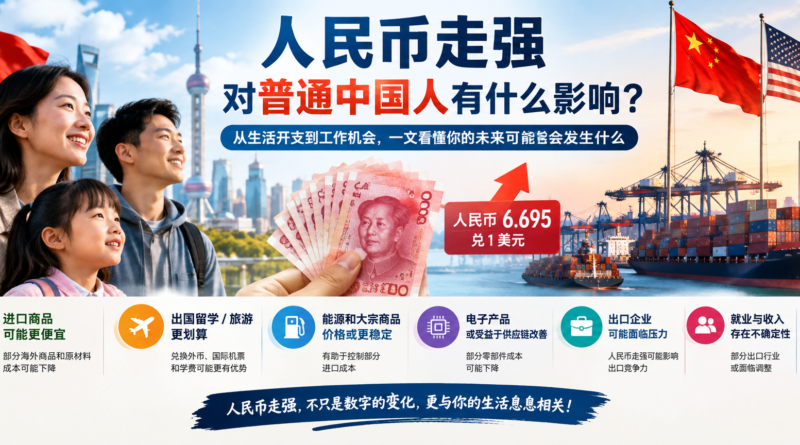
For most people in China, a currency story can sound like something that belongs only to banks, traders and financial markets. But when the yuan moves sharply against the U.S. dollar, the effects can eventually reach ordinary households through the prices of imported goods, energy, travel, overseas education, business costs and even employment. On September 21, 2026, China’s yuan strengthened to around 6.695 yuan per U.S. dollar, its strongest level in more than three and a half years, while the People’s Bank of China, or PBOC, set its daily midpoint at 6.7487. Reuters reported that the move came as Chinese policymakers appeared to allow greater yuan strength ahead of President Xi Jinping’s September 23–25 state visit to the United States to meet President Donald Trump.
What Does a Stronger Yuan Actually Mean?
The easiest way to understand the move is to remember one simple rule: when the exchange rate falls from, for example, 7 yuan per dollar to 6.7 yuan per dollar, the yuan has become stronger against the dollar. A person or company in China needs fewer yuan to buy one U.S. dollar. That does not mean every product in China suddenly becomes cheaper, and it does not mean household incomes automatically rise. Currency movements work through the economy gradually. The first effects are normally seen in international trade, imported goods, overseas payments and companies that earn money or buy products in foreign currencies. From there, the impact can reach consumers and workers.
Why Is the Yuan Strong Right Now?
The latest move is particularly important because it comes just before a major U.S.–China meeting. China’s Foreign Ministry confirmed on September 21 that President Xi Jinping will visit the United States from September 23 to September 25 at President Trump’s invitation. The Chinese Foreign Ministry said Xi will discuss major issues concerning China-U.S. relations as well as broader questions involving world peace and development. The White House separately confirmed that Trump and First Lady Melania Trump will welcome Xi and Peng Liyuan to the White House on September 24 for an official state visit.
Reuters reported that the PBOC’s September 21 midpoint was the strongest since February 2023, while the market yuan reached about 6.6950 against the dollar. Analysts cited by Reuters viewed the move partly as an effort to maintain currency stability around the summit. That is important because China does not simply leave the yuan to move without policy management. The PBOC sets a daily reference rate, and the onshore yuan trades within a permitted range around that midpoint.
What Could Ordinary Chinese Families Gain?
For an ordinary family, one of the clearest potential benefits of a stronger yuan is cheaper foreign purchasing power. If the yuan is stronger against the dollar, Chinese consumers need fewer yuan to buy the same amount of U.S. dollars. That matters for people who travel abroad, pay international tuition, purchase foreign services or buy products whose prices are closely connected to international markets. The benefit will not be identical for every household because most daily expenses in China are paid in yuan and are determined mainly by domestic costs, wages, rent, taxes, transportation and local supply and demand.
A stronger yuan can also reduce the yuan cost of some imported goods and raw materials. China imports large quantities of energy, industrial commodities, food products, machinery and other materials from international markets. Many global commodities are priced in U.S. dollars. When the yuan becomes stronger, Chinese companies can theoretically purchase the same dollar-priced commodity using fewer yuan. Whether consumers actually see that saving at the supermarket, gas station or electronics store depends on the full supply chain. Companies may keep part of the savings, use it to reduce costs, or pass some of it to customers.
Could Food Prices Become More Stable?
This is one area ordinary families may care about most. A stronger currency can make some imported agricultural products, food ingredients and other dollar-priced commodities less expensive in yuan terms. But the final price of food in a Chinese supermarket depends on much more than the exchange rate. Weather, domestic harvests, transportation costs, wages, storage, fuel prices, government policies and international commodity prices can all matter.
So it would be wrong to say that a stronger yuan automatically means cheaper food. The more accurate point is that a stronger yuan can reduce one part of the cost structure for imported products.
What About Oil and Gas?
Energy is another major channel. International crude oil is generally traded in U.S. dollars, so the yuan’s exchange rate can influence the domestic cost of imported energy. If the dollar price of oil stays unchanged while the yuan strengthens, Chinese importers need fewer yuan to purchase the same dollar value of oil.
But again, ordinary consumers should not expect an immediate fall in fuel prices simply because the yuan is stronger. Oil prices themselves can move sharply because of wars, production decisions, shipping disruptions, sanctions, OPEC policy and global demand. In September 2026, geopolitical risks in the Middle East remain an important factor in global energy markets. Therefore, the currency effect can be outweighed by a large change in the international oil price.
What About Phones, Computers and Electronics?
The connection becomes even more interesting with technology products. Many electronic products contain components, raw materials or equipment that move through international supply chains. A stronger yuan can reduce the local-currency cost of certain imported components.
For consumers, this could eventually help manufacturers manage production costs. But there is no guarantee that a lower input cost will immediately appear as a lower retail price. Companies consider wages, logistics, tariffs, taxes, competition and profit margins before setting prices.
For this reason, the average consumer should think of the stronger yuan as potential cost relief for parts of the supply chain, rather than an automatic discount at the electronics store.
What About Chinese Workers?
This is where the story becomes more complicated.
A stronger yuan can help consumers who buy imported products, but it can create challenges for companies that depend heavily on exports. Imagine a Chinese manufacturer sells products to an American customer for $1 million. If the company converts that $1 million into yuan, the company receives fewer yuan when the yuan is stronger.
That does not automatically mean the company loses money. The company may have foreign-currency expenses, pricing power, hedging arrangements and other financial protections. But if the yuan appreciates significantly while international selling prices remain unchanged, exporters can face pressure on their yuan-denominated revenue and profit margins.
That matters for ordinary workers because China’s manufacturing sector employs millions of people directly and indirectly. If an export business becomes less profitable, management may respond through pricing, investment, production decisions or hiring. The actual effect on employment depends on the company and industry rather than the exchange rate alone.
Could a Stronger Yuan Hurt Export Jobs?
Potentially, yes—but this needs to be understood carefully.
China’s exporters compete with companies from many countries. If the yuan becomes significantly stronger, Chinese products can become relatively more expensive for foreign buyers when prices are otherwise unchanged. Exporters may respond by cutting prices in foreign markets, accepting lower margins or improving productivity.
That means there is a trade-off.
Consumers can gain purchasing power from a stronger currency, while exporters can face greater pressure.
This is one reason Chinese policymakers have to manage the currency carefully. A currency that is too weak can make imports more expensive and increase the cost of foreign goods. A currency that rises too quickly can create difficulties for exporters.
What About People Studying Abroad?
For Chinese families paying tuition or living expenses overseas, a stronger yuan can be easier on the household budget.
Suppose a student needs U.S. dollars to pay tuition, housing or other expenses. If the yuan becomes stronger against the dollar, the family may need fewer yuan to obtain the same amount of dollars.
The same principle applies to Chinese citizens traveling abroad. Hotels, flights, tuition and other foreign expenses are generally paid in foreign currencies. A stronger yuan can improve the purchasing power of Chinese travelers and students.
However, airfare, hotel prices and tuition themselves can change, so the exchange-rate benefit may not always translate into a lower total bill.
Could Chinese Businesses Benefit?
Many businesses could benefit from lower costs for imported equipment, technology, raw materials and other inputs. A company that needs to purchase machinery priced in dollars may find that a stronger yuan reduces the yuan cost of that purchase.
This can be particularly relevant for companies investing in new factories or upgrading production lines. Lower import costs can potentially free up money for investment, wages, research or expansion.
At the same time, companies earning most of their revenue in foreign currencies may face the opposite effect when they convert overseas earnings back into yuan.
What Does This Mean for Small Businesses?
For small businesses, the effect depends heavily on what they sell.
A company importing foreign equipment or materials may welcome a stronger yuan because its purchasing costs can become easier to manage. A business that exports products overseas may face greater competition if its prices become relatively higher in foreign markets.
A small restaurant or local shop that buys almost everything domestically may see little immediate effect.
That is why the yuan’s exchange rate should not be viewed as a direct measure of whether every Chinese household or business is better or worse off.
Could the Stronger Yuan Help Control Inflation?
Potentially, yes.
When imported goods become cheaper in domestic currency terms, businesses may face less pressure from imported costs. This can help reduce what economists call imported inflation.
But China’s overall inflation picture depends on domestic demand, wages, housing, food prices, energy costs and other factors. A stronger yuan can help with one part of the inflation equation, but it cannot solve every economic problem.
Reuters reported on September 20 that China’s one-year Loan Prime Rate remained at 3.00% and the five-year LPR at 3.50% for the 16th consecutive month. The broader interest-rate environment, domestic demand and the property sector remain important factors for China’s economy.
Why Does the Xi–Trump Summit Matter to Ordinary People?
For ordinary Chinese citizens, the summit matters because U.S.–China relations affect much more than diplomacy.
The two countries are deeply connected through trade, manufacturing, technology, agriculture, finance and supply chains. Changes in tariffs can influence the prices of goods. Restrictions on technology can affect companies and investment. Rare-earth policies can influence manufacturers. Supply-chain disruptions can affect factory orders and employment.
China’s Foreign Ministry says Xi’s visit will include discussions on major China-U.S. relations issues, while Reuters reports that trade, AI and geopolitical tensions are among the major issues surrounding the meeting.
For a Chinese family, these issues eventually become practical questions:
Will my job remain stable?
Will imported products become cheaper or more expensive?
Will my business receive more export orders?
Will overseas tuition cost less?
Will fuel and food costs remain manageable?
Those are the questions that matter beyond the political headlines.
What If the Summit Produces Better Trade Relations?
If the two governments reach concrete understandings that reduce trade uncertainty, companies may have greater confidence when planning production, investment and international shipments.
That could benefit workers and consumers indirectly. Businesses generally make hiring and investment decisions based on expected demand and costs. When trade rules are unpredictable, companies may delay decisions. Greater clarity can make long-term planning easier.
But the summit itself does not guarantee lower prices or higher wages. The actual economic effect depends on what agreements are reached and whether those agreements are implemented.
What If Trade Tensions Rise Again?
The opposite is also possible.
If negotiations fail to reduce major disagreements, businesses could continue to face uncertainty over tariffs, technology restrictions, critical minerals and supply chains. Companies might pass higher costs to customers, shift production or delay investment.
For ordinary households, that could eventually show up through higher prices for some products, fewer choices or weaker employment opportunities in industries heavily dependent on international trade.
That is why the yuan story cannot be separated completely from the larger U.S.–China economic relationship.
The Rare-Earth Question
Rare earths are another important part of the story because they are used in electronics, electric vehicles, renewable-energy equipment, robotics and other advanced technologies.
Reuters reported that China’s large role in global rare-earth mining and processing has become a significant factor in U.S.–China trade discussions ahead of the summit.
For ordinary people, the connection is simple: if the supply of critical materials becomes uncertain, manufacturers can face higher costs or production delays. Those costs can eventually reach consumers.
If supply becomes more predictable, manufacturers may have an easier time planning production.
What Does a Stronger Yuan Mean for China’s Global Position?
The yuan’s movement also matters because China’s currency is part of its international economic position. A stable currency can make international trade and investment easier to manage, while extreme volatility can create uncertainty for businesses.
But China does not need the yuan to move in only one direction. Policymakers have to balance multiple objectives: price stability, economic growth, exports, imports, financial stability and international trade.
The recent move toward 6.695 therefore should not automatically be interpreted as a promise that the yuan will continue rising indefinitely. Reuters reported that analysts viewed the move as partly related to near-term stability around the summit rather than proof of a permanent shift toward continuous yuan appreciation.
What Should Ordinary People Watch Next?
For Chinese households, the most useful things to watch are not complicated financial charts. Four practical indicators matter.
First, watch imported prices. If the yuan remains stronger while global commodity prices stay stable, some imported products and inputs may become cheaper in yuan terms.
Second, watch employment in export industries. A stronger yuan can create pressure for businesses that depend heavily on foreign sales, although individual companies will respond differently.
Third, watch the outcome of the Xi–Trump talks. The actual agreements on trade, technology, supply chains and other economic issues will matter more than the exchange rate alone.
Fourth, watch whether the yuan remains stable after the summit. A temporary move around a major diplomatic event is different from a long-lasting change in currency policy.
The Bottom Line for Ordinary Chinese Families
The strongest message from the yuan’s latest move is not that everything in China will suddenly become cheaper. The more realistic story is that a stronger and stable yuan can improve China’s purchasing power for imported goods and overseas expenses while creating some additional pressure on exporters.
For an ordinary Chinese family, that can mean a potentially better exchange rate when paying for overseas education or travel, lower yuan costs for some imported goods and materials, and potentially less imported inflation. At the same time, families connected to export manufacturing need to watch the other side of the story because a rapidly stronger currency can make international competition more difficult for some exporters.
The timing is especially important because the yuan’s multi-year high comes just before Xi Jinping’s state visit to the United States from September 23 to 25. The Chinese and U.S. governments are entering the meeting with trade, technology, supply chains and broader geopolitical questions on the table.
For ordinary people, however, the biggest question is much simpler than the language used in financial markets:
Will this stronger yuan make everyday life more affordable, or will it put pressure on the businesses that provide jobs?
The answer will depend less on one day’s exchange rate and more on what happens next—especially to China’s trade, exports, imports, prices, investment and employment.
In One Sentence
A stronger yuan can give Chinese consumers more purchasing power abroad and potentially lower some import costs, but if the currency rises too quickly, it can also put pressure on exporters and the jobs connected to them.
Source: Reuters, People’s Bank of China-related reporting, China’s Ministry of Foreign Affairs and the White House.
Official Government Sources
People’s Bank of China (PBOC) — Exchange Rate Information
People’s Bank of China — RMB Exchange Rate Information
China Ministry of Foreign Affairs — Xi Jinping U.S. Visit
China Ministry of Foreign Affairs — Xi Jinping State Visit to the United States
State Council of the People’s Republic of China
The State Council Information Office of China
White House — U.S.–China State Visit Information
The White House — Official Statements and Briefings
Office of the United States Trade Representative (USTR)
U.S. Trade Representative — China Trade Information
Source Note
This article uses official information from the People’s Bank of China (PBOC), China’s Ministry of Foreign Affairs, the State Council of China, the White House and the Office of the United States Trade Representative. Currency movements, trade negotiations and policy discussions remain subject to change as new official information becomes available.
