
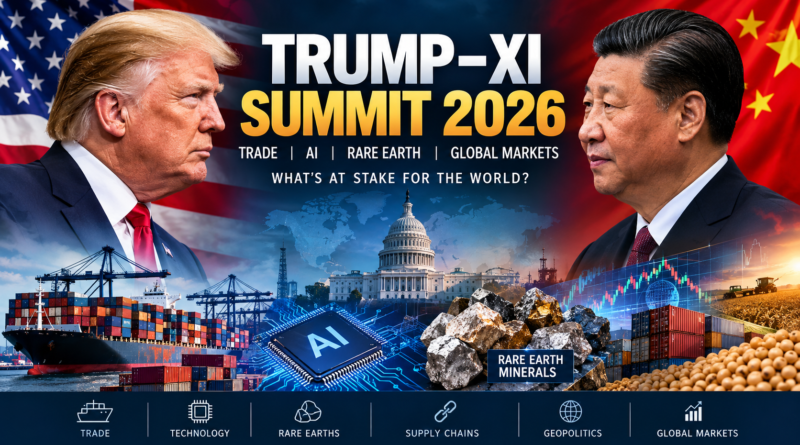
Trump–Xi Summit 2026: The Full Story Behind the U.S.-China Trade, AI, Rare Earth and Global Market Battle
Author: Dr. Abhishek Bhatt
Published Date: September 21, 2026
Updated Date: September 21, 2026
Role: CEO & International Relations/Global Affairs Writer, New York Finance Think (NYFT)
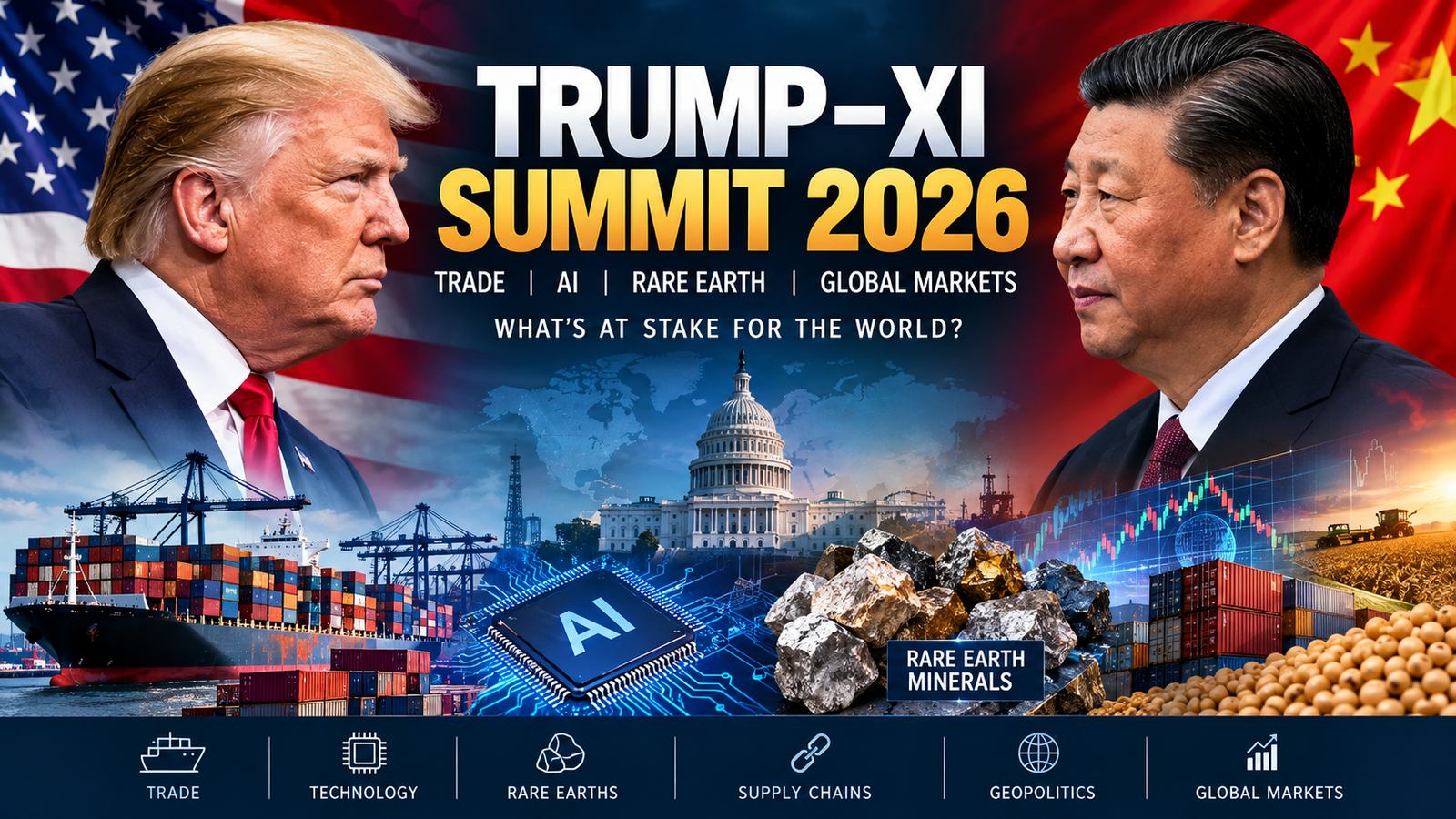
The meeting between U.S. President Donald Trump and Chinese President Xi Jinping in Washington on September 24, 2026, is one of the most closely watched diplomatic and economic events of the year. Xi Jinping is scheduled to visit the United States from September 23 to September 25 for talks with President Donald Trump, with trade, artificial intelligence, critical minerals, supply chains and wider geopolitical issues expected to be part of the discussions. For financial markets, the meeting matters because the United States and China remain deeply connected through global trade, manufacturing, technology, agriculture, energy and investment. Any meaningful change in their relationship can quickly affect companies, commodities, currencies and stock markets far beyond Washington and Beijing.
Why the Trump–Xi Summit Matters
The September 2026 meeting is not an isolated diplomatic event. It is the latest chapter in a relationship that has changed dramatically over the past decade. What began primarily as a dispute over trade, tariffs, intellectual property and market access has expanded into a much broader competition involving semiconductors, artificial intelligence, rare-earth minerals, advanced manufacturing, investment and national security.
For American businesses and investors, the key issue is uncertainty. Companies need to know how much they will pay to import goods, whether they can obtain critical materials, which technologies they can sell internationally and where they should build factories. China faces a similar challenge because its exporters depend heavily on global markets, while many Chinese industries remain connected to American technology, capital and consumers.
That is why the Trump–Xi meeting is being watched not only by governments and diplomats but also by Wall Street, manufacturers, farmers, technology companies, shipping firms and commodity traders.
The U.S.-China Trade War Started the Modern Conflict
The roots of the current relationship go back to 2018, when the Trump administration began imposing tariffs on large amounts of Chinese imports. The U.S. Trade Representative said the measures were linked to concerns involving technology transfer, intellectual property and Chinese industrial policies.
China responded with tariffs on American products.
The result was the beginning of a major U.S.-China trade conflict. At first, the dispute was largely described in terms of tariffs and the American trade deficit. But the consequences quickly spread across the global economy.
Manufacturers began reconsidering their dependence on Chinese factories. Importers looked for alternative suppliers. Companies started examining production opportunities in countries such as Vietnam, India and Mexico. Investors began paying closer attention to the political relationship between Washington and Beijing because changes in tariff policy could affect corporate costs and earnings.
The trade dispute therefore changed how multinational companies thought about global supply chains.
The Phase One Trade Deal Did Not End the Problem
In January 2020, the United States and China signed the Phase One trade agreement. China agreed to increase purchases of American products and address several economic concerns raised by Washington.
The agreement reduced some immediate pressure between the two countries, but it did not resolve every major disagreement.
Then the COVID-19 pandemic disrupted the global economy.
Factories closed, shipping networks were interrupted and supply shortages spread across industries. The pandemic also changed the way governments viewed supply-chain security. Products that had once been considered ordinary commercial goods increasingly became part of national economic-security discussions.
By the time the global economy began recovering, the U.S.-China relationship had become more complicated than it was before the trade war.
Biden Continued Many of the Existing Trade Measures
When President Joe Biden entered office in 2021, the United States did not simply reverse the Trump-era China policy.
Many tariffs remained in place, while Washington increasingly focused on advanced technology, semiconductor manufacturing and national security.
This was an important change in the relationship.
The central question was no longer only:
How much does America import from China?
The question increasingly became:
Who controls the technologies and industrial capabilities that will shape the next decade of the global economy?
Semiconductors became one of the most important parts of that debate.
Why Semiconductors Became So Important
Modern artificial intelligence systems, advanced computers, telecommunications equipment, automobiles and many defense technologies depend on sophisticated semiconductors.
The United States has major strengths in chip design, software, research and advanced technology. China has built enormous manufacturing capacity and is investing heavily in domestic semiconductor production.
Washington introduced restrictions on some advanced semiconductor technologies reaching China. Beijing responded by strengthening domestic production and using its own position in critical-mineral supply chains.
This created a new form of economic competition.
The old trade war was mainly about tariffs.
The new competition is also about technology, industrial capacity and supply-chain control.
Rare Earths Became a Strategic Issue
Rare-earth minerals are another major part of the story.
These materials are used in electric vehicles, electronics, robotics, renewable-energy equipment, aerospace systems and defense technologies.
China has a dominant position in global rare-earth processing. That gives Beijing significant leverage over industries that depend on these materials.
For the United States and other industrial economies, the concern is not simply the price of rare earths. The bigger concern is reliable access.
If manufacturers cannot obtain critical minerals, production can slow or become more expensive.
That is why rare earths have become part of the wider U.S.-China negotiations.
The issue also explains why the Trump–Xi summit could have consequences for technology companies, automakers, defense contractors and manufacturers around the world.
Trump Returned and the Trade Conflict Escalated Again
Donald Trump’s return to the White House in 2025 brought tariffs back to the center of U.S. economic policy toward China.
The two countries went through another period of tariff escalation, negotiations and temporary agreements.
At several points, investors worried that the relationship could deteriorate into a much larger economic confrontation.
At other points, negotiations produced signs of stabilization.
This pattern created a market environment in which investors had to react not only to economic data but also to diplomatic announcements.
A statement from Washington or Beijing could change expectations for tariffs, supply chains, technology companies and commodity prices.
The Trade Truce Changed the Conversation
Negotiations eventually produced temporary arrangements designed to reduce the risk of a much larger trade confrontation.
The important point, however, is that the underlying strategic competition did not disappear.
The United States continued to focus on market access, technology security and supply-chain resilience.
China continued to protect its industrial interests and maintain its position in critical minerals, manufacturing and global trade.
This is why the current relationship is better understood as a mixture of competition, negotiation and limited cooperation.
The two countries can cooperate on selected economic issues while remaining strategic competitors in technology and security.
AI Is Now One of the Biggest Issues
Artificial intelligence has added another major dimension to the relationship.
AI requires advanced chips, enormous computing power, data centers and sophisticated software. Both the United States and China are investing heavily in AI.
For Washington, maintaining access to advanced computing and protecting sensitive technology has become a national-security issue.
For Beijing, developing domestic AI and semiconductor capabilities is part of its broader effort to reduce dependence on foreign technology.
The two countries may still have limited areas for cooperation, including communication around AI-related risks. But cooperation in one area does not mean the broader technology competition has ended.
For investors, this matters because changes in semiconductor export rules or AI-related trade restrictions can affect some of the world’s largest technology companies.
Taiwan Is the Most Sensitive Geopolitical Issue
Taiwan remains one of the most difficult subjects in the U.S.-China relationship.
China considers Taiwan part of its territory and seeks eventual reunification. The United States maintains unofficial relations with Taiwan and supports its ability to defend itself.
Taiwan is also central to the global semiconductor industry.
That makes the island important for both geopolitical and economic reasons.
Any serious disruption in the Taiwan Strait could affect semiconductor production, shipping, insurance costs, technology companies and global financial markets.
The presence of Taiwan on the summit agenda does not mean that the United States and China are expected to reach a new agreement on the issue. It means that Taiwan remains one of the major strategic questions surrounding the broader relationship.
Why Global Supply Chains Are Watching
The Trump–Xi summit could have a major effect on the way multinational companies plan their supply chains.
For years, many companies operated under a simple model: manufacture large quantities of products in China and sell them around the world.
The trade war, pandemic and technology restrictions changed that calculation.
Companies began building additional production capacity in countries such as India, Vietnam and Mexico.
This does not necessarily mean companies are leaving China completely. China remains one of the world’s largest manufacturing centers and consumer markets.
Instead, many companies are trying to create more flexible supply chains.
The outcome of the Trump–Xi summit could influence whether that diversification accelerates or whether companies become more comfortable maintaining larger China-based operations.
What the Summit Could Mean for Wall Street
Wall Street is likely to focus heavily on the economic details behind the diplomatic headlines.
Technology stocks could react to developments involving semiconductors and AI.
Industrial companies could react to changes in tariffs and critical-mineral access.
Automakers could watch rare-earth and battery supply chains.
Agricultural companies could watch Chinese purchases of American farm products.
Shipping companies could watch changes in global trade volumes.
Banks and investors could focus on the broader effect on economic growth, inflation and interest rates.
The important point is that the market reaction will not necessarily be the same across every sector.
A policy that helps technology companies could create different consequences for domestic manufacturers. A change that benefits American farmers could have different effects on Chinese exporters.
The summit therefore needs to be analyzed industry by industry rather than as a single market event.
What Could Happen to Oil Prices?
Oil is another market to watch, although the Trump–Xi meeting is only one factor influencing crude prices.
China is one of the world’s largest oil consumers. If investors believe a more stable U.S.-China relationship will support global economic growth, expectations for energy demand could strengthen.
But oil prices are also heavily influenced by Middle East conflicts, OPEC decisions, shipping risks, inventories and global economic conditions.
Therefore, a change in crude prices after the summit should not automatically be attributed to Trump and Xi.
The broader global energy environment will remain important.
What Could Happen to Gold?
Gold could respond differently.
If the summit reduces geopolitical and trade uncertainty, some safe-haven demand could decline.
If tensions increase, investors could seek protection in traditional defensive assets.
But gold also responds to U.S. interest rates, Treasury yields, inflation expectations and the dollar.
The Trump–Xi relationship is therefore one part of the gold story rather than the entire story.
The Dollar and Chinese Yuan
Currency markets will also be watching the summit.
A more stable trade relationship could reduce some pressure around the Chinese yuan and improve expectations for international trade.
A renewed confrontation could increase demand for the U.S. dollar as investors seek liquidity and safety.
However, the Federal Reserve remains a major driver of the dollar. U.S. inflation, employment, Treasury yields and interest-rate expectations can move currency markets even when there is no major geopolitical development.
What It Means for India
India is also watching the relationship closely.
The China-plus-one manufacturing strategy has created opportunities for Indian manufacturers and exporters because some global companies want alternatives to China.
If U.S.-China tensions remain high, companies may continue diversifying production.
If the two countries reach a more durable trade agreement, some companies may become more comfortable expanding production in China.
India could therefore benefit from continued supply-chain diversification, but the scale of that opportunity will depend on corporate decisions, infrastructure, labor costs, trade policy and global demand.
Europe and Asia Are Closely Connected
European manufacturers are exposed to both American and Chinese markets. Changes in tariffs, technology rules and Chinese demand can therefore affect European industrial companies.
Japan and South Korea are particularly sensitive to the relationship because their economies are deeply connected to electronics, automobiles, semiconductors and Chinese trade.
Southeast Asian economies also have a growing role in global manufacturing.
A change in U.S.-China trade policy can therefore shift investment decisions across the entire Asian supply chain.
Agriculture Could Become an Important Part of the Deal
Agriculture is one of the areas where the two countries have strong reasons to maintain commercial ties.
China is a major buyer of agricultural commodities, while American farmers depend heavily on export markets.
Soybeans are especially important.
If China increases purchases from U.S. farmers, American agricultural exporters could receive greater market access and improved demand visibility.
If trade tensions return, agricultural exporters could once again face uncertainty.
That is why farm groups and commodity traders will be watching the summit alongside technology investors.
The November Deadline Matters
The September meeting also needs to be viewed in the context of the next stage of the trade arrangement.
The current period of relative stability cannot simply be assumed to continue indefinitely.
November is an important point for the future of the U.S.-China trade relationship.
That means September may produce the political headline, but October and November could provide the real test.
Investors will want to know whether commitments made by the two governments are actually implemented.
What Investors Should Watch After September 24
The most important signals will be concrete policy details.
Investors should watch for changes in tariff rates, the length of any agreement, rare-earth export licenses, semiconductor restrictions, agricultural purchases, investment arrangements and enforcement mechanisms.
A diplomatic statement can improve market sentiment temporarily.
A detailed agreement with clear implementation rules can influence corporate decisions for much longer.
That difference is critical for investors.
The Bigger Picture
The U.S.-China relationship has gone through several stages.
First came the trade and tariff dispute.
Then came negotiations and the Phase One agreement.
The pandemic disrupted global supply chains.
The Biden administration maintained many tariffs and expanded the technology-security focus.
Semiconductors became strategically important.
Artificial intelligence created a new technology race.
Rare-earth minerals became a major supply-chain issue.
Trump’s return brought another round of tariff pressure.
Negotiations produced temporary trade arrangements.
And now Xi Jinping is preparing to visit Washington for another high-level meeting with Donald Trump.
The September 2026 summit is therefore not a new beginning from zero.
It is another stage in a relationship that has been evolving for years.
What This Means for the World Economy
The biggest issue is not whether Trump and Xi appear friendly during the summit.
The bigger question is whether the two governments can create enough stability for businesses to make long-term decisions.
Manufacturers need predictable supply chains.
Technology companies need clear semiconductor rules.
Farmers need reliable export markets.
Investors need greater clarity around tariffs and corporate costs.
Consumers need to know whether trade restrictions will increase prices.
Governments need to manage national-security concerns without creating unnecessary economic disruption.
Those competing priorities make the Trump–Xi relationship one of the most important economic stories in the world.
Final Takeaway
The September 2026 Trump–Xi summit is the latest chapter in a long U.S.-China economic and strategic competition.
The story began with tariffs and trade.
It expanded into technology.
It moved into semiconductors.
It reached critical minerals and rare earths.
Artificial intelligence added another layer.
Supply-chain security became a central concern.
Taiwan added a major geopolitical dimension.
And now the two countries are trying to manage all of these issues while keeping their enormous economic relationship from becoming even more unstable.
For global investors, the key word is certainty.
Markets will be watching whether Washington and Beijing can provide clearer rules for trade, technology, critical minerals and supply chains.
The summit itself will generate headlines, but the lasting market impact will depend on what happens after the leaders leave the negotiating table.
The real test will be implementation.
If agreements announced in Washington become durable policies, companies may have greater visibility over costs, supply chains and investment decisions. If disagreements return quickly, businesses may continue shifting production, diversifying suppliers and preparing for another period of uncertainty.
That is why the Trump–Xi summit is not just a meeting between two presidents.
It is a meeting that could influence the direction of global trade, technology and markets for years to come.
Official Government Sources
White House — U.S. President Donald Trump and Chinese President Xi Jinping
White House — Xi Jinping State Visit Details
China Ministry of Foreign Affairs — Xi Jinping’s United States Visit
China Ministry of Foreign Affairs — September 21, 2026
Office of the United States Trade Representative — U.S.–China Trade Relations
U.S. Trade Representative — China Trade Information
Office of the United States Trade Representative — U.S.–China Board of Trade
USTR — U.S.–China Board of Trade
Source Note
This article uses official U.S. and Chinese government sources for information concerning the planned U.S.–China summit, bilateral trade relations and related government initiatives. Policy positions, negotiations and future outcomes remain subject to change as official discussions continue.
