
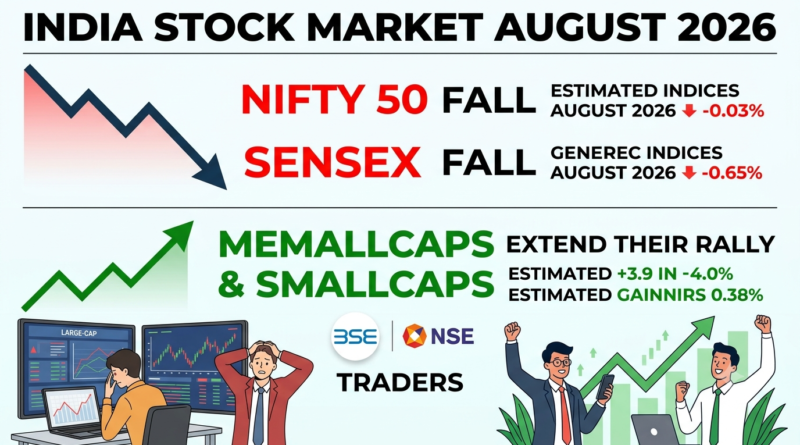
India Stock Market August 2026: Nifty and Sensex Fall While Mid caps and Small caps Extend Their Rally
August 2026 Market Analysis ReportPrepared for New York Finance Think
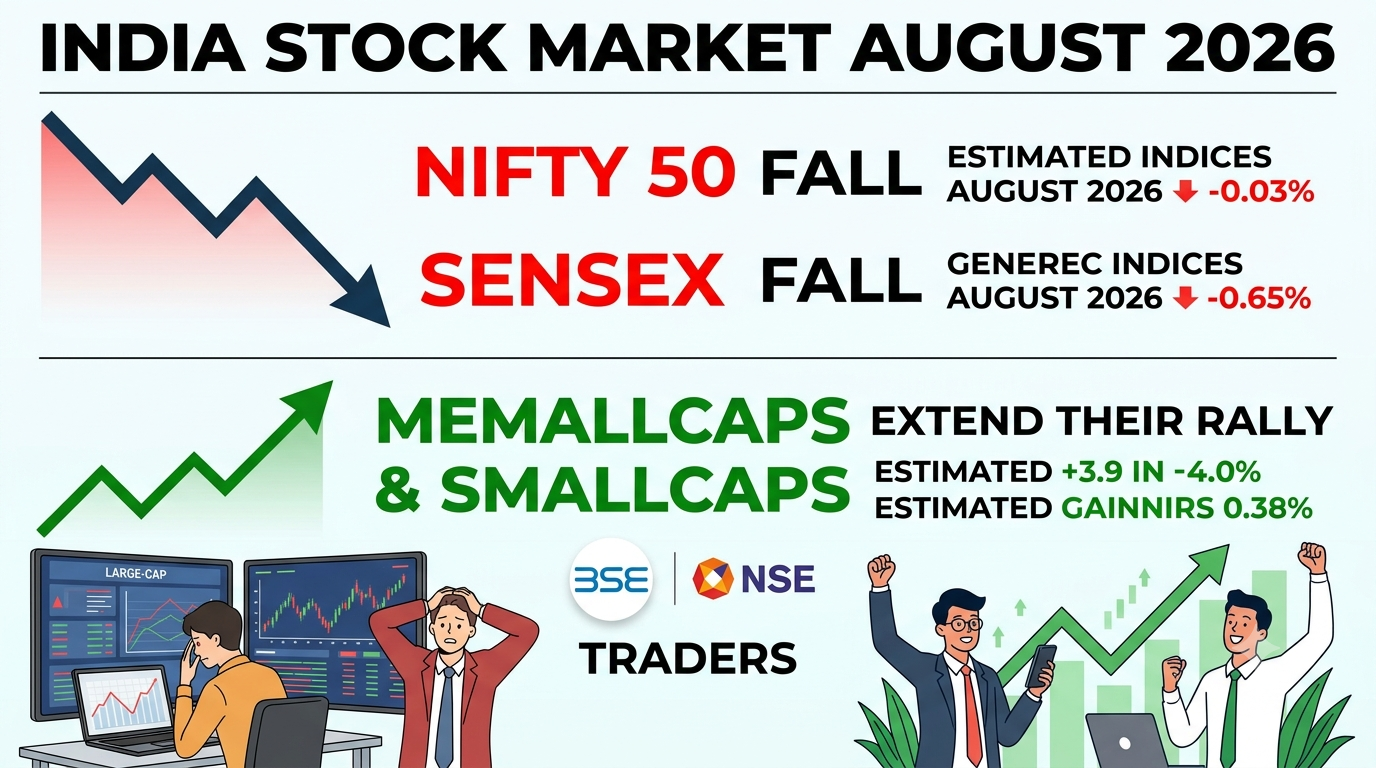
India Stock Market August 2026: Nifty and Sensex Fall While Midcaps and Smallcaps Extend Their RallyAugust 2026 Market Analysis ReportPrepared for New York Finance ThinkExecutive SummaryAugust 2026 was a mixed month for Indian equities.The headline benchmark indices lost ground, with the Nifty 50 ending August at 24,080.40 and the BSE Sensex at 76,957.27. The Nifty declined about 1.2% during the month, while the Sensex fell about 1.5%, ending a two-month winning streak for the major benchmarks.The broader market told a different story. The Nifty Midcap 100 gained about 2.15%, while the Nifty Smallcap 100 advanced about 3.16%, marking a fifth consecutive monthly gain for both segments.The month was shaped by several competing forces: crude oil prices, geopolitical tensions, expectations around U.S. interest rates, foreign investment flows, corporate earnings and the introduction of India’s new Closing Auction Session.—August 2026 Market Data TableIndex| August Start*| August 31 Close| August PerformanceNifty 50| 24,572.70| 24,080.40| -1.24%BSE Sensex| 78,883.34| 76,957.27| -1.46%Nifty Midcap 100| 63,235.60| 64,224.75| +2.15%Nifty Smallcap 100| 19,446.30| 19,931.65| +3.16%Nifty 100| 25,676.75| 25,235.05| -0.88%*Start figures represent the August-period starting levels reported by Navia; monthly-return comparisons can differ slightly depending on whether the previous month’s official close or the first August trading session is used.—1. Nifty 50: August Ends in the RedThe Nifty 50 finished August at 24,080.40, down 95.25 points, or 0.39%, on August 31.The index briefly moved below 24,000 during the final session, touching an intraday low of approximately 23,993.60 before recovering some ground into the close.For the full month, the Nifty lost roughly 1.2%, reversing some of the gains recorded during the previous two months.The key issue for large-cap investors was the combination of expensive crude oil, geopolitical uncertainty and questions surrounding global interest rates.—2. Sensex Underperformed the Broader MarketThe BSE Sensex ended August at 76,957.27.On August 31 alone, the index dropped 307.24 points, or 0.40%.For August, the Sensex declined approximately 1.46%, according to monthly market data.The weakness was concentrated among several heavyweight stocks, meaning pressure on a relatively small number of large companies had an important effect on the benchmark.—3. Midcap and Smallcap Stocks Tell a Different StoryOne of the most important features of August was the divergence between the benchmark indices and the broader market.The Nifty Midcap 100 gained about 2.15%, while the Nifty Smallcap 100 rose around 3.16%.Both indices extended their winning streak to five consecutive months.This suggests that the weakness in the headline indices did not translate into a broad-based collapse across Indian equities.Instead, market performance was highly selective.Investors continued to find opportunities outside some of the largest benchmark constituents.—4. Foreign Investors Return to Indian EquitiesAnother important development came from foreign portfolio investment.According to Reuters, foreign portfolio investors invested approximately $3.1 billion in Indian equities during August 2026, the strongest monthly inflow in nearly two years.That is notable because foreign investors had been net sellers of Indian equities for much of 2026.Reuters reported that cumulative foreign withdrawals for the year remained very large despite the August improvement.The August inflows therefore represented an important change in the monthly flow picture, although they did not immediately translate into gains for the major benchmark indices.—5. Crude Oil Remained a Major RiskOil was one of the biggest variables for Indian investors during August.India is heavily dependent on imported crude oil. Higher oil prices can increase the country’s import bill and create pressure on inflation, the rupee and corporate margins.The final trading session of August was particularly sensitive to higher crude prices amid renewed geopolitical tensions.Reuters reported that concerns about rising crude prices and possible U.S. rate increases contributed to the negative market mood on August 31.For the Indian market, the oil equation remains straightforward:Higher crude → higher import costs → potential inflation pressure → pressure on margins and the rupee.The effect is not identical across sectors, however. Oil producers and some energy-related companies can benefit from higher prices, while oil-consuming businesses can face greater cost pressure.—6. New Closing Auction Session Changed Market DynamicsAugust also brought an important structural change to Indian market trading.A new Closing Auction Session (CAS) mechanism was introduced on August 3 for stocks with futures and options contracts.Reuters reported that the new mechanism replaced the previous method of calculating closing prices based on the volume-weighted average of the final 30 minutes of continuous trading.The first trading day produced unusual divergence between the major indices.On August 3:- Nifty 50 gained about 1.6%- Sensex gained about 0.7%- Nifty closed at 24,774.30- Sensex closed at 78,639.03The new mechanism became an additional point of attention for traders and market participants during August.—7. Sector Performance Was Highly SelectiveThe final trading session demonstrated how uneven the market had become.On August 31, sectors including Metal and FMCG came under pressure, while Bank Nifty and Pharma provided some support.Individual stocks also showed substantial divergence.For example, on August 31:Stock| August 31 MoveTech Mahindra| +2.38%M&M| +1.08%Axis Bank| +0.82%Sun Pharma| -0.99%Reliance Industries| -1.18%Infosys| -2.20%Adani Ports| -2.41%Tata Steel| -2.71%These are single-day August 31 movements, not full-month returns.The data illustrates the stock-specific nature of the market.—8. Rupee Shows Some StabilityThe Indian rupee also attracted attention during August.Reuters reported that the rupee ended August at approximately ₹95.1625 per U.S. dollar, gaining around 0.2% during the month.Equity-related flows and RBI support were among the factors cited in the currency’s August performance.For Indian investors, the rupee remains closely connected with crude oil prices, foreign capital flows and the direction of the U.S. dollar.—9. What August Told InvestorsAugust 2026 did not produce a simple “bull market” or “bear market” story.Instead, the market showed three distinct characteristics:Benchmark pressureNifty and Sensex declined during the month.Broader-market strengthMidcaps and smallcaps continued their upward momentum.Strong stock selectionPerformance varied considerably between individual companies and sectors.This divergence is important because headline index performance alone did not fully describe what happened across Indian equities during August.—10. Key Market Drivers Going Into SeptemberInvestors entering September are likely to continue watching several variables closely.Crude OilOil prices remain important because India imports a substantial amount of its energy requirements.U.S. Interest RatesChanges in expectations for U.S. monetary policy can affect global capital flows and emerging-market currencies.Foreign Portfolio FlowsAugust’s $3.1 billion foreign equity inflow was a significant development, but the broader 2026 flow picture remained negative.Corporate EarningsDomestic earnings remained one of the supports for Indian equities during August.Rupee-Dollar MovementCurrency stability remains important for imported inflation, foreign investors and companies with significant dollar exposure.Geopolitical RiskDevelopments affecting crude oil supply and global trade can quickly change investor sentiment.—August 2026 Market ScorecardFactor| August 2026 DirectionNifty 50| DownSensex| DownMidcaps| UpSmallcaps| UpForeign Equity Flows| Strong August inflowCrude Oil Risk| ElevatedRupee| Slight monthly gainGeopolitical Risk| ElevatedMarket Breadth| Stronger outside large capsVolatility| Stock and sector specific—Bottom LineAugust 2026 was a month of divergence in the Indian stock market.The Nifty 50 and Sensex lost ground, but the broader market remained considerably stronger. Midcap and Smallcap indices recorded another month of gains, while foreign investors returned to Indian equities with their strongest monthly buying in nearly two years.At the same time, crude oil, geopolitical developments and global interest-rate expectations remained important risks.For September, the key question for investors is not simply whether the Nifty rises or falls. The more important issue is whether the broader-market strength seen in August can continue while large-cap stocks deal with global macroeconomic pressure.New York Finance Think will continue tracking Nifty, Sensex, crude oil, the rupee, foreign flows and global market signals throughout September.DisclaimerThis article is for informational and educational purposes only. It is not investment advice, a recommendation to buy or sell securities, or a guarantee of future market performance. Market conditions can change rapidly. Investors should conduct their own research and consider their financial circumstances and risk tolerance before making investment decisions.Author:Dr. Abhishek BhattPhD, History; Gold Medalist, Delhi University; JNU; Andhra Pradesh State University; Kerala University; Nagaland UniversityNew York Finance Think
