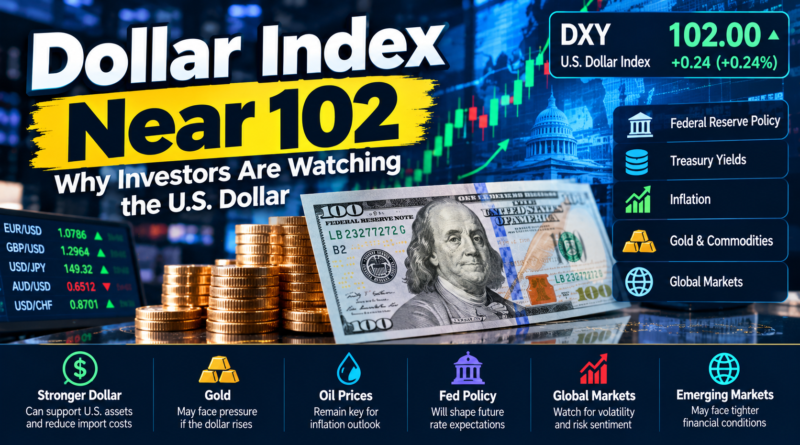
Dollar Index Near 102: Why the U.S. Dollar Matters for Markets and the Economy
The U.S. dollar is back in focus as the Dollar Index trades near 102, putting the currency market at an
Read More
Your Trusted Source for U.S. Finance, Markets & Economic News
Investment banking in 2026 has entered one of its most active periods since the post-pandemic deal boom.
The business is being driven by a combination of strong equity markets, large corporate transactions, artificial intelligence, private-equity capital, infrastructure investment and renewed interest in initial public offerings.
But this is not a simple return to the old Wall Street.
Investment banks are changing what they finance and how they make money. Large technology companies need enormous amounts of capital for data centers, chips and electricity. Governments are spending more on defense and strategic infrastructure. Private-equity firms need to sell mature investments and return capital to investors. Companies are reconsidering their businesses as artificial intelligence changes entire industries.
At the same time, inflation, interest rates, geopolitical tensions, regulation and market volatility continue to create risks.
Goldman Sachs reported that global M&A volumes increased 48% year over year in the first half of 2026, with mega-deal volumes increasing 125%. (Goldman Sachs) JPMorgan’s 2026 mid-year M&A outlook also describes dealmaking as reaching record levels, driven by large transactions, artificial intelligence and boardroom confidence. (JPMorgan)
The first half of 2026 was also strong for Wall Street’s largest banks. Reuters reported that global investment-banking revenue exceeded $60 billion in the first half of the year, while major U.S. banks benefited from stronger deal fees and trading activity. (Reuters)
This report examines how investment banking and Wall Street are changing across the United States and major global financial centers.
Investment banking is often associated with Wall Street, but its activities extend across the world.
Investment banks help companies:
They also advise governments, financial institutions, private-equity firms and other large organizations.
The business is commonly divided into several areas.
M&A advisers help companies buy, sell or combine businesses.
ECM teams help companies raise money by selling shares.
DCM teams help companies and governments raise money through bonds and other debt instruments.
Trading divisions help institutional clients buy and sell securities and manage market risk.
Investment-bank research teams analyze companies, industries, economies and markets.
Banks also provide loans and other forms of financing connected with corporate transactions.
Wall Street has benefited from a major recovery in deal activity.
Reuters reported in July that investment-banking revenues at major U.S. banks reached their highest level since the 2021 boom. IPOs, M&A transactions and trading activity all contributed to the improvement. (Reuters)
This matters because investment banking is highly cyclical.
When companies are uncertain about the economy, they often delay acquisitions and IPOs.
When executives become more confident, deal pipelines can grow quickly.
That appears to be happening in 2026.
Mergers and acquisitions are one of the biggest stories in investment banking this year.
Goldman Sachs said global M&A volumes rose 48% year over year during the first half of 2026. Mega-deal volume increased 125%. (Goldman Sachs)
Goldman Sachs has also estimated that pure M&A volume could reach approximately $3.8 trillion in 2026. (Goldman Sachs)
These numbers demonstrate that the recovery is not being driven only by small transactions.
Large corporations are increasingly willing to make major strategic bets.
The reasons behind today’s M&A market are different from one transaction to another.
Companies may want:
Artificial intelligence is particularly important.
A traditional company may decide that developing AI capabilities internally would take too long.
Buying an existing technology company can provide a faster route.
AI is affecting investment banking in two ways.
First, AI companies themselves are becoming valuable acquisition targets.
Second, AI is changing the strategic value of companies outside the technology sector.
Goldman Sachs says AI is affecting sectors ranging from software and semiconductors to data centers, real estate, power and transmission infrastructure. (Goldman Sachs)
That means the AI investment story is much bigger than software.
The physical infrastructure required to operate AI systems is becoming an investment theme of its own.
Artificial intelligence requires enormous computing capacity.
That requires:
Investment banks are increasingly involved in financing these projects.
This creates opportunities for M&A advisers, debt bankers, infrastructure-finance teams and equity-market specialists.
The IPO market has also improved in 2026.
Morgan Stanley reported that IPO activity was building during the year, with larger and later-stage companies entering public markets. It identified AI and aerospace and defense among the major themes supporting issuance. (Morgan Stanley)
This is important because a healthy IPO market gives private companies an alternative to being acquired.
A company can:
Investment banks play a central role in this process.
An IPO can generate several sources of business for investment banks.
Banks may advise the company.
They may structure the offering.
They may underwrite shares.
They may market the transaction to institutional investors.
They may provide research coverage after the listing.
A successful IPO can therefore create a long-term client relationship.
Private equity has become central to global investment banking.
Private-equity firms have accumulated enormous amounts of capital.
They need to do two things:
Invest capital.
and
Exit investments.
Investment banks help with both.
They advise private-equity firms when they buy businesses.
They also help sell those businesses later through:
Goldman Sachs identifies private markets as a major force in the 2026 M&A environment. (Goldman Sachs)
A private-equity fund cannot hold every investment forever.
Funds have investors who expect returns.
That creates pressure to sell mature assets.
If public markets are strong, an IPO becomes more attractive.
If strategic buyers are willing to pay high prices, an M&A sale becomes attractive.
Investment banks benefit from both routes.
Not every company raises money by selling shares.
Many businesses prefer debt.
Debt capital markets help corporations issue bonds.
Governments also depend heavily on bond markets.
The investment bank helps determine:
Interest rates therefore matter enormously.
Investment banking activity is closely connected to interest rates.
High rates can make acquisitions more expensive.
They can reduce the value of future cash flows.
They can make leveraged transactions harder to finance.
Lower rates can have the opposite effect.
But the relationship is not always simple.
Companies may continue to transact even when rates are high if the strategic reason for a deal is strong enough.
That is one reason 2026 has been unusual.
Strong stock markets can make M&A and IPOs easier.
A company with a high stock valuation can use shares as acquisition currency.
Private companies are also more willing to go public when they believe investors will value them favorably.
JPMorgan raised its year-end 2026 S&P 500 target to 8,000 in August, citing strong corporate earnings and continued investor confidence. (MarketWatch)
That does not mean the market is guaranteed to rise.
It shows that major Wall Street institutions remain relatively constructive about the equity environment.
Investment banks do not depend entirely on M&A.
Trading is another major source of revenue.
Banks make markets in:
Market volatility can increase trading activity because institutional investors need to adjust positions and manage risk.
Reuters reported that geopolitical tensions, energy-market movements and AI-related market concerns contributed to strong trading revenue at major Wall Street banks during the second quarter. (Reuters)
Equities trading remains an important Wall Street business.
Institutional investors trade large positions in:
AI-related stocks have become particularly important.
Investors are debating whether AI valuations accurately reflect future earnings.
That debate creates trading opportunities and risks.
Bond trading is equally important.
Banks trade:
Changes in inflation and central-bank policy can produce major moves in bond markets.
Global companies and investors need currency markets.
A European company buying an American business may need dollars.
A Japanese investor buying U.S. bonds needs dollars.
A multinational company receiving revenue in several currencies may need to hedge exchange-rate risk.
Investment banks provide those services.
Energy and commodity markets have become particularly important.
Oil prices influence:
Investment banks provide commodity trading, hedging and advisory services.
Geopolitics has become a permanent factor in investment decisions.
Wars and trade disputes can affect:
Investment banks increasingly advise clients on these risks.
Defense spending has become a major investment theme.
Governments are increasing attention to:
This creates opportunities for M&A and capital raising.
Morgan Stanley has highlighted innovation, infrastructure and strategic investment as major areas of capital deployment in the United States. (The Wall Street Journal)
The global economy needs enormous infrastructure investment.
Major areas include:
Investment banks help structure financing for these projects.
Morgan Stanley remains one of Wall Street’s largest investment banks.
Its strategy increasingly combines:
Morgan Stanley expects the M&A rebound to continue in 2026, citing AI, private-equity activity, cross-border transactions, lower rates and an IPO revival as important drivers. (Morgan Stanley)
The firm is also expanding its role in financing American infrastructure and innovation.
Goldman Sachs remains one of the world’s most important investment-banking firms.
Its 2026 M&A outlook emphasizes:
Goldman’s M&A business has benefited from the revival in large transactions. (Goldman Sachs)
At the same time, Goldman is expanding asset management.
In August 2026, Reuters reported that Goldman agreed to buy NEOS Investments for $2.3 billion as part of its effort to build more stable asset-management revenue alongside cyclical investment banking. (Reuters)
JPMorgan remains one of the largest global investment banks.
It operates across:
JPMorgan’s 2026 M&A outlook describes the market as highly active, with large transactions and AI among the major forces behind the increase. (JPMorgan)
Its strong global footprint gives it an important role in cross-border transactions.
Bank of America is another major U.S. investment bank.
Its investment-banking business works with corporations, governments and institutional clients.
The bank is increasingly involved in financing infrastructure, energy and technology investment.
Citigroup has one of Wall Street’s largest international networks.
Its global footprint is particularly important for multinational corporations.
Cross-border banking remains a major advantage for Citi.
The largest Wall Street banks compete in similar markets but have different strengths.
JPMorgan has enormous scale across banking and markets.
Goldman remains particularly associated with investment banking and trading while expanding asset management.
Morgan Stanley has built a major wealth-management business alongside investment banking.
This diversification matters because investment banking revenues can change sharply from one year to another.
London remains one of the world’s most important financial centers.
European banks compete with American investment banks across:
Barclays reported strong second-quarter 2026 results, with increased global-markets revenue and investment-banking fees. (The Wall Street Journal)
UBS remains a major global financial institution with a large wealth-management business and investment-banking operations.
Its position is particularly important in Europe and Switzerland.
The integration of Credit Suisse remains a major strategic undertaking.
Deutsche Bank remains one of Europe’s major corporate and investment banks.
It has strong relationships with European corporations and international clients.
BNP Paribas is one of Europe’s largest banks.
Its corporate and investment-banking operations provide financing and advisory services across Europe and international markets.
Asia remains central to global capital markets.
China, Hong Kong, Japan, India, Singapore and South Korea all play important roles.
The region’s investment-banking market is influenced by:
China’s investment-banking market has experienced a major shift.
CICC has become particularly important in financing technology and AI companies.
The Financial Times reported that CICC led several major AI-related listings in China and Hong Kong in 2026, with its deal volume reaching $11.5 billion. (Financial Times)
This reflects a broader change.
China’s capital markets are increasingly being used to finance strategic technology sectors.
Hong Kong remains an important bridge between Chinese companies and international investors.
Its IPO market has regained momentum.
Investment banks use Hong Kong for:
Japan has become increasingly important in global M&A.
Morgan Stanley specifically highlighted growing international appetite and increased activity involving Japan in its 2026 M&A outlook. (Morgan Stanley)
Japanese companies are increasingly examining overseas acquisitions.
Corporate governance reforms have also encouraged companies to think more carefully about capital allocation.
India’s capital markets have expanded rapidly.
Major Indian companies increasingly access:
India’s technology, manufacturing, infrastructure and financial sectors are especially important.
Mumbai remains India’s primary financial center.
Singapore is an important regional financial center.
Its strengths include:
The Middle East has become increasingly important to global investment banking.
Sovereign wealth funds have enormous pools of capital.
Saudi Arabia and the UAE are investing in:
These investments create opportunities for international banks.
Sovereign wealth funds are increasingly important players in global finance.
They can invest directly in:
Investment banks often advise them on major transactions.
Emerging markets are attracting renewed investor interest.
The Institute of International Finance reported that emerging markets received $18.8 billion of net portfolio inflows in July 2026 after outflows in May and June. Emerging-market debt attracted $26.7 billion. (Reuters)
This demonstrates how quickly international capital can move when investors see attractive valuations or yields.
Debt remains one of the largest parts of global finance.
Companies need debt to:
Governments also rely heavily on bond markets.
Higher government borrowing can influence bond yields and investor expectations.
Private credit has become one of the fastest-growing parts of global finance.
Private-credit funds lend directly to businesses rather than relying entirely on traditional bank loans.
Investment banks increasingly work alongside private-credit providers.
This creates both competition and partnership.
Traditional banks face competition from private lenders.
But investment banks can also benefit.
They can introduce clients to private-credit funds.
They can structure transactions involving multiple forms of capital.
This is another reason the definition of investment banking is becoming broader.
Activist investors are increasingly involved in corporate strategy.
They may push companies to:
Goldman Sachs says activist activity is rising and public campaign volumes could reach a five-year high during 2026. (Goldman Sachs)
Investment banks advise both activists and companies facing campaigns.
Investment banking and trading remain highly paid areas of finance.
Compensation tends to rise when deal activity and trading revenue increase.
The 2026 recovery is therefore also affecting competition for bankers and traders.
London provides an example.
Goldman Sachs International’s first-half revenue increased sharply in 2026, with particularly strong equities and fixed-income trading. (Financial News London)
Investment banks are using technology throughout their businesses.
AI can assist with:
But investment banking remains heavily dependent on human judgment.
A major acquisition cannot be reduced to a computer-generated answer.
Executives still need advisers who understand strategy, management, markets and regulation.
AI is likely to change investment-banking jobs.
Some repetitive tasks may become automated.
Junior bankers may spend less time formatting documents and collecting information.
They may spend more time interpreting data and communicating with clients.
The result may be fewer manual tasks but greater demand for people who understand both finance and technology.
Investment banking remains heavily regulated.
Regulators focus on:
Large banks must balance profitability with regulatory requirements.
U.S. banks continue to operate under extensive federal and state regulation.
The Federal Reserve, Securities and Exchange Commission, Office of the Comptroller of the Currency and other agencies all have important roles.
Changes in regulation can influence M&A, bank capital, trading and financing.
Cross-border transactions are increasingly important.
Companies may acquire businesses in other countries to gain:
But cross-border deals are more complicated.
They may involve:
The traditional image of Wall Street is a trading floor full of people shouting orders.
Modern Wall Street looks very different.
Much of the business now runs through:
But the core purpose remains the same:
connecting capital with businesses and investors.
The strongest themes are:
AI is influencing M&A, IPOs, infrastructure and capital spending.
Large transactions are driving a disproportionate share of total M&A volume.
More mature private companies are returning to public markets.
Sponsors need to monetize older investments.
Data centers, power, transportation and technology infrastructure require enormous capital.
Geopolitical uncertainty is increasing investment in defense-related industries.
Direct lending is becoming a larger source of corporate financing.
Companies are again looking beyond domestic markets.
Volatility is supporting institutional trading activity.
The positive outlook is not guaranteed.
Potential risks include:
A major market correction could quickly reduce M&A and IPO activity.
One of the biggest questions for Wall Street is whether AI-related valuations are sustainable.
Investors are spending enormous amounts on AI infrastructure.
Companies are reporting strong demand.
But the long-term returns on that investment remain a major subject of debate.
If AI profits grow as expected, current valuations may prove reasonable.
If returns disappoint, markets could reprice quickly.
Investment bankers therefore have to understand both the technology and the financial economics behind it.
Investors watching Wall Street in the rest of 2026 should pay attention to:
These factors can influence the direction of investment banking.
The outlook for investment banking in 2026 is considerably stronger than it was during the most difficult period of the recent rate cycle.
M&A has returned.
IPO activity is improving.
Trading revenue is strong.
Private capital remains abundant.
AI is creating new investment opportunities.
Infrastructure requires enormous amounts of financing.
However, the market has also become more demanding.
Companies cannot simply announce deals because capital is available.
They need a clear strategic reason.
Investors want evidence that acquisitions and AI spending will generate returns.
Boards are under pressure to demonstrate disciplined capital allocation.
Global investment banking and Wall Street in 2026 are being reshaped by a combination of technology, capital and geopolitical change.
M&A is one of the strongest parts of the market.
Goldman Sachs reported a 48% increase in global M&A volume during the first half of 2026, while mega-deal volume rose 125%. (Goldman Sachs)
IPO markets are recovering.
Private-equity firms are looking for exits.
Artificial intelligence is creating demand for data centers, semiconductors, power and infrastructure.
Trading desks are benefiting from market volatility.
Emerging-market capital flows are recovering after a difficult period.
At the same time, the risks have not disappeared.
Inflation, interest rates, geopolitical tensions, regulation and market valuations can all change the direction of capital quickly.
The most important change may be the expanding definition of investment banking itself.
It is no longer only about taking companies public or advising on mergers.
Modern investment banking connects corporations, governments, private capital, infrastructure projects, technology companies and institutional investors across borders.
Wall Street in 2026 is becoming a global capital platform rather than simply a U.S. stock-market center.
The banks that succeed will likely be those that can combine traditional financial expertise with technology, international networks, private capital and the ability to finance the next generation of infrastructure.
J.P. Morgan — 2026 Global M&A Mid-Year Outlook
Official J.P. Morgan M&A Outlook
Goldman Sachs — 2026 Global M&A Outlook
Official Goldman Sachs 2026 M&A Outlook
Goldman Sachs — 2H 2026 M&A Outlook
Official Goldman Sachs Second-Half 2026 M&A Outlook
Morgan Stanley — 5 Forces Driving M&A in 2026
Official Morgan Stanley 2026 M&A Outlook
Morgan Stanley — 2026 IPO Market Outlook
Official Morgan Stanley IPO Outlook 2026
J.P. Morgan — 2026 Mid-Year Market Outlooks
Official J.P. Morgan 2026 Outlooks
Reuters — Wall Street Banks’ Q2 2026 Results
Reuters Investment-Banking and Trading Report
Reuters — Goldman Sachs and NEOS Investments
Reuters Goldman Sachs Asset-Management Deal Report
Reuters — Emerging-Market Capital Flows
Reuters Emerging-Market Investment Flows Report
Editorial & Data Note: This is an original editorial analysis prepared from publicly available information and linked primary/official sources. It does not reproduce the original wording of any bank report, PDF or copyrighted publication. Market figures, forecasts and estimates can change as institutions revise their data.
The U.S. dollar is back in focus as the Dollar Index trades near 102, putting the currency market at an
Read More
Gold remains one of the most closely watched assets in global financial markets, and the precious metal is once again
Read More
WTI crude oil came under pressure as prices moved down toward $101.25 a barrel, with the benchmark falling nearly 2%
Read More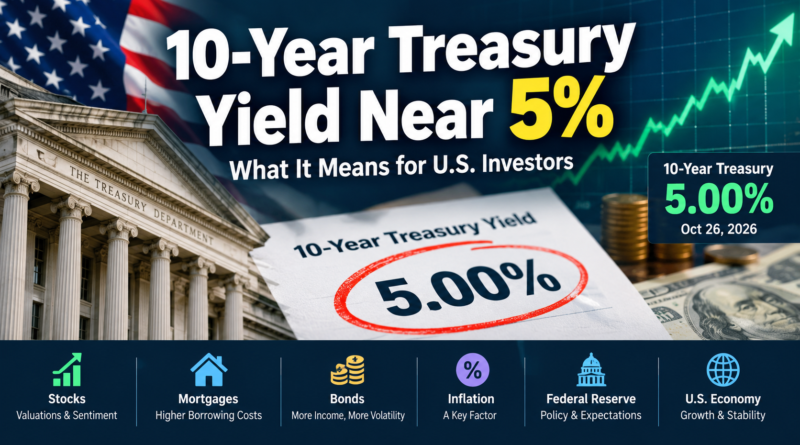
The U.S. bond market is once again becoming one of the biggest stories for investors. The 10-Year Treasury yield is
Read More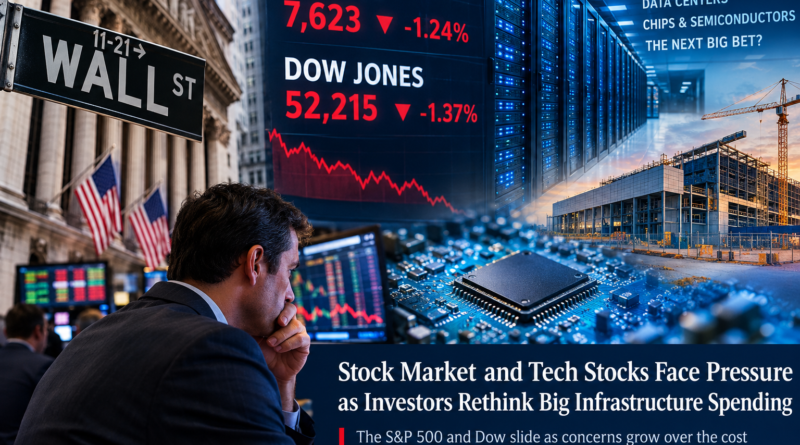
S&P 500: 7,676.77, +0.70% Wall Street started the week on a stronger note as the S&P 500 recovered from Friday’s
Read More
Here is the latest available weekly benchmark from Freddie Mac as of October 22, 2026. Mortgage type Average interest rate
Read More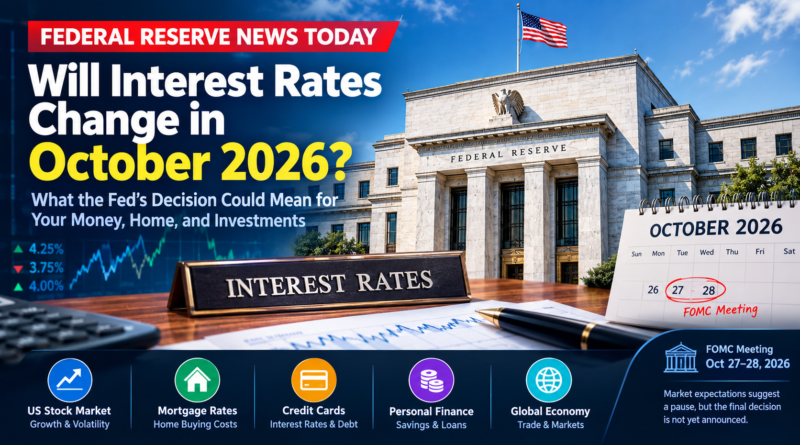
The Federal Reserve’s October 2026 interest rate decision is one of the biggest economic events for American households, investors, and
Read More
Published: October 25, 2026 Category: USA Finance, Federal Reserve, Economy, Stock Market Analysis The US financial markets are heading into
Read More
Credit card debt can become stressful surprisingly quickly. One month, a card may be used to cover groceries, a car
Read More
For many Americans, the biggest financial question is no longer whether they want to buy a home. It is whether
Read More