
U.S. Finance October 3, 2026: Wall Street Rallies as Weak Jobs Data Cools Fed Rate-Hike Bets
By Dr. Abhishek Bhatt, PhD
New York Finance Think
U.S. Finance Today: What Investors Need to Know on October 3
U.S. financial markets enter October 3, 2026, with Wall Street coming off a strong Friday session, but investors are facing a complicated economic picture.
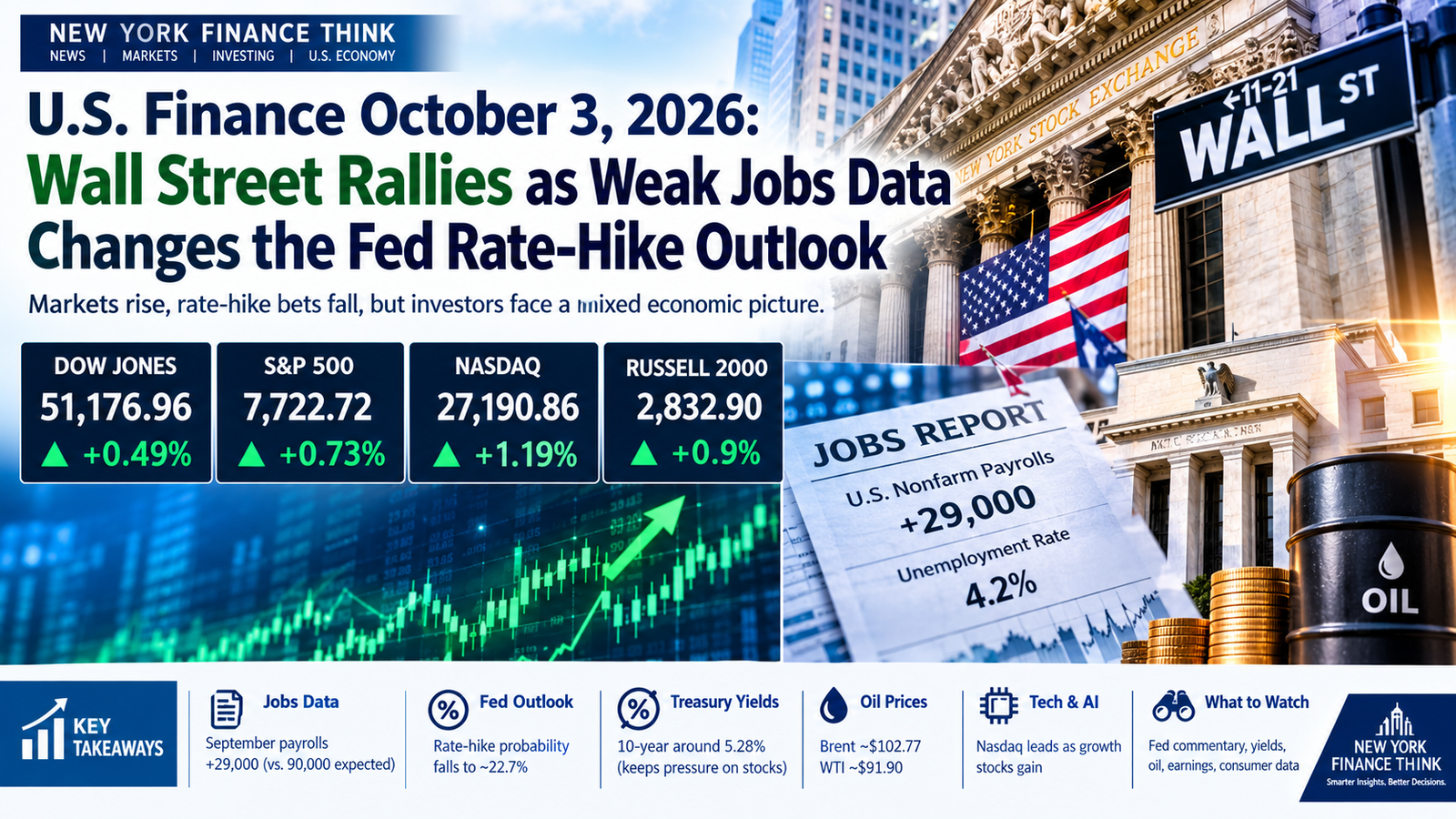
The Dow Jones Industrial Average, S&P 500 and Nasdaq Composite all finished higher on October 2 after a weaker-than-expected U.S. jobs report reduced expectations for another Federal Reserve interest-rate increase in October. The Nasdaq led the rally as investors moved back toward technology and growth stocks.
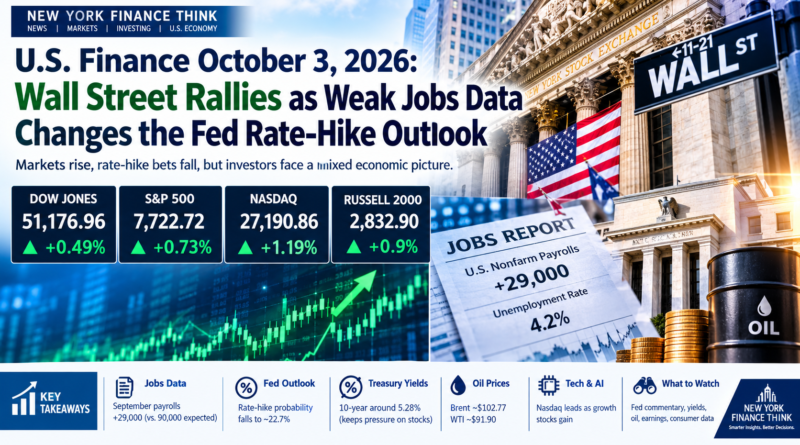
The Dow gained 0.49% to close at 51,176.96. The S&P 500 rose 0.73% to 7,722.72, while the Nasdaq Composite advanced 1.19% to 27,190.86. The Russell 2000, a key small-cap benchmark, gained about 0.9% to 2,832.90.
The immediate market message was straightforward: weaker economic data can reduce pressure on the Federal Reserve to raise interest rates.
But there is a second message that investors cannot ignore.
The same weak jobs data that helped stocks also raised questions about the strength of the U.S. economy.
That creates a difficult balancing act for investors going into the next trading week.
October 2 U.S. Market Snapshot
| Index | October 2 Close | Daily Move |
|---|---|---|
| Dow Jones Industrial Average | 51,176.96 | +0.49% |
| S&P 500 | 7,722.72 | +0.73% |
| Nasdaq Composite | 27,190.86 | +1.19% |
| Russell 2000 | 2,832.90 | +0.9% |
Source: Reuters and Associated Press market data.
The performance shows that investors were willing to take more risk after the employment report.
Technology and growth stocks benefited particularly strongly because lower expectations for near-term Fed tightening can reduce the pressure created by higher interest rates.
1. The Biggest U.S. Finance Story: Jobs Data
The September employment report became the main catalyst for Friday’s market rally.
According to the U.S. Bureau of Labor Statistics, nonfarm payroll employment increased by only 29,000 in September.
That was substantially below the approximately 90,000 jobs economists had expected.
The unemployment rate was 4.2%, while average hourly earnings for private-sector workers increased 3.0% over the previous 12 months.
The report also contained important revisions.
July employment was revised from a gain of 21,000 to a decline of 10,000, while August employment was revised from 162,000 to 133,000. Combined July and August employment was therefore 60,000 lower than previously reported.
That matters because investors are not looking at one isolated monthly number.
They are watching the direction of the labor market.
If hiring continues to slow, the Federal Reserve may have less reason to increase interest rates aggressively.
2. Why Bad Economic News Was Good News for Stocks
Normally, weaker employment data would be negative for stocks.
A weaker labor market can mean slower consumer spending, weaker corporate revenues and a greater risk of recession.
But financial markets can react differently when investors are focused heavily on monetary policy.
A weaker jobs report can reduce expectations for interest-rate increases.
Lower expected rates can make stocks more attractive relative to bonds and can particularly help companies whose valuations depend heavily on future earnings.
That is exactly what happened on October 2.
The Nasdaq gained 1.19%, outperforming the Dow and S&P 500.
This is the classic “bad news is good news” market reaction.
However, investors should be careful.
If employment weakness becomes severe enough to damage consumer demand and corporate earnings, the market can eventually shift from:
Bad news = lower Fed rate expectations
to:
Bad news = weaker economic growth and weaker earnings.
That transition is one of the biggest risks for U.S. stocks in the coming months.
3. Federal Reserve Rate-Hike Expectations Changed
The employment report immediately changed interest-rate expectations.
Reuters reported that market pricing for at least a 25-basis-point Federal Reserve rate increase at the October meeting fell to approximately 22.7%, compared with 64.2% one week earlier.
That is a major shift in a short period.
For investors, the important question is no longer simply:
“Will the Fed raise rates?”
The bigger question is:
“How much additional tightening does the U.S. economy actually need?”
The employment report gives policymakers more evidence that the labor market is cooling.
But inflation and energy prices remain important complications.
4. Treasury Yields Are Still a Major Risk
Stocks received good news from the jobs report, but the bond market sent a more complicated message.
The benchmark 10-year U.S. Treasury yield remained above 5%.
Reuters reported the 10-year yield around 5.28% after moving lower immediately following the jobs report. The two-year Treasury yield was around 4.83%.
This matters because Treasury yields influence borrowing costs throughout the U.S. economy.
Higher yields can affect:
- Mortgage rates
- Credit-card borrowing
- Corporate debt
- Commercial real estate
- Auto loans
- Government financing
- Stock valuations
Therefore, even if the Fed becomes less aggressive, investors cannot assume that borrowing costs will immediately fall.
The bond market has its own forces.
5. Why the 10-Year Treasury Yield Matters for Stock Investors
Many new investors concentrate almost entirely on the Dow, S&P 500 and Nasdaq.
Professional investors also watch Treasury yields closely.
The 10-year Treasury is especially important because it acts as a benchmark for many other interest rates.
When the 10-year yield rises substantially, future corporate earnings can become less valuable when discounted back to today’s dollars.
That can put pressure on high-growth companies.
Technology companies are particularly sensitive because a large portion of their valuation can depend on expected earnings far into the future.
That helps explain why Nasdaq investors need to watch both:
Federal Reserve policy
and
Treasury yields.
6. Nasdaq Leads Wall Street
The Nasdaq Composite was the strongest major U.S. index on October 2.
It gained 1.19%, compared with 0.73% for the S&P 500 and 0.49% for the Dow.
The stronger Nasdaq performance reflects the market’s renewed appetite for technology and growth stocks.
Investors often become more comfortable with higher-growth companies when interest-rate expectations become less restrictive.
However, technology stocks are not automatically safe simply because the Fed may pause.
Investors still need to examine:
- Earnings growth
- AI spending
- Revenue growth
- Profit margins
- Valuations
- Capital expenditure
- Competition
- Semiconductor demand
The AI investment cycle remains one of the biggest themes influencing U.S. markets.
7. AI Stocks Remain a Major Wall Street Theme
Artificial intelligence continues to influence investor expectations for technology companies.
The market has been willing to assign high valuations to companies expected to benefit from AI infrastructure, chips, cloud computing and data-center investment.
But higher Treasury yields create a challenge.
If the 10-year Treasury remains around or above 5%, investors may become less willing to pay extremely high prices for future growth.
That means the next phase of the AI trade may depend increasingly on actual earnings.
The market will want evidence that enormous AI investment is producing:
- Higher revenue
- Higher profits
- Stronger cash flow
- Sustainable competitive advantages
The story is gradually moving from “AI opportunity” toward “AI financial results.”
8. Oil Prices Add Another Complication
Energy markets are also important for the U.S. financial outlook.
Reuters reported Brent crude around $102.77 per barrel on October 2, while U.S. WTI was around $91.90.
High oil prices can create problems for both consumers and the Federal Reserve.
For households, expensive gasoline can reduce money available for discretionary spending.
For companies, higher energy costs can increase operating expenses.
For the Federal Reserve, higher energy prices can make inflation more difficult to control.
That creates a difficult combination:
Slower employment + high oil prices + elevated Treasury yields.
Investors should watch this combination carefully.
9. The U.S. Economy Is Sending Mixed Signals
The current economic picture is not simply bullish or bearish.
There are positive signals.
The stock market remains near historically high levels, technology investment remains strong, and the U.S. economy continues to benefit from large-scale AI investment.
But there are also warning signals.
Employment growth has slowed significantly, Treasury yields are elevated, oil prices are high and borrowing costs remain restrictive.
This creates a two-speed economy.
Some parts of corporate America are benefiting from technology investment and strong capital spending.
Other businesses are more exposed to consumer pressure and higher financing costs.
10. Small-Cap Stocks Deserve Attention
The Russell 2000 gained approximately 0.9% on October 2, outperforming the Dow but trailing the Nasdaq.
Small-cap stocks can be particularly sensitive to interest rates.
Many smaller companies depend more heavily on bank lending and refinancing than mega-cap corporations.
Therefore, if investors become confident that interest rates have peaked, small-cap stocks can benefit.
But if Treasury yields remain elevated, small companies may continue to face higher financing costs.
For investors looking for a broader market signal, the relationship between the Nasdaq and Russell 2000 is worth watching.
11. What Happened During the Week?
Friday’s rally did not completely erase the difficult week.
According to AP, the S&P 500 declined about 0.3% for the week, while the Dow dropped approximately 1.3%. The Nasdaq gained about 0.5%, and the Russell 2000 fell around 0.2%.
That tells an important story.
The October 2 rally was strong, but investors should not interpret one positive session as proof that market risks have disappeared.
The broader market is still dealing with:
- High Treasury yields
- Oil-price uncertainty
- Inflation risks
- Fed policy uncertainty
- Labor-market weakness
- High equity valuations
- AI concentration
- Geopolitical risks
12. What U.S. Investors Should Watch Next Week
The next trading week will be important because investors will begin asking whether Friday’s rally can continue.
1. Treasury yields
The 10-year yield should remain near the top of every investor’s watch list.
A sustained move higher could put pressure on technology and growth stocks.
2. Federal Reserve commentary
Any comments from Fed officials could influence expectations for the October and December meetings.
3. Oil
Brent crude around or above $100 remains a major inflation variable.
4. Technology earnings
Investors will increasingly demand evidence that AI spending is producing real earnings growth.
5. Consumer strength
Retail sales, credit-card usage and other consumer indicators will help determine whether the labor-market slowdown is spreading into spending.
6. Small-cap performance
The Russell 2000 can provide clues about whether investors are becoming more optimistic about interest-rate-sensitive companies.
13. Dow vs. S&P 500 vs. Nasdaq: What Friday’s Move Tells Investors
The three major indexes represent different parts of the U.S. market.
| Index | October 2, 2026 | What It Shows |
|---|---|---|
| Dow Jones | 51,176.96 | Large established companies |
| S&P 500 | 7,722.72 | Broad large-cap U.S. market |
| Nasdaq | 27,190.86 | Strong technology and growth exposure |
| Russell 2000 | 2,832.90 | Smaller U.S. companies |
The Nasdaq’s stronger performance shows that Friday’s rally was particularly favorable to growth-oriented stocks.
The Russell 2000’s gain also suggests that lower rate expectations helped interest-rate-sensitive companies.
14. What Does This Mean for a New U.S. Investor?
A beginner investor should avoid interpreting the October 2 rally as an automatic buy signal.
Markets can move quickly in response to economic data.
Instead, new investors should understand the relationship between:
Jobs → Fed → Treasury yields → stocks → earnings.
The chain works like this:
Weak jobs data can reduce expectations for Fed tightening.
Lower rate expectations can support stocks.
But if weak employment damages consumer spending, corporate earnings may eventually weaken.
At the same time, high oil prices can keep inflation elevated.
That can prevent the Fed from becoming as easy as investors expect.
This is why market analysis requires looking at several economic indicators together.
15. Is the October 2 Rally Bullish?
In the short term, the market reaction was clearly positive.
The S&P 500 moved 0.73% higher, the Dow rose 0.49%, and the Nasdaq jumped 1.19%.
The S&P 500 also finished within about 1% of its record high, according to AP.
But a sustainable bullish trend requires more than one jobs report.
Investors need to see:
- Stable corporate earnings
- Controlled inflation
- More manageable Treasury yields
- Continued consumer demand
- A healthy labor market
- Sustainable technology growth
If those conditions remain in place, the market can continue to absorb economic uncertainty.
16. The Biggest Risk: “Bad News Is Bad News”
The biggest danger to the current market narrative is a deeper labor-market slowdown.
For now, investors are treating weak employment data as positive because it reduces the probability of another immediate Fed rate hike.
But there is a limit.
If monthly job creation continues to weaken substantially, unemployment rises and consumer spending slows, investors may eventually focus less on interest rates and more on recession risk.
That could change the market’s reaction function.
Instead of saying:
“Weak jobs = lower rates = higher stocks,”
investors could begin saying:
“Weak jobs = weaker economy = weaker earnings.”
That would be a much more challenging environment for equities.
17. What This Means for Retirement Investors
Long-term investors should be careful not to make major portfolio decisions based on a single trading session.
Retirement investors may be more concerned with:
- Diversification
- Long-term asset allocation
- Investment costs
- Risk tolerance
- Time horizon
- Regular contributions
A one-day Nasdaq rally or Dow decline does not fundamentally change a long-term investment plan.
Short-term traders have a different objective.
They may focus heavily on Treasury yields, futures, technical levels, economic releases and Fed expectations.
Investors should understand which type of market participant they are before reacting to daily headlines.
18. What to Watch Before the U.S. Market Opens Monday
Before the next Wall Street session, investors should check five things.
First: U.S. Treasury yields.
Second: Brent and WTI crude prices.
Third: S&P 500 and Nasdaq futures.
Fourth: New Federal Reserve comments.
Fifth: Corporate earnings and guidance.
These five areas can provide a better picture than simply checking whether the Dow is green or red.
19. Bottom Line for October 3, 2026
The October 3 U.S. finance story is not simply that Wall Street rallied.
The deeper story is that investors are trying to balance two competing economic narratives.
The first narrative is supportive for stocks:
The labor market is cooling, inflation pressure may become easier to manage, and the Federal Reserve may not need to raise rates again immediately.
The second narrative is more concerning:
The labor market may be weakening, Treasury yields remain unusually high, oil prices are elevated and economic growth could slow.
On October 2, investors focused more heavily on the first narrative.
That helped the Nasdaq gain 1.19%, the S&P 500 rise 0.73% and the Dow advance 0.49%.
But the October market story is likely to remain highly sensitive to interest rates, Treasury yields, oil prices and economic data.
For U.S. investors, the most important lesson is simple:
Do not watch the stock indexes alone. Watch the economy behind them.
Jobs data influence Fed expectations.
Fed expectations influence Treasury yields.
Treasury yields influence valuations.
Oil prices influence inflation.
Inflation influences monetary policy.
And all of these factors ultimately influence stock prices.
That is the bigger U.S. finance story heading into the next trading week.
Key Data at a Glance
| Indicator | Latest Available Reading |
|---|---|
| Dow Jones | 51,176.96 |
| S&P 500 | 7,722.72 |
| Nasdaq Composite | 27,190.86 |
| Russell 2000 | 2,832.90 |
| September payroll growth | +29,000 |
| Unemployment rate | 4.2% |
| 10-year Treasury yield | Around 5.28% |
| 2-year Treasury yield | Around 4.83% |
| Brent crude | Around $102.77 |
| WTI crude | Around $91.90 |
Market data and economic figures reflect the latest available October 2 information as of the October 3 publication date.
Sources
- U.S. Bureau of Labor Statistics — September 2026 Employment Situation
- Reuters — U.S. stocks and jobs report, October 2, 2026
- Associated Press — How major U.S. stock indexes performed Friday, October 2, 2026
Disclaimer
This article is for educational and informational purposes only. It is not personalized investment, financial, tax or legal advice. Investors should consider their own financial situation, risk tolerance and investment objectives and conduct independent research before making investment decisions.
New York Finance Think (NYFT) provides financial news and market analysis for informational purposes and does not guarantee future market performance.
Sources — October 3, 2026 U.S. Finance Analysis
- Reuters — U.S. Stocks & Fed Rate Expectations
Reuters: Equities close higher as softer jobs data quiets rate-hike expectations - U.S. Bureau of Labor Statistics — September 2026 Jobs Report
BLS: Employment Situation — September 2026 - Reuters — Global Markets, October 2, 2026
Reuters: Stocks rise after weak U.S. jobs data - Reuters — Detailed October 2 Market Close Data
Reuters market report via Investing.com
Key verified figures: September payrolls +29,000, unemployment 4.2%; October 2 close — Dow 51,176.96 (+0.49%), S&P 500 7,722.72 (+0.73%), Nasdaq 27,190.86 (+1.19%), Russell 2000 +0.9%. (bls.gov)
