Dow Jones vs. S&P 500 vs. Nasdaq: A Beginner’s Guide to the U.S. Stock Market
New York Finance Think (NYFT)
Website: New York Finance Think
Short brand: NYFT
Focus: U.S. Finance, Wall Street, Markets, Banking, Economy & Global Financial News.
If you are new to investing in the United States, you will quickly come across three names in financial news: the Dow Jones, the S&P 500 and the Nasdaq.
You may hear headlines such as “the Dow gained 300 points,” “the S&P 500 hit a record high,” or “the Nasdaq led the market higher.”
For a new U.S. investor, these headlines can be confusing.
What exactly are these indexes? Why do they move differently? Which one matters most? And can you actually invest in them?
The simple answer is that all three are important measures of the U.S. stock market, but they represent different groups of companies and use different methods to measure performance.
Understanding the differences can help investors make better sense of daily Wall Street news.
What Is the Dow Jones?
The Dow Jones Industrial Average, commonly called the Dow or DJIA, is one of the best-known U.S. stock market indexes.
It tracks 30 large, established U.S. companies.
The Dow does not represent the entire American stock market. Instead, it provides a snapshot of how a select group of major companies is performing.
The Dow is also a price-weighted index.
That means companies with higher share prices have a greater influence on the index than companies with lower share prices, regardless of their total market capitalization.
This is one of the biggest differences between the Dow and the S&P 500.
Why Does the Dow Matter to U.S. Investors?
The Dow remains one of the most widely watched market indicators in the United States.
When the Dow rises, it generally indicates that many of its large-company components are gaining value.
When the Dow falls, investors may be seeing weakness among those companies.
However, a move in the Dow does not automatically mean the entire U.S. stock market is rising or falling.
That is why investors often look at the Dow alongside the S&P 500 and Nasdaq.
What Is the S&P 500?
The S&P 500 is one of the most important benchmarks for the U.S. stock market.
It tracks approximately 500 leading U.S. companies and is weighted by market capitalization.
Market capitalization means the total market value of a company’s outstanding shares.
Because the S&P 500 covers hundreds of companies across many industries, it provides a broader picture of the U.S. large-cap stock market than the Dow.
The index includes companies from sectors such as:
- Technology
- Financial services
- Healthcare
- Consumer goods
- Industrials
- Communication services
- Energy
- Real estate
For many investors and financial professionals, the S&P 500 is a key benchmark for measuring U.S. large-cap stock performance.
What Is the Nasdaq?
When financial news says “the Nasdaq,” it may refer to the Nasdaq Composite, although investors also frequently follow the Nasdaq-100.
The Nasdaq Composite tracks thousands of stocks listed on the Nasdaq Stock Market.
Technology and growth-oriented companies have a significant influence on the index.
That means the Nasdaq can react strongly to developments involving:
- Artificial intelligence
- Semiconductors
- Cloud computing
- Software
- Internet companies
- Technology earnings
- Growth-stock valuations
However, it is not technically correct to call the Nasdaq Composite a pure technology index. It includes companies from many industries.
Dow vs. S&P 500 vs. Nasdaq
| Feature | Dow Jones | S&P 500 | Nasdaq Composite |
|---|---|---|---|
| Companies | 30 | About 500 | Thousands |
| Weighting | Price-weighted | Market-cap weighted | Market-cap weighted |
| Main use | Large established companies | Broad U.S. large-cap benchmark | Nasdaq-listed stocks with strong technology/growth influence |
| Diversification | Lower | Higher | Broad |
| Popular with | Financial news and market watchers | Long-term investors and professionals | Technology and growth investors |
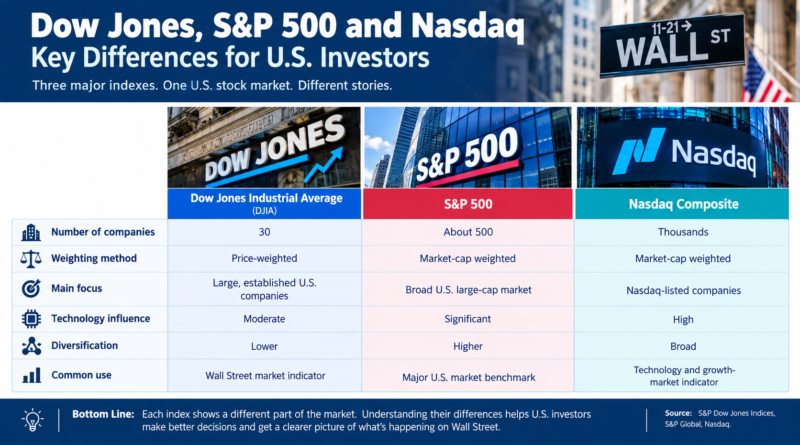
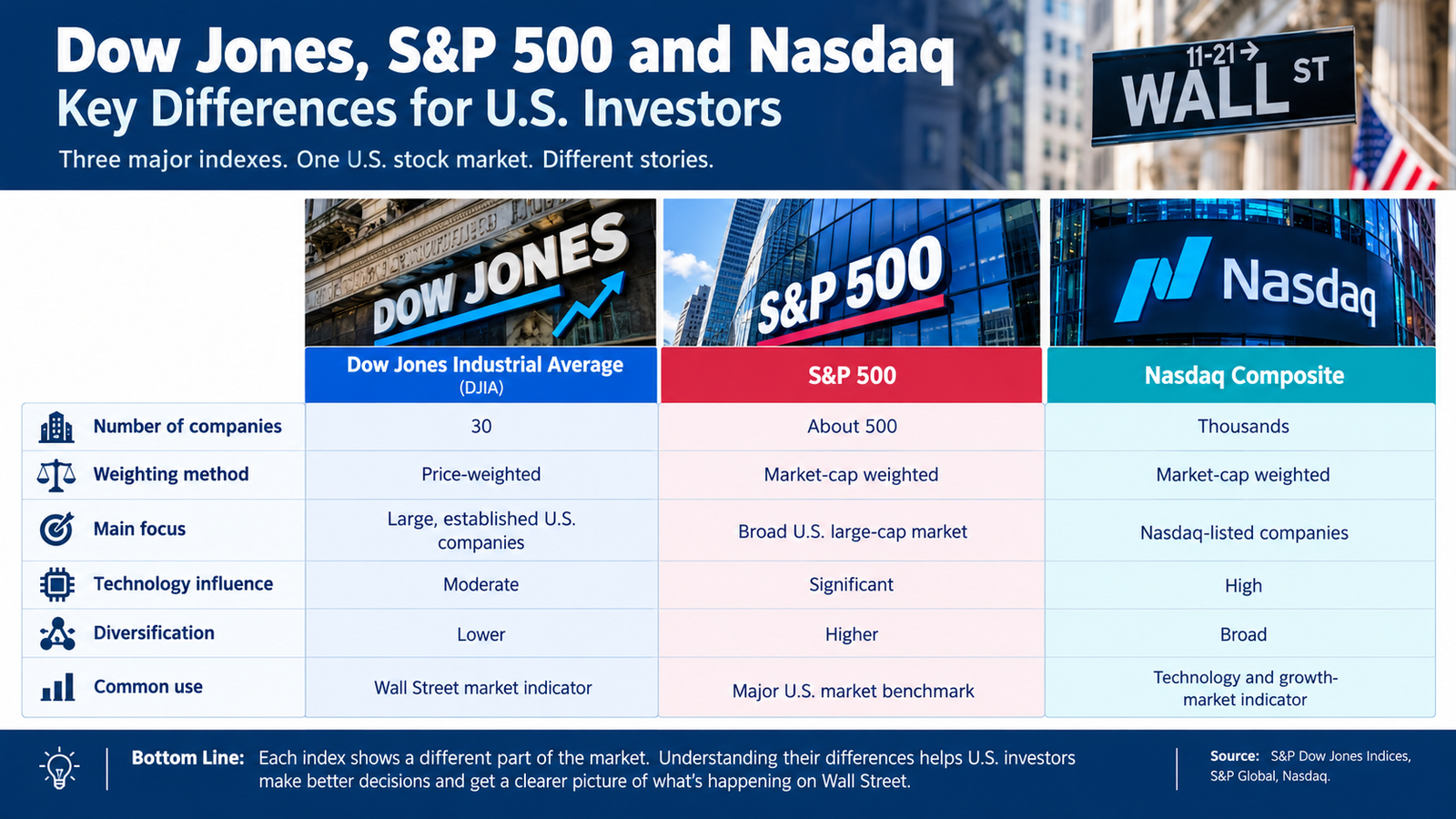
Dow Jones, S&P 500 and Nasdaq compared for U.S. investors, showing their company coverage, weighting methods, market focus and role in understanding Wall Street.
Why Can the Dow Rise While the Nasdaq Falls?
This is one of the most important concepts for a new investor.
The three indexes do not contain the same companies.
Imagine technology stocks are falling because Treasury yields are rising.
At the same time, banks, industrial companies and other established businesses may be performing well.
The result could be:
Dow: Up
Nasdaq: Down
That does not necessarily mean the market data is contradictory.
It means different parts of the market are performing differently.
Why Can the Nasdaq Rise Faster Than the Dow?
The Nasdaq has a significant exposure to technology and growth-oriented companies.
When investors become more optimistic about:
- AI
- technology earnings
- lower interest rates
- economic growth
- corporate investment
growth stocks can attract significant buying interest.
That can push the Nasdaq higher than the Dow.
However, technology stocks can also experience larger declines when valuations become stretched or interest rates rise.
How Does the Federal Reserve Affect These Indexes?
The Federal Reserve is one of the most important forces influencing U.S. financial markets.
When the Fed raises interest rates, borrowing generally becomes more expensive.
Higher rates can affect:
- Consumer borrowing
- Mortgage costs
- Business investment
- Corporate financing
- Stock valuations
- Economic growth
When investors expect the Fed to lower rates, stocks can receive a boost.
But investors should not assume that every rate cut is automatically bullish.
If the Fed cuts rates because the economy is deteriorating sharply, investors may become concerned about corporate earnings and employment.
The key question is not simply:
“Will the Fed cut rates?”
It is:
“Why is the Fed cutting rates?”
Why Treasury Yields Matter
U.S. Treasury yields are closely watched by Wall Street.
The 10-year Treasury yield is particularly important because it influences borrowing costs and financial-market valuations.
When Treasury yields rise sharply, investors may reassess the attractiveness of stocks, particularly higher-growth companies whose valuations depend heavily on future earnings.
This is one reason Nasdaq stocks can sometimes react strongly to changes in Treasury yields.
For a new investor, watching the Nasdaq without watching Treasury yields can leave out an important part of the market story.
Inflation and the U.S. Stock Market
Inflation is another major factor for investors.
If inflation remains high, the Federal Reserve may keep interest rates elevated for longer.
Higher rates can increase borrowing costs for American households and businesses.
Investors therefore watch economic reports such as:
- Consumer Price Index
- Producer Price Index
- Personal Consumption Expenditures
- Employment reports
- Wage growth
Inflation does not affect every company in the same way.
Companies with strong pricing power may be better positioned to deal with higher costs, while businesses with thin profit margins may face greater pressure.
Why the U.S. Jobs Report Matters
The monthly U.S. employment report is one of the most closely watched economic releases on Wall Street.
Investors look at:
- Nonfarm payroll growth
- Unemployment
- Wage growth
- Labor-force participation
- Revisions to previous months
A strong labor market can support consumer spending and economic growth.
But there is an important complication.
Very strong employment data can also make investors worry that inflation will remain elevated and that the Fed may keep rates higher for longer.
On the other hand, weaker employment data can reduce expectations for additional rate increases.
That can sometimes help stocks.
But if employment deteriorates too much, investors may begin worrying about recession and weaker corporate earnings.
So:
Weak economic data is not automatically good news for stocks.
What Should a New U.S. Investor Watch Every Day?
You do not need to follow hundreds of indicators.
Start with a simple market checklist.
1. Dow Jones
Shows how a group of 30 major U.S. companies is performing.
2. S&P 500
Provides a broader view of large-cap U.S. stocks.
3. Nasdaq
Helps investors understand the performance of Nasdaq-listed companies, with significant technology and growth exposure.
4. 10-Year Treasury Yield
Provides important information about interest rates and financial conditions.
5. Federal Reserve
Watch Fed decisions, speeches and interest-rate expectations.
6. Inflation
Monitor major inflation reports and trends.
7. Jobs
Watch payroll growth, unemployment and wage data.
8. Corporate Earnings
Ultimately, stock prices are closely connected to expectations about company profits and cash flows.
Can You Invest Directly in the Dow?
No.
The Dow is an index, not a stock.
You cannot buy one share of “the Dow.”
However, investors can buy investment products designed to track the index.
One well-known example is the SPDR Dow Jones Industrial Average ETF Trust (DIA).
Similarly, investors can use ETFs or index funds designed to track the S&P 500 or Nasdaq-related indexes.
Before investing, investors should review fees, holdings, tax considerations, risk and whether the investment fits their financial goals.
What Is an ETF?
ETF stands for exchange-traded fund.
An ETF can hold a basket of securities and trade on a stock exchange during market hours.
For example, instead of buying dozens of individual companies, an investor may choose an ETF designed to provide exposure to a particular index.
This can provide diversification, although diversification does not eliminate market risk.
Are Index Funds Safe?
Index investing can provide diversification, but no stock-market investment is guaranteed to make money.
An index fund can lose value when the underlying market declines.
For example, during a major market selloff, an S&P 500 index fund would generally decline along with the stocks it tracks.
That is why investors should consider:
- Investment time horizon
- Risk tolerance
- Emergency savings
- Diversification
- Investment goals
- Fees and expenses
before investing.
Why Beginners Should Not Chase Daily Market Moves
One of the biggest mistakes new investors make is reacting emotionally to market headlines.
A headline might say:
“Nasdaq jumps 2%.”
A new investor may immediately feel pressure to buy technology stocks.
But a professional investor may ask:
- Why did the Nasdaq rise?
- Were earnings better than expected?
- Did Treasury yields fall?
- Did Fed expectations change?
- Are valuations reasonable?
- Is the move likely to be temporary?
- What are the risks?
Understanding the reason behind a market move is more useful than simply knowing the number.
Dow Points vs. Percentage Change
Financial headlines often say:
“Dow jumps 500 points.”
Beginners should also look at the percentage change.
A 500-point move means something different when the Dow is at 20,000 than when it is at 50,000.
That is why percentage changes are often more useful for comparing market moves over time.
Always consider:
Points + Percentage + Context
Do These Indexes Predict a Recession?
No.
A falling Dow, S&P 500 or Nasdaq does not automatically mean the United States is entering a recession.
Investors and economists look at a much wider range of information, including:
- GDP
- Employment
- Consumer spending
- Business investment
- Industrial production
- Corporate earnings
- Inflation
- Credit conditions
- Housing activity
The stock market can also move ahead of economic data because investors are constantly pricing expectations about the future.
Which Index Should a Beginner Follow?
There is no single correct answer.
If you want a broad view of large U.S. companies:
Watch the S&P 500.
If you want to understand technology and growth-stock sentiment:
Watch the Nasdaq.
If you want to follow 30 major established U.S. companies and a familiar Wall Street benchmark:
Watch the Dow Jones.
For a beginner, watching all three can provide a much better understanding of what is happening across the U.S. market.
A Simple Daily Routine for U.S. Investors
Before making an investment decision, a beginner can ask:
What are the Dow, S&P 500 and Nasdaq doing?
Then check:
What are Treasury yields doing?
What is the Federal Reserve expected to do?
What is happening with inflation?
What does the latest jobs data show?
Are corporate earnings improving or weakening?
Are oil prices rising?
Is the U.S. dollar strengthening or weakening?
Is market volatility increasing?
This simple routine can help investors understand the market instead of simply reacting to headlines.
The Bottom Line for New Investors
The Dow Jones, S&P 500 and Nasdaq are not interchangeable.
The Dow Jones tracks 30 major U.S. companies and uses a price-weighted methodology.
The S&P 500 tracks approximately 500 leading U.S. companies and provides a broader view of the large-cap U.S. stock market.
The Nasdaq Composite tracks Nasdaq-listed companies and has significant exposure to technology and growth stocks.
For U.S. investors, all three can be useful.
But the most important lesson is this:
Do not invest simply because an index is rising. Understand why it is rising.
Markets move because of changing expectations about earnings, interest rates, inflation, economic growth, government policy and investor sentiment.
For a new investor, learning how these forces interact is more valuable than trying to predict whether the market will be higher or lower tomorrow.
New York Finance Think will continue to explain Wall Street, the Federal Reserve, U.S. economic data and market movements in simple language for American investors.
Disclaimer: This article is for educational and informational purposes only. It is not personalized investment, tax or financial advice. Investors should consider their individual circumstances and conduct their own research or consult a qualified financial professional before making investment decisions.
Sources
- S&P Dow Jones Indices — Dow Jones Industrial Average Methodology — Dow 30-stock, price-weighted structure.
- S&P Dow Jones Indices — S&P U.S. Indices Methodology — S&P 500 composition market-cap weighting.
- Nasdaq — Nasdaq Composite Index — Nasdaq Composite composition, technology exposure market-cap weighting.
- S&P Dow Jones Indices — The S&P 500 and The Dow — Dow और S&P 500 weighting methods comparison.