
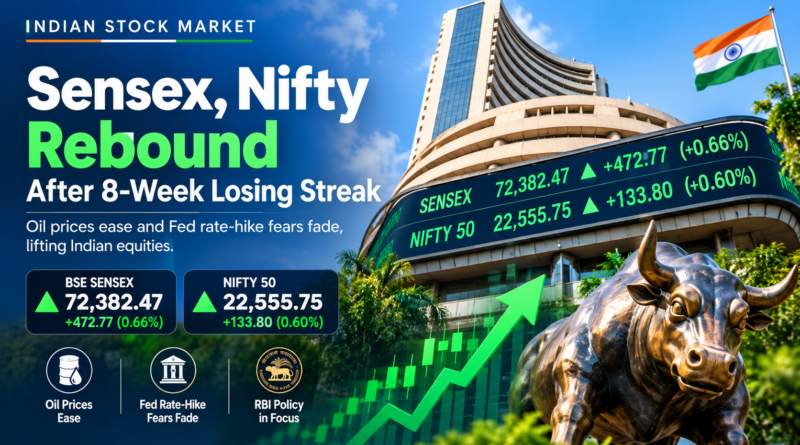
Sensex Today: BSE Sensex Jumps 473 Points as Oil and Fed Rate Fears Ease
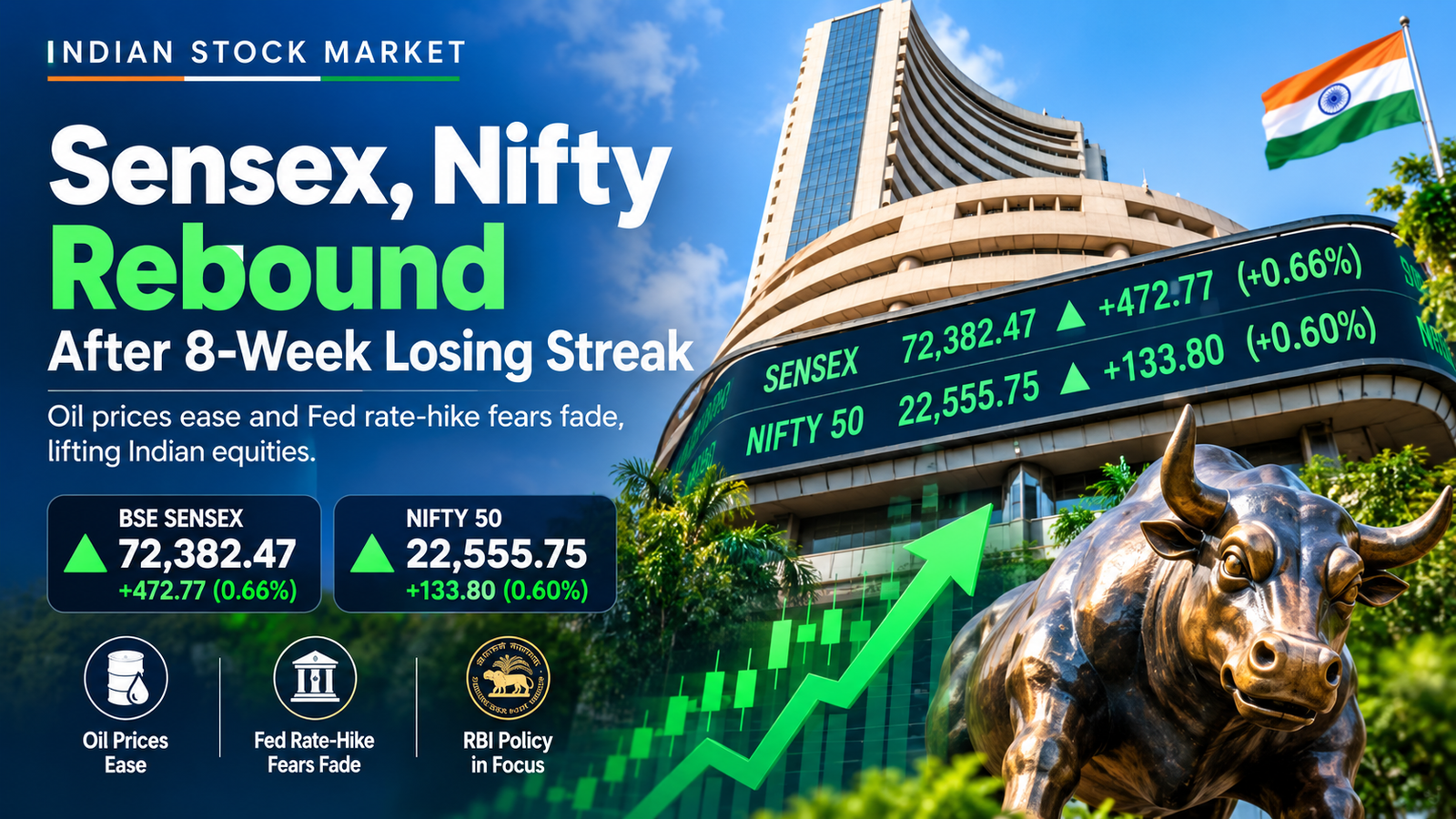
India’s benchmark BSE Sensex staged a strong rebound on Monday, gaining 472.77 points, or 0.66%, to close at 72,382.47. The index briefly climbed more than 700 points during the session before giving back part of its gains.
The Nifty 50 also recovered, rising 133.80 points, or 0.60%, to finish at 22,555.75. The rebound came after Indian equities had suffered eight consecutive weekly declines, making Monday’s session an important relief rally for investors.
Sensex Today: What Happened?
The Sensex started the week on a stronger note as investors responded to improving global risk sentiment, softer crude oil prices and reduced expectations of an aggressive Federal Reserve rate move.
The market had entered Monday after a prolonged period of weakness. The eight-week losing streak had put pressure on both large-cap and broader Indian equities.
Monday’s gains therefore represented more than just a one-day move. Investors were looking for signs that selling pressure could be easing.
However, the rebound does not yet confirm a sustained change in the broader market trend.
Sensex Closing Data
| Index | October 5, 2026 Close | Change |
|---|---|---|
| Sensex | 72,382.47 | +472.77 points |
| Sensex % Change | — | +0.66% |
| Nifty 50 | 22,555.75 | +133.80 points |
| Nifty 50 % Change | — | +0.60% |
The Sensex reached an intraday high of around 72,631.93, showing that buying interest was considerably stronger during parts of the session.
Why Did the Sensex Rise Today?
1. Softer U.S. Jobs Data Reduced Fed Rate-Hike Fears
One of the biggest global drivers was the latest U.S. employment data.
Softer-than-expected U.S. jobs data reduced expectations that the Federal Reserve would aggressively tighten monetary policy. Lower expectations for U.S. rates can support emerging-market assets because higher U.S. interest rates generally make dollar assets more attractive.
For Indian equities, this provided some relief after weeks of pressure.
Investors will continue watching U.S. inflation, employment and Federal Reserve commentary because global interest-rate expectations remain an important driver of foreign portfolio flows.
2. Crude Oil Prices Eased
Oil remained another major factor for Indian investors.
Brent crude was trading around the $100-$102-a-barrel area on Monday, although prices remained elevated by historical standards.
Lower oil prices can be positive for India because the country depends heavily on imported crude.
When crude rises sharply, India can face pressure through:
- Higher import costs
- A wider trade deficit
- Pressure on the Indian rupee
- Higher inflation
- Higher transportation costs
- Pressure on corporate margins
That is why any sustained decline in crude prices could provide additional support to Indian stocks.
3. Banking and Financial Stocks Supported the Rebound
Financial stocks were among the important contributors to Monday’s recovery.
Punjab National Bank gained after reporting strong growth in global advances during the September quarter, while Bank of Baroda also benefited from positive business updates.
Bajaj Finance was another notable gainer after reporting an increase in new loans booked during the quarter.
The banking sector is particularly important for the Sensex and Nifty because large financial companies have significant index weights.
4. ITC Was One of the Biggest Gainers
ITC was among the strongest performers in the Nifty 50.
ITC shares rose roughly 5%, making the stock one of the biggest contributors to the market’s positive tone.
The strong move in a large index constituent can have a meaningful impact on benchmark indices.
Investors should nevertheless distinguish between an individual stock rally and a broad-based market recovery.
5. RBI Policy Meeting Is Now a Major Market Event
Another major issue for Indian investors is the Reserve Bank of India’s October Monetary Policy Committee meeting.
The RBI MPC is meeting from October 5 to October 7, with the policy decision expected on October 7.
A Reuters poll indicated that nearly 60% of economists expected a 25-basis-point rate increase, which would take the repo rate from 5.25% to 5.50%.
The possibility of a rate hike is important for the Sensex because interest rates affect:
- Bank lending
- Home loans
- Corporate borrowing
- Consumer spending
- Investment
- Bond yields
- Equity valuations
If the RBI adopts a more hawkish tone, rate-sensitive sectors could face pressure.
HDFC Bank Remains in Focus
Not every major stock participated in Monday’s rally.
HDFC Bank declined as investors assessed the appointment of Anup Bagchi as the bank’s next managing director and CEO.
Bagchi is set to succeed Sashidhar Jagdishan and would become the first outsider to lead India’s largest private-sector bank.
The appointment generated mixed investor sentiment because investors are evaluating the potential benefits of fresh leadership against the risks associated with a major management transition.
Because HDFC Bank is a major index constituent, movements in the stock can influence the Sensex.
Foreign Investors Remain a Risk
Despite Monday’s rebound, foreign investor selling remains one of the biggest risks for Indian equities.
Foreign portfolio investors have been selling Indian equities during the recent market correction, while domestic institutional investors have provided support.
This creates an important battle between foreign selling and domestic buying.
If foreign investors continue reducing exposure, the Sensex may struggle to sustain a strong recovery even when domestic institutions continue buying.
Investors should therefore watch daily FPI and DII flows alongside the headline index.
Is the Sensex Rally the Start of a New Bull Market?
It is too early to make that conclusion.
Monday’s move was encouraging, but the Sensex and Nifty are coming off an unusually long period of weakness.
The market had recorded eight consecutive weekly declines, one of the longest losing streaks in recent years.
A sustainable recovery would require several factors to improve together:
- Crude oil prices need to stabilize or decline.
- Foreign selling needs to slow.
- The rupee needs to stabilize.
- Global interest-rate concerns need to ease.
- Corporate earnings need to remain resilient.
- RBI policy needs to avoid creating a major valuation shock.
Without these improvements, Monday’s rally could remain a technical or relief rebound.
What Investors Should Watch Next
The next few trading sessions could be particularly important.
RBI Policy
The October 7 policy decision could become the biggest domestic market event of the week.
Investors will focus not only on the repo-rate decision but also on the RBI’s language regarding inflation, growth, crude oil and the rupee.
Crude Oil
Oil above $100 a barrel remains a major concern for India.
A sustained fall in crude could improve sentiment, while another sharp increase could put pressure on inflation and the rupee.
Foreign Fund Flows
FPI activity will remain important.
A return of foreign buying would strengthen the case for a broader market recovery. Continued selling would suggest that global investors remain cautious.
September-Quarter Business Updates
Investors will increasingly shift their attention toward September-quarter earnings and operating updates.
Banks, financial companies, technology firms, consumer businesses and energy companies will be closely watched.
Sensex Outlook for Indian Investors
The Sensex’s 472-point gain is a positive development after weeks of selling pressure, but investors should avoid treating one strong session as proof that the correction is over.
The combination of easing oil prices and reduced U.S. rate-hike concerns provided immediate relief. At the same time, RBI policy uncertainty, foreign outflows, elevated crude prices and rupee weakness remain important risks.
For long-term investors, the focus should remain on business fundamentals rather than trying to predict every daily move in the Sensex.
For short-term traders, volatility could remain high around the RBI policy announcement and global interest-rate signals.
Bottom Line
The Sensex closed at 72,382.47 on October 5, 2026, up 472.77 points, while the Nifty 50 finished at 22,555.75.
The rebound was supported by softer U.S. employment data, easing crude oil prices, stronger financial stocks and improved global risk sentiment.
But the Indian market still faces significant challenges.
The RBI’s October policy decision, crude oil prices, foreign investor flows, the rupee and September-quarter corporate updates could determine whether Monday’s rally develops into a broader recovery or remains a temporary bounce.
For Indian investors, the key message is simple: the Sensex has shown buying interest again, but confirmation of a lasting trend reversal will require more than one positive trading session.
Sources for the Sensex Article
- Reuters — Indian shares rise as oil and Fed fears ease; financials gain on Q2 updates
Reuters source (Reuters) - India Today — Sensex ends 472 points higher; Nifty above 22,500
India Today source - Moneycontrol — Markets snap 4-day losing streak; Sensex up 473 points
Moneycontrol source - Economic Times / Reuters — Rupee ends flat as oil and global pressures continue
Economic Times source - Reuters — Soft U.S. September jobs report sends markets higher
Reuters U.S. jobs report - Economic Times — RBI likely to hike repo rate by 25 bps to 5.50%
Economic Times RBI source
Best sources to keep in the article: Reuters + India Today + Moneycontrol + Economic Times. (Reuters)
