
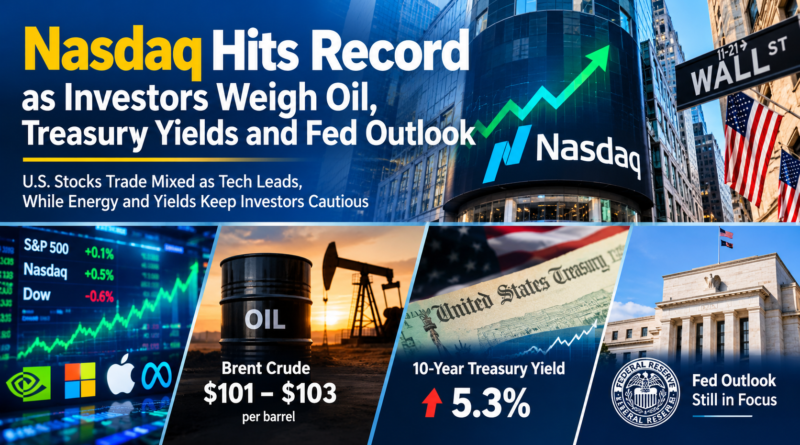
Stock Market Today: Nasdaq Hits Record as Investors Weigh Oil, Treasury Yields and Fed Outlook
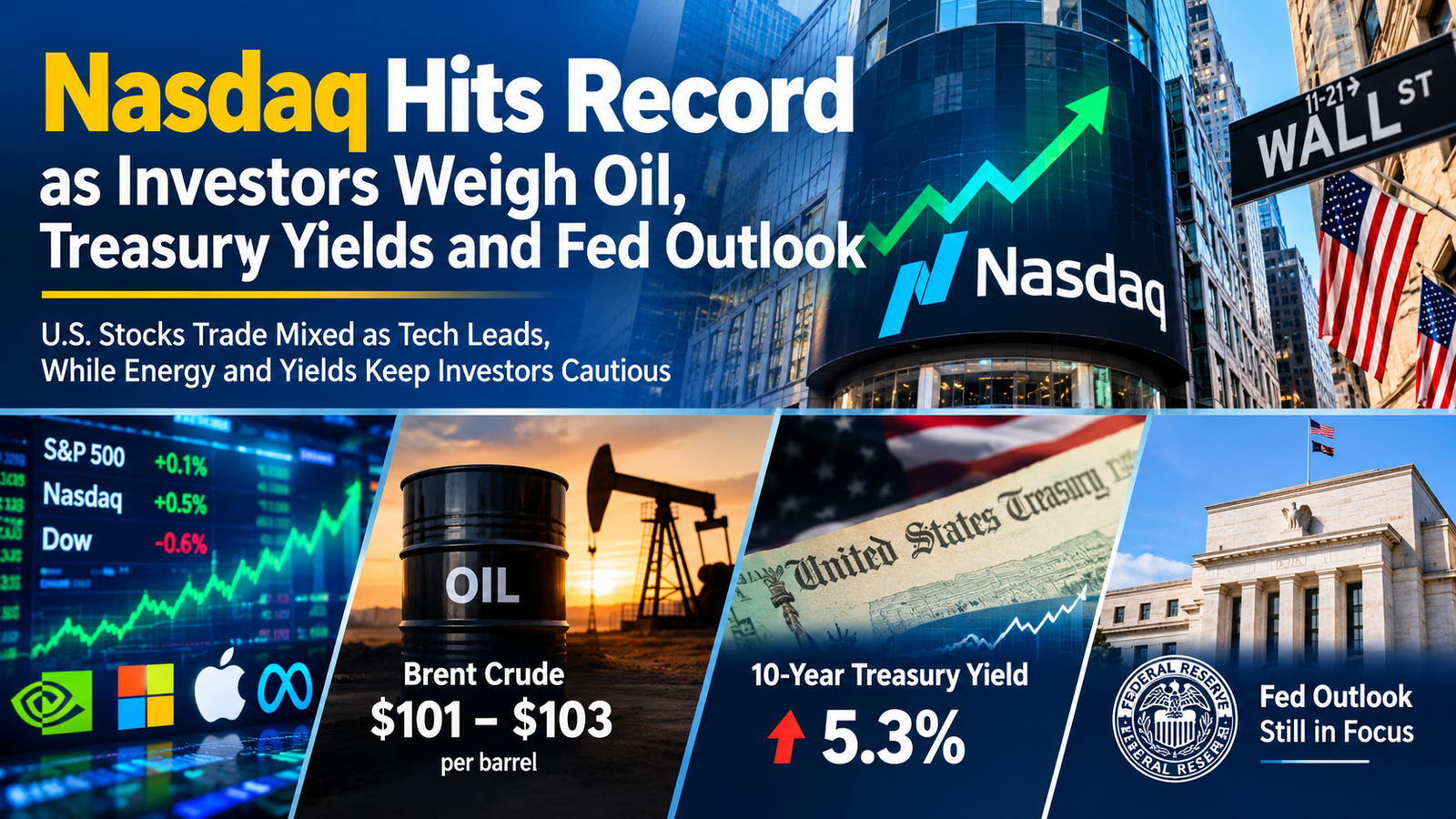
Wall Street started the new week with investors balancing two very different signals: strong demand for technology stocks and renewed pressure from high bond yields and elevated oil prices.
The Nasdaq Composite moved to a record high on Monday as large technology and growth stocks attracted buyers. The S&P 500 also gained, while the Dow Jones Industrial Average lagged and traded lower. The market’s mixed performance shows that investors are still willing to buy growth stocks, but they are becoming more selective as borrowing costs remain high.
For everyday American investors, the biggest question is no longer simply whether stocks are rising. The bigger question is whether the market can continue climbing while the 10-year Treasury yield remains around 5.3% and crude oil remains above $100 a barrel.
That combination could become increasingly important as Wall Street moves closer to the third-quarter corporate earnings season.
Wall Street Today: Nasdaq Leads, Dow Trails
The early session was mixed across the major U.S. indexes.
Reuters reported that the S&P 500 gained about 0.14% early Monday while the Nasdaq rose roughly 0.5%. The Dow was down about 0.57%.
Later market data showed the Nasdaq continuing to outperform as major technology companies pushed higher. Nvidia, Meta Platforms, Microsoft and Tesla were among the large-cap technology names gaining more than 1% during the session.
Why Technology Stocks Are Rising
The technology sector is getting support from changing expectations for Federal Reserve policy.
Last week’s weaker-than-expected U.S. employment data reduced expectations for another immediate Federal Reserve rate increase. That has helped growth stocks because lower expectations for future interest rates can improve the outlook for companies whose valuations depend heavily on future earnings growth.
The Nasdaq has therefore remained relatively strong even while the broader bond market is sending a more cautious signal.
Nvidia remains one of the most closely watched names. The chipmaker continued to trade near record levels as investors focused on artificial intelligence spending and demand.
Microsoft, Meta and Tesla also participated in Monday’s technology-led advance.
But investors should remember that strong technology performance does not automatically mean the entire market is equally healthy.
A market led by a relatively small group of large technology companies can continue rising even when other sectors are struggling.
The 10-Year Treasury Yield Is the Bigger Story
One of the most important numbers for investors today is not an equity index.
It is the 10-year U.S. Treasury yield.
The yield remained around 5.3% on Monday, close to multi-year highs. Reuters reported the benchmark yield at approximately 5.30%.
High Treasury yields matter because they affect the cost of money throughout the economy.
Mortgage rates, corporate borrowing costs, government financing and the valuation of stocks are all influenced by the bond market.
For growth companies, high long-term yields can be particularly important. Investors generally compare the potential return from stocks with what they can earn from relatively lower-risk government bonds.
That means technology stocks may face a tougher valuation environment if Treasury yields continue moving higher.
So far, however, strong expectations for artificial intelligence investment and corporate earnings have helped offset some of that pressure.
Oil Remains Above $100
Crude oil is another major issue for Wall Street.
Brent crude traded around the $101-to-$103 range during Monday’s session, while U.S. crude remained near $90 a barrel.
Oil prices remain volatile because of uncertainty surrounding the Middle East and global energy supplies.
For American consumers, higher oil prices can eventually affect gasoline prices, transportation costs and household budgets.
For businesses, expensive energy can increase operating costs.
The inflation question therefore remains important.
If oil stays above $100 for an extended period, investors will want to know whether higher energy costs begin feeding back into broader inflation.
That could make the Federal Reserve’s job more complicated.
What the Fed Means for Stocks
The Federal Reserve remains at the center of the market discussion.
Recent labor-market data reduced expectations for an immediate October rate increase. Reuters reported that market pricing showed only an 18% probability of an October hike, down from 64% a week earlier.
That shift has been supportive for stocks.
However, investors are not expecting the Fed to disappear from the market conversation.
The Federal Reserve’s September meeting minutes are scheduled for release this week. Investors will examine them for clues about how policymakers view inflation, employment and interest rates.
The market is therefore entering an important period.
If Fed officials appear comfortable waiting, growth stocks could receive additional support.
If policymakers sound concerned about inflation and high energy prices, Treasury yields could remain elevated and put pressure on stock valuations.
Earnings Season Is Coming
Corporate earnings could soon become the next major driver of Wall Street.
Companies including Delta Air Lines, PepsiCo, Constellation Brands and Levi Strauss are scheduled to report earnings this week.
The banking sector will become particularly important next week as several major financial institutions begin reporting.
Investors will be watching more than just profits.
They will want to know what companies are saying about:
- Consumer spending
- Inflation
- Labor costs
- Interest expenses
- Artificial intelligence investment
- Business demand
- Global economic growth
- Energy costs
- 2027 expectations
Strong earnings could help stocks absorb higher Treasury yields.
Weak earnings guidance, however, could expose some of the market’s valuation risks.
Nvidia and AI Remain Central to the Market
Artificial intelligence continues to be one of the strongest themes on Wall Street.
Nvidia has become one of the clearest symbols of this trend.
The company’s stock has benefited from expectations for continued demand for AI computing infrastructure, while investors are also watching the broader technology ecosystem that includes cloud providers, semiconductor companies and software firms.
Nvidia shares were up about 1.1% Monday and remained close to their record level.
The important question for investors is whether AI spending can translate into sustainable corporate earnings growth.
So far, investors have continued to place significant value on that growth story.
But higher interest rates mean future earnings are being discounted at a higher rate. That makes earnings growth and cash-flow performance increasingly important.
What American Investors Should Watch Today
For someone checking a 401(k), IRA or brokerage account, Monday’s market may look confusing.
The Nasdaq can be at a record while the Dow is falling.
That is not necessarily unusual.
Different indexes contain different companies and sectors.
The Nasdaq has a heavier concentration of technology and growth companies, while the Dow contains a more limited group of large established companies.
Today’s divergence therefore tells investors something useful: money is still moving toward growth and technology, even while concerns about rates and energy costs remain.
Investors should watch five major indicators during the rest of the session:
1. The 10-Year Treasury Yield
A move significantly above current levels could put additional pressure on high-growth stocks.
2. Crude Oil
Brent crude staying above $100 could keep inflation concerns alive.
3. Nvidia and Mega-Cap Technology
The performance of Nvidia, Microsoft, Meta and other major technology stocks will remain important for the Nasdaq and S&P 500.
4. Federal Reserve Signals
The upcoming Fed minutes could provide more information about the central bank’s thinking.
5. Corporate Earnings
The beginning of third-quarter earnings season will provide a better test of whether companies can continue delivering strong profits in a higher-cost environment.
The Bigger Picture for U.S. Investors
Monday’s trading shows why investors should look beyond the headline number on the Dow or S&P 500.
The U.S. stock market is currently being pulled in several directions.
On one side is optimism surrounding artificial intelligence, corporate earnings and a potentially less aggressive Federal Reserve.
On the other side are high Treasury yields, expensive energy and geopolitical uncertainty.
Those forces can produce sharp differences between sectors.
Technology stocks may benefit from strong earnings expectations, while companies that are sensitive to fuel prices or borrowing costs may face a more difficult environment.
That does not necessarily mean investors should make large short-term moves based on one trading session.
For long-term investors, the more useful question is whether corporate earnings can continue growing strongly enough to justify current stock valuations.
What Comes Next
The next few trading sessions could be important.
Investors will receive additional economic information, study the Federal Reserve’s meeting minutes and prepare for a more active earnings calendar.
The bond market will remain particularly important.
If Treasury yields stabilize while earnings expectations remain strong, stocks could continue receiving support.
If yields rise sharply again while oil prices remain elevated, investors may become more cautious.
That tension is likely to define much of the market conversation this week.
Bottom Line
The U.S. stock market is starting October with technology stocks in the driver’s seat, but the bond market is sending a warning that investors should not ignore.
The Nasdaq reached a record high Monday, while the S&P 500 moved closer to its own record. At the same time, the Dow struggled, Treasury yields remained near multi-year highs and Brent crude stayed above $100.
For American investors, the next major test will be whether strong technology and earnings expectations can continue to overcome the pressure created by expensive energy and high borrowing costs.
The market may be rising, but the underlying story is more complicated than the headline index numbers suggest.
For investors, this is a week to watch the Fed, Treasury yields, oil prices and corporate earnings—not just the daily direction of the Dow, S&P 500 or Nasdaq.
This article is for informational and educational purposes only. It is not investment, financial, tax or legal advice. Market conditions can change rapidly, and investors should consider their own financial circumstances and risk tolerance before making investment decisions.
Sources
Reuters — U.S. stocks and global markets, October 5, 2026.
Reuters — S&P 500 and Nasdaq market update, October 5, 2026.
AP — U.S. stocks, oil and Treasury yields, October 5, 2026.
Investopedia — U.S. stock market factors for October 5, 2026.
