
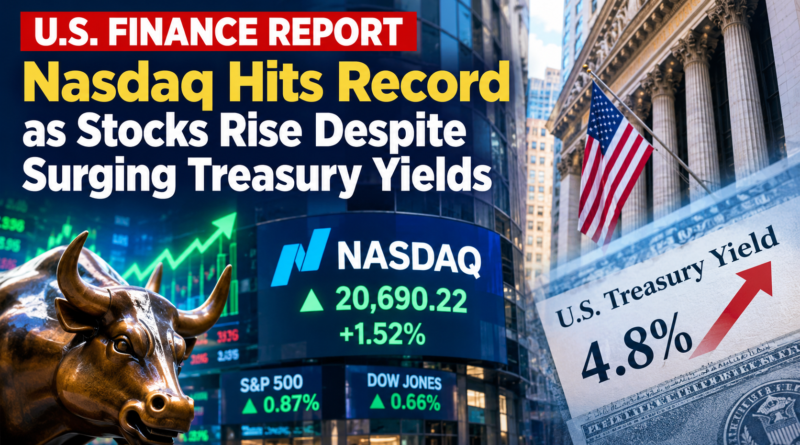
U.S. Finance Report: Nasdaq Hits Record as Stocks Rise Despite Surging Treasury Yields
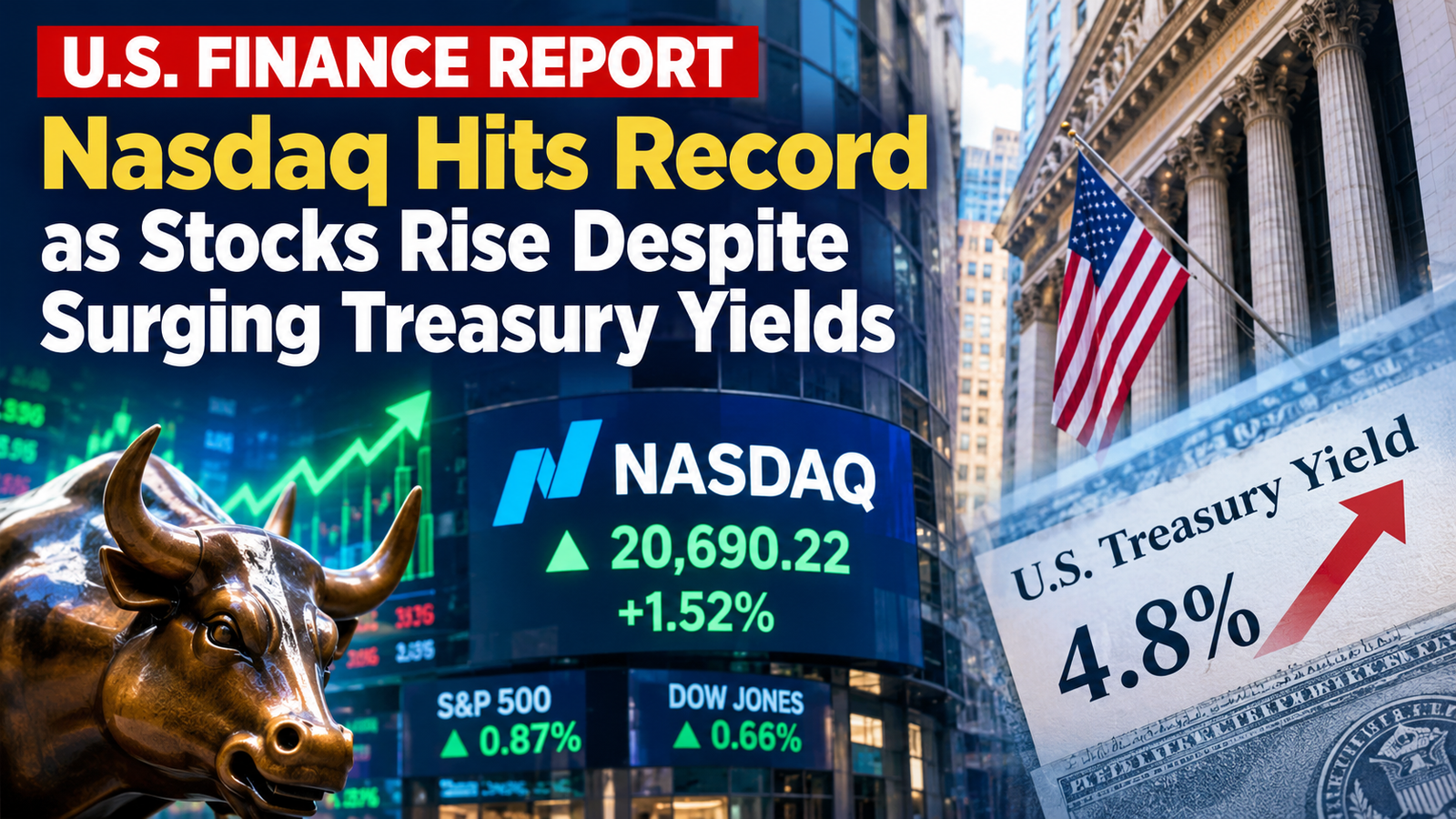
Wall Street trading floor with Nasdaq, S&P 500 and Dow Jones market screens, U.S. Treasury yields and technology stocks, October 5, 2026 — 16:9 financial-news style.
By NYFT Finance Desk | Updated October 5, 2026, 4:30 p.m. ET
Short Introduction
U.S. financial markets started October with a strong stock-market rally, but the gains came alongside an important warning from the bond market.
On Monday, October 5, the Nasdaq Composite climbed to a new record, while the S&P 500 moved close to its all-time high. The Dow Jones Industrial Average also finished higher, and small-cap stocks gained.
The rally was supported by large technology companies, expectations for strong third-quarter corporate earnings and reduced expectations for an immediate Federal Reserve rate increase.
At the same time, Treasury yields moved sharply higher. The 10-year Treasury yield finished around 5.31%, its highest level since 2002. Brent crude also remained above $100 a barrel, keeping inflation and energy costs in focus.
For investors, October 5 showed a market caught between strong corporate-growth optimism and rising macroeconomic risks.
KEY TAKEAWAYS
- The Nasdaq Composite rose 1.1% to a record 27,477.31.
- The S&P 500 gained about 0.7% to 7,773.95, moving within roughly 0.3% of its record.
- The Dow Jones gained 0.2% to 51,267.90.
- The Russell 2000 rose about 0.5%.
- Nvidia and other major technology companies helped lead the rally.
- The 10-year Treasury yield reached about 5.31%, its highest level since April 2002.
- The 30-year Treasury yield remained around 5.66%, also at a multidecade high.
- September U.S. services activity remained in expansion territory, with the ISM Services PMI at 54.9.
- The ISM services prices index jumped to 74, its highest level since July 2022.
- Brent crude settled around $100.32 a barrel.
- Markets increasingly expected the Federal Reserve to hold rates at its October meeting after weaker recent employment data.
MARKET DATA TABLE
| Market / Indicator | October 5, 2026 Close | Daily Move |
|---|---|---|
| S&P 500 | 7,773.95 | +0.7% |
| Nasdaq Composite | 27,477.31 | +1.1% |
| Dow Jones Industrial Average | 51,267.90 | +0.2% |
| Russell 2000 | 2,847.14 | +0.5% |
| U.S. 10-Year Treasury | ~5.31% | Higher |
| U.S. 30-Year Treasury | ~5.66% | Higher |
| Brent Crude | ~$100.32 | -1.9% |
| WTI Crude | ~$89.43 | -1.8% |
Market data for the major U.S. indexes and commodities is based on October 5 closing information.
What Happened?
Wall Street started the week on a positive note.
The biggest move came from the technology-heavy Nasdaq Composite, which gained approximately 1.1% and established another record close.
The S&P 500 advanced approximately 0.7%, while the Dow rose about 0.2%. Small-cap stocks also participated in the advance, with the Russell 2000 gaining roughly 0.5%.
Technology and large-cap growth stocks were among the major sources of buying interest. Nvidia was particularly strong, while other megacap technology companies including Microsoft and Meta also helped support the broader market.
The rally was notable because Treasury yields were moving in the opposite direction.
The 10-year Treasury yield climbed to approximately 5.31%, its highest level since 2002. The move showed that investors continued demanding higher yields on long-term U.S. government debt.
Why It Matters
Normally, sharply higher long-term Treasury yields can put pressure on stocks because they increase the return investors can receive from relatively lower-risk government securities.
Higher yields can also increase borrowing costs for companies, homebuyers and consumers.
That makes October 5 unusual.
Stocks continued climbing even as long-term borrowing costs moved higher.
One explanation is that investors are increasingly focused on corporate earnings and the continuing expansion of artificial-intelligence investment.
If companies produce strong earnings growth, investors may be willing to tolerate higher interest rates and Treasury yields.
But this creates an important test for the market.
If Treasury yields remain elevated while earnings expectations weaken, high-growth stocks could become more vulnerable because their valuations depend heavily on expectations of future profits.
What Is Driving the Market?
1. Artificial Intelligence
AI remains one of the strongest themes in the U.S. stock market.
Nvidia continued to attract investors, while major technology companies remain beneficiaries of heavy spending on AI infrastructure.
The market is increasingly asking whether AI investment can translate into sustainable revenue and earnings growth.
So far, investors appear willing to give leading technology companies considerable valuation support.
2. Third-Quarter Earnings
Investors are now turning toward the third-quarter earnings season.
Strong earnings and positive corporate guidance could provide another reason for stocks to move higher.
However, the market’s high valuations also mean that companies may need to beat expectations rather than simply meet them.
3. Treasury Yields
The bond market remains one of the biggest risks.
The 10-year Treasury yield climbed to approximately 5.31%, while the 30-year yield moved around 5.66%. These levels represent a significant increase in long-term financing costs.
4. Oil
Brent crude remained above $100 per barrel despite falling on October 5.
Oil at these levels can create renewed inflation pressure because energy costs affect transportation, manufacturing and household spending.
Brent crude settled around $100.32, while WTI settled around $89.43.
Federal Reserve and Economic Outlook
The Federal Reserve faces a difficult policy environment.
Recent weaker employment data reduced expectations for an immediate October rate increase. Reuters reported that markets had reduced the probability of an October Fed hike substantially following the weaker employment report.
However, inflation risks have not disappeared.
The September ISM Services PMI came in at 54.9, down slightly from 55.4 in August but still comfortably above the 50 level that separates expansion from contraction.
More concerning for inflation watchers was the services prices index.
It increased to 74, the highest level since July 2022.
That combination creates a difficult situation for the Fed:
Growth remains positive + employment has weakened + price pressures are rising.
The central bank therefore has to balance the risk of keeping policy too restrictive against the possibility that inflation could accelerate again.
Stocks / Sectors to Watch
Nvidia
Nvidia remains one of the most important stocks in the AI trade.
Its performance matters not only for the company itself but also for investor sentiment toward the broader technology sector.
Microsoft
Microsoft remains closely watched because of its exposure to cloud computing and enterprise AI.
Strong AI-related spending could support future revenue growth, although high valuations and rising Treasury yields remain risks.
Meta Platforms
Meta continues to be an important technology and advertising stock.
Investors will watch whether AI investment improves advertising efficiency and user engagement enough to support earnings growth.
Financial Stocks
Banks and financial companies deserve attention as Treasury yields rise.
Higher yields can support some lending economics, but they can also increase funding costs and pressure bond portfolios.
Energy
Energy companies remain important because crude oil prices are around historically significant levels.
If oil remains above $100 for an extended period, investors may begin reassessing inflation and consumer-spending expectations.
What Investors Should Watch Next
The next phase of the market will depend on several major developments.
Treasury yields
A sustained move above 5% in the 10-year Treasury could place additional pressure on equity valuations.
Corporate earnings
Investors should focus not only on earnings per share but also on revenue growth, profit margins and forward guidance.
Federal Reserve communications
Fed officials’ comments and the release of meeting minutes will provide additional clues about the central bank’s thinking.
Inflation
The combination of higher energy prices and rising services input costs could become increasingly important.
AI valuations
Investors should watch whether AI companies continue producing earnings growth strong enough to justify their elevated valuations.
What This Means for Americans
The stock-market rally is positive for investors with retirement accounts and stock exposure, but rising Treasury yields can create challenges for households.
Higher long-term interest rates can keep pressure on mortgage rates, business borrowing and other forms of credit.
Higher oil prices can also affect gasoline, transportation and household expenses.
This means Americans may experience a mixed financial environment:
Stocks: Strong
Technology: Strong
Employment: Showing signs of cooling
Treasury yields: Very high
Oil: Around $100
Inflation risk: Still significant
Fed policy: Uncertain
For households carrying variable-rate debt, high interest rates remain an important consideration.
For long-term investors, however, the combination of strong corporate earnings and continued economic growth could continue supporting equities if inflation does not accelerate significantly.
Frequently Asked Questions
Why did U.S. stocks rise on October 5, 2026?
Stocks rose primarily because investors remained optimistic about technology companies, AI investment and the upcoming third-quarter earnings season. Reduced expectations for an immediate Fed rate increase also supported sentiment.
Did the Nasdaq reach a record?
Yes. The Nasdaq Composite closed at approximately 27,477.31, establishing a new record.
What happened to the S&P 500?
The S&P 500 gained approximately 0.7% to 7,773.95, finishing close to its record high.
Why are Treasury yields important for stocks?
Higher Treasury yields increase the return available from government bonds and can raise borrowing costs. That can make highly valued growth stocks less attractive if yields remain elevated.
What happened to the 10-year Treasury yield?
The 10-year Treasury yield rose to approximately 5.31%, its highest level since 2002.
Is the U.S. services economy growing?
Yes. The ISM Services PMI was 54.9 in September. A reading above 50 indicates expansion.
Why is oil important for the U.S. economy?
Higher oil prices can increase transportation and production costs and can contribute to broader inflation.
What should investors watch most closely?
Investors should watch Treasury yields, inflation, oil prices, Federal Reserve policy and third-quarter corporate earnings.
Financial Disclaimer
This article is provided for informational and educational purposes only and does not constitute financial, investment, tax or legal advice. Market data can change rapidly, and past market performance does not guarantee future results. Investors should conduct their own research and consider their financial goals, risk tolerance and investment horizon before making investment decisions. NYFT does not guarantee the accuracy or future performance of any investment, security, market or financial strategy discussed in this article.
- Reuters — https://www.reuters.com/
- U.S. Department of the Treasury — https://home.treasury.gov/
- Federal Reserve — https://www.federalreserve.gov/
- Nasdaq — https://www.nasdaq.com/
- NYSE — https://www.nyse.com/
- S&P Dow Jones Indices — https://www.spglobal.com/spdji/
- Federal Reserve Bank of New York — https://www.newyorkfed.org/
- Associated Press (AP News) — https://apnews.com/
- MarketWatch — https://www.marketwatch.com/
- Investopedia — https://www.investopedia.com/
