
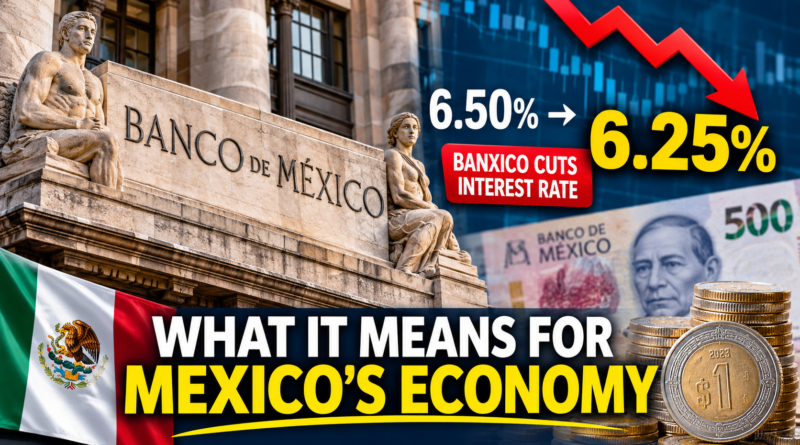
Bank of Mexico Cuts Interest Rate to 6.25% in Surprise 3–2 Decision: What It Means for Borrowers, Savers and the Peso
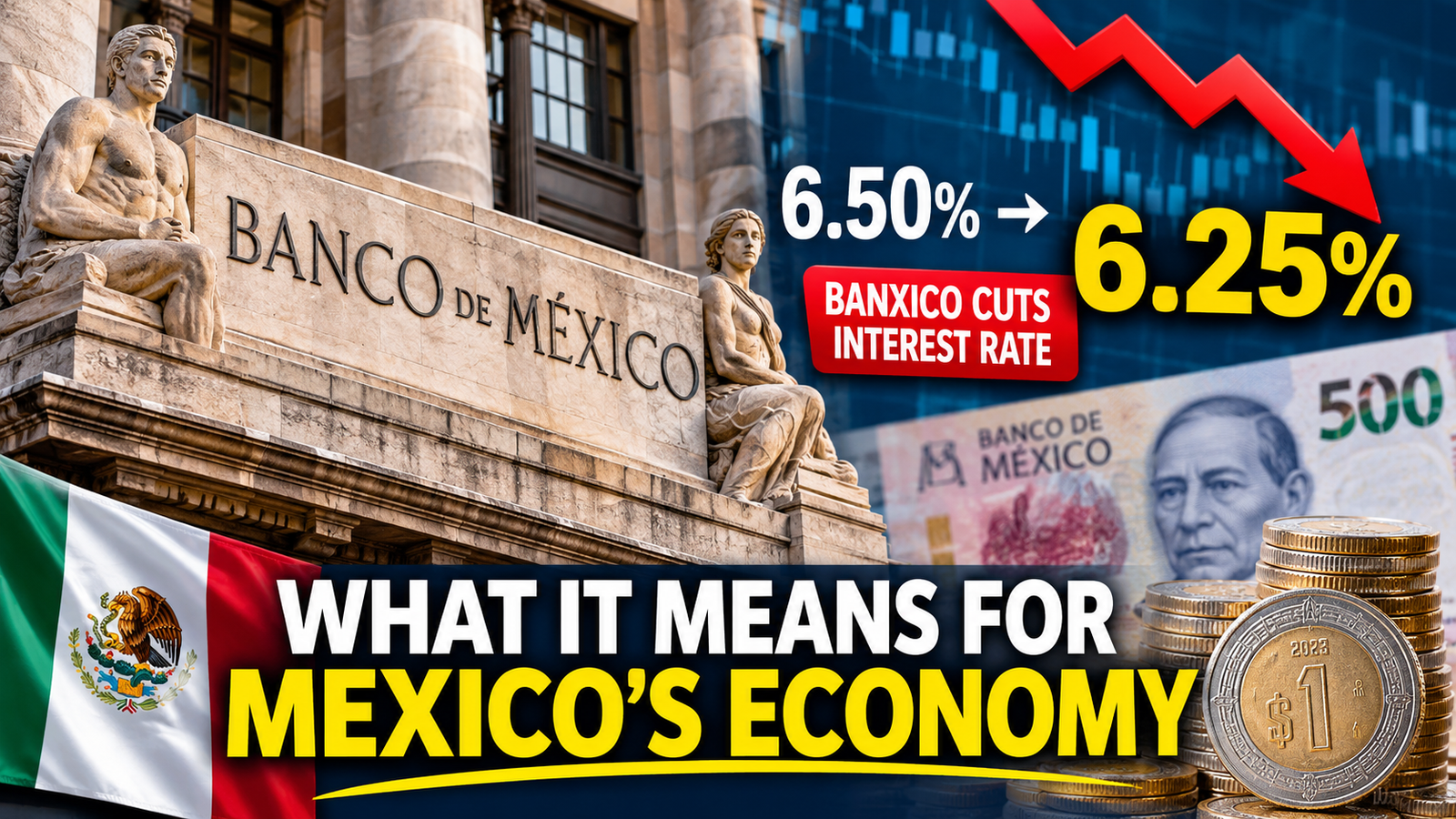
MEXICO CITY — November 6, 2026
Mexico’s central bank has delivered an unexpected interest-rate cut, lowering its benchmark rate by 25 basis points to 6.25% in a closely divided 3–2 decision. The move has drawn attention from financial markets because it came despite continuing inflation concerns and signals a difference of opinion among policymakers over the direction of monetary policy.
The decision by Banco de México, commonly known as Banxico, reduces the overnight interbank interest rate from 6.50% to 6.25%. Announced on November 5 and effective November 6, the reduction could influence borrowing costs, savings returns, business financing and the Mexican peso in the months ahead.
However, the decision should not automatically be interpreted as the beginning of an extended cycle of interest-rate cuts. The narrow vote and the central bank’s forward guidance suggest that policymakers remain cautious.
A Divided Central Bank Approves the Rate Cut
The 25-basis-point reduction was approved by a 3–2 vote, revealing a significant difference of opinion within Banxico’s governing board.
Governor Victoria Rodríguez Ceja and Deputy Governors José Gabriel Cuadra García and Omar Mejía Castelazo supported reducing the benchmark rate to 6.25%. Deputy Governors Galia Borja Gómez and Jonathan Heath preferred to leave the rate unchanged at 6.50%.
The split decision matters because interest-rate policy is not determined by economic growth alone. Central bankers must balance inflation, employment, domestic demand, exchange-rate movements and international financial conditions.
Supporters of the reduction appear to have judged that a modest adjustment was appropriate under the current economic conditions. The two members who preferred a hold reflected concerns that cutting rates while inflation remains above the central bank’s target could create additional risks.
The disagreement also gives investors an important signal: future decisions may depend heavily on incoming inflation data rather than following a predetermined path.
Why Did Banxico Cut Interest Rates?
Central banks generally reduce interest rates when they believe monetary conditions can be eased without undermining price stability.
Lower benchmark rates can make borrowing less expensive for households and companies. They may also encourage investment and consumption by reducing the cost of financing.
For Mexico, the challenge is finding the right balance between supporting economic activity and ensuring that inflation continues moving toward the central bank’s target.
Banxico has an inflation target of 3%, with a tolerance range around that level. Inflation remaining above the target makes monetary decisions particularly sensitive.
The central bank’s updated projections have also attracted attention. Its forecasts for headline and core inflation in the fourth quarter of 2026 were revised upward, according to reports following the announcement. The projected return of inflation to the 3% target has been pushed further into the future, with convergence expected in the fourth quarter of 2027.
That outlook explains why the rate reduction has been viewed as a cautious and potentially controversial decision.
What Does the 6.25% Interest Rate Mean for Mexican Borrowers?
For borrowers, a lower benchmark rate can eventually reduce the cost of some forms of credit. However, the effect is not necessarily immediate, and the reduction will not automatically lower every loan payment.
Banks and other lenders consider several factors when setting interest rates, including their own funding costs, customer credit histories, operating expenses and expectations about future inflation.
Personal loans
Consumers seeking personal loans may gradually benefit if lenders reduce their rates. People planning to borrow should compare the annual percentage rate, fees, repayment period and total cost of credit rather than relying only on the central bank’s announcement.
Credit cards
Credit-card interest rates do not necessarily fall immediately after a benchmark-rate reduction. Card issuers may adjust pricing according to their own policies and market conditions.
Consumers carrying high-interest balances should continue prioritising repayment and checking the terms of their existing agreements.
Mortgages
The effect on mortgage borrowers will depend on the type of mortgage they hold.
People with existing fixed-rate mortgages generally continue paying according to their original contracts. A central-bank rate reduction does not automatically change those payments.
New borrowers may encounter different mortgage offers over time, while variable-rate mortgage customers should check whether their contracts link payments to a benchmark that can change.
For homebuyers, the most important comparison remains the total borrowing cost, including interest, insurance, fees and other expenses.
What Could Happen to Savings Accounts and Deposits?
The rate reduction may also affect Mexican households that keep money in savings accounts, fixed-term deposits and other interest-bearing products.
When benchmark rates decline, financial institutions may eventually lower the returns offered on certain savings products. The timing and size of those adjustments vary between banks and account types.
For savers, this creates a reason to review deposit rates and compare available products.
A lower policy rate does not mean that every savings account will immediately pay less. Banks may maintain competitive offers to attract deposits, while some products may have fixed terms that protect the agreed return until maturity.
Consumers should also consider inflation. The real return on savings depends on the interest earned after accounting for the rise in prices.
The Mexican Peso Faces Another Important Test
The peso is one of the financial indicators investors will watch closely after Banxico’s decision.
Interest rates influence currency markets because international investors compare the returns available in different countries. When a central bank lowers rates, the difference between domestic and foreign interest rates can narrow.
If investors believe Mexican assets offer relatively less attractive returns, demand for peso-denominated investments could weaken. That may put pressure on the currency.
However, exchange rates are influenced by much more than interest-rate differences. Investor confidence, trade flows, foreign investment, economic growth, political developments and movements in the US dollar can all affect the peso.
The currency’s reaction should therefore be assessed alongside broader market conditions rather than attributed entirely to the central bank’s decision.
The United States Interest-Rate Gap Matters
Mexico’s monetary policy is closely watched in relation to the United States because the two economies are deeply connected through trade, investment and financial markets.
Changes in US interest rates can influence international capital flows and the relative attractiveness of Mexican assets.
If Mexican rates decline while US rates remain comparatively high, the interest-rate gap between the two countries may narrow. That could become a consideration for investors deciding where to allocate capital.
A weaker peso could also make imported goods more expensive for Mexican businesses and consumers. This is one reason currency movements remain important when assessing the inflation outlook.
Nevertheless, the relationship is not automatic. The peso can strengthen or weaken for reasons unrelated to the latest interest-rate decision.
Why Inflation Remains the Biggest Concern
The central bank’s main challenge is ensuring that inflation returns sustainably to its target.
Inflation affects household budgets through food, housing, transport, healthcare, energy and other essential expenses. Even when the overall inflation rate declines, families may continue experiencing pressure if prices remain high.
Core inflation is particularly important because it excludes certain volatile items and can provide information about underlying price pressures.
If core inflation remains persistent, policymakers may find it difficult to justify further reductions. If price pressures ease consistently, the central bank could have more room to adjust monetary policy.
The upward revisions to some inflation projections therefore make the latest cut more complicated. Investors will want to understand why policymakers considered a reduction appropriate despite the revised outlook.
Businesses Could Benefit, but the Impact Will Take Time
Mexican companies may welcome lower interest rates because financing is an important part of business operations.
Manufacturers, retailers, construction companies and smaller businesses often rely on credit to purchase equipment, maintain inventories, pay suppliers and expand operations.
Lower borrowing costs can improve the economics of new projects and reduce financial pressure on companies with variable-rate debt.
Small and medium-sized businesses could benefit if commercial lenders gradually pass on the lower policy rate.
However, access to credit remains a separate challenge. Banks may continue applying strict lending standards, particularly for businesses with limited financial records or weak cash flows.
Companies should also consider exchange-rate risks. Businesses that depend on imported materials or equipment could face higher costs if the peso weakens.
Investors Will Watch Banxico’s Next Signals
The 3–2 vote makes the central bank’s next communications especially important.
Investors will be looking for evidence that the latest reduction was intended as a one-time adjustment or whether additional cuts could follow.
Banxico’s guidance has indicated a cautious approach, with expectations of maintaining the rate at 6.25% for an extended period. That suggests policymakers are not necessarily committing to a rapid sequence of reductions.
The distinction is important for financial markets. A central bank that cuts rates and signals an extended pause sends a different message from one that is preparing to reduce rates at every upcoming meeting.
The next decisions are likely to depend on inflation, economic activity, wage developments, currency movements and international financial conditions.
What Mexican Households Should Do Now
For ordinary households, the latest decision is a reason to review financial plans rather than make sudden changes.
Borrowers should compare loan offers and check whether existing agreements contain variable interest rates. People with credit-card debt should pay attention to interest charges and avoid assuming that their borrowing costs will fall automatically.
Savers should compare deposit products, including their interest rates, maturity periods, withdrawal conditions and fees.
Families considering a major purchase should calculate the full cost of financing and make sure repayments remain affordable if interest rates do not decline further.
Businesses should review financing arrangements and assess their exposure to currency fluctuations, particularly if they import goods or have debt denominated in foreign currencies.
What Happens Next?
The immediate question for financial markets is whether the 6.25% rate will remain in place for an extended period or whether new economic data will prompt another adjustment.
Several indicators will be important:
- Inflation: Whether headline and core inflation move consistently toward the 3% target.
- Economic growth: Whether domestic demand and business activity show signs of weakness or resilience.
- The peso: Whether currency movements create additional inflation risks.
- US monetary policy: Whether changes in American interest rates affect capital flows and the peso.
- Wages and employment: Whether labour-market conditions contribute to persistent price pressures.
The central bank will need to evaluate these developments before deciding whether another rate change is justified.
Conclusion: A Small Cut With Significant Market Implications
Banco de México’s decision to reduce its benchmark interest rate to 6.25% is a significant development for Mexico’s economy. Although the reduction is only 25 basis points, the closely divided 3–2 vote highlights the uncertainty surrounding the country’s inflation outlook.
Borrowers may eventually benefit from lower financing costs, while savers could face reduced returns on some products. Businesses may find credit conditions more favourable, but currency movements and inflation risks remain important considerations.
For investors, the central message is caution. The decision does not guarantee a weaker peso, cheaper loans or another round of rate cuts. Those outcomes will depend on economic data, banking decisions and global financial conditions.
Mexico’s next monetary-policy decisions will show whether the November reduction marks a limited adjustment or the beginning of a broader shift. Until then, households, businesses and investors will be watching inflation and the peso for signs of what comes next.
Editorial note: This article is for general news and informational purposes. Interest-rate changes do not guarantee specific movements in loan costs, savings returns, exchange rates or investment values. Readers should review the terms of individual financial products before making decisions.
