
SEPTEMBER 2026 MARKET OUTLOOK: FED, $100 OIL AND 5% TREASURY YIELDS PUT WALL STREET AT A CROSSROADS
September 12, 2026
EXECUTIVE SUMMARY
Wall Street enters the middle of September at a major crossroads.

U.S. stocks recovered on Friday, September 11, after suffering four consecutive losing sessions. The S&P 500 rose 0.86% to 7,656.98, the Nasdaq Composite gained 0.96% to 26,333.04, the Dow Jones Industrial Average advanced 0.98% to 52,573.29, and the Russell 2000 gained about 0.45% to 2,903.94.
But the rebound did not erase the week’s damage.
For the week, the S&P 500 fell about 0.8%, the Dow dropped 1.6%, the Nasdaq declined 0.7%, and the Russell 2000 lost approximately 2.4%.
The central question now is not simply whether stocks can rebound.
The bigger question is:
CAN WALL STREET HANDLE HIGHER OIL, HIGHER TREASURY YIELDS AND A POSSIBLE FEDERAL RESERVE RATE HIKE AT THE SAME TIME?
That question will dominate markets as the Federal Open Market Committee meets on September 15–16, 2026.
Markets have increasingly priced in a quarter-point rate increase. Recent reports put the implied probability in the mid-to-high 80% range. But a rate hike is still not officially confirmed until the Federal Reserve announces its decision.
At the same time, oil remains above $100 a barrel, inflation remains above the Federal Reserve’s 2% objective, and the 10-year Treasury yield has moved close to 5%.
This combination creates a difficult environment for investors.
OUR SEPTEMBER 2026 MARKET OUTLOOK: CAUTIOUSLY NEUTRAL WITH HIGH VOLATILITY.
FRIDAY’S WALL STREET REBOUND
Friday brought some relief after one of the toughest stretches of the month.
The decline in crude oil prices helped calm some inflation fears, while investors also interpreted the latest inflation report as largely consistent with expectations.
SEPTEMBER 11, 2026 U.S. MARKET CLOSE
| INDEX | SEPTEMBER 11 CLOSE | DAILY MOVE | WEEKLY MOVE |
|---|---|---|---|
| S&P 500 | 7,656.98 | +0.86% | -0.8% |
| DOW JONES | 52,573.29 | +0.98% | -1.6% |
| NASDAQ COMPOSITE | 26,333.04 | +0.96% | -0.7% |
| RUSSELL 2000 | 2,903.94 | +0.45% | -2.4% |
If you want the full heading in ALL CAPS, use:
SEPTEMBER 11, 2026 U.S. MARKET CLOSE
The verified closing figures were S&P 500 7,656.98, Dow Jones 52,573.29, Nasdaq 26,333.04, and Russell 2000 2,903.94. (apnews.com)
TABLE CAPTION: WALL STREET REBOUNDED ON SEPTEMBER 11, BUT ALL FOUR MAJOR U.S. INDEXES STILL FINISHED THE WEEK LOWER.
The Friday rebound is important because it shows investors are still willing to buy stocks when oil and bond-market pressure temporarily ease.
But it does not yet prove that the market has entered a new sustained rally.
WHY SEPTEMBER HAS BECOME SO IMPORTANT
Several major economic forces are now moving at the same time.
INFLATION
OIL
TREASURY YIELDS
FEDERAL RESERVE POLICY
CORPORATE EARNINGS
AI INVESTMENT
GEOPOLITICAL RISK
These forces can push markets in opposite directions.
Strong corporate earnings and AI investment can support stocks.
Higher oil prices and Treasury yields can pressure them.
A Fed rate hike could create additional volatility.
This is why September’s market environment is better described as a high-volatility policy market rather than a straightforward bull or bear market.
THE FED IS THE BIGGEST EVENT NEXT WEEK
The Federal Reserve’s next FOMC meeting is scheduled for September 15–16.
Investors will focus on three things:
1. THE INTEREST-RATE DECISION
Will the Fed raise rates by 25 basis points?
2. THE FED’S POLICY STATEMENT
What will policymakers say about inflation, employment and economic growth?
3. THE CHAIR’S PRESS CONFERENCE
Will the Fed signal another rate increase later in 2026, or suggest that the September move could be a one-time adjustment?
The third question may be the most important for Wall Street.
A rate hike that was already expected may produce only a limited market reaction.
A hawkish message about additional increases could produce a much larger reaction.
INFLATION REMAINS THE CORE PROBLEM
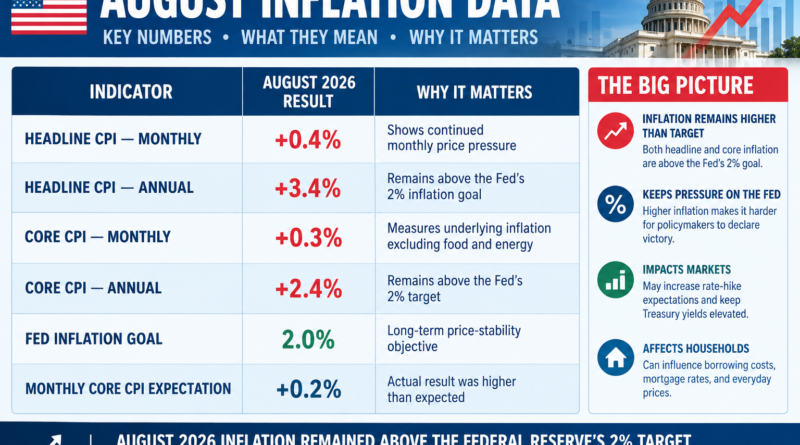
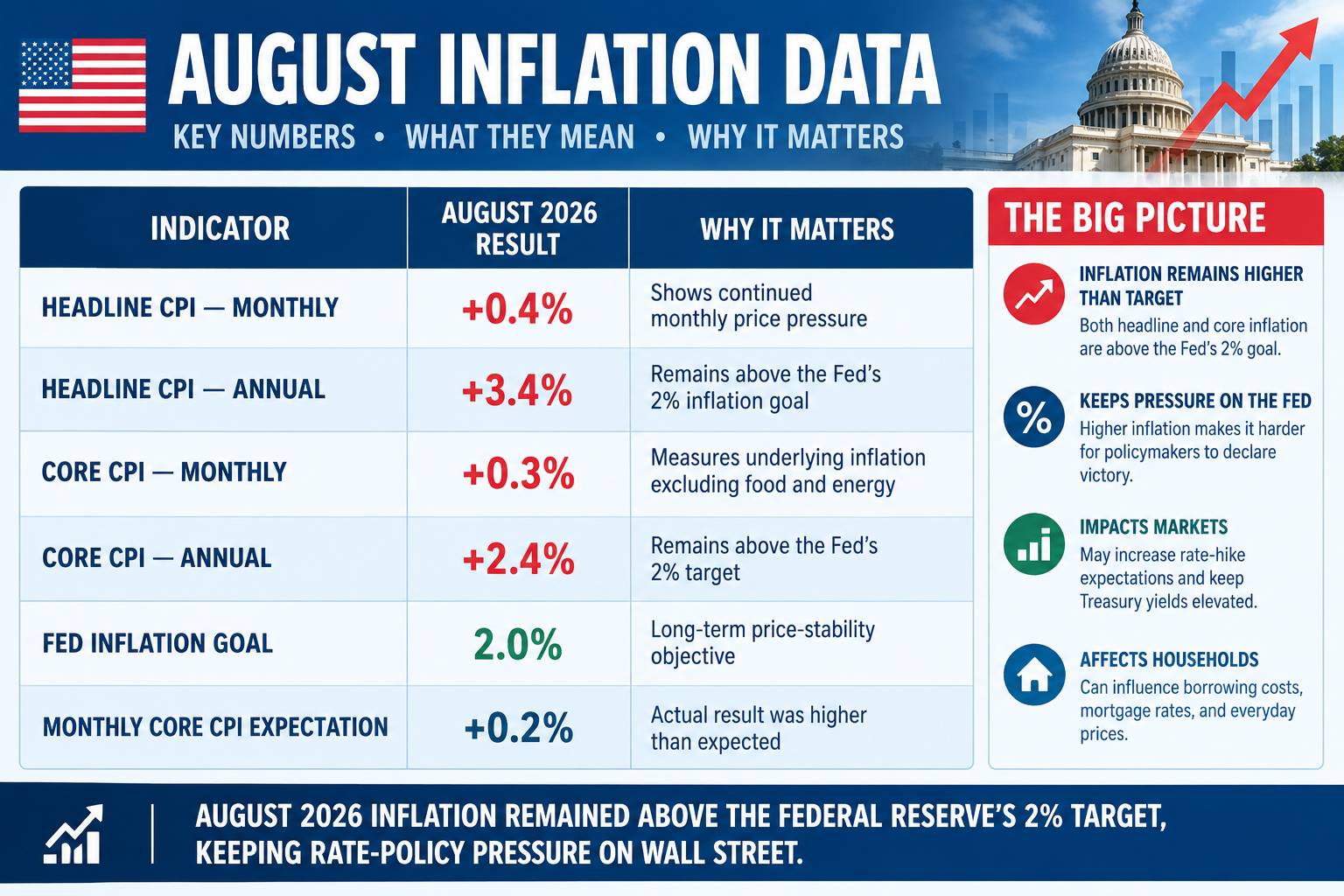
August inflation data gave the Federal Reserve another reason to remain cautious.
Headline consumer prices increased 0.4% from the previous month and 3.4% from a year earlier.
Core CPI increased 0.3% month over month and 2.4% year over year.
The problem for policymakers is straightforward.
Inflation remains above the Fed’s 2% long-term objective.
That does not automatically mean rates must rise.
But it makes it harder for the Fed to declare victory over inflation.
AUGUST INFLATION DATA
| INDICATOR | AUGUST 2026 RESULT | MARKET SIGNIFICANCE |
|---|---|---|
| HEADLINE CPI MONTHLY | +0.4% | Continued monthly inflation |
| HEADLINE CPI ANNUAL | +3.4% | Above the Fed’s 2% goal |
| CORE CPI MONTHLY | +0.3% | Underlying price pressure |
| CORE CPI ANNUAL | +2.4% | Still above target |
| FED LONG-RUN INFLATION GOAL | 2% | Policy benchmark |
The latest numbers help explain why markets have increased expectations for another rate increase.
| INDICATOR | AUGUST 2026 RESULT | WHY IT MATTERS |
|---|---|---|
| HEADLINE CPI — MONTHLY | +0.4% | Shows continued monthly price pressure |
| HEADLINE CPI — ANNUAL | +3.4% | Remains above the Fed’s 2% inflation goal |
| CORE CPI — MONTHLY | +0.3% | Measures underlying inflation excluding food and energy |
| CORE CPI — ANNUAL | +2.4% | Remains above the Fed’s 2% target |
| FED INFLATION GOAL | 2.0% | Long-term price-stability objective |
| MONTHLY CORE CPI EXPECTATION | +0.2% | Actual result was higher than expected |
$100 OIL IS THE OTHER BIG PROBLEM
Oil has become one of the most important variables in the September market outlook.
Brent crude recently moved above $100 a barrel, while WTI also traded around or above the $100 level.
On September 11, oil pulled back from its recent highs, helping stocks recover.
But the weekly increase remained substantial.
Reuters reported that oil had still gained sharply over the week despite Friday’s decline.
This matters because oil is not just an energy-market story.
It affects the entire economy.
OIL → GASOLINE → TRANSPORTATION → BUSINESS COSTS → CONSUMER PRICES → INFLATION
Higher gasoline prices can reduce household purchasing power.
Higher transportation costs can increase the cost of moving goods.
Higher energy costs can pressure manufacturers.
Airlines face higher fuel expenses.
Trucking companies face higher diesel costs.
Farmers face higher operating expenses.
Retailers may face higher shipping costs.
Eventually, some businesses may pass those costs to consumers.
THE OIL-INFLATION-FED CONNECTION
The current market environment can be understood through a simple chain:
HIGHER OIL PRICES
↓
HIGHER ENERGY COSTS
↓
HIGHER INFLATION PRESSURE
↓
HIGHER TREASURY YIELDS
↓
HIGHER FED RATE EXPECTATIONS
↓
HIGHER BORROWING COSTS
↓
PRESSURE ON STOCK VALUATIONS
This chain is not automatic.
But it explains why Wall Street is watching crude oil so closely.
If oil falls significantly, inflation fears could ease.
If oil moves substantially higher again, investors may become more concerned that inflation will remain elevated.
THE 10-YEAR TREASURY YIELD IS NEAR 5%
The Treasury market is sending another important signal.
The 10-year Treasury yield moved close to 5% during the week, reaching levels not seen since 2023 according to recent market reporting. On September 11, the 10-year yield remained around the high-4% range.
The 30-year Treasury yield also remained above 5%.
KEY MARKET LEVELS
| MARKET | RECENT LEVEL | WHY INVESTORS CARE |
|---|---|---|
| 10-YEAR TREASURY | NEAR 5% | Influences borrowing costs and stock valuations |
| 30-YEAR TREASURY | ABOVE 5% | Important for mortgages and long-term financing |
| BRENT CRUDE | ABOVE $100 | Inflation and energy-cost risk |
| WTI CRUDE | AROUND $100+ | U.S. gasoline and energy-cost pressure |
| VIX | MID-TEENS | Measure of expected stock-market volatility |
TABLE CAPTION: KEY MARKET SIGNALS INVESTORS ARE WATCHING AS THE FED MEETING APPROACHES.
WHY HIGH TREASURY YIELDS MATTER FOR STOCKS
Stocks compete with bonds for investor capital.
When Treasury yields rise, bonds can become more attractive relative to stocks.
Higher yields can also increase the discount rate used to value future corporate earnings.
This can create particular pressure on growth companies.
For example, a technology company expected to produce large profits many years in the future can become less attractive mathematically when interest rates rise.
That does not mean technology stocks must fall.
It means valuations become more sensitive to interest rates.
NASDAQ AND AI STOCKS FACE A KEY TEST
The technology sector has been one of the major engines of the 2026 market.
Artificial intelligence investment continues to drive spending on:
- Data centers
- Advanced semiconductors
- Cloud computing
- Networking
- Software
- Power infrastructure
- AI systems
That creates a powerful growth story.
But high-growth companies can also be sensitive to rising yields.
During the recent sell-off, major chip stocks came under pressure as oil prices surged and Treasury yields increased. Reuters reported that Nvidia fell 2.3% and Micron dropped 4.7% on September 10.
The question for investors is whether AI earnings growth can remain strong enough to offset higher financing costs and valuation pressure.
SMALL-CAP STOCKS MAY FACE MORE PRESSURE
The Russell 2000 has been weaker than the large-cap indexes during the recent pullback.
That matters.
Small companies often have greater exposure to financing conditions.
When borrowing costs rise, smaller businesses may have less flexibility than large corporations with substantial cash reserves.
That can affect:
DEBT COSTS
CAPITAL INVESTMENT
HIRING
EXPANSION
PROFIT MARGINS
This is one reason the Russell 2000 should remain on the September watch list.
COULD THE FED RATE HIKE ACTUALLY HELP STOCKS?
This is one of the most interesting questions facing investors.
At first glance, a rate hike sounds bearish.
But markets do not react only to the direction of interest rates.
They react to expectations.
If investors already expect a quarter-point increase, the actual hike may not be a major surprise.
In fact, a clear and decisive Fed decision could reduce uncertainty.
Some market strategists have argued that a hike could restore confidence in the Fed’s willingness to fight inflation and potentially stabilize bond markets.
That creates an unusual possibility:
A RATE HIKE COULD BE NEGATIVE FOR STOCKS INITIALLY BUT POSITIVE FOR MARKET CONFIDENCE IF IT RESTORES POLICY CREDIBILITY.
THREE POSSIBLE FED SCENARIOS
SCENARIO 1: RATE HIKE + CALM GUIDANCE
The Fed raises rates by 25 basis points but signals that inflation should gradually cool.
POSSIBLE MARKET RESPONSE:
BULLISH TO MIXED
Stocks could recover because uncertainty has been removed.
SCENARIO 2: RATE HIKE + HAWKISH GUIDANCE
The Fed raises rates and signals that another increase may be necessary.
POSSIBLE MARKET RESPONSE:
BEARISH / HIGH VOLATILITY
Treasury yields could rise further.
Growth stocks could face pressure.
The dollar could strengthen.
SCENARIO 3: NO RATE HIKE + INFLATION CONCERNS
The Fed keeps rates unchanged but acknowledges that inflation remains a serious concern.
POSSIBLE MARKET RESPONSE:
MIXED / VOLATILE
Stocks might initially celebrate the lack of a hike, but investors could become nervous if the Fed signals that a future increase remains possible.
SEPTEMBER 2026 MARKET OUTLOOK DATA TABLE
| DRIVER | CURRENT SIGNAL | POTENTIAL MARKET EFFECT |
|---|---|---|
| FED POLICY | Hike increasingly expected | Higher volatility |
| INFLATION | Above 2% target | Pressure for tighter policy |
| OIL | Above $100 | Inflation risk |
| 10-YEAR YIELD | Near 5% | Valuation pressure |
| AI INVESTMENT | Strong | Supports technology stocks |
| CORPORATE EARNINGS | Major support | Bullish |
| GEOPOLITICAL RISK | Elevated | Risk-off potential |
| SMALL CAPS | Under pressure | Financing concerns |
| GOLD | Elevated | Safe-haven demand |
| DOLLAR | Rate-sensitive | Could benefit from higher rates |
TABLE CAPTION: THE MAJOR FORCES THAT COULD DETERMINE WALL STREET’S DIRECTION DURING THE REST OF SEPTEMBER 2026.
WHAT COULD MAKE WALL STREET BULLISH?
The September outlook could improve significantly if several things happen together.
BULLISH CATALYSTS
OIL PRICES FALL
TREASURY YIELDS STABILIZE
INFLATION CONTINUES COOLING
FED SIGNALS LIMITED ADDITIONAL TIGHTENING
CORPORATE EARNINGS REMAIN STRONG
AI INVESTMENT CONTINUES
GEOPOLITICAL RISKS EASE
If these conditions develop, investors could move back toward risk assets.
The Friday rebound demonstrated how quickly sentiment can improve when oil prices decline and market uncertainty eases.
WHAT COULD MAKE THE MARKET BEARISH?
The opposite combination would be much more dangerous.
BEARISH RISKS
OIL MOVES SHARPLY ABOVE $110
10-YEAR TREASURY YIELD BREAKS ABOVE 5%
INFLATION ACCELERATES AGAIN
FED SIGNALS MULTIPLE RATE HIKES
CORPORATE EARNINGS WEAKEN
AI VALUATIONS CONTRACT
GEOPOLITICAL CONDITIONS DETERIORATE
A combination of these factors could create a broader risk-off environment.
WHAT DOES THIS MEAN FOR AMERICAN HOUSEHOLDS?
The September market story is not only about investors.
Higher interest rates can affect everyday Americans.
CREDIT CARDS
Variable-rate credit-card balances can become more expensive.
MORTGAGES
Mortgage rates are influenced by broader bond-market conditions and may remain elevated if Treasury yields remain high.
AUTO LOANS
Higher financing costs can increase monthly vehicle payments.
SAVINGS
Savers may benefit from higher yields on certain interest-bearing products.
SMALL BUSINESSES
Higher borrowing costs can make expansion and investment more expensive.
GASOLINE
Higher crude oil prices can eventually increase fuel costs.
The important lesson is that monetary policy reaches households through many different channels.
GOLD COULD REMAIN IMPORTANT
Gold is another market worth watching during this period.
Higher Treasury yields can create pressure on gold because gold does not pay interest.
But gold also benefits from uncertainty, inflation concerns and geopolitical risk.
That means gold can rise even while the Fed is preparing to raise rates.
This is exactly why investors should avoid simplistic market rules.
FED HIKE DOES NOT AUTOMATICALLY MEAN GOLD FALLS.
The market reaction depends on the dollar, real yields, inflation expectations, geopolitical risk and investor demand.
WHAT INVESTORS SHOULD WATCH NEXT WEEK
The following indicators could determine whether the Friday rebound develops into a larger recovery.
1. BRENT CRUDE
If oil remains above $100, inflation concerns may remain strong.
2. 10-YEAR TREASURY YIELD
A sustained move toward or above 5% would be important for stock valuations.
3. FED RATE DECISION
The September 16 decision will be the week’s central event.
4. FEDERAL RESERVE GUIDANCE
The future path of rates could matter more than the immediate move.
5. NASDAQ
Technology stocks remain sensitive to Treasury yields.
6. RUSSELL 2000
Small caps can provide an important signal about financing conditions.
7. GOLD
Gold can reveal how investors are responding to inflation and geopolitical risk.
8. U.S. DOLLAR
Currency strength can affect commodities and multinational companies.
IMPORTANT LEVELS FOR WALL STREET
Investors should not treat these levels as guaranteed support or resistance.
They are simply useful reference points based on the latest market structure.
| MARKET | REFERENCE LEVEL |
|---|---|
| S&P 500 | 7,650 AREA |
| NASDAQ COMPOSITE | 26,300 AREA |
| DOW JONES | 52,500 AREA |
| RUSSELL 2000 | 2,900 AREA |
| 10-YEAR TREASURY | 5% WATCH LEVEL |
| BRENT CRUDE | $100 WATCH LEVEL |
| WTI CRUDE | $100 WATCH LEVEL |
TABLE CAPTION: REFERENCE LEVELS FOR INVESTORS MONITORING THE SEPTEMBER 2026 MARKET.
SEPTEMBER MARKET OUTLOOK: BULLISH OR BEARISH?
The answer is:
NEITHER EXTREME.
The current environment is best described as:
CAUTIOUSLY NEUTRAL — HIGH VOLATILITY
The bull case remains alive.
Corporate earnings are providing support.
AI investment remains powerful.
The U.S. economy has not entered a clear recession.
Stocks remain above their earlier-year levels.
But the bear risks have increased.
Oil is high.
Inflation remains above target.
Treasury yields are near 5%.
The Federal Reserve may tighten policy.
Small caps are under pressure.
Geopolitical uncertainty remains elevated.
That combination makes September a month where investors need to expect sharp moves in both directions.
THE BIGGEST MARKET QUESTION
The biggest question is no longer simply:
“WILL THE FED RAISE RATES?”
The bigger question is:
“WHAT WILL THE FED DO AFTER SEPTEMBER?”
If September is a one-time adjustment, markets could eventually stabilize.
If it becomes the beginning of another tightening cycle, valuations may face more pressure.
That distinction could determine whether the September correction becomes a temporary pullback or the beginning of a deeper market adjustment.
THE WALL STREET CONNECTION
The entire September market story can be summarized in one chain:
OIL
↓
INFLATION
↓
FED POLICY
↓
TREASURY YIELDS
↓
STOCK VALUATIONS
↓
HOUSEHOLD BORROWING COSTS
↓
ECONOMIC GROWTH
This is why investors should not look at the S&P 500 in isolation.
The stock market is connected to the bond market.
The bond market is connected to inflation.
Inflation is connected to energy prices.
And monetary policy sits at the center of the system.
BOTTOM LINE
September 2026 has become a critical month for Wall Street.
The U.S. stock market remains fundamentally supported by corporate earnings and powerful investment themes such as artificial intelligence.
But the market is facing a difficult combination of higher oil prices, persistent inflation, elevated Treasury yields and a possible Federal Reserve rate increase.
Friday’s rebound was encouraging.
The S&P 500, Dow Jones, Nasdaq and Russell 2000 all finished higher on September 11, breaking the four-day losing streak.
But the weekly losses show that investors remain cautious.
The next major test comes on September 15–16 when the Federal Reserve meets.
A quarter-point hike is increasingly expected by financial markets, but investors should remember:
MARKET EXPECTATIONS ARE NOT THE SAME AS AN OFFICIAL FEDERAL RESERVE DECISION.
The reaction will depend heavily on what comes next.
If oil falls, Treasury yields stabilize and the Fed signals limited additional tightening, Wall Street could regain momentum.
If oil rises again, Treasury yields break decisively above 5%, and the Fed signals more hikes, stocks could face another period of pressure.
For now, the most reasonable September outlook is:
CAUTIOUSLY NEUTRAL — WITH HIGH VOLATILITY
The market is not broken.
The bull market is not automatically over.
But the easy environment of falling-rate expectations is no longer the story.
Investors now have to deal with a more complicated equation:
$100+ OIL + ABOVE-TARGET INFLATION + NEAR-5% TREASURY YIELDS + FED POLICY UNCERTAINTY.
That is the September 2026 market challenge.
WHAT INVESTORS SHOULD WATCH
FEDERAL RESERVE RATE DECISION
10-YEAR TREASURY YIELD
BRENT AND WTI CRUDE
AUGUST INFLATION DATA
S&P 500
NASDAQ
RUSSELL 2000
GOLD
U.S. DOLLAR
CORPORATE EARNINGS
AI INVESTMENT
GEOPOLITICAL DEVELOPMENTS
The direction of these markets over the next several weeks could determine whether September ends as a temporary correction or becomes a much larger test for Wall Street.
NEW YORK FINANCE THINK WILL CONTINUE TO TRACK THE FEDERAL RESERVE, WALL STREET, OIL, TREASURY YIELDS, INFLATION, GOLD AND THE U.S. ECONOMY THROUGHOUT SEPTEMBER 2026.
OFFICIAL AND PRIMARY SOURCES
Federal Reserve — Monetary Policy
Federal Reserve Monetary Policy
Federal Reserve — September 2026 Meeting Calendar
Federal Reserve September 2026 Calendar
U.S. Bureau of Labor Statistics — Consumer Price Index
Bureau of Labor Statistics CPI
U.S. Treasury
U.S. Department of the Treasury
CME Group — U.S. Treasury Futures
U.S. Energy Information Administration
U.S. Energy Information Administration
Reuters — September 11 Wall Street Market Report
Reuters Wall Street Market Report
Associated Press — September 11 U.S. Market Close
Associated Press U.S. Market Close
IMPORTANT INVESTMENT DISCLAIMER
This article is for news, educational and informational purposes only. It is not personalized investment, financial, tax or legal advice.
Financial markets can move rapidly and unexpectedly. Past market performance does not guarantee future results. Investors should conduct their own research and consider their individual financial circumstances and risk tolerance before making investment decisions.
NEW YORK FINANCE THINK DOES NOT GUARANTEE ANY MARKET FORECAST OR INVESTMENT OUTCOME.