
Crude Oil Catches Fire : How Saudi Arabia, Libya, Yemen and Iran Risks Are Shaking America
By New York Finance Think | U.S. Markets & Energy
September 15, 2026
Crude Oil Is Catching Fire Again
NEW YORK — Crude oil is back at the center of the U.S. market story.
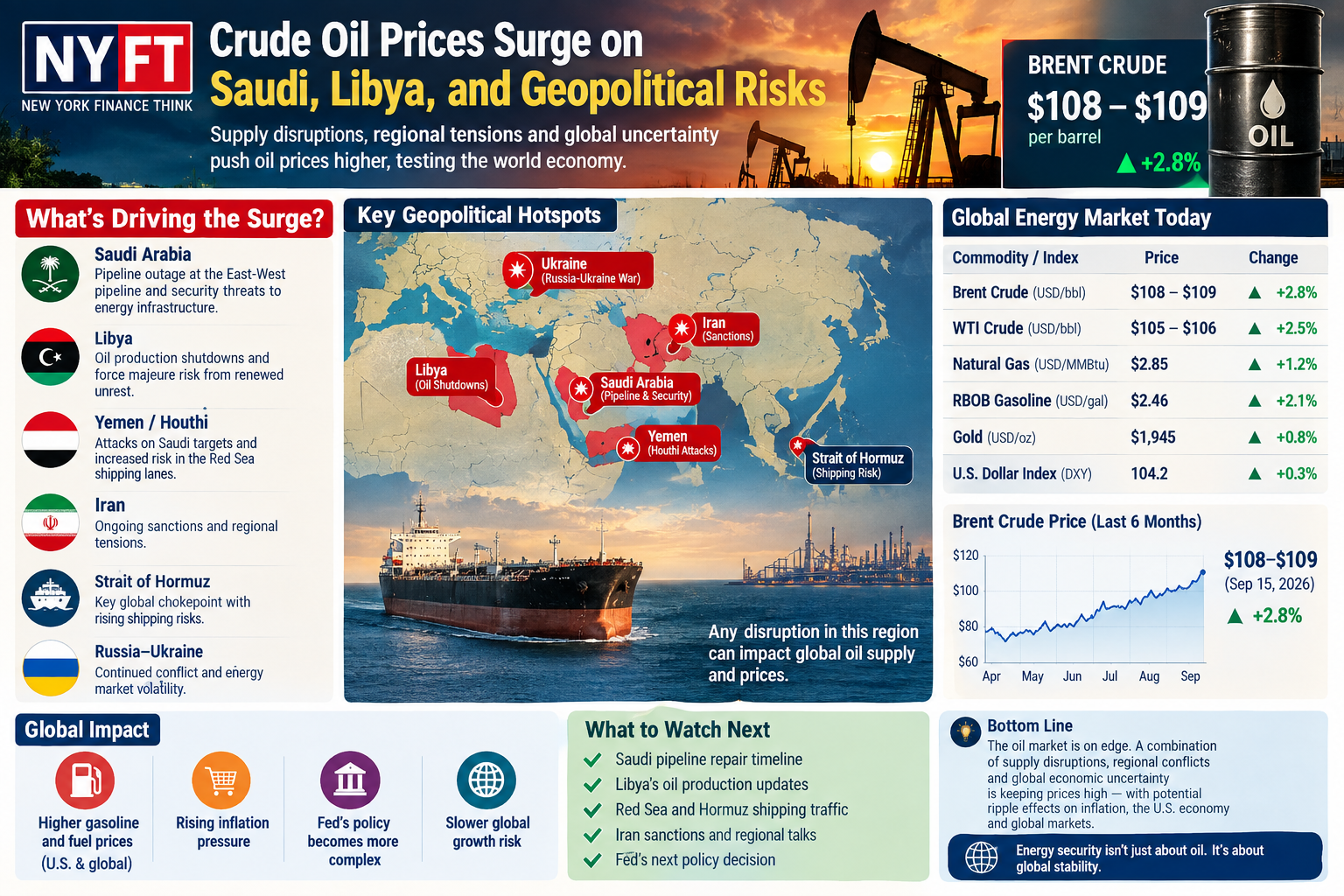
Brent crude climbed to around $109.20 a barrel, while U.S. West Texas Intermediate (WTI) crude reached about $106.46, as investors reacted to a growing list of disruptions across major oil-producing and oil-transport regions. Reuters reported that Brent gained about 3.3% and WTI roughly 5% during Tuesday trading, putting both benchmarks near their highest closing levels in almost four months.
This is no longer simply a story about oil traders.
For Americans, higher crude prices can eventually affect gasoline, diesel, transportation, food distribution, manufacturing and household budgets.
For Wall Street, the concern is even broader:
Oil shock → Inflation risk → Treasury yields → Fed pressure → Stock-market pressure.
That chain is now back in focus.
Oil Market Data: September 15, 2026
| Market | Latest Reported Level | Move | What It Means |
|---|---|---|---|
| Brent Crude | $109.20/barrel | +3.3% | Global oil benchmark under supply pressure |
| WTI Crude | $106.46/barrel | +5.0% | U.S. crude surging |
| Brent vs. $100 | +$9.20 | — | Above major psychological level |
| WTI vs. $100 | +$6.46 | — | Higher U.S. energy-cost risk |
| Saudi Oil Supply | Disrupted | — | Major global supply concern |
| Libya Oil Output | Multiple fields suspended | — | Additional supply pressure |
Prices are based on Reuters’ latest September 15 report and can change rapidly during trading.
Why Is Crude Oil Rising So Fast?
There is no single reason.
The current oil surge is the result of multiple supply risks arriving at the same time.
1. Saudi Arabia’s East-West Pipeline Was Hit
One of the biggest developments is the disruption to Saudi Arabia’s East-West Pipeline.
The pipeline is strategically important because it allows Saudi crude to move from the kingdom’s oil-producing region toward the Red Sea, providing an alternative route to shipping through the Persian Gulf.
After attacks linked to Iran-backed Houthi forces, the pipeline was shut down.
That immediately raised a basic market question:
How much Saudi oil can still reach global buyers, and how quickly?
Reuters reported that the disruption could affect a significant portion of global supply if the shutdown continues.
For oil traders, even the possibility of losing supply can be enough to push prices higher.
2. Saudi Arabia’s Yanbu Oil Loadings Were Suspended
The problem became more serious Tuesday.
Shipping-industry sources told Reuters that oil loadings at Saudi Arabia’s Yanbu export terminal were suspended.
Saudi Arabia also reportedly informed some European customers that late-September crude cargoes would be canceled.
That matters because Europe may have to search for replacement barrels.
And where could some of that replacement crude come from?
The United States.
Reuters reported that expectations of stronger U.S. crude demand helped support WTI prices.
This creates an unusual market dynamic:
Saudi supply falls → Europe searches for replacement crude → U.S. crude becomes more valuable → WTI rises.
3. Houthi Attacks Are Adding Another Layer of Risk
The Yemen-based Houthi movement has become another major factor in the oil market.
Iran-backed Houthi forces have launched fresh attacks against Saudi Arabia, adding to concerns about the security of oil infrastructure and shipping routes.
The risk is not limited to one pipeline.
The broader concern is that conflict could threaten Red Sea shipping and the Bab el-Mandeb corridor, an important route for global commerce and energy transportation.
Reuters reported that the latest attacks have increased fears that damage to energy infrastructure and transport routes could take longer to repair.
For oil markets, geography matters.
When a major shipping route becomes dangerous, ships can be forced to take longer routes.
That increases:
- Shipping costs
- Insurance costs
- Delivery times
- Fuel consumption
- Supply uncertainty
All of those factors can eventually become part of the price consumers pay.
4. Libya Has Added Another Supply Shock
Saudi Arabia is not the only problem.
In Libya, protests involving the Petroleum Facilities Guard resulted in the closure of a valve on the Hamada-Zawiya crude-loading pipeline.
The disruption forced production to stop at several oil fields, including Hamada, Tahara and NC5.
Libya’s National Oil Corporation warned that it could declare force majeure if the disruption continues or spreads to additional facilities.
The stakes are high for Libya because oil is the country’s dominant source of economic revenue.
The NOC said oil accounts for roughly 90% of Libya’s economy.
So the world is watching another major oil producer lose production at the same time that Saudi supply is under pressure.
5. Iran and Gulf Tensions Are Keeping Traders Nervous
The oil market is also watching the relationship between Iran and the Gulf Arab states.
Planned discussions related to maritime safety and regional tensions were postponed.
That matters because traders are not simply pricing today’s supply.
They are pricing the possibility of tomorrow’s disruption.
If diplomacy reduces the risk, oil could fall quickly.
If tensions worsen, traders could add an even larger geopolitical premium to crude.
This is one reason oil markets can move violently during geopolitical crises.
6. The Strait of Hormuz Remains a Critical Risk
One of the biggest questions hanging over the global energy market is the Strait of Hormuz.
The narrow waterway is one of the world’s most important energy chokepoints.
Any major disruption there could have consequences far beyond Saudi Arabia, Yemen or Iran.
That is why traders are watching shipping activity and regional military developments so closely.
The market does not need the entire Strait to close before prices rise.
Even a significant reduction in shipping can increase:
Risk → Insurance costs → Freight rates → Delivery costs → Oil prices.
7. Russia and Ukraine Are Also Hitting Energy Infrastructure
The oil story is not limited to the Middle East.
Russia and Ukraine continue to target energy infrastructure despite diplomatic efforts aimed at reducing the conflict.
Reuters reported that both sides continued strikes involving energy assets.
That creates another source of uncertainty for global energy markets.
The world is therefore dealing with multiple energy risks at once:
Middle East + Saudi Arabia + Yemen + Libya + Russia + Ukraine.
That combination is particularly uncomfortable for energy consumers.
The U.S. Is Feeling the Pressure
Why should an American family care if Brent crude is $109?
Because crude oil sits underneath a huge portion of the modern economy.
Oil affects:
- Gasoline
- Diesel
- Trucking
- Airlines
- Shipping
- Agriculture
- Plastics
- Chemicals
- Manufacturing
- Construction
- Retail distribution
A truck does not move goods for free.
An airline does not fly without fuel.
A farmer cannot operate machinery without diesel.
A manufacturer cannot transport raw materials without energy.
That is why a sustained oil shock can spread throughout the economy.
The Gasoline Effect
The first thing many Americans notice is the gas pump.
But crude oil does not move directly from a futures exchange into a gasoline station.
The transmission process takes time.
A simplified chain looks like this:
Crude Oil Rises
↓
Refinery Costs and Wholesale Fuel Prices Rise
↓
Gasoline/Diesel Prices Increase
↓
Transportation Costs Increase
↓
Business Costs Increase
↓
Consumer Prices Can Rise
The important word is “can.”
A $10 increase in crude does not automatically mean gasoline rises by a specific amount overnight.
Refinery capacity, inventories, taxes, seasonal demand and regional conditions also matter.
Why This Is a Federal Reserve Problem
This is where oil becomes a Wall Street story.
The Federal Reserve is trying to control inflation.
But if energy prices suddenly rise, inflation can become harder to control.
Imagine an American household already dealing with higher food, housing and insurance costs.
Now gasoline rises.
The family’s monthly budget gets squeezed again.
Businesses face a similar problem.
If transportation and energy costs rise, companies may either:
- Absorb the cost and reduce profit margins, or
- Pass some of the cost to customers.
Either way, investors pay attention.
Oil → Inflation → Treasury Yields → Stocks
This is the market chain NYFT should watch closely.
Step 1: Oil rises
Brent moves above $100 and toward $110.
Step 2: Inflation expectations rise
Investors worry that energy costs could push consumer prices higher.
Step 3: Treasury yields respond
If investors believe inflation will remain elevated, longer-term Treasury yields can rise.
Step 4: Fed policy becomes more complicated
The Fed must balance economic growth against inflation.
Step 5: Stock valuations come under pressure
Higher yields can make future corporate earnings less valuable today.
That can particularly affect high-valuation growth and technology stocks.
Why Oil Can Hurt Both Consumers and Investors
An oil shock creates an unusual economic problem.
Energy companies can benefit from higher oil prices.
But many other industries can suffer.
Potential beneficiaries
- Oil producers
- Some energy-service companies
- Certain refiners
- Some commodity businesses
Potential pressure points
- Airlines
- Trucking
- Transportation
- Chemicals
- Consumer businesses
- Manufacturers
- Agriculture
- Retailers with high shipping costs
The stock market therefore becomes a competition between energy profits and economy-wide cost pressure.
What About U.S. Stocks?
Wall Street is already responding to the combination of higher oil prices and rising Treasury yields.
Reuters reported that U.S. stocks were under pressure Tuesday as oil jumped and the benchmark 10-year Treasury yield moved above the psychologically important 5% level.
That creates a difficult environment for investors.
The market is simultaneously dealing with:
Oil shock
Higher yields
Fed uncertainty
Geopolitical risk
Technology valuation concerns
That combination can increase volatility.
What Investors Should Watch Next
The next few trading sessions could be extremely important.
1. Brent $110
If Brent decisively moves above $110 and remains there, investors will ask whether the oil shock is becoming structural.
2. WTI $100–$110
WTI remaining above $100 would keep U.S. energy inflation concerns alive.
3. Saudi pipeline restoration
This could be one of the biggest short-term catalysts for oil.
If the pipeline returns to normal faster than expected, crude could fall sharply.
If repairs take longer, the supply premium could increase.
4. Libya
Investors will watch whether Libya’s shutdown expands.
A broader production halt could add another layer of supply pressure.
5. Yemen and Houthi attacks
Any new attack against Saudi energy infrastructure could immediately affect oil futures.
6. Iran-Gulf diplomacy
Diplomatic progress could reduce geopolitical risk.
A breakdown in negotiations could do the opposite.
7. U.S. gasoline prices
This is where the energy shock reaches ordinary Americans.
Could Oil Reach $120?
That is now a question investors are beginning to ask.
Reuters reported that Goldman Sachs sees a possibility of Brent moving above $120 if Gulf oil output remains depressed through 2027.
But that is a scenario, not a prediction that $120 is guaranteed.
Oil prices can fall just as quickly if:
- Saudi production recovers
- Pipelines reopen
- Shipping risks decline
- Libya restores production
- Iran tensions ease
- Global demand weakens
That is why investors should distinguish between a temporary geopolitical spike and a long-lasting supply shortage.
The Bigger Economic Question
The most important question is not:
“Why is oil $109 today?”
The more important question is:
“How long can oil stay above $100?”
If crude quickly returns below $100, the inflation impact could be limited.
If oil remains above $100 for months, the consequences become much larger.
The difference between a one-week oil shock and a six-month oil shock could be enormous.
What This Means for American Families
For households, the impact may appear gradually.
First:
Gasoline
Then:
Diesel
Then:
Transportation
Then potentially:
Food and consumer goods
If energy prices remain high, families may have less money available for discretionary spending.
That can eventually affect restaurants, travel, retail and entertainment.
In other words, the oil market can eventually become a consumer-spending story.
Bottom Line
The latest crude-oil surge is not being driven by one headline.
It is the result of several risks arriving together.
Saudi Arabia: East-West Pipeline disruption and suspended Yanbu loadings.
Yemen: Houthi attacks increasing regional and shipping risk.
Libya: Multiple oil fields shut down amid protests and a possible force-majeure warning.
Iran and Gulf states: Diplomatic uncertainty keeps geopolitical risk elevated.
Russia and Ukraine: Continued attacks on energy infrastructure add another layer of global supply uncertainty.
Together, these events have pushed Brent toward $110 and WTI above $105.
For America, the real danger is not simply expensive crude.
The bigger risk is the chain reaction:
Oil Shock → Higher Fuel Costs → Inflation Pressure → Higher Treasury Yields → Fed Pressure → Stock-Market Volatility
That is why crude oil is suddenly one of the most important numbers on Wall Street.
The fire is in the oil market—but the heat can spread into the American economy.
100 Research Sources — Crude Oil & U.S. Market
A. Breaking Oil & Market News
- Reuters — Oil Markets
- Reuters — World Markets
- Reuters — Middle East
- Reuters — Global Energy
- Associated Press — Business
- Bloomberg
- CNBC — Energy
- Wall Street Journal — Markets
- Financial Times — Commodities
- MarketWatch — Energy
B. U.S. Government & Energy Data
- U.S. Energy Information Administration
- EIA — Petroleum
- EIA — Today in Energy
- EIA — Short-Term Energy Outlook
- EIA — Weekly Petroleum Status Report
- EIA — Gasoline Prices
- EIA — Crude Oil Prices
- U.S. Department of Energy
- DOE — Energy News
- U.S. Strategic Petroleum Reserve
C. Federal Reserve & U.S. Inflation
- Federal Reserve
- Federal Reserve — Monetary Policy
- Federal Reserve — FOMC
- Federal Reserve Bank of New York
- Federal Reserve Bank of Dallas — Energy Survey
- Federal Reserve Bank of Kansas City
- Federal Reserve Bank of St. Louis
- FRED Economic Data
- BLS — Consumer Price Index
- BLS — Producer Price Index
D. International Oil Organizations
- International Energy Agency
- IEA — Oil Market Report
- IEA — Oil Data
- IEA — Global Energy Review
- OPEC
- OPEC — Monthly Oil Market Report
- OPEC — World Oil Outlook
- OPEC — Data
- International Energy Forum
- Energy Institute
E. Global Economic & Financial Institutions
- World Bank
- World Bank — Commodity Markets
- IMF
- IMF — Commodity Prices
- BIS
- OECD
- United Nations
- UNCTAD
- UN Energy
- International Energy Agency Data & Statistics
F. Saudi Arabia & Gulf Energy
- Saudi Aramco
- Saudi Ministry of Energy
- Saudi Press Agency
- Saudi Arabia Government
- Gulf Cooperation Council
- UAE Ministry of Energy and Infrastructure
- ADNOC
- QatarEnergy
- Kuwait Petroleum Corporation
- Bahrain National Oil & Gas Authority
G. Iran, Iraq & Regional Energy
- Iran Ministry of Petroleum
- National Iranian Oil Company
- Iraq Ministry of Oil
- Iraq Oil Tanker Company
- Kurdistan Regional Government — Natural Resources
- U.S. State Department — Iran
- U.S. State Department — Middle East
- U.S. Treasury — Iran Sanctions
- Congressional Research Service
- U.S. Energy Information Administration — Middle East
H. Libya & North Africa
- Libya National Oil Corporation
- Libya Government
- Libya Ministry of Oil and Gas
- African Energy Chamber
- African Union
- U.S. State Department — Libya
- World Bank — Libya
- IMF — Libya
- UN Libya Mission
- U.S. EIA — Libya Analysis
I. Yemen, Red Sea & Shipping
- UN Yemen
- UN Security Council
- UN Office for the Coordination of Humanitarian Affairs
- U.S. State Department — Yemen
- U.S. Central Command
- U.S. Navy — Fifth Fleet
- International Maritime Organization
- UNCTAD — Maritime Transport
- Lloyd’s List
- International Chamber of Shipping
J. Russia, Ukraine & Global Energy Security
- U.S. State Department — Russia
- U.S. State Department — Ukraine
- U.S. Energy Information Administration — Russia
- U.S. Energy Information Administration — Ukraine
- European Commission — Energy
- European Energy Exchange
- International Energy Agency — Russia Energy
- International Energy Agency — Ukraine Energy
- U.S. Treasury — Russia Sanctions
- U.S. Department of Energy — International Energy
Primary Sources for Today’s September 15, 2026 Story
Most important sources to cite directly in the article:
- Reuters — Saudi Pipeline, Yanbu and Libya Oil Disruptions
- Reuters — Saudi East-West Pipeline Supply Risk
- Reuters — Saudi Pipeline Shutdown and Houthi Attacks
- Reuters — Libya NOC Force-Majeure Risk
- Reuters — Saudi Security Alerts and Energy Infrastructure Risk
- Reuters — Strait of Hormuz Shipping Traffic
- IEA — August 2026 Oil Market Report
- IEA — July 2026 Oil Market Report
- EIA — U.S. Energy Data
- Federal Reserve
