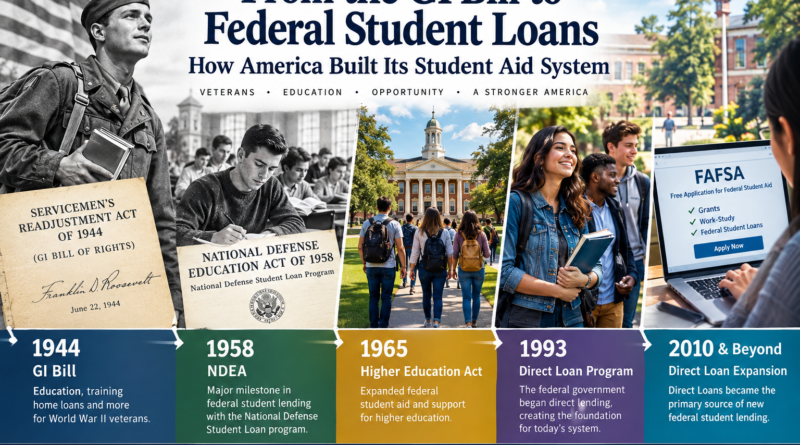
From the GI Bill to Federal Student Loans: How America Built Its Student Aid System
By New York Finance Think | U.S. Education & Personal Finance
For millions of Americans, paying for college today can mean filling out the FAFSA, comparing financial-aid offers, considering federal student loans and planning years of repayment.
But the American student-aid system did not appear overnight.
Its history stretches across more than a century of changing education policy, military needs, economic pressures and debates about who should pay for higher education.
One of the most important turning points came in 1944, when the United States created the Servicemen’s Readjustment Act, better known as the GI Bill. The law helped millions of World War II veterans attend college, receive vocational training and transition back into civilian life.
But there is an important historical distinction:
The 1944 GI Bill was not the modern federal student-loan program.
The development of broad federal student lending came later, with a major milestone in 1958, when Congress passed the National Defense Education Act (NDEA).
That law created the National Defense Student Loan program, opening a new chapter in the federal government’s role in helping college students finance their education.
Over the following decades, the system expanded through the Higher Education Act of 1965, federal loan reforms in the 1990s and the eventual dominance of the Direct Loan program.
Today, the federal student-loan system is one of the largest education-financing programs in the United States.
To understand why Americans borrow for college today, it helps to understand how this system was built.
Before Federal Student Loans: College Was Already Expensive
Higher education in America existed long before the federal government became a major participant in student financing.
During the 19th and early 20th centuries, colleges and universities relied largely on tuition, private support, endowments and state funding.
There were also early examples of institutions and private organizations providing financial assistance to students.
But these programs were limited.
There was no nationwide federal student-loan system comparable to what exists today.
College attendance itself was also much less common than it became after World War II.
For much of American history, higher education was available primarily to a relatively small portion of the population.
That began to change dramatically during and after World War II.
1944: The GI Bill Changes American Education
On June 22, 1944, President Franklin D. Roosevelt signed the Servicemen’s Readjustment Act of 1944.
The law became popularly known as the GI Bill of Rights.
The United States was still fighting World War II, but policymakers were already thinking about what would happen when millions of military personnel returned home.
The country had learned difficult lessons from the aftermath of World War I.
American policymakers did not want returning veterans to face mass unemployment and economic instability.
The GI Bill offered a different approach.
Instead of simply returning veterans to the civilian economy and hoping they found work, the government created a large-scale package of benefits designed to help them rebuild their lives.
Education was one of its most important components.
What Did the 1944 GI Bill Provide?
The original GI Bill provided eligible veterans with access to several types of assistance.
These included:
- College and university education
- Vocational and technical training
- On-the-job training
- Farm training
- Books and supplies
- Educational counseling
- Unemployment assistance
- Government-backed home loans
- Business and farm loan opportunities
This was a major change in the relationship between the federal government and individual Americans.
Education was no longer viewed only as a private investment made by a student or family.
For returning veterans, the federal government became a major financial supporter of education and economic mobility.
Millions of Veterans Used the GI Bill
The scale of the program was enormous.
Historical records from the Department of Veterans Affairs indicate that approximately 7.8 million World War II veterans participated in education or training programs under the GI Bill.
Not all of these people attended four-year colleges.
Veterans used their benefits for different forms of education and training.
Historical figures include approximately:
| Education or Training | Approximate Participants |
|---|---|
| Higher education | 2.2 million |
| Vocational and technical training | Nearly 3.5 million |
| On-the-job training | About 1.4 million |
| Farm training | Nearly 700,000 |
| Total | About 7.8 million |
These figures show why calling every GI Bill participant a “college student” would be inaccurate.
The program was much broader.
It was an education and workforce-development program for veterans.
The GI Bill and the American College Boom
The effect on American higher education was dramatic.
Veterans arrived on college campuses in numbers that universities had never experienced before.
According to historical federal records, veterans eventually represented a very large share of college enrollment in the immediate postwar period.
The result was a major expansion of American higher education.
Universities had to accommodate more students.
Communities needed more classrooms, housing and educational infrastructure.
Colleges became increasingly important pathways into professional careers.
The GI Bill helped accelerate a transformation that would continue for decades.
America was becoming a mass higher-education society.
The GI Bill Was Not a Student Loan
This distinction is essential when discussing the history of student loans.
The original GI Bill did not operate like today’s federal student loans.
A student loan generally involves borrowing money and later repaying principal and interest.
GI Bill education benefits were different.
Eligible veterans received government-supported education benefits under the law.
The government was not simply handing veterans a loan that they would repay after graduation.
That is why the GI Bill should be described as a veterans’ education benefit program, not as the beginning of the modern federal student-loan system.
However, the GI Bill demonstrated something important:
The federal government could play a major role in expanding access to higher education.
That lesson influenced later education policy.
1958: The National Defense Education Act
The next major chapter came during the Cold War.
In the 1950s, American policymakers became increasingly concerned about competition with the Soviet Union.
The launch of Sputnik in 1957 intensified concerns about America’s scientific and technological capabilities.
Education suddenly became closely connected to national security.
Congress responded with the National Defense Education Act of 1958.
The law was designed to strengthen education in fields important to national defense and the country’s scientific and technological future.
It also created a major new federal student-loan mechanism.
The National Defense Student Loan Program
The NDEA created the National Defense Student Loan (NDSL) program.
This was a significant step toward the development of modern federal student lending.
Unlike the GI Bill, which primarily targeted veterans, the NDEA student-loan program provided federally supported loans to eligible students in higher education.
The policy reflected a new idea:
America could invest in students because an educated population was considered important to national economic and national-security interests.
The government was no longer supporting education only through veterans’ benefits.
Federal policy was beginning to address higher education more broadly.
Why 1958 Matters in Student-Loan History
If someone asks, “When did federal student loans begin?” the answer requires some historical nuance.
There were earlier forms of government-supported education assistance and lending arrangements.
But 1958 is widely recognized as a major milestone in the development of the federal student-loan system because of the NDEA and its National Defense Student Loan program.
That is very different from saying:
“The GI Bill created federal student loans.”
It did not.
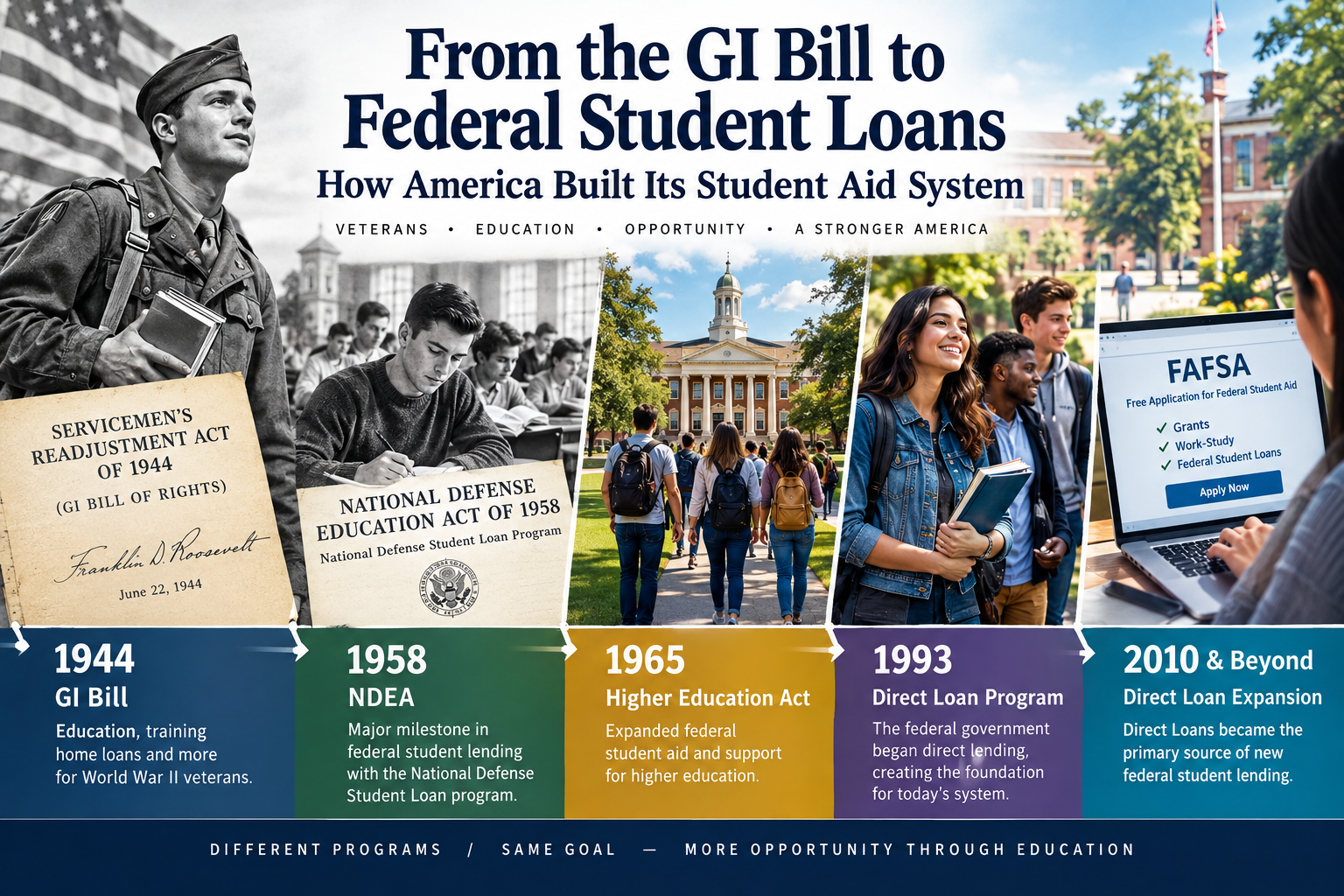
A more accurate historical timeline is:
1944 — GI Bill
Federal education benefits for veterans.
1958 — NDEA
Major federal student-loan milestone through the National Defense Student Loan program.
1965 — Higher Education Act
Federal student aid expanded substantially.
1993 — Direct Loan Program
The federal government established the William D. Ford Federal Direct Loan Program.
2010 — Direct Lending Expansion
New federal student lending became predominantly Direct Loans.
1965: The Higher Education Act Expands Federal Aid
The next major transformation came in 1965.
President Lyndon B. Johnson signed the Higher Education Act of 1965.
The law became one of the foundations of modern federal higher-education policy.
The Higher Education Act expanded federal support for colleges and students.
It helped establish and expand programs that would eventually become central parts of the federal student-aid system.
Federal assistance increasingly moved beyond the limited populations served by earlier programs.
The basic idea was becoming broader:
Financial circumstances should not completely determine whether an American can attend college.
That principle would remain central to federal education policy.
From NDSL to Perkins Loans
The student-loan program created under the NDEA did not remain unchanged.
Over the years, the program was modified and renamed.
The National Defense Student Loan program became the National Direct Student Loan program.
It was later associated with the Federal Perkins Loan Program.
Perkins Loans eventually became another historical chapter in federal student lending before the program expired for new lending in 2017.
The evolution shows that federal student lending has never been a static system.
Congress repeatedly changed the programs, eligibility rules and financing structures as the country’s education needs changed.
1993: The Federal Direct Loan Era Begins
Another major turning point came in the 1990s.
The William D. Ford Federal Direct Loan Program was created in 1993.
The Direct Loan system changed how the federal government financed student borrowing.
Instead of depending primarily on private lenders to originate federally guaranteed student loans, the federal government increasingly became the direct lender.
This created the foundation for the federal Direct Loan system that dominates federal student borrowing today.
Students can receive different types of Direct Loans depending on eligibility and circumstances.
These include:
- Direct Subsidized Loans
- Direct Unsubsidized Loans
- Direct PLUS Loans
The structure is very different from the education benefits created for veterans in 1944.
2010: Federal Student Lending Changes Again
In 2010, Congress enacted another major change to federal student lending.
The federal government moved toward making Direct Loans the primary source of new federal student lending.
This meant that new federal student loans increasingly came directly through the federal government rather than through the older Federal Family Education Loan structure.
The change simplified an important part of federal lending.
For today’s students, the federal Direct Loan system is the central federal borrowing mechanism.
What the GI Bill Taught America
The historical importance of the 1944 GI Bill goes beyond the number of veterans who received education benefits.
The program demonstrated the economic power of investing in human capital.
A veteran who received education could potentially move into a higher-skilled occupation.
A veteran who purchased a home could contribute to the growth of a local community.
A veteran who received vocational training could return to the workforce with new skills.
The effects were therefore not limited to individual students.
They extended into communities and the broader American economy.
Higher Education Became Part of the American Dream
Before World War II, a college degree was far from universal.
After the war, the idea of college as a pathway to economic opportunity became much more deeply embedded in American life.
The GI Bill helped accelerate that change.
Universities expanded.
Professional occupations grew.
More Americans began viewing higher education as an investment in their future.
The government also increasingly viewed education as an investment in the country’s economic strength.
This created a foundation for the enormous expansion of American higher education during the second half of the 20th century.
The Homeownership Side of the GI Bill
The GI Bill was not only about education.
It also helped veterans obtain home financing through government-backed loan guarantees.
This became another important part of America’s postwar transformation.
Millions of veterans used the program to purchase homes.
Homeownership expanded rapidly in the postwar years, contributing to suburban growth and the development of new communities.
The education and housing provisions worked together.
A veteran could return from military service, receive education or training, enter a new career and potentially purchase a home.
The federal government was effectively helping millions of people transition from wartime service into civilian economic life.
The GI Bill Had Limits and Inequalities
The GI Bill is often remembered as one of America’s most successful social and economic programs.
But its history is not entirely uncomplicated.
Access to the benefits was affected by discrimination and unequal treatment.
Black veterans, in particular, faced barriers in housing, lending and education.
Even when a federal benefit was technically available, local institutions and discriminatory practices could make it much harder for some veterans to use that benefit.
This is an important part of the historical record.
The GI Bill expanded opportunity on a massive scale, but the benefits were not distributed equally across every American community.
GI Bill vs. Student Loans: The Difference
The easiest way to understand the historical transition is to compare the two systems.
| Feature | 1944 GI Bill | Modern Federal Student Loans |
|---|---|---|
| Primary purpose | Help returning veterans | Finance higher education |
| Main population | Eligible veterans | Eligible students |
| Basic structure | Education benefits | Borrowed money |
| Repayment | Generally not a student-loan repayment obligation | Generally required |
| Interest | Not structured as a normal student loan | Applies according to loan type |
| Housing support | Yes, through separate VA-backed loan programs | Not a standard student-loan benefit |
| Historical importance | Expanded veteran education and homeownership | Created broad federal student-financing system |
The distinction matters.
The GI Bill helped demonstrate that federal policy could dramatically expand educational access.
The NDEA and later laws built the federal student-loan system.
Why Americans Still Talk About These Laws Today
The history of federal student aid remains relevant because college financing is still a major financial decision for American families.
Students today may combine:
- Scholarships
- Grants
- Personal savings
- Family contributions
- Work income
- Federal student loans
- Private student loans
The FAFSA remains the primary federal application used to determine eligibility for federal student aid.
But the basic question is still similar to the question policymakers faced decades ago:
How should America make higher education accessible without creating an unsustainable financial burden?
That debate has never completely disappeared.
From Veterans’ Benefits to Today’s FAFSA System
The American student-aid system now contains several different layers.
The federal government provides grants and loans.
States operate their own aid programs.
Colleges offer institutional scholarships and grants.
Private organizations provide scholarships.
Banks and other private lenders offer private student loans.
The FAFSA connects students with the federal financial-aid process.
But the historical foundation was built over several generations.
The GI Bill showed the impact of large-scale federal education assistance.
The NDEA introduced a major federal student-loan program.
The Higher Education Act expanded federal financial aid.
The Direct Loan program later changed the federal government’s role as a lender.
A Simple Timeline of American Student Aid
1944 — GI Bill
The Servicemen’s Readjustment Act provides major education and other benefits to eligible World War II veterans.
1958 — National Defense Education Act
The NDEA creates the National Defense Student Loan program, marking a major milestone in federal student lending.
1965 — Higher Education Act
Federal higher-education assistance expands significantly.
1970s–1980s — Federal Aid Expands
Federal grants and loan programs become increasingly important to American college financing.
1993 — Direct Loan Program
The William D. Ford Federal Direct Loan Program is created.
2010 — Direct Lending Becomes Dominant
New federal student lending moves primarily through the Direct Loan system.
Today
Students use FAFSA and other financial-aid resources to determine eligibility for federal grants, work-study and federal student loans.
The Long-Term Economic Impact
The history of student aid is also economic history.
Education affects earnings.
Higher education can increase access to professional occupations and skilled employment.
At the national level, a more educated workforce can support productivity, research, innovation and economic growth.
That is one reason federal policymakers repeatedly returned to education as a national investment.
The argument has changed over time.
In 1944, the focus was largely on helping veterans return from war.
In 1958, national defense and scientific competition became central concerns.
In 1965, expanding opportunity became a major policy objective.
Today, education policy also intersects with workforce shortages, technology, healthcare, manufacturing, artificial intelligence and the cost of living.
The underlying question remains remarkably similar:
How much should the nation invest in educating its people?
The Student-Loan Question Is Different
The success of the GI Bill also highlights an important issue in today’s student-loan debate.
Education benefits and student loans are not economically identical.
A grant or benefit does not create the same repayment burden as borrowing.
A student loan provides immediate access to money but creates a future obligation.
That means the expansion of student borrowing has created a different policy challenge from the one America faced in 1944.
The question is no longer simply how to help Americans attend college.
It is also:
How can students finance college without taking on debt that becomes difficult to repay?
What Americans Can Learn From the History
There are several lessons from the history of American student aid.
1. Federal education policy can reshape society
The GI Bill changed who could attend college and how Americans viewed higher education.
2. Education policy often reflects national priorities
The NDEA connected education with national defense and scientific competition.
3. Federal aid can create both opportunity and challenges
Government assistance can expand access, but the structure of that assistance matters.
4. Benefits do not always reach everyone equally
The history of the GI Bill shows how discrimination and local institutions can influence access to federal programs.
5. Student loans are only one part of the education-financing system
Grants, scholarships, work-study, savings and benefits can all play different roles.
The Bottom Line
America’s student-aid system was built over generations.
The 1944 GI Bill was a landmark because it helped millions of World War II veterans pursue education, training and homeownership.
But it was not the beginning of today’s federal student-loan system.
That distinction belongs to the later development of federal lending, with the 1958 National Defense Education Act representing one of the most important early milestones.
The Higher Education Act of 1965 expanded federal student assistance further.
The 1993 Direct Loan Program created the foundation for today’s federal direct-lending system.
And by 2010, federal student lending had moved predominantly into the Direct Loan structure.
The story is therefore bigger than student loans.
It is the story of how the United States gradually moved from a system in which college was primarily a private or limited opportunity toward one in which the federal government became a major participant in helping Americans finance higher education.
The GI Bill helped prove that large-scale public investment in education could change the country.
The student-loan system that followed created a different kind of opportunity—and a different kind of financial obligation.
Understanding that history helps explain why the American college-financing debate remains one of the country’s most important economic and public-policy questions.
Key Historical Facts
| Year | Event | Why It Matters |
|---|---|---|
| 1944 | GI Bill signed | Major federal education benefits for veterans |
| 1958 | NDEA enacted | Major milestone in federal student lending |
| 1965 | Higher Education Act | Federal student aid expanded |
| 1993 | Direct Loan Program | Federal government expands direct lending |
| 2010 | Direct Lending expansion | Direct Loans become dominant for new federal lending |
| Today | FAFSA + federal aid system | Students access grants, work-study and federal loans |
Historical takeaway: The 1944 GI Bill and the modern federal student-loan system are connected by the broader history of federal involvement in higher education, but they are not the same program.
Sources & Further Research
- National Archives — Servicemen’s Readjustment Act of 1944 (GI Bill)
National Archives — GI Bill of 1944 - U.S. Department of Veterans Affairs — GI Bill History PDF
VA — GI Bill History PDF - U.S. Department of Veterans Affairs — History of GI Bill Benefits
VA — GI Bill History and Benefits - U.S. Department of Veterans Affairs — GI Bill Timeline PDF
VA — 70 Years of the GI Bill Timeline - U.S. Department of Veterans Affairs — World War II GI Bill Historical Comparison PDF
VA — World War II GI Bill Historical Data - U.S. Department of Veterans Affairs — WWII Veteran and GI Bill Experience
VA — WWII Veteran Reflects on GI Bill Benefits - U.S. Department of Veterans Affairs — GI Bill and American Economic Impact
VA — 70th Anniversary of the Original GI Bill - U.S. Department of Education — Higher Education Laws and Policy
U.S. Department of Education — Higher Education Laws and Policy - Federal Student Aid — U.S. Department of Education
Federal Student Aid — Department of Education - Federal Student Aid — Title IV and Higher Education Act Historical Material
Federal Student Aid — Student Financial Aid Programs - Federal Student Aid — Federal Direct Student Loan Program, 1993
Federal Direct Student Loan Program — 1993 Historical Record - Federal Student Aid — Direct Loan Program Historical Record
Federal Student Aid — Establishment of the Direct Loan Program - Federal Student Aid — FY 2010 Annual Report PDF
Federal Student Aid FY 2010 Annual Report - Government Publishing Office — 1958 Congressional Record
1958 Congressional Record — National Defense Education Act Student Loans - U.S. Department of Education — Higher Education Act of 1965
Higher Education Act of 1965 — U.S. Department of Education - Federal Student Aid — Higher Education Act of 1965 Handbook
Higher Education Act — Federal Student Aid Handbook - ERIC — A History of Federal Aid to Education, 1785–1965
ERIC — History of Federal Aid to Education - ERIC — History of Federal Student Aid, 1965–1985
ERIC — Federal Student Aid and Equal Opportunity - ERIC — Federal Student Aid and Higher Education Policy
ERIC — Federal Student Aid Research PDF - Government Publishing Office — Higher Education Amendments
GovInfo — Higher Education Amendments of 1968 - U.S. Department of Veterans Affairs — VA History
VA History — Department of Veterans Affairs - VA Home Loan History — GI Bill and Veteran Homeownership
VA Home Loan History - VA Historical Report — GI Bill Economic and Education Benefits PDF
VA Historical Report PDF - Federal Student Aid — Direct Loan Information
Federal Direct Loan Information - U.S. Department of Education — Office of Postsecondary Education Legislation
Office of Postsecondary Education — Legislation and Regulations
