
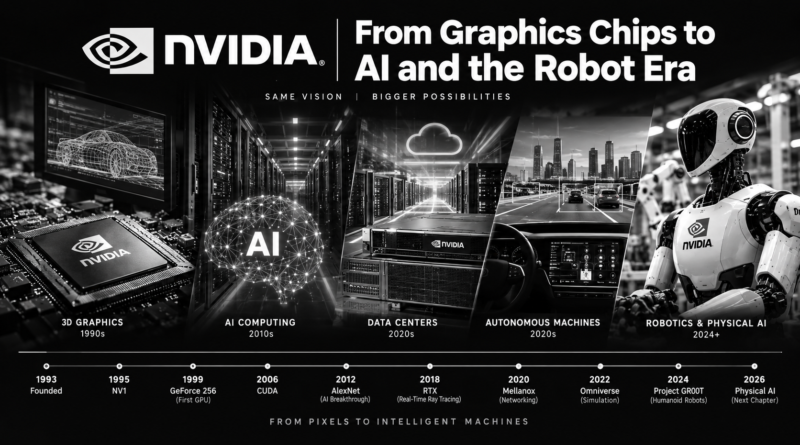
NVIDIA: From Graphics Chips to AI and the Robot Era1993
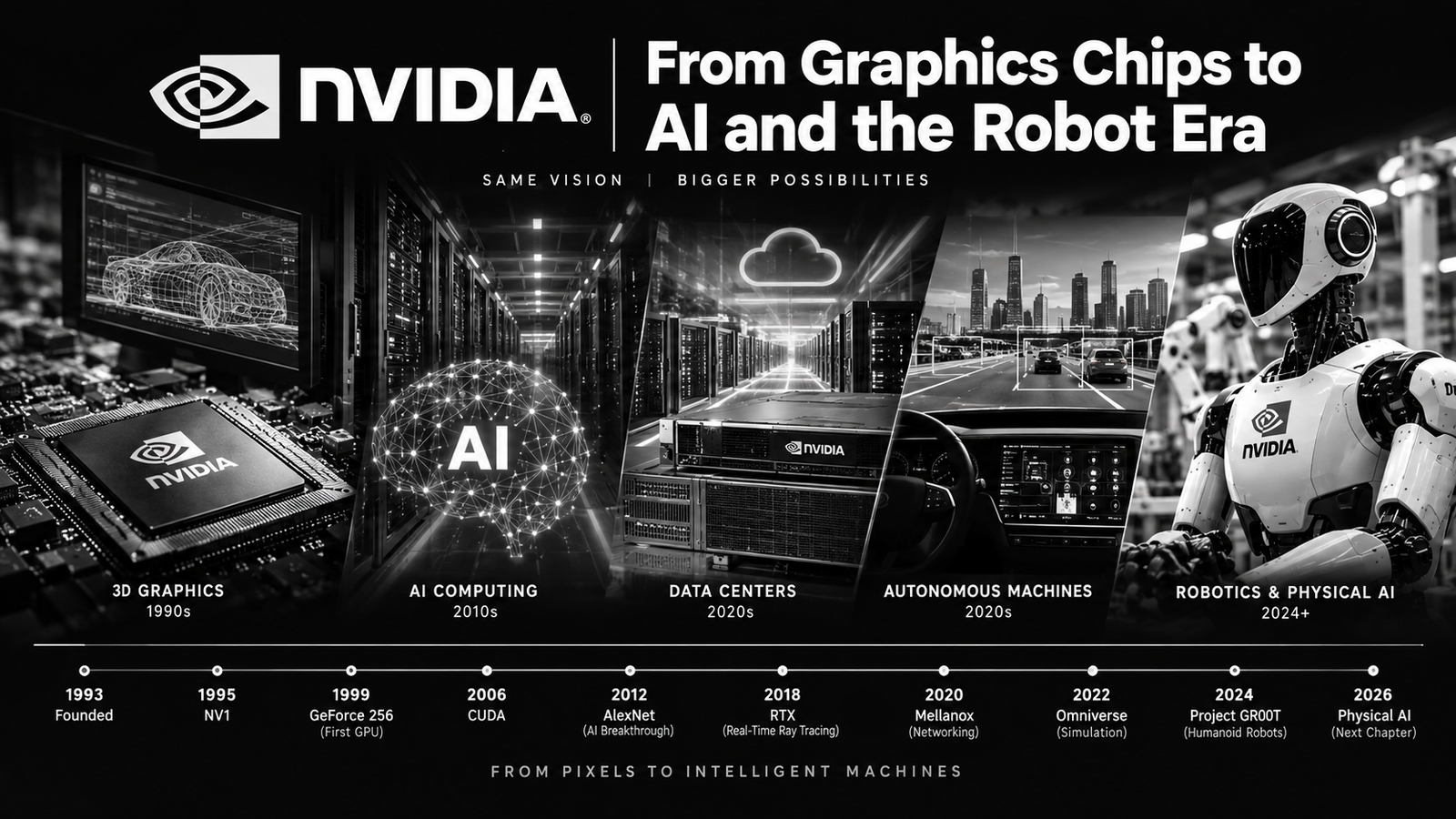
NVIDIA’s story is one of the most important technology transformations of the modern computing era.
The company did not begin as an artificial intelligence giant. It began with a much narrower ambition: make computer graphics better.
Over more than three decades, NVIDIA moved through several major technology eras. It started with 3D graphics in the 1990s, helped establish the modern GPU, opened GPUs to scientific computing through CUDA, became a critical supplier of AI computing, expanded into data centers and networking, and is now building technologies designed to bring AI into the physical world through robotics and autonomous machines.
The journey can be understood as a chain:
3D Graphics → GPU → Parallel Computing → CUDA → AI → Data Centers → Generative AI → Physical AI → Robots
That transformation explains why NVIDIA is much more than a graphics-chip company today.
Stage 1 — 1993: NVIDIA Begins With a Graphics Vision
NVIDIA was founded on April 5, 1993, by Jensen Huang, Chris Malachowsky and Curtis Priem.
The founders believed that personal computers would increasingly become important platforms for games and multimedia. At the time, the graphics-chip industry was highly competitive, with many companies trying to develop better ways to bring sophisticated graphics to personal computers.
NVIDIA’s original mission was therefore closely connected to 3D graphics and multimedia.
The company was taking a major technological risk: computer graphics were becoming more demanding, but the hardware available to consumers was still limited.
NVIDIA wanted to build specialized processors capable of handling increasingly complex visual calculations.
That decision became the starting point for everything that followed.
Stage 2 — 1995: The First Product
In 1995, NVIDIA launched its first product, the NV1.
The company was entering a market where 3D graphics were becoming increasingly important to video games and interactive entertainment.
One early connection to the gaming industry came through Sega’s Virtua Fighter, which became an early example of a 3D game running with NVIDIA graphics technology.
But the NV1 was only the beginning.
NVIDIA still had to compete against much larger and better-established players in the rapidly changing graphics market.
The company’s survival would depend on whether it could repeatedly develop new graphics architectures fast enough to keep pace with the industry.
Stage 3 — 1999: The GPU Changes the Direction of Computing
The year 1999 became one of the most important points in NVIDIA’s history.
NVIDIA introduced the GeForce 256, which it described as the world’s first GPU, or Graphics Processing Unit.
The idea was important because the GPU was designed to handle specialized graphics calculations in a highly parallel way.
At first, the benefits were obvious mainly in gaming and professional visualization.
Games could display increasingly detailed 3D environments. Designers and engineers could work with more complex digital models. Professional graphics applications could take advantage of increasingly powerful visual computing.
But the deeper significance of the GPU would become apparent years later.
A processor designed to perform many similar calculations in parallel could potentially be useful for much more than drawing pixels.
That realization eventually became one of the foundations of modern AI computing.
NVIDIA also introduced its Quadro professional graphics line during this period and went public in January 1999 at $12 per share.
Stage 4 — 2000s: NVIDIA Expands Beyond Gaming
After establishing itself in graphics, NVIDIA began expanding into additional markets.
The company acquired technology from 3dfx in 2000 and became the graphics processor supplier for Microsoft’s original Xbox.
This helped NVIDIA strengthen its position in consumer graphics and gaming.
But the company was also exploring a much bigger question:
Could GPUs be used for calculations that had nothing to do with graphics?
That question would eventually transform NVIDIA.
During the 2000s, the company developed GPU architectures aimed at scientific computing, professional visualization, high-performance computing and other specialized workloads.
NVIDIA also entered mobile computing with its Tegra processor family.
At the same time, GPUs were beginning to attract attention from researchers who needed enormous amounts of computing power.
The technology was gradually moving from the graphics world toward a broader idea:
accelerated computing.
Stage 5 — 2006: CUDA Opens the GPU to the World of Computing
One of NVIDIA’s most important decisions came in 2006, when it introduced the CUDA architecture and programming model.
CUDA allowed developers and researchers to use NVIDIA GPUs for general-purpose parallel computing.
This was a major change.
Before this shift, a GPU was primarily associated with graphics.
CUDA made it possible for developers to think of the GPU as a powerful computing engine that could be used for scientific simulations, data processing, engineering and eventually artificial intelligence.
NVIDIA itself describes CUDA as a turning point that opened the parallel-processing capabilities of GPUs to science and research.
This is arguably one of the most important parts of NVIDIA’s entire history.
The company was no longer simply selling faster graphics.
It was building an ecosystem around accelerated computing.
That ecosystem included hardware, software, developer tools and libraries.
And this would become extremely important when machine learning began demanding enormous computing resources.
Stage 6 — 2008–2011: GPUs Enter High-Performance Computing
As GPUs became programmable through CUDA, researchers began using them for increasingly demanding scientific and computational workloads.
Supercomputing became an important area.
NVIDIA GPUs could perform large numbers of calculations in parallel, making them attractive for certain workloads where traditional CPUs were less efficient.
The company continued developing its Tesla computing products and expanding its presence in high-performance computing.
This was an important strategic transition.
NVIDIA was no longer dependent only on the consumer gaming market.
It was building a second business around professional and scientific computing.
That second business would eventually become a bridge to AI.
Stage 7 — 2012: The AI Breakthrough
Then came a moment that changed NVIDIA’s future.
In 2012, the AlexNet neural network achieved a breakthrough in image recognition using NVIDIA GPUs.
The significance went far beyond one research competition.
Deep neural networks required enormous amounts of computation, and GPUs were particularly well suited to the parallel mathematical operations involved in training these models.
NVIDIA identifies AlexNet as a key moment that helped spark the modern AI era.
The basic idea was powerful:
The same type of parallel computing that made GPUs good at graphics could also make them extremely useful for training neural networks.
This created a new opportunity for NVIDIA.
The company had spent years building GPU hardware and CUDA software before the AI boom became mainstream.
When deep learning suddenly began demanding huge amounts of computing power, NVIDIA already had much of the technology infrastructure needed to respond.
Stage 8 — NVIDIA Becomes an AI Computing Company
Following the deep-learning breakthrough, NVIDIA increasingly focused on AI.
Its GPUs became widely used for training and running machine-learning models.
But hardware alone was not enough.
NVIDIA continued building software libraries, developer tools, networking technology and complete computing platforms.
This created what became a major competitive advantage:
NVIDIA was building a full computing ecosystem rather than simply selling chips.
The company’s technology increasingly appeared in:
- AI research
- Cloud computing
- Supercomputers
- Data centers
- Scientific research
- Medical research
- Autonomous vehicles
- Professional visualization
- Generative AI
- Robotics
The company’s research organization, established in 2006, also worked on areas including computer architecture, AI, graphics and robotics.
Stage 9 — 2018: RTX and Real-Time Ray Tracing
NVIDIA’s transformation was not limited to AI.
In 2018, the company introduced NVIDIA RTX, bringing hardware-accelerated real-time ray tracing to its graphics architecture.
Ray tracing attempts to simulate how light behaves in a digital environment.
For gamers and creators, this could produce more realistic lighting, reflections and shadows.
RTX demonstrated another important part of NVIDIA’s strategy:
specialized hardware could make previously expensive computational techniques practical in real time.
NVIDIA’s history describes RTX as the first GPU capable of real-time ray tracing.
The company was simultaneously advancing graphics and AI.
That combination would later become important in simulation, digital twins and robotics.
Stage 10 — Autonomous Vehicles and Embedded AI
NVIDIA also began pushing its computing technology into vehicles and edge devices.
The company developed platforms for autonomous driving and embedded AI, including the NVIDIA DRIVE platform.
The idea was simple but ambitious:
Instead of sending every decision to a distant data center, intelligent machines could process information locally.
A vehicle could use cameras and sensors, analyze its surroundings, understand objects and make decisions with onboard computing.
This was another step toward physical AI.
AI was no longer limited to a computer screen.
It was beginning to interact with the physical world.
Stage 11 — Data Centers Become Central to NVIDIA’s Strategy
As AI workloads exploded, data centers became increasingly important.
Training advanced AI models requires enormous amounts of computing power.
But modern AI infrastructure is not simply about putting more GPUs into a server.
It requires:
- GPUs
- CPUs
- High-speed networking
- Memory
- Storage
- Software
- Cooling
- Power infrastructure
- Data-center systems
This is why NVIDIA’s acquisition of Mellanox, completed in April 2020 for approximately $7 billion, became strategically important.
Mellanox specialized in high-performance networking.
Combining NVIDIA’s computing technology with Mellanox’s networking capabilities helped the company move toward more complete data-center systems.
The strategy was becoming clear:
NVIDIA wanted to accelerate the entire AI computing system, not just the processor.
Stage 12 — 2020s: The AI Infrastructure Explosion
The arrival of large-scale generative AI dramatically increased demand for accelerated computing.
Large language models and other generative AI systems require huge amounts of computational power for training and inference.
NVIDIA’s data-center GPUs became central to this new AI infrastructure.
The company increasingly supplied complete accelerated-computing platforms combining processors, networking, software and development tools.
This changed the public perception of NVIDIA.
It was no longer primarily viewed as a gaming company.
It had become one of the central infrastructure companies behind the AI industry.
Stage 13 — 2022: Omniverse and the Digital World
NVIDIA also expanded into simulation and digital worlds through Omniverse.
The platform is designed to connect 3D workflows and support physically based simulation and collaboration.
For robotics, this concept is particularly important.
A robot can be difficult and expensive to train entirely in the physical world.
Instead, developers can create simulated environments where robots can practice tasks.
This creates a bridge:
Digital simulation → AI training → Physical machine
That bridge would become increasingly important to NVIDIA’s robotics strategy.
Stage 14 — 2024: NVIDIA Moves Directly Into Humanoid Robotics
In March 2024, NVIDIA announced Project GR00T, a foundation model designed for humanoid robots.
The company also announced the Jetson Thor computing platform and major updates to its Isaac robotics platform.
This was a significant step.
NVIDIA was no longer simply providing generic computing technology that robotics companies could use.
It was developing specialized hardware, software, simulation tools and AI models for robots.
The company’s vision was to create technologies that allow robots to understand their environment, learn skills and perform physical tasks.
This represents another major transition:
AI that understands information → AI that can interact with the physical world.
Stage 15 — 2025: Physical AI Becomes a Major Focus
By 2025, NVIDIA was increasingly describing robotics as part of a broader physical AI opportunity.
The company introduced new versions of its GR00T humanoid robotics models and tools for generating synthetic training data.
NVIDIA also announced partnerships involving companies developing humanoid and industrial robots.
The idea behind physical AI is larger than humanoid robots.
It includes machines that can perceive, reason, learn and act in the real world.
That can include:
- Humanoid robots
- Industrial robots
- Autonomous machines
- Warehouse robots
- Surgical systems
- Agricultural machines
- Autonomous vehicles
NVIDIA’s strategy is to provide the computing infrastructure that allows these systems to be trained and deployed.
Stage 16 — 2026: From AI Models to Physical Machines
The robotics story continued into 2026.
In January 2026, NVIDIA announced new physical-AI models and frameworks while several global robotics companies unveiled machines built using NVIDIA technology.
The company introduced updates involving NVIDIA Cosmos, Isaac GR00T and Isaac Lab-Arena, along with tools designed to support robot training, evaluation and deployment.
In March 2026, NVIDIA announced further partnerships across the robotics ecosystem, including industrial robotics, humanoid robotics and surgical robotics.
The company described its goal as helping move physical AI toward production-scale deployment.
And in May 2026, NVIDIA announced an open humanoid robot reference design built around the Isaac GR00T platform, with Jetson Thor onboard computing.
The reference design was aimed at academic and research use and brought together robot hardware, onboard computing and NVIDIA’s robotics software and models.
This is an important development because it shows where NVIDIA’s long-term strategy is heading.
The company wants to participate not only in the brain of AI systems, but also in the software, simulation and computing infrastructure that allows intelligent machines to operate in the real world.
The NVIDIA Journey in One Table
| Era | Major Development | Why It Mattered |
|---|---|---|
| 1993 | NVIDIA founded | Began with a 3D graphics vision |
| 1995 | NV1 launched | First NVIDIA product |
| 1999 | GeForce 256 / GPU | Established the modern GPU concept |
| 2000s | Gaming and professional graphics | Expanded GPU adoption |
| 2006 | CUDA | Made GPUs useful for general parallel computing |
| 2008+ | Tesla / HPC | Expanded into scientific computing |
| 2012 | AlexNet | Demonstrated GPU power for modern AI |
| 2018 | RTX | Advanced real-time ray tracing |
| 2019+ | DRIVE / Jetson | Expanded AI into vehicles and edge devices |
| 2020 | Mellanox acquisition | Strengthened networking and data-center infrastructure |
| 2020s | Accelerated AI computing | NVIDIA became a major AI infrastructure provider |
| 2022 | Omniverse | Expanded simulation and digital-world capabilities |
| 2024 | Project GR00T | Major move into humanoid robotics |
| 2025 | GR00T / Physical AI | Expanded robot training and simulation |
| 2026 | Robotics ecosystem | Broader push toward production-scale physical AI |
The Most Important Part of NVIDIA’s Story
The most interesting part of NVIDIA’s history is not any single GPU.
It is the connection between the company’s technologies.
The company first developed processors for graphics.
Those processors became powerful parallel-computing engines.
CUDA allowed programmers to use that computing power for applications beyond graphics.
Researchers then discovered that GPUs were highly effective for deep learning.
AI workloads created enormous demand for GPU computing.
NVIDIA expanded into data-center networking and complete AI infrastructure.
Then the company began applying the same computing philosophy to autonomous machines and robotics.
The journey therefore looks like this:
Graphics created the GPU.
The GPU created accelerated computing.
CUDA opened accelerated computing to developers.
Accelerated computing helped fuel modern AI.
AI created demand for massive data-center infrastructure.
Simulation and AI are now helping machines learn.
And those machines are beginning to enter the physical world.
That is the deeper NVIDIA story.
NVIDIA’s Next Chapter: The Robot Era?
The future is still uncertain.
NVIDIA faces competition from companies developing their own AI accelerators, networking systems, software platforms and robotics technologies.
The robotics market itself is also still developing.
Humanoid robots have attracted enormous attention, but widespread commercial deployment remains a major engineering and economic challenge.
Robots need to be able to understand their surroundings, move safely, manipulate objects, operate reliably and justify their cost.
NVIDIA’s opportunity is therefore not necessarily to manufacture every robot.
Instead, the company can provide the computing platform, AI models, simulation tools and software infrastructure that many different robot manufacturers use.
That is similar to the role NVIDIA developed in AI computing.
The company does not need to build every AI application itself.
It can provide the infrastructure on which an ecosystem of developers and companies builds.
The same approach could become important in robotics.
From a Graphics Company to an AI Infrastructure Company
NVIDIA’s transformation took more than three decades.
In the 1990s, its world was primarily 3D graphics and gaming.
In the 2000s, the company began turning GPUs into broader computing platforms.
In the 2010s, deep learning revealed the enormous value of GPU acceleration.
In the 2020s, generative AI transformed demand for computing infrastructure.
Now NVIDIA is pushing toward physical AI and robotics.
The company’s own historical timeline summarizes the major milestones as 3D graphics, GPU, CUDA, AI, RTX and Omniverse.
The next chapter is increasingly centered on what happens when AI leaves the screen and begins interacting with the physical world.
That could mean robots working in factories, autonomous machines operating in dangerous environments, intelligent vehicles navigating roads, or humanoid systems learning to perform tasks alongside people.
NVIDIA’s journey therefore is not simply a story about faster graphics cards.
It is a story about how a technology originally created to process pixels evolved into a platform for processing intelligence, simulation and physical action.
And that may be the most important reason NVIDIA remains one of the companies to watch as the AI era develops.
Final Takeaway
NVIDIA began with a simple idea: make computer graphics better.
More than 30 years later, that idea has evolved into something much larger.
From NV1 to GeForce, from CUDA to AI, from data centers to Omniverse, and from AI models to humanoid robots, NVIDIA has repeatedly expanded the role of accelerated computing.
The company’s next challenge is not simply making computers calculate faster.
It is helping machines see, learn, reason, simulate and act.
If that transition succeeds, NVIDIA’s graphics origins may eventually look like only the first chapter of a much bigger technology story.
1993: Graphics.
1999: GPU.
2006: CUDA.
2012: Modern AI.
2020s: Generative AI.
2024–2026: Physical AI and robotics.
The journey from pixels to intelligent machines is still underway.
Official Sources
- NVIDIA — Company History & Corporate Timeline
https://www.nvidia.com/en-us/about-nvidia/corporate-timeline/ - NVIDIA — About the Company
https://www.nvidia.com/en-us/about-nvidia/ - NVIDIA — NVIDIA in Brief 2026
https://www.nvidia.com/content/dam/en-zz/Solutions/about-nvidia/corporate-nvidia-in-brief.pdf - NVIDIA — Project GR00T and Humanoid Robots
https://investor.nvidia.com/news/press-release-details/2024/NVIDIA-Announces-Project-GR00T-Foundation-Model-for-Humanoid-Robots-and-Major-Isaac-Robotics-Platform-Update/ - NVIDIA — Isaac GR00T N1 and Robotics
https://investor.nvidia.com/news/press-release-details/2025/NVIDIA-Announces-Isaac-GR00T-N1–the-Worlds-First-Open-Humanoid-Robot-Foundation-Model–and-Simulation-Frameworks-to-Speed-Robot-Development/ - NVIDIA — Physical AI and Global Robotics Leaders, 2026
https://investor.nvidia.com/news/press-release-details/2026/NVIDIA-and-Global-Robotics-Leaders-Take-Physical-AI-to-the-Real-World/ - NVIDIA — GR00T Reference Humanoid Robot, 2026
https://nvidianews.nvidia.com/news/nvidia-open-humanoid-robot-reference-design - NVIDIA — Official Investor Relations
https://investor.nvidia.com/