

U.S. Department of the Treasury 2026: Federal Finance, Debt, Taxes, Banking, Sanctions and the American Economy
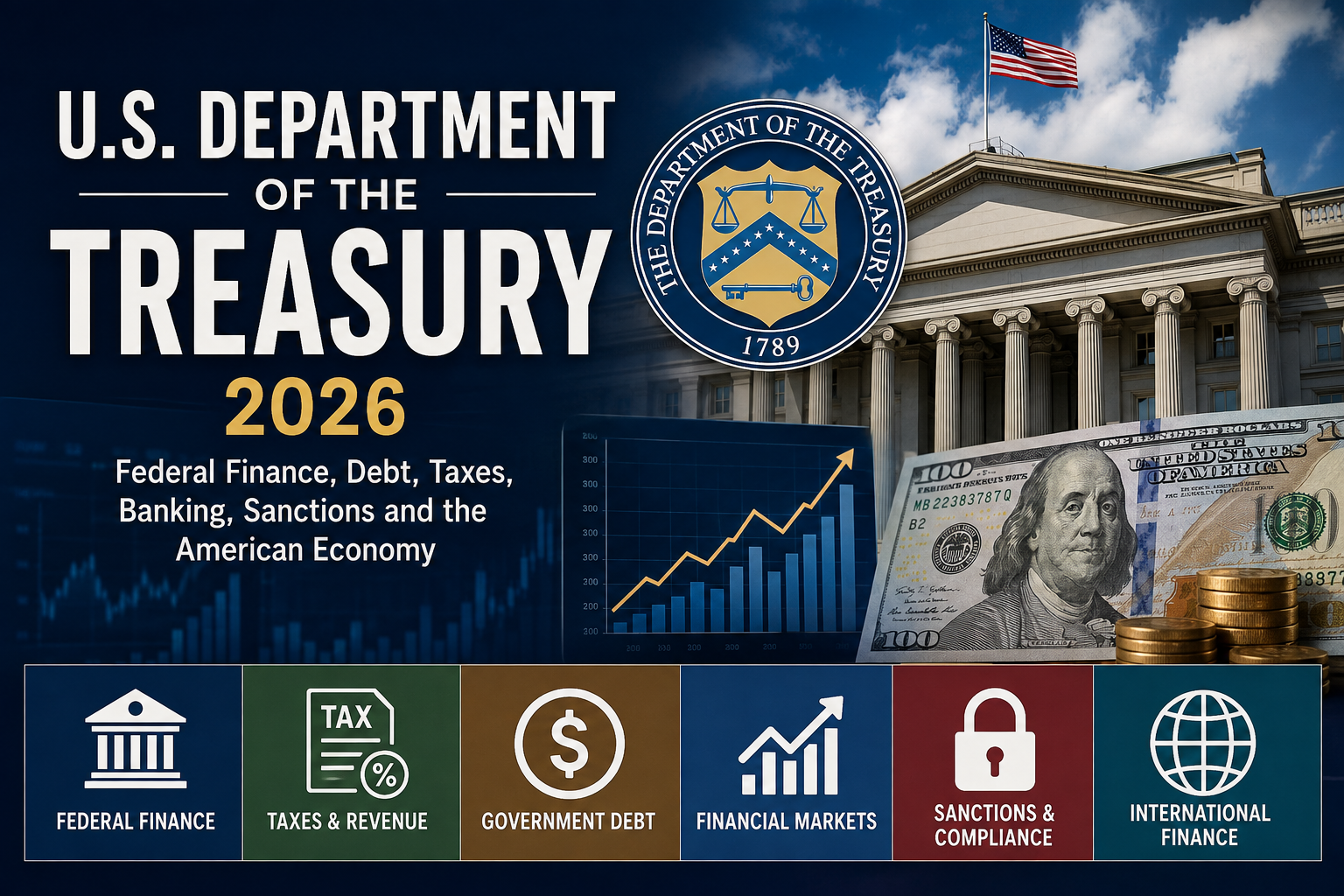
The U.S. Department of the Treasury is one of the most important institutions in the American financial system. It manages major parts of the federal government’s finances, oversees the Internal Revenue Service, manages federal borrowing, administers economic sanctions, supports government payments and participates in international financial policy.
For Americans, Treasury policy can affect taxes, government spending, interest costs, financial markets and the wider economy. For businesses, Treasury decisions can influence financing conditions, tax administration, sanctions compliance and international transactions. For investors around the world, U.S. Treasury securities remain one of the most closely watched assets in global financial markets.
The Treasury should not be confused with the Federal Reserve. The Treasury manages federal government finances and carries out responsibilities assigned by federal law. The Federal Reserve is the U.S. central bank and is responsible for monetary policy, including decisions concerning the federal funds rate.
In 2026, the relationship between government borrowing, interest rates, inflation, economic growth and financial markets remains an important part of the U.S. economic story.
What Is the U.S. Department of the Treasury?
The U.S. Department of the Treasury was established in 1789 and is one of the oldest departments of the U.S. federal government.
Its responsibilities include managing federal finances, public debt, government payments, tax administration, currency production, economic sanctions and international financial relations.
The Treasury also works with other federal agencies and international institutions on economic and financial matters.
Because of its wide responsibilities, the Treasury is connected to many areas of the U.S. economy.
Why the Treasury Matters in 2026
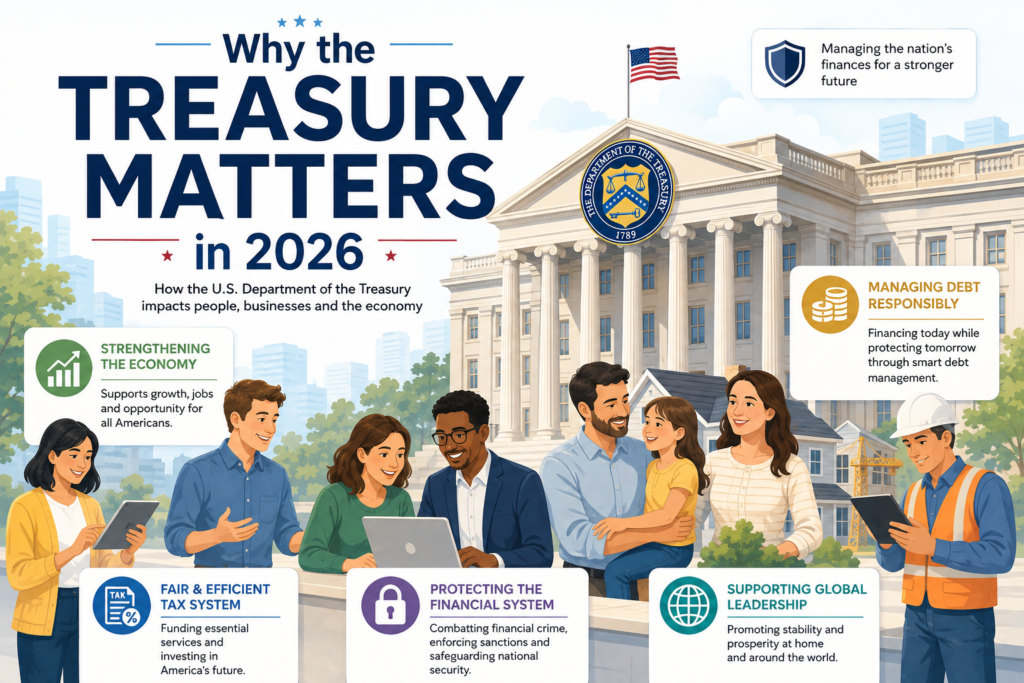
The federal government collects revenue and spends money on a wide range of programs and obligations.
When government spending exceeds revenue, the government runs a budget deficit.
The Treasury finances federal deficits primarily by issuing government securities.
Those securities are purchased by banks, investment funds, pension funds, corporations, households and investors around the world.
The Treasury market is therefore both a source of government financing and a major part of the global financial system.
Treasury yields influence borrowing costs throughout the American economy.
Mortgage rates, corporate borrowing costs, bond valuations and investment decisions can all be affected by movements in Treasury yields.
Treasury and the Federal Budget
The federal budget describes government revenue and spending.
Congress establishes federal taxes and spending laws, while the executive branch implements those laws.
The Treasury manages important financial operations associated with the government’s revenue, spending and borrowing requirements.
This distinction matters because the Treasury does not independently create the entire federal budget.
Instead, it manages federal finances under laws enacted by Congress.
Federal Deficit
A federal deficit occurs when government spending exceeds federal revenue during a fiscal year.
For example, if the government collects $100 in revenue and spends $120, the deficit is $20.
The government needs to finance that difference.
The Treasury raises funds by issuing government securities.
A deficit is measured over a period of time, while federal debt represents accumulated borrowing and related obligations.
Federal Debt
The Treasury manages the federal government’s outstanding debt.
The United States issues Treasury bills, notes, bonds and other securities.
These securities are held by investors in the United States and around the world.
Federal debt has increased over many years as the government has frequently operated with budget deficits.
The long-term fiscal debate therefore involves spending, revenue, economic growth, interest costs and debt management.
Why Treasury Debt Matters
Treasury debt matters because the United States is one of the world’s largest borrowers.
Investors monitor Treasury auctions and yields closely.
Strong demand for Treasury securities can help the government borrow at favorable rates, while weaker demand can contribute to higher borrowing costs.
The interest rate paid on newly issued debt also affects future government interest expenses.
Treasury Bills
Treasury bills are short-term U.S. government securities.
They generally have maturities of one year or less.
Banks, companies, investment funds and individual investors can use Treasury bills as part of short-term cash management.
Their short maturities make them particularly important in money markets.
Treasury Notes
Treasury notes generally have intermediate maturities.
The two-year Treasury yield is closely watched because it can reflect market expectations about monetary policy and short-term economic conditions.
Longer-term Treasury yields are influenced by inflation expectations, economic growth, government borrowing and investor demand.
Treasury Bonds
Treasury bonds are longer-term government securities.
They provide investors with exposure to U.S. government debt over extended periods.
Long-term Treasury yields can influence mortgage rates, corporate borrowing costs and investment valuations.
Treasury Inflation-Protected Securities
Treasury Inflation-Protected Securities, commonly known as TIPS, are designed to provide protection against inflation.
Their principal adjusts according to changes in the Consumer Price Index.
TIPS are closely watched by investors because their pricing can provide information about market expectations for inflation.
Treasury Yields and the American Economy
Treasury yields are among the most important indicators in financial markets.
When Treasury yields rise, borrowing costs can increase across the economy.
Mortgage rates can face upward pressure.
Corporate bond yields can increase.
Business financing can become more expensive.
Stock-market valuations can also be affected because higher interest rates change the value investors place on future earnings.
When Treasury yields decline, some borrowing costs may become less expensive.
The relationship is not automatic, but Treasury yields remain an important benchmark.
Treasury and the Federal Reserve
The Treasury and Federal Reserve are separate institutions.
The Federal Reserve conducts monetary policy.
The Federal Open Market Committee determines the target range for the federal funds rate.
The Treasury does not set the federal funds rate.
The Treasury manages federal government finances and debt.
The Federal Reserve manages monetary policy and performs other central-bank functions.
Understanding this distinction is essential when reporting on U.S. financial policy.
Treasury and Interest Rates
Although the Treasury does not control the federal funds rate, Treasury borrowing is affected by interest rates.
When rates are high, newly issued government debt can become more expensive.
When rates decline, new borrowing can become less expensive.
The effect depends on the maturity of the debt and conditions in financial markets.
Inflation and Treasury Finance
Inflation affects federal finances in several ways.
Higher prices can increase government spending.
Higher wages and business revenues can increase nominal tax receipts.
At the same time, higher inflation can contribute to higher interest rates.
Higher interest rates can increase the cost of newly issued government debt.
The Treasury therefore operates within a financial environment shaped by inflation, economic growth and interest rates.
Treasury and Tax Collection
Tax revenue is one of the federal government’s main sources of income.
The Internal Revenue Service administers the federal tax system and collects federal taxes.
The Treasury oversees the IRS.
Federal taxes include individual income taxes, payroll taxes, corporate taxes and other receipts.
Tax revenue plays an important role in determining the federal government’s fiscal position.
Treasury and the IRS
The IRS is one of the most visible parts of the Treasury Department for American households and businesses.
Individuals interact with the IRS through tax returns, payments, refunds, credits and tax documentation.
Businesses interact with the IRS through corporate taxes, payroll taxes, reporting requirements and other obligations.
Changes in federal tax laws can therefore have a direct effect on households and businesses.
Treasury and Business Taxes
Businesses closely monitor Treasury and IRS policies.
Corporate tax rules can influence investment decisions.
Tax credits can affect the economics of new projects.
International tax rules can affect multinational companies.
Tax reporting and compliance requirements also create administrative responsibilities.
For businesses, Treasury policy can therefore become an important part of financial planning.
Treasury and Financial Markets
The Treasury market is a foundation of the American financial system.
Banks, asset managers, pension funds, insurance companies and other financial institutions invest in government securities.
Treasury securities are also used in financial transactions and as collateral.
Because the Treasury market is so important, changes in Treasury yields can affect many other financial markets.
Treasury and the Stock Market
The relationship between Treasury yields and stocks is complicated.
When yields rise, bonds can become more attractive compared with stocks.
Higher interest rates can also reduce the present value of future corporate earnings.
Companies that depend heavily on borrowing may face higher financing costs.
However, rising yields can sometimes reflect strong economic growth.
The impact on stocks therefore depends on the reason Treasury yields are changing.
Treasury and the Bond Market
Treasury securities provide a benchmark for the broader bond market.
Corporate bonds often trade at a yield spread above comparable Treasury securities.
When Treasury yields rise, corporate borrowing costs can increase even if credit spreads remain unchanged.
This is why companies and investors closely monitor Treasury markets.
Treasury and Mortgage Rates
The 10-year Treasury yield is an important reference point for long-term interest rates.
Mortgage rates are determined by many factors, but movements in long-term Treasury yields can influence them.
Higher long-term yields can put upward pressure on mortgage rates.
Lower yields can create conditions for lower mortgage rates.
The Treasury does not directly set mortgage rates.
Treasury and Banking
Banks are major participants in the Treasury market.
They can hold Treasury securities as investment and liquidity assets.
Treasury yields can influence how banks price loans and manage their portfolios.
Interest-rate changes can also affect bank net interest margins and the market value of fixed-income securities.
Treasury and Regional Banks
Regional banks can be sensitive to interest-rate movements.
They hold loans and securities with different maturities.
When interest rates rise rapidly, the market value of some fixed-rate securities can decline.
The U.S. regional banking stress of 2023 demonstrated why interest-rate and liquidity risk remain important considerations for banks.
Treasury and Community Banks
Community banks also use government securities as part of liquidity and investment management.
A community bank may hold Treasury securities while providing loans to households and businesses in its local market.
Changes in Treasury yields can therefore influence the value and income characteristics of a bank’s securities portfolio.
Treasury and Credit Markets
Credit markets depend heavily on interest rates.
Businesses use bank loans and bond markets to finance investment.
Consumers use mortgages, auto loans, credit cards and other forms of borrowing.
Treasury yields provide an important reference point for many financial transactions.
Treasury and Corporate Investment
Companies need capital to expand.
They can finance investment through retained earnings, bank loans or capital markets.
When borrowing costs rise, some projects become less attractive.
When financing costs fall, businesses may find it easier to expand.
Treasury yields therefore matter to corporate investment decisions.
Treasury and Small Businesses
Small businesses can be especially sensitive to changes in financing conditions.
Many small companies rely on banks rather than issuing bonds.
Higher borrowing costs can lead businesses to delay hiring, equipment purchases or expansion.
Treasury yields are not the only factor affecting small-business financing, but they are part of the broader interest-rate environment.
Treasury and Consumer Credit
Households are also affected by interest-rate conditions.
Mortgage rates, auto loans and personal loans can change as financial-market conditions change.
Credit-card rates often respond to short-term interest-rate conditions.
The Treasury does not directly set these rates.
Banks and lenders determine rates based on funding costs, risk, competition and market conditions.
Treasury and the U.S. Dollar
The U.S. dollar remains the world’s leading reserve currency.
It is widely used in international trade and finance.
The dollar is also heavily represented in central-bank reserves and international financial transactions.
Treasury securities are closely connected to the dollar because international investors often hold U.S. government debt as part of their dollar-based portfolios.
Treasury and Global Investors
Foreign investors hold substantial amounts of U.S. government securities.
Central banks, governments, investment funds and financial institutions around the world participate in the Treasury market.
This means U.S. fiscal policy can affect international financial markets.
Changes in Treasury yields can influence global capital flows and currency markets.
Treasury and International Finance
The Treasury participates in international economic and financial policy.
It works with foreign governments and international institutions on matters involving economic growth, financial stability, development finance, international taxation and sanctions.
The Treasury also represents important U.S. interests in international financial institutions.
Treasury and the IMF
The International Monetary Fund works with member countries on economic and financial issues.
The United States is an important member of the IMF.
The Treasury plays a significant role in U.S. policy toward the organization.
The IMF monitors global economic conditions and provides financial assistance and policy support to eligible member countries.
Treasury and the World Bank
The Treasury also plays a role in U.S. relations with the World Bank.
The World Bank supports development projects and economic programs around the world.
U.S. participation in international financial institutions is an important component of American economic diplomacy.
Treasury and Economic Sanctions
Economic sanctions are another major responsibility connected to the Treasury.
The Office of Foreign Assets Control, known as OFAC, administers and enforces U.S. economic and trade sanctions.
Sanctions can target countries, individuals, organizations, companies or specific economic sectors.
Businesses that operate internationally must monitor applicable sanctions requirements.
Why OFAC Matters to Banks
Banks must maintain systems to identify potentially prohibited transactions.
A financial institution processing a transaction involving a sanctioned person or entity can face significant regulatory and legal consequences.
Large financial institutions often maintain specialized sanctions-compliance departments.
Smaller institutions also need appropriate systems based on their risk.
OFAC Sanctions Lists
OFAC maintains sanctions lists identifying individuals and entities subject to restrictions.
The lists can change.
For that reason, companies should rely on current official OFAC information rather than outdated articles or old databases.
Businesses involved in international transactions should conduct appropriate compliance checks before processing transactions that could raise sanctions concerns.
Treasury and International Trade
Treasury policy can influence international commerce through sanctions, financial regulation and tax policy.
Companies involved in international business may need to evaluate counterparties, payment channels and jurisdictions.
Banks processing international transactions must also consider applicable sanctions and financial-crime requirements.
Treasury and National Security
Financial policy is increasingly connected to national security.
Financial sanctions can restrict access to the U.S. financial system.
The Treasury uses financial tools to address certain national-security concerns.
This has made the financial system an important part of U.S. foreign policy.
Treasury and Cybersecurity
Financial institutions rely heavily on digital systems.
Banks, payment companies and government agencies need to protect financial information and payment infrastructure.
Cybersecurity is therefore part of financial stability.
A major cyberattack against a financial institution could disrupt payments and create broader economic problems.
Treasury and Digital Finance
Digital payments, online banking and financial technology are changing the financial system.
Consumers increasingly use digital services for payments and money management.
Businesses are developing new financial products.
Government agencies must adapt while maintaining security and consumer protection.
Treasury and Cryptocurrency
Digital assets have created new questions involving taxation, financial regulation, sanctions, money laundering and financial stability.
Treasury and other federal agencies have responsibilities in different parts of this policy area.
Banks and financial companies also continue to evaluate how digital assets fit into their businesses.
Treasury and Artificial Intelligence
Artificial intelligence is becoming increasingly important in financial services.
Banks can use AI for fraud detection, customer service, document analysis and risk management.
Government agencies can use technology to improve financial administration.
At the same time, AI creates new risks involving cybersecurity, privacy, fraud and model reliability.
Treasury and Financial Fraud
Financial fraud affects consumers, businesses and financial institutions.
Fraud can involve identity theft, false payments, investment scams, tax fraud and other activities.
Treasury agencies work with other federal institutions to combat financial crime.
Banks also maintain fraud-detection systems.
Treasury and Money Laundering
Anti-money-laundering rules are an important part of the financial system.
Banks and other financial institutions are required to maintain compliance programs designed to identify suspicious transactions and meet applicable legal requirements.
The goal is to prevent the financial system from being used to move illicit funds.
Treasury and FinCEN
The Financial Crimes Enforcement Network, known as FinCEN, is a bureau of the Treasury Department.
FinCEN works to protect the financial system from money laundering and other financial crimes.
It collects and analyzes financial information and works with law-enforcement and regulatory agencies.
Treasury and Financial Stability
Financial stability matters because banks, investment funds, insurers and other financial institutions are connected.
They lend to one another, trade securities and rely on shared payment infrastructure.
A major disruption can therefore spread through the financial system.
The Treasury works with other federal agencies on financial-stability issues when necessary.
Treasury and Financial Crises
The Treasury has played important roles during previous financial crises.
The federal government has sometimes created emergency programs to stabilize markets or support the broader economy.
Such interventions can be controversial.
Supporters argue that emergency measures can prevent a much larger economic crisis.
Critics argue that government intervention can create moral hazard and financial risks for taxpayers.
Treasury and the Pandemic Economy
The COVID-19 pandemic showed how quickly the federal government can become involved in economic stabilization.
Congress authorized large fiscal programs.
The Treasury implemented several programs and worked with other agencies.
The Federal Reserve separately used monetary-policy tools.
The experience demonstrated the different but connected roles of fiscal and monetary authorities.
Treasury and Recession Risk
A recession can reduce tax revenue.
Employment can decline.
Corporate profits can fall.
Government spending can increase in some areas.
These changes can cause the federal deficit to widen.
Treasury borrowing needs can therefore increase during an economic downturn.
Treasury and Economic Growth
Economic growth generally supports government revenue.
When incomes and business activity increase, tax receipts can rise.
Strong growth can therefore help federal finances.
Weak economic growth can reduce revenue and increase fiscal pressure.
Treasury and Inflation Expectations
Financial markets pay close attention to inflation expectations.
If investors expect higher inflation, they may demand higher yields on longer-term Treasury securities.
If inflation expectations decline, long-term yields may fall.
These changes affect government borrowing costs and financial-market valuations.
Treasury and Energy Prices
Energy prices can influence inflation and economic growth.
Higher energy costs can reduce household purchasing power and increase business expenses.
Energy-market developments can therefore influence government revenue, spending and financial conditions.
Treasury and Manufacturing
Manufacturing companies monitor taxes, financing costs, trade policy and government investment.
Federal tax incentives can influence capital spending.
Government procurement can create demand.
Interest rates affect the cost of expanding factories and equipment.
Treasury and Technology Companies
Technology companies rely on investment, capital markets and international trade.
Tax policy can influence research and development.
Financial regulations affect financial-technology businesses.
International sanctions can affect transactions with overseas companies.
Treasury policy is therefore relevant to the technology sector.
Treasury and Infrastructure
Infrastructure projects often require long-term investment.
Roads, bridges, ports, energy systems and digital infrastructure can involve public and private financing.
Interest rates and tax policy can affect the economics of these projects.
Treasury and State Governments
State governments have separate budgets and borrowing systems.
However, federal economic policies can affect state finances.
Federal grants, tax policies and national economic conditions can influence state revenue and spending.
State and local borrowing costs are also affected by broader interest-rate conditions.
Treasury and Local Governments
Cities, counties and other local governments issue debt to finance infrastructure and public projects.
Municipal borrowing costs are influenced by the wider bond market.
Treasury yields therefore matter to local government finance even though municipalities operate independently of the federal Treasury.
Social Security is one of the largest federal programs.
Its financial structure involves payroll taxes and trust funds.
Population aging creates long-term challenges for the program.
The Treasury manages financial operations associated with federal programs under existing law, while Congress determines the legal framework governing Social Security.
Treasury and Medicare
Medicare is another major federal program.
Its costs are influenced by population aging, healthcare prices and healthcare utilization.
Long-term healthcare spending is therefore an important part of the federal fiscal outlook.
Treasury and Population Aging
The aging U.S. population has significant fiscal implications.
Older Americans generally use more healthcare services.
Retirement programs become more important.
The number of workers supporting payroll-tax systems also matters.
Demographic changes therefore play a major role in long-term fiscal planning.
Treasury and Fiscal Sustainability
Fiscal sustainability means the government can manage its finances over the long term.
Persistent deficits increase debt.
Economic growth can make debt easier to manage.
Interest rates matter because they determine the cost of servicing newly issued debt.
A combination of slow growth, high borrowing costs and persistent deficits can create greater fiscal pressure.
Treasury and Fiscal Reform
Fiscal reform can involve spending, revenue or both.
Policy discussions can include tax changes, entitlement reforms, discretionary spending changes and economic-growth measures.
These decisions are made through the political and legislative process.
The Treasury’s role is to implement and manage the financial consequences of laws and policies.
Treasury and Congress
Congress has an essential role in federal finance.
Congress establishes taxes and spending programs and determines the legal framework governing federal borrowing.
The Treasury manages federal financial operations under that framework.
Changes in congressional spending or tax legislation can significantly affect Treasury borrowing requirements.
Treasury and the President
The Treasury Secretary serves as a senior economic adviser to the President.
The department participates in economic and financial policy development.
The President can propose tax and spending policies, but many major measures require congressional approval.
Treasury Auctions
The Treasury regularly auctions government securities.
Investors submit bids for Treasury securities.
Auction results provide information about investor demand and market conditions.
Strong demand can support lower borrowing costs.
Weak demand can contribute to higher yields.
Why Treasury Auctions Matter
Treasury auctions can influence bond-market prices.
A stronger-than-expected auction can push yields lower.
A weaker-than-expected auction can push yields higher.
The market reaction also depends on expectations before the auction.
Treasury Yield Curve
The Treasury yield curve compares yields across different maturities.
A normal curve generally has higher yields for longer maturities.
An inverted curve occurs when short-term yields are higher than long-term yields.
Investors study the yield curve for information about economic growth, inflation and monetary-policy expectations.
Treasury and Safe-Haven Demand
During periods of uncertainty, investors often seek highly liquid government securities.
U.S. Treasury securities are widely viewed as important safe and liquid assets.
Strong demand can push Treasury prices higher and yields lower.
Market conditions can change quickly, however.
Treasury and Foreign Governments
Foreign governments can hold Treasury securities as part of their reserves.
They may use dollar assets for international payments, reserve management or currency-market operations.
Foreign holdings are therefore closely monitored by investors.
Treasury and Global Capital Flows
Capital moves between countries according to expected returns, risk and liquidity.
Treasury yields can influence these decisions.
Higher U.S. yields can make dollar assets more attractive.
Changes in global risk sentiment can also change capital flows.
Treasury and Currency Markets
The dollar’s value is influenced by many factors.
Interest rates, economic growth, inflation, fiscal policy and global risk sentiment all matter.
Treasury yields can influence currency markets because they affect the relative attractiveness of dollar-denominated investments.
Treasury and Geopolitical Risk
Geopolitical events can increase demand for safe assets.
At the same time, geopolitical disruptions can increase energy prices and inflation.
Treasury markets therefore respond to geopolitical events through several different channels.
Treasury and Financial Journalism
Treasury coverage should use precise financial language.
A deficit is not the same thing as debt.
Treasury policy is not the same as Federal Reserve monetary policy.
Sanctions are not the same as tariffs.
Treasury securities are not the same as bank deposits.
Clear terminology helps readers understand financial news.
Treasury and Official Data
Primary sources are particularly important when reporting Treasury news.
Useful official sources include:
U.S. Department of the Treasury
Treasury Fiscal Data
Internal Revenue Service
Office of Foreign Assets Control
Financial Crimes Enforcement Network
Federal Reserve
Government Accountability Office
Using official sources allows journalists and readers to verify financial information.
Treasury and Transparency
Government financial information is publicly available.
Treasury publishes financial data and reports that allow investors, researchers, journalists and citizens to examine federal finances.
Public data improves transparency and makes independent analysis possible.
Treasury and Financial Education
Understanding the Treasury makes it easier to understand American finance.
A reader who understands the difference between debt and deficit can better understand federal-budget reporting.
A reader who understands Treasury yields can better understand bond-market movements.
A reader who understands OFAC can better understand sanctions news.
A reader who understands the difference between the Treasury and Federal Reserve can better interpret interest-rate stories.
What to Watch in 2026
Readers following U.S. finance should watch:
Federal borrowing
Treasury auction results
Two-year Treasury yield
Ten-year Treasury yield
Federal tax receipts
Federal spending
Federal debt
Interest costs
Inflation
Economic growth
Dollar exchange rates
OFAC sanctions
International capital flows
Federal Reserve policy
Together, these indicators provide a clearer picture of American financial conditions.
Final Analysis
The U.S. Department of the Treasury is one of the central institutions in American finance.
Its role goes far beyond government debt.
The Treasury manages federal financial operations, oversees the IRS, supports government payments, administers sanctions, participates in international financial policy and manages the government’s borrowing program.
Its decisions can affect banks, businesses, investors, consumers and international markets.
The Treasury market is one of the most important financial markets in the world.
Treasury yields influence borrowing costs.
Federal debt affects future interest expenses.
Tax policy influences households and companies.
OFAC sanctions influence international financial transactions.
FinCEN works to protect the financial system from illicit finance.
The Treasury also works with international institutions and foreign governments on economic and financial issues.
In 2026, these responsibilities remain important because the U.S. economy is operating in an environment shaped by changing interest rates, inflation, government financing needs, technological investment and geopolitical uncertainty.
The Treasury cannot set the federal funds rate.
The Federal Reserve cannot write the federal budget.
Congress determines taxes and spending laws.
Each institution has a different role, but all influence the same economy.
For investors, Treasury borrowing and Treasury yields are essential indicators.
For banks, Treasury securities and interest rates influence investment and balance-sheet decisions.
For businesses, taxes, financing costs and sanctions can influence investment and international operations.
For households, tax policy, interest rates, inflation and government spending can affect personal finances.
For global markets, U.S. Treasury securities remain an important source of dollar-based liquidity and a major component of international reserves.
That is why the U.S. Department of the Treasury should remain a major focus for anyone following USA Finance 2026.
Official Sources and References
U.S. Department of the Treasury
U.S. Department of the Treasury
U.S. Treasury Fiscal Data
Fiscal Data
Internal Revenue Service
Internal Revenue Service
Office of Foreign Assets Control
OFAC
Financial Crimes Enforcement Network
FinCEN
Federal Reserve
Federal Reserve
Government Accountability Office
Government Accountability Office
Editorial Note
This article is original editorial analysis prepared in reader-friendly language. Official government sources should be checked for the latest figures, regulations, interest rates, sanctions and fiscal information before making financial or business decisions.