
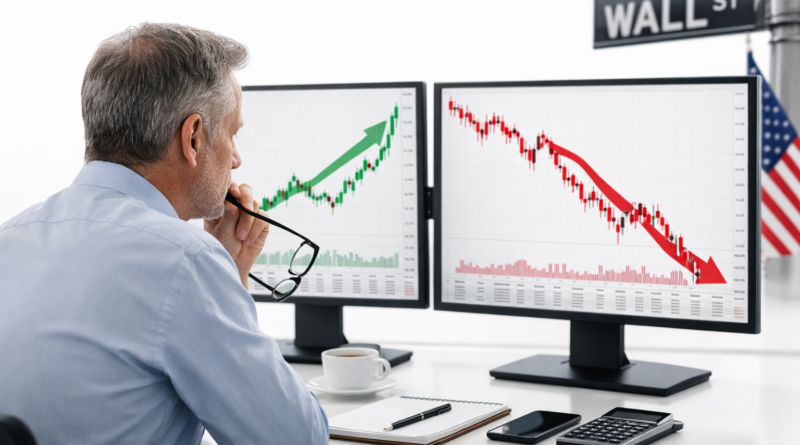
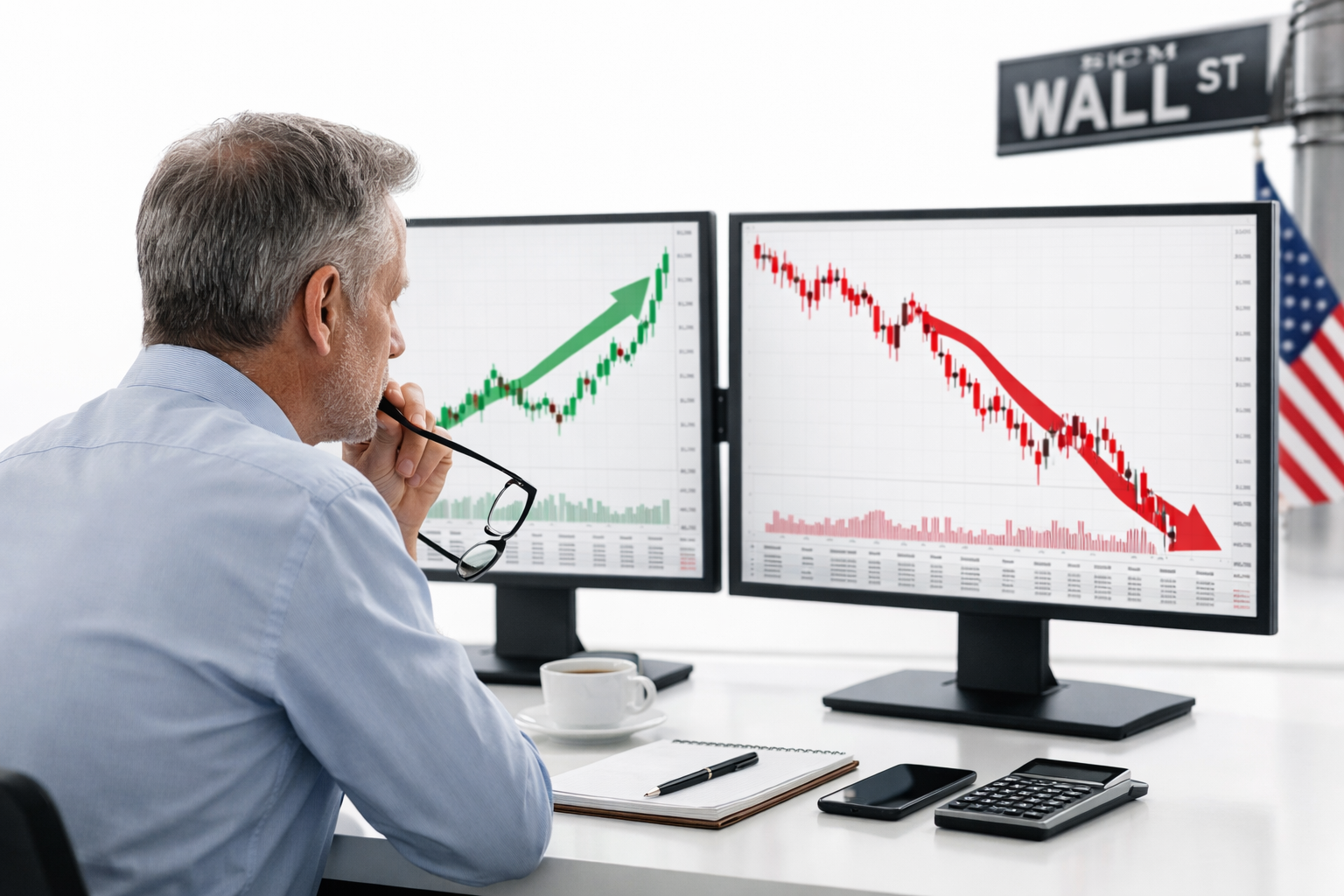
U.S. Stock Market Rally or Crash?
By New York Finance Think | U.S. Markets Desk
Updated: October 7, 2026
The U.S. stock market is sending investors two very different messages at the same time.
One message is bullish.
The S&P 500 and Nasdaq Composite recently reached record closing levels. The Dow Jones Industrial Average has also remained close to historic highs. Artificial intelligence spending, strong technology stocks and expectations for continued corporate earnings growth have helped push major indexes higher.
But the second message is much more cautious.
Treasury yields have climbed sharply. Oil remains elevated. Inflation is still above the Federal Reserve’s 2% target. The U.S. labor market has weakened, and Federal Reserve officials now appear concerned that inflation may remain persistent enough to require another interest-rate increase later this year.
That combination creates a difficult environment for investors.
The market can continue rising even when the economy is sending warning signals. At the same time, a record high does not automatically mean a stock-market crash is coming.
The real question for investors is therefore not simply:
“Will the market rally or crash?”
The more useful question is:
“What could keep the rally going, and what could cause it to reverse?”
That is the question this analysis examines.
Key Takeaways
- The S&P 500 and Nasdaq recently reached record highs, powered in large part by technology and AI-related stocks.
- On October 6, the S&P 500 gained about 0.6%, the Dow gained about 0.5% and the Nasdaq gained about 0.4%.
- On October 7, the market reversed direction as Treasury yields climbed and investors absorbed new Federal Reserve meeting minutes.
- The Fed’s latest minutes showed that most policymakers believe another rate increase could be necessary before the end of 2026.
- The Fed’s current target range is 3.75% to 4.00%, while August PCE inflation was 3.4% and September unemployment was 4.2%.
- The September jobs report showed only about 29,000 jobs were added, highlighting a cooling labor market.
- Rising Treasury yields are particularly important because they can pressure high-growth stocks, small companies, housing-related businesses and other interest-rate-sensitive assets.
- AI remains one of the biggest drivers of the current bull market, but concentration in a small group of mega-cap companies is an important risk.
- Investors should watch inflation, employment, Treasury yields, oil prices, Fed policy, corporate earnings and market breadth rather than relying on one indicator.
- A market record by itself is not a reliable signal that investors should sell everything.
- Likewise, a one-day decline does not automatically mean a market crash has begun.
The U.S. Stock Market Is at a Critical Point
Wall Street is entering one of those periods when investors can make very different interpretations of the same economic data.
A strong stock market normally suggests confidence.
Investors are willing to pay higher prices for companies because they expect earnings to grow. Businesses are investing. Consumers are spending. Technology companies are expanding. Corporate profits remain an important source of support.
But high stock prices can also create vulnerability.
When valuations become expensive, investors become more sensitive to interest rates and disappointing earnings.
That is what makes the current environment so interesting.
The market has demonstrated remarkable strength, but the bond market is sending a different signal.
On October 7, the 30-year Treasury yield reached its highest level since 2002 before giving back some of the increase. The 10-year Treasury yield also moved toward levels not seen in decades.
For everyday investors, the bond market can seem distant from stocks.
It is not.
Treasury yields influence mortgage rates, corporate borrowing costs, consumer credit and the valuation investors place on future corporate profits.
That means a large movement in Treasury yields can eventually become a stock-market story.
What Happened to Stocks This Week?
The market’s recent behavior illustrates the tension perfectly.
On October 6, major indexes reached new records.
The S&P 500 closed at approximately 7,818.93. The Dow finished around 51,521.28, while the Nasdaq Composite closed around 27,599.79.
The S&P 500 was up approximately 14.2% for the year at that point. The Nasdaq had gained about 18.7%, while the Dow was up about 7.2%.
Those numbers show that investors have not been behaving as though a crash is already underway.
Instead, investors have been willing to buy stocks despite concerns about inflation, energy prices, government debt and interest rates.
Technology has been especially important.
AI-related companies have attracted enormous amounts of capital because investors believe artificial intelligence could create a long-term transformation in computing, software, data centers, semiconductors and business productivity.
But the following day brought a reminder of how quickly sentiment can change.
On October 7, the Dow declined while the S&P 500 and Nasdaq also pulled back from their records. The move was linked to rising bond yields and investor reaction to the Federal Reserve’s latest meeting minutes.
This is not necessarily a crash.
It is a warning about volatility.
Rally or Crash: Which One Is More Likely?
There is no reliable way to predict the exact day a market rally will end.
That is why investors should avoid headlines claiming that a crash is guaranteed or that stocks can only go higher.
Markets rarely move in straight lines.
A bull market can experience sharp corrections.
A correction can occur without becoming a bear market.
A bear market can occur without becoming a financial crisis.
And a financial crisis can develop for reasons that investors did not expect.
Instead of predicting one outcome, investors should examine the conditions that would make each scenario more likely.
Scenario One: The Rally Continues
The bullish scenario is still possible.
The biggest argument for the bulls is corporate earnings.
If companies continue delivering strong revenue and profit growth, investors may continue accepting high stock valuations.
AI spending is another major support.
Companies are investing heavily in data centers, chips, cloud computing and artificial-intelligence infrastructure.
That creates demand across multiple parts of the economy.
Semiconductor companies benefit directly.
Cloud companies benefit from computing demand.
Data-center operators benefit from infrastructure spending.
Utilities and power companies can benefit from increased electricity demand.
Industrial companies can benefit from construction and infrastructure investment.
Software companies may eventually benefit from productivity improvements.
This means the AI trade is broader than simply buying one technology stock.
Scenario Two: A Normal Market Correction
A correction would be much less dramatic than a crash.
Investors sometimes forget this.
Stocks can fall 5%, 10% or even more without the financial system collapsing.
A correction can simply represent a repricing.
For example, if investors believe earnings will grow 10% but Treasury yields rise sharply, they may decide that the appropriate price for stocks is lower.
The underlying companies may remain healthy.
That is why long-term investors should distinguish between:
Price risk
and
Business risk.
A stock price can fall even when the company’s long-term business outlook remains intact.
Conversely, a stock can rise while the company’s fundamentals deteriorate.
Scenario Three: A More Serious Market Sell-Off
The risk becomes greater if several negative forces appear together.
Imagine the following combination:
- Inflation accelerates.
- Oil prices rise sharply.
- Treasury yields continue climbing.
- The Fed raises interest rates again.
- Corporate earnings estimates decline.
- Unemployment rises.
- Consumer spending weakens.
- AI-related valuations become excessive.
- Credit markets begin showing stress.
That would be a much more dangerous combination.
Investors could move rapidly from “buy the dip” to “reduce risk.”
Markets can fall much faster when investors are positioned aggressively on one side.
Why the Federal Reserve Matters So Much
The Federal Reserve remains one of the most important forces affecting U.S. stocks.
The reason is simple:
Interest rates influence the price of money.
When interest rates rise, borrowing becomes more expensive.
Companies may pay more to finance expansion.
Consumers may pay more for mortgages, auto loans and credit.
Investors may demand better returns from stocks because safer Treasury securities offer higher yields.
That last point is especially important for expensive growth stocks.
A company whose profits are expected many years in the future is generally more sensitive to interest-rate changes than a mature company producing substantial cash today.
The Latest Fed Message
The Federal Reserve’s September meeting produced an important change in the market narrative.
The central bank raised its benchmark rate by a quarter percentage point to approximately 3.9%, according to reporting on the September meeting. The Fed’s current target range is listed at 3.75% to 4.00%.
The October 7 minutes showed that most Fed officials believe another increase may be needed before the end of the year because inflation has not made enough progress toward the central bank’s 2% objective.
That is important because many investors would prefer lower interest rates.
Lower rates can support stock valuations.
But the Fed cannot simply lower rates because investors want cheaper money.
If inflation remains stubbornly high, cutting rates too quickly could make the inflation problem worse.
That leaves policymakers balancing two risks:
Inflation risk
versus
economic slowdown risk.
Inflation Is Still the Big Problem
The Federal Reserve’s preferred inflation measure, the personal consumption expenditures price index, was running at 3.4% in August, according to the Fed’s October 7 economic data.
That is well above the 2% target.
For Americans, inflation is not just a Wall Street statistic.
It affects:
- Groceries
- Rent
- Home prices
- Insurance
- Utilities
- Transportation
- Restaurant prices
- Medical costs
- Credit-card interest
- Borrowing costs
When inflation remains high, households have less purchasing power.
That can eventually affect consumer spending.
And consumer spending is extremely important to the U.S. economy.
The Labor Market Is Sending a Different Signal
The labor market has started to cool.
The September employment report showed that employers added only about 29,000 jobs, according to recent reporting. The unemployment rate reached 4.2%.
That creates a difficult situation for the Fed.
If employment remains strong while inflation is high, the Fed has more room to keep rates elevated.
But if employment weakens significantly, policymakers have to worry about the economy losing momentum.
This is one reason investors should watch the labor market closely.
A modest slowdown can be healthy.
A rapid deterioration is different.
What a Weak Labor Market Could Mean for Stocks
At first glance, weak employment might seem positive for stocks because it could encourage the Fed to lower rates.
But that is only half of the story.
A weak labor market can also mean:
- Lower consumer spending
- Lower corporate revenue
- Weaker earnings
- Higher defaults
- Lower business confidence
Therefore, investors should not automatically assume:
Bad economic news = good stock-market news.
There is a point where economic weakness becomes bad for corporate profits.
That distinction is critical.
Treasury Yields Could Become the Market’s Biggest Problem
One of the most important developments investors should watch is the rise in Treasury yields.
The 30-year Treasury yield recently reached its highest level since 2002, while the 10-year yield moved toward historically high levels.
Why does this matter?
Because Treasury securities compete with stocks for investor capital.
Suppose a Treasury investment offers a much higher yield.
An investor may decide that taking substantial stock-market risk is less attractive.
Higher yields can also increase the discount rate used to value future earnings.
That can put pressure on expensive growth stocks.
Why Small-Cap Stocks May Feel More Pressure
Small companies often depend more heavily on borrowing.
That makes them more sensitive to interest rates.
The Russell 2000 declined about 0.6% on October 6 even as the S&P 500 and Nasdaq reached records.
That divergence is worth watching.
If large technology companies continue rising while smaller companies struggle, investors should ask why.
It could indicate that investors are concentrating their money in companies they view as financially stronger.
It can also indicate that the market rally is becoming narrower.
The AI Rally Is Powerful — But Concentration Matters
Artificial intelligence has become one of the biggest investment stories of the decade.
Companies are spending enormous amounts on:
- AI chips
- Data centers
- Cloud computing
- Networking
- Energy infrastructure
- Software
- Cybersecurity
- Advanced computing
Nvidia has been one of the central beneficiaries.
Its market value has moved toward approximately $6 trillion, making it one of the most influential companies in the market.
But this creates an important risk.
When a small number of companies account for a large percentage of index performance, the market can appear healthier than the average stock actually is.
Why Market Breadth Matters
Market breadth asks a simple question:
How many stocks are participating in the rally?
A healthy market generally has broad participation.
If hundreds of companies are rising alongside the major indexes, the rally has more support.
If only a handful of mega-cap companies are responsible for most gains, the market becomes more concentrated.
That does not mean a crash is inevitable.
It simply means investors should understand what is actually driving the index.
Recent reporting noted that Nvidia, Apple and Microsoft together account for roughly one-fifth of the S&P 500.
That is a significant concentration.
Nvidia and the AI Trade
Nvidia has become more than just another technology stock.
It is now a major representation of investor expectations about the future of artificial intelligence.
The bullish argument is straightforward.
AI requires enormous computing power.
That computing power requires advanced chips.
Nvidia is one of the leading suppliers of that technology.
If AI infrastructure spending continues expanding, Nvidia and related companies could continue benefiting.
But the risk is equally straightforward.
When expectations become extremely high, companies must deliver exceptional results to justify those expectations.
A company can report good earnings and still see its stock decline if investors expected even better results.
That is why investors should never confuse:
A great company
with
a stock that is guaranteed to rise.
What About Apple, Microsoft, Amazon, Meta and Alphabet?
The largest technology companies remain important because of their scale and financial strength.
Companies such as Apple, Microsoft, Amazon, Meta and Alphabet operate across enormous global markets.
They also have substantial cash flows and access to capital.
But their stocks are still exposed to valuation risk.
Investors should watch:
- Revenue growth
- Earnings growth
- AI spending
- Cloud growth
- Advertising demand
- Consumer demand
- Capital expenditure
- Free cash flow
- Share buybacks
- Regulatory developments
The biggest companies can be excellent businesses while still experiencing significant stock-market declines.
Oil Prices Could Change the Market Story
Energy prices are another important risk.
Higher oil prices can create inflationary pressure.
That can make the Federal Reserve’s job harder.
If gasoline prices rise, consumers have less money available for other purchases.
If transportation costs rise, companies can face higher expenses.
If energy-intensive industries face higher costs, profit margins can come under pressure.
That creates a potential chain reaction:
Higher oil → higher inflation → higher interest rates → higher Treasury yields → pressure on stock valuations.
This is one reason investors should not look at the stock market in isolation.
The U.S. Consumer Remains Critical
The American consumer is one of the biggest engines of the economy.
Consumers drive spending on:
- Housing
- Cars
- Food
- Travel
- Restaurants
- Entertainment
- Electronics
- Online shopping
- Healthcare
If households remain financially healthy, companies can continue generating revenue.
But if inflation remains high while employment weakens, households may begin cutting discretionary spending.
That could become a major earnings problem.
Credit Cards and Household Debt
High interest rates also matter for American households carrying revolving debt.
Credit-card borrowing can become extremely expensive when interest rates remain elevated.
If consumers increasingly use credit to maintain their spending, financial stress can build underneath the headline economic numbers.
Investors should therefore monitor consumer-credit data as well as stock prices.
A strong stock market does not necessarily mean every household is financially comfortable.
Could the Market Crash Even at Record Highs?
Yes.
But a record high itself is not the reason.
Markets have historically reached many new highs during long bull markets.
The more important question is whether the underlying economic and corporate fundamentals support the valuation.
A crash usually requires a catalyst or a combination of catalysts.
Possible catalysts include:
- Unexpected inflation
- Aggressive Fed tightening
- Banking stress
- Credit-market problems
- Geopolitical escalation
- Major corporate failures
- Sharp oil-price increases
- Recession
- AI valuation collapse
- Sovereign-debt concerns
- Severe consumer weakness
None of these should be assumed to happen.
They are risks investors should monitor.
What Would a Healthy Pullback Look Like?
A healthy pullback could involve:
- Several days of lower prices
- Profit-taking
- Rotation into defensive sectors
- Lower trading volume
- Stable credit markets
- Continued corporate earnings growth
- No major deterioration in employment
That type of decline can actually strengthen a bull market by removing excessive optimism.
Markets do not need to rise every day to remain bullish.
What Would a Dangerous Sell-Off Look Like?
A more concerning market decline would involve multiple warning signs appearing together.
For example:
- Stocks fall sharply.
- Treasury yields rise simultaneously.
- Credit spreads widen.
- Banks begin tightening lending.
- Corporate earnings estimates fall.
- Unemployment rises rapidly.
- Consumer spending weakens.
- Volatility jumps.
- Investors sell both stocks and riskier credit.
- Market breadth deteriorates.
That combination would deserve much more attention than a normal one-day decline.
Five Warning Signs Investors Should Watch
1. Treasury Yields
Watch the 10-year and 30-year Treasury yields.
A sustained rise can pressure equity valuations.
2. Inflation
If inflation accelerates unexpectedly, rate-cut expectations could disappear.
3. Employment
A gradual cooling may be manageable.
A sharp deterioration could signal recession risk.
4. Corporate Earnings
The stock market ultimately depends on corporate profits.
If earnings expectations fall substantially, valuations may have to adjust.
5. Market Breadth
If fewer stocks participate in the rally, concentration risk increases.
Five Signs the Rally Could Continue
Strong Earnings
If companies continue beating expectations and raising guidance, stocks may remain supported.
AI Investment
Continued AI infrastructure spending could support technology and industrial companies.
Economic Resilience
If the U.S. economy avoids recession, corporate profits may remain healthy.
Controlled Inflation
If inflation gradually moves lower without a severe recession, the Fed could eventually become less restrictive.
Improving Market Breadth
A rally spreading beyond mega-cap technology would provide stronger evidence of broad investor confidence.
What Investors Should Watch in the S&P 500
The S&P 500 remains the most important broad U.S. equity benchmark for many investors.
But investors should look beyond the index level.
Watch:
- Earnings growth
- Forward earnings estimates
- Sector participation
- Valuation
- Treasury yields
- Profit margins
- Consumer spending
- AI capital expenditure
- Fed policy
A rising index with falling earnings expectations can be more fragile than a rising index supported by improving profits.
What Investors Should Watch in the Nasdaq
The Nasdaq is heavily influenced by technology and growth companies.
That makes it especially sensitive to:
- Interest rates
- AI expectations
- Semiconductor demand
- Cloud spending
- Software earnings
- Technology valuations
If Treasury yields continue climbing, investors should expect greater volatility in high-growth stocks.
What Investors Should Watch in the Dow
The Dow has a different composition from the Nasdaq.
It includes large established companies across several sectors.
That means it can behave differently from technology-heavy indexes.
During periods of rising interest rates, investors may rotate toward profitable, established businesses.
But industrial and consumer companies can also suffer if economic growth slows.
What Investors Should Watch in the Russell 2000
Small-cap stocks can provide useful information about the domestic economy.
They are often more sensitive to:
- Borrowing costs
- Bank lending
- Domestic consumer demand
- Economic growth
If large technology companies rise while small caps decline, investors should pay attention.
It does not automatically predict a crash.
But it can indicate that the market’s strength is concentrated.
Banks and Financial Stocks
Financial companies occupy a particularly interesting position.
Higher interest rates can sometimes benefit banks by improving lending income.
But higher rates can also increase credit stress.
If consumers and businesses struggle to repay loans, banks may face rising losses.
Investors should therefore monitor:
- Loan growth
- Credit losses
- Commercial real estate exposure
- Deposit costs
- Net interest margins
- Bank capital levels
Housing and Mortgage Rates
The bond market also affects American housing.
Higher Treasury yields can contribute to higher mortgage rates.
That can make home ownership less affordable.
For consumers already struggling with housing costs, this matters enormously.
For investors, housing weakness can affect:
- Homebuilders
- Mortgage companies
- Banks
- Building-material companies
- Real-estate businesses
- Consumer spending
What a Market Crash Means for the Average American
A stock-market crash does not affect only wealthy investors.
It can affect ordinary Americans through retirement accounts and employment.
Many workers have exposure to stocks through:
- 401(k) plans
- IRAs
- Pension funds
- Brokerage accounts
- Index funds
A major decline can therefore reduce household wealth.
But the impact depends on time horizon.
A 25-year-old investor with decades until retirement has a very different situation from someone retiring next month.
Why Long-Term Investors Should Think Differently
A long-term investor should focus more on:
- Asset allocation
- Diversification
- Time horizon
- Risk tolerance
- Regular contributions
- Quality of investments
Short-term market forecasting is extremely difficult.
Trying to sell before every decline and buy before every rally sounds attractive.
In reality, consistently timing both decisions is extraordinarily difficult.
The Biggest Mistake: Panic Selling
One of the most common investor mistakes occurs after prices have already fallen.
Investors see their portfolio declining.
Fear increases.
They sell.
Then the market recovers.
The investor is left holding cash while prices rise.
This is why having a plan before volatility arrives is so important.
Another Mistake: Buying Every Dip
The opposite mistake is equally dangerous.
Not every decline is a buying opportunity.
Some companies decline because their business fundamentals are deteriorating.
A falling price does not automatically make a stock cheap.
Investors should ask:
Why did the stock fall?
Then ask:
Has the underlying business changed?
A Better Question for Investors
Instead of asking:
“Will the market crash?”
Ask:
“What would make my investment thesis wrong?”
That is a much stronger investment question.
For an AI company, the answer might be:
- AI spending slows.
- Competition increases.
- Margins fall.
- Customers delay purchases.
- Valuation becomes excessive.
For a bank, it could be:
- Credit losses rise.
- Deposits become expensive.
- Loan demand weakens.
- Commercial real-estate losses increase.
Thinking in terms of risk makes investing more disciplined.
How Beginners Can Handle a Volatile Market
New investors should not build a portfolio around headlines.
A simple framework is:
Understand the investment
Know what you own.
Understand the risk
Know what could cause it to decline.
Diversify
Avoid making one company or one sector your entire portfolio.
Think about time
Money needed soon should generally not be treated the same as retirement money needed decades later.
Keep an emergency reserve
Investing should not replace basic financial stability.
Avoid excessive leverage
Borrowing money to invest can magnify both gains and losses.
What Could Trigger the Next Major Rally?
Several catalysts could push stocks higher.
Falling inflation
If inflation continues declining, the Fed could eventually become less restrictive.
Lower Treasury yields
Lower yields can support equity valuations.
Strong earnings
Corporate profit growth can justify higher stock prices.
AI productivity
If AI begins producing measurable productivity gains, investors may become more confident in long-term earnings.
Better market breadth
If more sectors participate, the rally could become stronger.
What Could Trigger the Next Major Sell-Off?
The biggest risks are not necessarily visible in today’s index levels.
Investors should watch for:
Persistent inflation
This could force the Fed to maintain or increase rates.
Higher oil prices
Energy inflation could spread through the economy.
Rising Treasury yields
High yields can pressure valuations.
Earnings disappointment
Expensive stocks have little room for weak results.
Labor-market deterioration
A sharp employment slowdown could increase recession fears.
Credit stress
Problems in banks or corporate debt markets could quickly change sentiment.
The Fed’s October Decision Is Important
The Federal Reserve’s next policy meeting will be closely watched.
Recent reporting suggested policymakers were leaning toward holding rates in October while evaluating additional economic data, although the latest minutes indicate that another increase later in the year remains possible.
That means investors should avoid assuming that the next move is guaranteed.
The Fed is data-dependent.
Inflation, jobs, consumer spending and financial conditions will all matter.
Why the Market Can Rise Even When the Fed Is Hawkish
This may seem confusing.
If higher rates are bad for stocks, why did stocks recently reach records?
Because markets price expectations.
If investors already expect higher rates, the actual news may not cause a major decline.
Meanwhile, strong earnings expectations can offset some of the pressure from higher yields.
This is why markets sometimes rise on apparently negative news.
The reaction depends on what investors expected before the news arrived.
The Importance of Expectations
Imagine investors expect a company to earn $5 per share.
The company reports $5.50.
The stock may rise.
Now imagine investors expected $6.
The same $5.50 result could cause the stock to fall.
The same principle applies to economic data.
Markets respond not simply to whether data is good or bad.
They respond to whether the data is better or worse than expected.
Is the Current Rally Too Concentrated?
This is one of the most important questions for investors.
The recent market advance has received significant support from mega-cap technology companies.
The Magnificent Seven have collectively approached a $25 trillion market capitalization, with Nvidia and Meta among the notable recent leaders.
That concentration creates both strength and vulnerability.
If these companies continue delivering exceptional growth, the market can remain strong.
If expectations suddenly change, the impact could be large because of their weight in major indexes.
The Bull Case for 2027
Looking beyond the immediate market noise, the bullish case depends on several factors.
If AI investment continues.
If productivity improves.
If inflation eventually moves closer to 2%.
If the labor market stabilizes.
If earnings continue growing.
If Treasury yields stop rising.
Then the current bull market could have additional room to run.
That does not mean stocks will rise every month.
It means the underlying environment could remain supportive.
The Bear Case for 2027
The bearish case is equally straightforward.
If inflation remains stubborn.
If oil prices remain elevated.
If Treasury yields rise further.
If the Fed keeps tightening.
If employment deteriorates.
If consumers reduce spending.
If corporate earnings weaken.
Then the market could face a substantial repricing.
The most dangerous environment would be one where inflation stays high while growth simultaneously slows.
That is the classic problem of stagflation.
Why Investors Should Watch Bonds as Closely as Stocks
Many individual investors check stock prices every day but rarely look at Treasury yields.
That can be a mistake.
The bond market can sometimes reveal changes in financial conditions before they become obvious in equity prices.
A major increase in long-term Treasury yields can influence:
- Mortgage rates
- Corporate borrowing
- Stock valuations
- Government financing costs
- Consumer loans
- Currency markets
For the current market, Treasury yields deserve particular attention.
What About Gold and Bitcoin?
Alternative assets can also provide clues about investor sentiment.
Gold has faced pressure as interest-rate expectations have shifted, while Bitcoin recently fell from higher levels as broader risk sentiment weakened.
But investors should be careful about treating either asset as a guaranteed market-crash indicator.
Gold, Bitcoin and stocks can sometimes move together.
At other times they move in opposite directions.
The relationship changes with liquidity, interest rates and investor positioning.
A Practical Market Checklist
For investors who want a simple daily framework, watch these ten indicators:
- S&P 500 trend
- Nasdaq trend
- Dow Jones trend
- Russell 2000
- 10-year Treasury yield
- 30-year Treasury yield
- Oil prices
- Federal Reserve expectations
- Corporate earnings estimates
- Market breadth
You do not need to predict every market move.
You need to understand whether the overall environment is becoming more supportive or more dangerous.
What Investors Should Watch Next
The next phase of the market will probably be shaped by the interaction of three forces.
First: Inflation
If inflation stays high, the Fed may have less flexibility.
Second: Employment
If the labor market weakens sharply, recession concerns could increase.
Third: Earnings
If corporate earnings remain strong, stocks may be able to absorb higher interest rates.
The market is essentially trying to answer one question:
Can corporate profits continue growing fast enough to justify today’s valuations while interest rates remain high?
That is the central investment debate.
Market Rally vs. Market Crash: A Simple Comparison
| Factor | Rally Scenario | Crash/Sell-Off Scenario |
|---|---|---|
| Inflation | Falls gradually | Accelerates |
| Fed | Becomes less restrictive | Tightens further |
| Treasury yields | Stabilize/fall | Continue rising |
| Jobs | Stabilize | Deteriorate sharply |
| Earnings | Beat expectations | Estimates decline |
| AI spending | Remains strong | Slows materially |
| Consumer | Resilient | Spending weakens |
| Oil | Stabilizes | Surges |
| Credit | Healthy | Stress increases |
| Market breadth | Improves | Narrows |
This table is not a prediction.
It is a framework.
What Americans Should Take Away
For ordinary Americans, the stock market should not be treated as a casino that must be watched every minute.
The market is a mechanism through which investors participate in the growth of businesses.
But participation comes with risk.
The current environment is a perfect example.
Stocks can reach record highs while economic concerns remain.
A weak jobs report can increase hopes for lower rates while simultaneously raising recession fears.
Higher Treasury yields can hurt stocks while reflecting stronger concerns about inflation or government borrowing.
AI can create enormous economic opportunities while also producing valuation risk.
The market is complicated because the economy is complicated.
Final Analysis: Rally, Correction or Crash?
The evidence available on October 7, 2026 does not by itself prove that a stock-market crash has begun.
Instead, the market is showing a mixture of strength and vulnerability.
The strength is clear.
The S&P 500 and Nasdaq recently reached records. Corporate earnings optimism remains important. AI investment remains powerful. Major technology companies continue to attract investors.
The risks are also clear.
Treasury yields are elevated. Inflation remains above the Federal Reserve’s target. Employment has weakened. Oil prices remain an important inflation risk. And the Fed’s latest minutes suggest that another rate increase could be necessary later this year.
That means investors should not become excessively bullish simply because indexes are at record highs.
But they also should not assume that every decline is the beginning of a crash.
The more useful approach is to watch the evidence.
If earnings remain strong, inflation cools and Treasury yields stabilize, the rally could continue.
If inflation accelerates, yields climb further, employment weakens and earnings expectations fall, the probability of a deeper correction would increase.
For long-term investors, the most important lesson is simple:
Do not build an investment strategy around predicting tomorrow’s headline. Build it around understanding risk, diversification, valuation, time horizon and the economic forces that drive markets.
The next major move in U.S. stocks will not be determined by one number.
It will be determined by the relationship between inflation, interest rates, economic growth, corporate earnings, AI investment, consumer demand and investor expectations.
That is what Wall Street will be watching.
And that is what investors should watch next.
Frequently Asked Questions
Is the U.S. stock market going to crash?
Nobody can reliably predict a specific market crash in advance. Current conditions show both bullish and bearish signals. Record highs are being supported by technology and earnings optimism, while elevated Treasury yields, inflation and Fed policy create risks.
Is the S&P 500 still in a bull market?
The recent record highs are consistent with a strong bullish market environment, but investors should monitor whether earnings, market breadth and economic fundamentals continue supporting the advance.
Why are Treasury yields important for stocks?
Higher Treasury yields can increase borrowing costs and make bonds more attractive relative to stocks. They can also reduce the valuation investors are willing to pay for future corporate earnings.
Why does the Federal Reserve affect the stock market?
The Fed controls short-term monetary policy and influences financial conditions. Interest-rate expectations can affect borrowing, consumer spending, corporate investment and stock valuations.
Could high interest rates cause a recession?
Persistently high rates can slow borrowing and spending. Whether they cause a recession depends on the strength of the economy and how long restrictive financial conditions remain in place.
Why is Nvidia important to the market?
Nvidia is a major supplier of AI-related computing technology and has become one of the largest companies in the stock market. Because of its size and influence, large moves in Nvidia can affect major indexes.
Should investors sell before a market crash?
There is no universal answer. Investors should consider their time horizon, risk tolerance, financial needs and portfolio allocation rather than trying to predict the exact top of the market.
Is a market correction the same as a crash?
No. A correction is generally a smaller decline from recent highs. A crash is a much more severe and rapid decline. The exact definitions can vary depending on the context.
What should beginner investors watch?
Beginners should focus on diversification, asset allocation, investment costs, time horizon, risk tolerance and the quality of the underlying investments.
What should investors watch next?
The most important areas are inflation, Federal Reserve policy, Treasury yields, employment, oil prices, corporate earnings, consumer spending and market breadth.
Financial Disclaimer
This article is for informational and educational purposes only. It is not investment, financial, tax or legal advice. Market conditions can change rapidly, and past performance does not guarantee future results. Investors should conduct their own research and consider their financial situation, investment objectives and risk tolerance before making investment decisions. Consider consulting a qualified financial professional for personalized advice.
Sources
- Federal Reserve — monetary policy, inflation, unemployment and economic data.
- Associated Press — October 6, 2026 U.S. market performance.
- Reuters — Federal Reserve rate-hike expectations and October policy outlook.
- Associated Press — Federal Reserve September meeting minutes and inflation concerns.
- Yahoo Finance — October 7 market decline, Treasury yields and market concentration
official + high-authority source links
Official Sources
- Federal Reserve — September 15–16, 2026 FOMC Minutes
Federal Reserve — FOMC Minutes
Fed minutes inflation, Treasury yields, energy prices monetary-policy expect (Federal Reserve) - Federal Reserve — October 7, 2026 Minutes Release
Federal Reserve — October 7 FOMC Minutes Release (Federal Reserve) - Federal Reserve — FOMC Meeting Calendar 2026
Federal Reserve — FOMC Calendar (Federal Reserve) - Federal Reserve — U.S. Economy & Monetary Policy
Federal Reserve — U.S. Economy and Monetary Policy (Federal Reserve)
Current Market Sources
- Reuters — October 7, 2026: Wall Street Ends Lower
Reuters — Wall Street Ends Lower as Treasury Yields Climb (Reuters) - Reuters — October 6, 2026: S&P 500 & Nasdaq Record Highs
Reuters — S&P 500, Nasdaq Reach Record Closing Highs (Reuters) - AP — October 7, 2026: Major U.S. Index Performance
AP News — How Major U.S. Stock Indexes Fared Wednesday (AP News) - Reuters — U.S. Treasury Yield Outlook
Reuters — U.S. Treasury Yield Outlook (Reuters)
