
WHO SETS THE GOLD PRICE IN THE USA? HOW AMERICA’S GOLD MARKET REALLY WORKS 2026
By New York Finance Think Newsroom
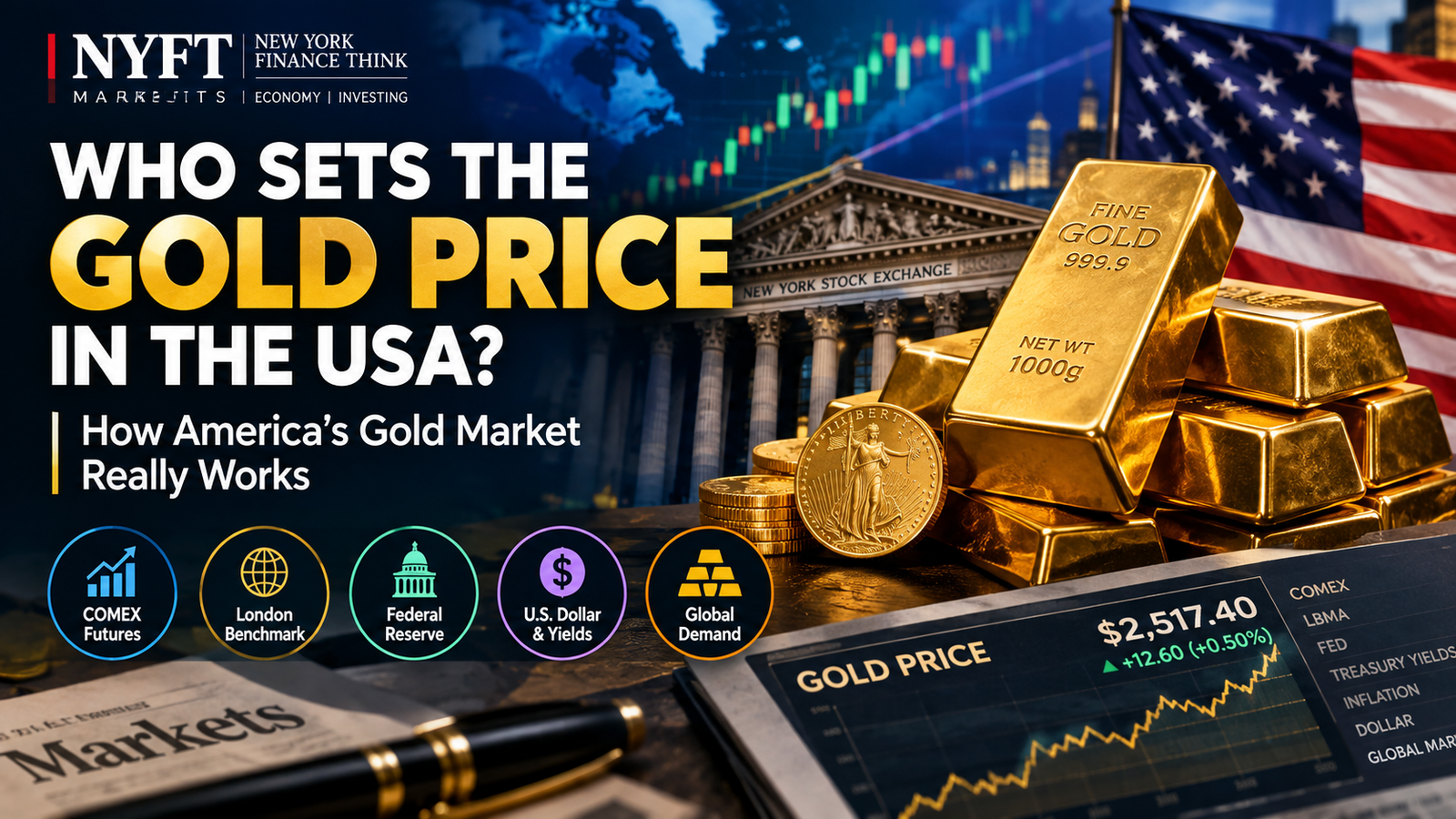
Gold is one of the most closely watched financial assets in America. Investors follow the gold price when inflation is rising, interest rates are changing, the U.S. dollar is moving, or global tensions are creating uncertainty.
But there is one basic question many Americans have:
Who actually sets the price of gold in the United States?
The short answer is surprising: No single person, government agency, bank, or Federal Reserve official sets the U.S. gold price.
Instead, gold prices are formed through a large global marketplace involving futures exchanges, banks, institutional investors, mining companies, dealers, central banks and millions of buyers and sellers.
In the United States, the COMEX gold futures market in New York is one of the most important price-discovery centers. At the same time, the global gold market also relies heavily on international benchmarks, particularly the LBMA Gold Price in London.
Understanding this system helps investors understand why the price of gold can change within seconds.
THE SIMPLE ANSWER: WHO SETS THE GOLD PRICE?
The U.S. gold price is primarily determined by market supply and demand.
When more investors want to buy gold, prices can rise.
When more investors want to sell, prices can fall.
But the modern gold market is much more complicated than a simple store shelf price.
Several major markets and financial institutions contribute to price discovery.
The most important factors include:
- COMEX gold futures trading
- Global spot gold trading
- London gold benchmarks
- U.S. dollar movements
- Federal Reserve interest-rate expectations
- Treasury yields
- Inflation expectations
- Central-bank gold purchases
- Investment demand
- Jewelry demand
- Gold mine supply
- Geopolitical risk
So, there is no single person sitting in New York deciding that gold should cost $3,000 or $4,000 an ounce.
The market determines the price.
WHAT IS COMEX AND WHY DOES IT MATTER?
For Americans, one of the most important parts of the gold market is COMEX, the commodities exchange operated by CME Group in New York.
COMEX provides a major marketplace for gold futures.
A gold futures contract allows market participants to agree to buy or sell gold at a specified price for future delivery.
Large financial institutions, hedge funds, professional traders, producers and other market participants use these contracts for different reasons.
Some are trying to profit from changes in gold prices.
Others use futures to hedge against price risk.
Because of the large amount of trading taking place in gold futures, COMEX prices are closely watched by financial markets around the world.
This makes COMEX an important part of U.S. gold price discovery.
DOES COMEX ACTUALLY SET THE PHYSICAL GOLD PRICE?
Not exactly.
This distinction is important.
COMEX provides a highly visible and heavily traded futures market, but it does not simply announce one official price that every gold dealer in America must use.
Instead, COMEX trading contributes to price discovery.
The market continuously processes buying and selling information.
Gold dealers, financial institutions and other market participants then use market prices when establishing their own buying and selling prices.
This is why the price displayed on a financial website and the price offered by a local jewelry store may not be exactly the same.
WHAT IS THE LBMA GOLD PRICE?
Another major part of the international gold market is the London Bullion Market.
The LBMA Gold Price is an important global benchmark for gold.
The benchmark is administered by ICE Benchmark Administration and is established through an electronic auction process.
The benchmark is published twice each business day for gold:
- 10:30 a.m. London time
- 3:00 p.m. London time
The benchmark helps market participants value gold and settle transactions.
However, the LBMA Gold Price does not mean that London independently controls the U.S. gold market.
Gold is a global asset.
New York, London and other major financial centers interact continuously.
GOLD IS A GLOBAL MARKET
This is one of the most important things for new investors to understand.
Gold does not belong exclusively to America.
It is traded around the world.
Major gold trading centers include:
- New York
- London
- Shanghai
- Hong Kong
- Zurich
- Singapore
- Dubai
Because these markets are connected, gold prices can move around the clock during global trading sessions.
A major event in Asia or Europe can affect gold prices in New York before the U.S. stock market even opens.
Likewise, a major Federal Reserve announcement can affect gold prices around the world.
WHO ARE THE BIG PLAYERS IN THE GOLD MARKET?
Gold prices are influenced by many different participants.
1. CENTRAL BANKS
Central banks are major participants in the global gold market.
They can hold gold as part of their foreign-exchange reserves.
When central banks increase gold purchases, investors may interpret the move as a sign of strong official-sector demand.
Large purchases can therefore become an important market signal.
2. COMMERCIAL BANKS
Large banks participate in the gold market by providing liquidity, trading precious metals and managing exposure to gold prices.
Banks can act for themselves or provide services to institutional clients.
Their activity contributes to the overall market.
3. HEDGE FUNDS AND INVESTMENT FUNDS
Hedge funds and other institutional investors can trade gold futures and other gold-related financial products.
When large funds change their positions, gold prices can move quickly.
4. GOLD MINING COMPANIES
Mining companies produce physical gold.
Their production affects the supply side of the market.
Mining companies can also use financial markets to hedge future production against changes in gold prices.
5. JEWELRY BUYERS
Consumers also matter.
Gold is widely used in jewelry around the world.
When jewelry demand rises, physical demand for gold can increase.
When high prices reduce jewelry purchases, demand can weaken.
6. INDIVIDUAL INVESTORS
Americans can participate in the gold market through:
- Physical gold bars
- Gold coins
- Gold-backed exchange-traded funds
- Gold mining stocks
- Gold futures
- Other financial products
Individual investors are only one part of the market, but their combined demand can still matter.
DOES THE FEDERAL RESERVE SET THE GOLD PRICE?
No.
The Federal Reserve does not set the price of gold.
This is an important misconception.
The Federal Reserve sets U.S. monetary policy, including the federal funds target range.
Its decisions can have a major indirect effect on gold.
For example, if investors expect interest rates to fall, gold can become more attractive because the opportunity cost of holding a non-interest-bearing asset may decline.
If interest rates and Treasury yields rise sharply, gold can sometimes face pressure.
The relationship is not automatic, however.
Gold also reacts to inflation, currency movements, geopolitical risks and investor demand.
WHY DOES THE U.S. DOLLAR MATTER SO MUCH?
Gold is generally quoted internationally in U.S. dollars.
That makes the dollar one of the most important factors influencing gold prices.
If the dollar weakens, gold can become cheaper for buyers using other currencies.
That can support global demand.
If the dollar strengthens significantly, gold can become more expensive for international buyers.
That can sometimes put downward pressure on prices.
This is one reason gold traders closely monitor the U.S. Dollar Index and major currency markets.
WHY DO TREASURY YIELDS MATTER?
Gold does not pay interest.
A Treasury security, by contrast, can provide interest income.
Therefore, when Treasury yields rise, some investors may prefer interest-paying assets instead of holding gold.
When yields fall, gold can become relatively more attractive.
But this relationship is not perfect.
During periods of severe financial stress, investors may buy gold even when yields are moving higher because they are seeking a perceived safe-haven asset.
INFLATION AND GOLD
Gold is often described as an inflation hedge.
The idea is simple.
When the purchasing power of money declines, investors may look for assets that they believe can preserve value over long periods.
Gold has historically been used as a store of value.
But investors should not assume that gold automatically rises every time inflation rises.
Gold prices depend on many variables at the same time.
For example:
Inflation ↑ → Rate expectations ↑ → Treasury yields ↑ → Dollar ↑
This combination can sometimes create pressure on gold.
But:
Inflation ↑ → Economic uncertainty ↑ → Safe-haven demand ↑
can provide support.
That is why gold requires a broader market analysis.
GEOPOLITICAL RISK CAN MOVE GOLD
Gold is also closely watched during periods of geopolitical uncertainty.
Wars, financial crises, political instability and fears about global economic disruption can increase demand for assets investors perceive as defensive.
Gold can benefit from this type of safe-haven demand.
However, even during geopolitical crises, gold prices can move in both directions.
Investors may sell gold to raise cash, while others may buy it for protection.
WHY DOES GOLD PRICE CHANGE EVERY SECOND?
Gold is traded in highly liquid global financial markets.
Prices change whenever buyers and sellers transact or when market participants update their bids and offers.
Consider a simple example.
Suppose traders suddenly believe the Federal Reserve will cut interest rates.
Some investors may immediately buy gold.
Demand increases.
Gold futures prices may rise.
The higher futures price can influence other market prices.
Within seconds, financial websites, brokers and dealers can update their gold quotes.
This is why gold is not a once-a-day price.
It is a continuously changing market price.
WHY IS THE PRICE AT A GOLD STORE DIFFERENT?
A common question from ordinary consumers is:
“If gold is trading at one price online, why does my dealer charge more?”
The answer is that the consumer price includes more than the underlying market price.
A dealer may include:
- Dealer premium
- Manufacturing costs
- Minting costs
- Shipping
- Insurance
- Storage
- Business expenses
- Taxes where applicable
- Product scarcity
- Profit margin
A one-ounce gold bar and a collectible gold coin can therefore have different prices even if both contain approximately one ounce of gold.
GOLD SPOT PRICE VS. GOLD FUTURES PRICE
These two terms are often confused.
SPOT GOLD
The spot price refers broadly to the current market price for gold in the spot market.
It is widely used as a reference for the value of gold.
GOLD FUTURES
Gold futures are standardized contracts traded on exchanges such as COMEX.
The futures price reflects market expectations and the economics of buying, holding and delivering gold at a future date.
Spot and futures prices are closely connected but are not necessarily identical.
WHO CONTROLS GOLD PRICES IN AMERICA?
The answer is:
Nobody controls the U.S. gold price by themselves.
The price is the result of a global market.
A useful way to understand it is:
GLOBAL SUPPLY + GLOBAL DEMAND + COMEX TRADING + LONDON BENCHMARKS + U.S. DOLLAR + INTEREST RATES + INFLATION + INVESTOR SENTIMENT = GOLD PRICE DISCOVERY
This is not a mathematical formula used by an exchange.
It is simply a way to understand the major forces affecting the market.
WHAT ROLE DOES THE U.S. GOVERNMENT PLAY?
The U.S. government does not normally announce a daily retail gold price.
Government agencies can influence the environment in which gold trades through:
- Monetary policy
- Fiscal policy
- Financial regulation
- Economic policy
- Trade policy
The Federal Reserve is particularly important because its interest-rate decisions can influence the dollar, Treasury yields, financial conditions and investor expectations.
But that is different from directly setting gold prices.
DOES THE U.S. GOVERNMENT STILL HAVE GOLD?
Yes.
The United States holds a large official gold reserve.
The U.S. Treasury is responsible for the nation’s official gold holdings.
However, the existence of the U.S. government’s gold reserves does not mean the government sets the daily market price of gold.
The market price is determined through trading.
WHY DO GOLD PRICES SOMETIMES MOVE WITH STOCKS?
Gold is often considered a defensive asset, while stocks represent ownership in companies.
During periods of economic confidence, investors may favor stocks.
During periods of fear, some investors may increase exposure to gold.
But gold and stocks do not always move in opposite directions.
Both can rise at the same time.
For example, investors may buy stocks because corporate earnings are strong while also buying gold because inflation or geopolitical risks remain elevated.
THE GOLD MARKET AND WALL STREET
Wall Street plays an important role in gold trading.
Large financial institutions, investment funds and professional traders can trade:
- Gold futures
- Gold options
- Gold ETFs
- Mining stocks
- Other derivatives
This creates a large financial ecosystem around the physical gold market.
However, Wall Street does not have a single button that controls the gold price.
It is a marketplace where many participants compete.
WHAT SHOULD AMERICAN INVESTORS WATCH?
If you want to understand where gold may be heading, don’t look at only one number.
Watch several indicators together.
GOLD MARKET CHECKLIST
| FACTOR | WHY IT MATTERS |
|---|---|
| Gold Spot Price | Current reference price |
| COMEX Gold Futures | Major U.S. price-discovery market |
| U.S. Dollar | Gold is primarily quoted in dollars |
| 10-Year Treasury Yield | Measures the return available from U.S. government debt |
| Federal Reserve Policy | Influences rates and financial conditions |
| Inflation | Can influence demand for stores of value |
| Central Bank Buying | Important source of physical demand |
| Oil Prices | Can influence inflation expectations |
| Geopolitical Risk | Can increase safe-haven demand |
| ETF Flows | Shows investment demand |
| Mine Supply | Affects physical supply |
| Jewelry Demand | Major component of global consumption |
TABLE CAPTION: Major factors investors watch when analyzing the U.S. and global gold markets.
THE BIG MISUNDERSTANDING ABOUT GOLD
One of the biggest misconceptions is that someone in the U.S. government or at the Federal Reserve simply decides what gold should cost.
That is not how the modern gold market works.
The price is continuously discovered through global financial markets.
COMEX is extremely important for U.S. futures trading.
London is extremely important for global benchmark pricing.
Banks and institutional investors provide liquidity.
Central banks influence physical demand.
Mining companies influence supply.
Consumers influence jewelry demand.
The Federal Reserve influences financial conditions.
And millions of market participants ultimately create the price through buying and selling.
FINAL VERDICT: WHO SETS THE GOLD PRICE IN THE USA?
The answer is simple:
THE MARKET SETS THE PRICE.
There is no single American institution that controls the daily gold price.
For U.S. investors, COMEX gold futures in New York are a major source of price discovery.
Globally, the LBMA Gold Price is an important benchmark.
At the same time, the U.S. dollar, Federal Reserve policy, Treasury yields, inflation, central-bank purchases, physical demand, mine supply and geopolitical events can all push gold prices higher or lower.
So when you see a gold price on your financial screen, remember that it is not simply a number announced by Washington.
It is the result of a global financial market operating across multiple countries and trading centers.
For ordinary Americans, the most important lesson is this: the Fed does not set gold prices, the U.S. government does not set retail gold prices, and Wall Street does not control the market by itself. Gold prices emerge from global supply, demand and continuous trading.
OFFICIAL AND REFERENCE SOURCES
50 OFFICIAL GOLD MARKET AND U.S. FINANCIAL SOURCES
GOLD MARKET AND PRICE DISCOVERY
- CME Group — Gold Futures / COMEX
https://www.cmegroup.com/markets/metals/precious/gold-futures.html - CME Group — Gold Overview
https://www.cmegroup.com/markets/metals/precious/gold.html - CME Group — COMEX
https://www.cmegroup.com/company/comex.html - CME Group — Precious Metals
https://www.cmegroup.com/markets/metals/precious.html - CME Group — Gold Product Information
https://www.cmegroup.com/education/courses/event-contracts-underlying-markets/product-gold.html - LBMA — Gold Price
https://www.lbma.org.uk/prices-and-data/lbma-gold-price - LBMA — Precious Metals Prices
https://www.lbma.org.uk/prices-and-data - LBMA — Gold Market Information
https://www.lbma.org.uk/ - LBMA — Daily Auction Prices
https://www.lbma.org.uk/prices-and-data/about-lbma-daily-auction-prices - World Gold Council
https://www.gold.org/ - World Gold Council — Gold Market Overview
https://www.gold.org/what-we-do/market-infrastructure/gold-market-overview - World Gold Council — Goldhub Research
https://www.gold.org/goldhub - ICE Benchmark Administration
https://www.ice.com/iba - ICE — Precious Metals Benchmarks
https://www.ice.com/iba/precious-metals - CFTC — Commodity Futures Trading Commission
https://www.cftc.gov/
U.S. GOVERNMENT AND MONETARY POLICY
- Federal Reserve
https://www.federalreserve.gov/ - Federal Reserve — FOMC
https://www.federalreserve.gov/monetarypolicy/fomc.htm - Federal Reserve — Monetary Policy
https://www.federalreserve.gov/monetarypolicy.htm - Federal Reserve Bank of New York
https://www.newyorkfed.org/ - Federal Reserve Bank of St. Louis — FRED
https://fred.stlouisfed.org/ - Federal Reserve Bank of Chicago
https://www.chicagofed.org/ - U.S. Department of the Treasury
https://home.treasury.gov/ - U.S. Treasury — Interest Rates
https://home.treasury.gov/resource-center/data-chart-center/interest-rates - U.S. Treasury — Fiscal Data
https://fiscaldata.treasury.gov/ - United States Mint
https://www.usmint.gov/ - U.S. Mint — Precious Metal Coins
https://www.usmint.gov/coins/coin-programs/precious-metal-coins - Bureau of Engraving and Printing
https://www.bep.gov/ - Bureau of Economic Analysis
https://www.bea.gov/ - U.S. Census Bureau
https://www.census.gov/ - Bureau of Labor Statistics
https://www.bls.gov/
INFLATION, DOLLAR AND ECONOMIC DATA
- BLS — Consumer Price Index
https://www.bls.gov/cpi/ - BLS — Producer Price Index
https://www.bls.gov/ppi/ - FRED — Federal Reserve Economic Data
https://fred.stlouisfed.org/ - Federal Reserve — Foreign Exchange Rates
https://www.federalreserve.gov/releases/h10/ - Federal Reserve — Economic Data
https://www.federalreserve.gov/data.htm - BEA — Personal Income and Spending
https://www.bea.gov/data/income-saving/personal-income - BEA — Gross Domestic Product
https://www.bea.gov/data/gdp/gross-domestic-product - Congressional Budget Office
https://www.cbo.gov/ - U.S. Government Accountability Office
https://www.gao.gov/ - Federal Reserve — Financial Stability
https://www.federalreserve.gov/financial-stability.htm
COMMODITIES, ENERGY AND GLOBAL MARKETS
- U.S. Energy Information Administration
https://www.eia.gov/ - EIA — Petroleum Data
https://www.eia.gov/petroleum/ - International Energy Agency
https://www.iea.org/ - OPEC
https://www.opec.org/ - International Monetary Fund
https://www.imf.org/ - World Bank
https://www.worldbank.org/ - OECD
https://www.oecd.org/ - Bank for International Settlements
https://www.bis.org/ - Financial Stability Board
https://www.fsb.org/ - U.S. Securities and Exchange Commission
https://www.sec.gov/
BEST PRIMARY SOURCES FOR THIS ARTICLE
For the article “WHO SETS THE GOLD PRICE IN THE USA?”, the most important sources are:
- CME Group / COMEX — U.S. gold futures and price discovery
- LBMA — International gold benchmark
- ICE Benchmark Administration — LBMA Gold Price administrator
- World Gold Council — Global gold-market information
- CFTC — U.S. commodity futures regulation
- Federal Reserve — Interest-rate and monetary-policy information
- U.S. Treasury — Treasury yields and government financial data
- BLS — Inflation and CPI data
- U.S. Mint — Official U.S. bullion and coin information
- FRED — Historical economic and financial data
EDITORIAL NOTE: These sources are provided for research, verification and educational purposes. Gold prices are determined by global market activity and can change continuously. The Federal Reserve and U.S. government do not directly set the daily market price of gold.
Investor Note: This article is for educational and informational purposes only. Gold prices can rise or fall, and past performance does not guarantee future results. Investors should conduct their own research and consider their financial circumstances before making investment decisions.