
1944 GI Bill: How America Changed Higher Education Forever
By New York Finance Think | U.S. Education & Personal Finance
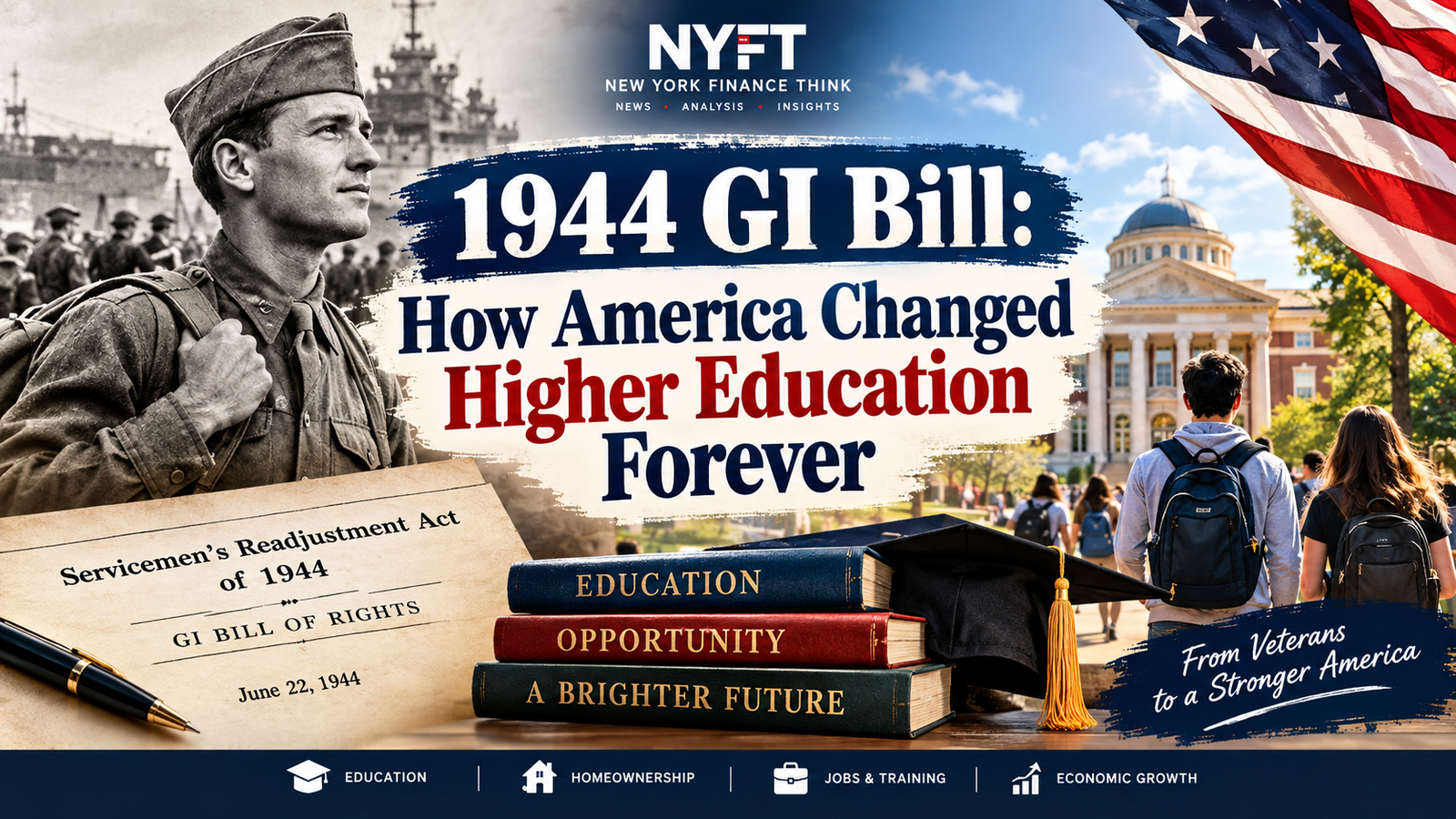
June 22, 1944, was more than another date in American history. It was the day the federal government made a historic promise to millions of Americans returning from World War II: military service would not have to mean giving up the chance to build a civilian career, attend college, buy a home, or start a business.
President Franklin D. Roosevelt signed the Servicemen’s Readjustment Act of 1944, better known as the GI Bill of Rights, into law on June 22, 1944.
The law would eventually help transform American higher education, homeownership and the postwar economy.
But there is an important distinction for anyone studying the history of student loans in America.
The 1944 GI Bill was not the modern federal student-loan system.
Instead, it created a massive federal benefits program that helped eligible World War II veterans pay for education and training while also providing unemployment compensation and government-backed loans for homes, farms and businesses.
And its impact was enormous.
By the time the original program ended in 1956, 7.8 million World War II veterans had participated in education or training programs. About 2.2 million attended institutions of higher learning, nearly 3.5 million received vocational or technical training, about 1.4 million received on-the-job training, and nearly 700,000 participated in institutional farm training.
For millions of Americans, the GI Bill became a bridge from wartime service to a new civilian life.
America Was Preparing for the End of World War II
In 1944, World War II was still being fought.
The Allied invasion of Normandy had taken place only weeks before Roosevelt signed the GI Bill. American troops were still overseas, and the final outcome of the war was not yet known.
But Washington was already thinking about what would happen when millions of service members came home.
The concern was straightforward.
What would happen when millions of men and women suddenly left the military and returned to civilian life?
The U.S. Department of Labor estimated that as many as 15 million people who had been serving in the armed forces could face unemployment after the war.
Government planners feared that the end of wartime production could produce another serious economic downturn. The country had only recently emerged from the Great Depression, and policymakers did not want millions of returning veterans to enter an economy without jobs or training.
The government therefore began looking at education, job training, unemployment assistance and other ways to help veterans transition back into civilian society.
That thinking became the foundation for the GI Bill.
Who Created the GI Bill?
The legislation was not created by one person alone.
President Roosevelt strongly supported the idea that returning service members should receive meaningful assistance after the war.
But the American Legion played a central role in developing and promoting the legislation.
One of the most important figures was Harry W. Colmery, a World War I veteran, former national commander of the American Legion and former Republican National Chairman.
Colmery is credited with drafting the first version of what became the GI Bill.
According to the Department of Veterans Affairs, Colmery worked through the winter of 1943–44 to turn the American Legion’s ideas into legislative language. The organization ultimately presented Congress with a broad package covering education, unemployment compensation, housing and other benefits.
The legislation was introduced in Congress in January 1944.
It faced disagreements, particularly over unemployment benefits, but the House and Senate eventually approved the final legislation.
President Roosevelt signed it on June 22, 1944.
What Did the 1944 GI Bill Actually Provide?
The GI Bill was much broader than a college program.
It provided several major forms of assistance.
1. Education
Veterans could receive financial assistance for education and training.
The program helped cover costs connected with:
- College education
- University education
- Vocational training
- Technical training
- On-the-job training
- Farm training
- Books and supplies
- Equipment
- Educational counseling
The federal government paid education and training benefits through the Veterans Administration.
For a veteran who had returned from war without a college degree or specialized civilian training, this could completely change the next stage of life.
2. A Monthly Living Allowance
Education assistance was not limited to tuition.
The program also included a subsistence allowance.
According to the VA’s historical summary, a full-time World War II veteran without dependents could initially receive up to $50 per month in subsistence support. That amount was later increased to $65 in 1946 and $75 in 1948.
Veterans with dependents received higher allowances.
This mattered because going to college meant something very different for a veteran supporting a family than it did for a traditional full-time student.
The GI Bill helped make it possible for veterans to leave the immediate labor market and pursue education.
The Numbers Tell the Story
The scale of the program was extraordinary.
More than 15 million World War II veterans were eligible for the original education and training program.
By July 25, 1956, when the original program ended, approximately 7.8 million veterans had received education or training benefits.
That included:
| Type of Education or Training | Veterans |
|---|---|
| Colleges and universities | About 2.2 million |
| Vocational/technical schools | Nearly 3.5 million |
| On-the-job training | About 1.4 million |
| Farm training | Nearly 700,000 |
| Total participants | About 7.8 million |
These were not all traditional “college students.”
That distinction is important.
Some veterans went to universities. Others learned skilled trades. Others received training directly at workplaces or in agriculture.
The GI Bill was designed around a broader idea:
Give veterans a path to productive civilian work.
The Veteran Who Became a College Student
Before World War II, attending college was not an ordinary path for every American.
Higher education was much less accessible to working-class families and people without substantial financial resources.
The GI Bill changed that equation for millions of veterans.
By 1947, veterans represented approximately 49% of U.S. college admissions, according to VA historical material.
That meant American colleges suddenly faced a huge new population of students.
Classrooms expanded.
Universities expanded.
Training programs expanded.
The country needed more teachers, engineers, doctors, accountants, scientists, lawyers and other professionals.
The effects reached far beyond the individual veteran.
What Did These Veterans Become?
The veterans who used the GI Bill were not one single type of student.
They came from different parts of the country and different economic backgrounds.
Some had grown up on farms.
Some had worked in factories.
Some had never attended college.
Others had started college before joining the military.
After the war, many returned with a new opportunity: education.
Historical Congressional records later described large numbers of GI Bill-trained veterans entering professional fields, including engineering, medicine, nursing, science, accounting and law.
The result was a major expansion of America’s skilled workforce.
The GI Bill was therefore not simply an education benefit.
It became an investment in human capital.
A Veteran’s Story: Thomas J. Glessner
One individual example helps put the history into human terms.
Thomas J. Glessner, a Pennsylvania native, was one of the World War II veterans who used GI Bill benefits.
Glessner enlisted in the U.S. Navy on April 18, 1944.
He later served as an aviation ordnance man and turret technician and had opportunities to fly during his military service.
His story is important because it illustrates the kind of transition the GI Bill was designed to support: from military service into civilian education and opportunity.
He was one person among millions.
And that is exactly what made the program historically significant.
The GI Bill Was Also About Homeownership
Education was only one part of the legislation.
The GI Bill also created a government loan-guarantee system designed to help eligible veterans purchase homes, farms and businesses.
This was different from the education benefit.
The federal government did not simply hand every veteran a home.
Instead, the government provided a loan guaranty, helping make private lending more accessible to eligible veterans.
The program contributed to a dramatic expansion in veteran homeownership.
According to the National Archives, by 1955 about 4.3 million home loans had been granted, with a total face value of approximately $33 billion.
VA historical material also reports that from 1944 to 1952, the agency backed nearly 2.4 million home loans for World War II veterans.
The economic effects spread beyond veterans.
More houses meant more demand for:
- Construction workers
- Lumber
- Appliances
- Furniture
- Cars
- Plumbing
- Electrical equipment
- Insurance
- Banking services
The GI Bill therefore became part of the larger economic transformation of postwar America.
But the GI Bill Did Not Reach Everyone Equally
This is one of the most important parts of the history.
It would be misleading to describe the GI Bill as an equally accessible opportunity for every veteran.
Black veterans faced significant discrimination.
The National Archives notes that Black veterans often struggled to obtain mortgage loans in Black neighborhoods and faced discriminatory housing practices that excluded many from buying homes in white suburban communities.
That means the headline numbers tell only part of the story.
The federal benefit existed.
But access to banks, neighborhoods, colleges, housing markets and local institutions was not equal.
For Black veterans and other marginalized groups, discrimination could limit the practical value of benefits that were legally available.
This remains an important lesson when examining American education and housing policy.
Did the GI Bill Create America’s Student Loan System?
No.
This is where the history needs to be precise.
The 1944 GI Bill was a federal veterans’ benefits program.
It provided education and training assistance, along with other benefits.
It also included government-backed loans for homes, farms and businesses.
But it was not the same thing as today’s federal student loans.
Modern federal student-loan history developed later through other legislation and programs.
The National Defense Education Act of 1958, for example, became a major milestone in the development of federal educational lending.
The Higher Education Act of 1965 then became another major foundation of the modern federal student-aid system.
So the historical chain is better understood this way:
1944 GI Bill → massive federal support for veterans’ education → expansion of American higher education → later federal student-aid and loan programs.
The GI Bill helped demonstrate what large-scale federal investment in education could accomplish.
The Economic Impact Was Bigger Than Education
The GI Bill arrived at a critical moment.
America was moving from a wartime economy to a peacetime economy.
Millions of military personnel were returning.
Factories were changing production.
Families were starting new lives.
Veterans were buying homes.
Students were entering colleges.
Workers were learning new trades.
The country was moving into the postwar economic boom.
The National Archives notes that the number of degrees awarded by U.S. colleges and universities more than doubled between 1940 and 1950.
That does not mean the GI Bill alone caused every change in the American economy.
But its scale made it one of the major forces behind the expansion of higher education and the professional workforce after World War II.
By 1956, the Experiment Had Changed America
The original GI Bill officially ended on July 25, 1956.
By then, approximately 7.8 million World War II veterans had participated in education or training programs.
The education and training portion had distributed billions of dollars in benefits.
Millions of veterans had attended colleges, universities and training programs.
Millions more had participated in other parts of the program, including housing and business-related benefits.
The postwar American economy was no longer the same economy that existed before the war.
Higher education had become more accessible to a much larger share of Americans.
The GI Bill’s Legacy Continues
The original 1944 program eventually expired, but the idea did not disappear.
Congress created and expanded later versions of GI Bill benefits for veterans of subsequent conflicts.
Today, the Department of Veterans Affairs continues to provide GI Bill education and training benefits to eligible veterans, service members and certain family members.
Modern programs can help eligible beneficiaries with education and training expenses, depending on the program and individual eligibility.
The Post-9/11 GI Bill is one of the major modern versions of these benefits.
The basic philosophy remains recognizable:
Military service can lead to an opportunity for education and civilian career development.
Why the 1944 GI Bill Still Matters to Today’s Student Loan Debate
Walk into a U.S. college today and the financing conversation is very different.
Students may use:
- Scholarships
- Grants
- Federal student loans
- Private student loans
- Work-study
- Family savings
- Employer assistance
- Veterans’ education benefits
But the historical question remains the same:
How should America help people afford education?
The GI Bill provides one of the most important answers in American history.
Instead of asking veterans to return from a global war and immediately compete for jobs, policymakers created a pathway toward education, training, employment and homeownership.
That policy changed millions of individual lives.
It also changed the country.
1944 GI Bill: Key Facts
| Fact | Historical Detail |
|---|---|
| Official name | Servicemen’s Readjustment Act of 1944 |
| Common name | GI Bill / GI Bill of Rights |
| Signed | June 22, 1944 |
| President | Franklin D. Roosevelt |
| Main beneficiaries | World War II veterans |
| Eligible veterans | More than 15 million |
| Education/training participants | About 7.8 million |
| Higher education participants | About 2.2 million |
| Vocational/technical training | Nearly 3.5 million |
| On-the-job training | About 1.4 million |
| Farm training | Nearly 700,000 |
| Original program ended | July 25, 1956 |
Sources: National Archives and U.S. Department of Veterans Affairs.
The Bottom Line
The 1944 GI Bill was not the beginning of today’s federal student-loan system.
It was something broader and, in many ways, more transformative.
It was a federal promise to help a generation of American veterans rebuild their lives after World War II.
For millions, that meant college.
For others, it meant vocational training or a new job.
For many families, it also meant the possibility of buying a home.
By 1956, 7.8 million World War II veterans had participated in education or training programs.
The program helped move higher education from an opportunity available primarily to a relatively limited portion of Americans toward something accessible to millions more.
That is why the GI Bill remains one of the most important chapters in the history of American education finance.
And when today’s debate turns to FAFSA, federal student loans, college affordability and education debt, the story ultimately leads back to a much older question:
How much should the United States invest in helping Americans build a better economic future through education?
In 1944, America answered that question for millions of returning veterans with one of the most ambitious education and economic programs in its history.
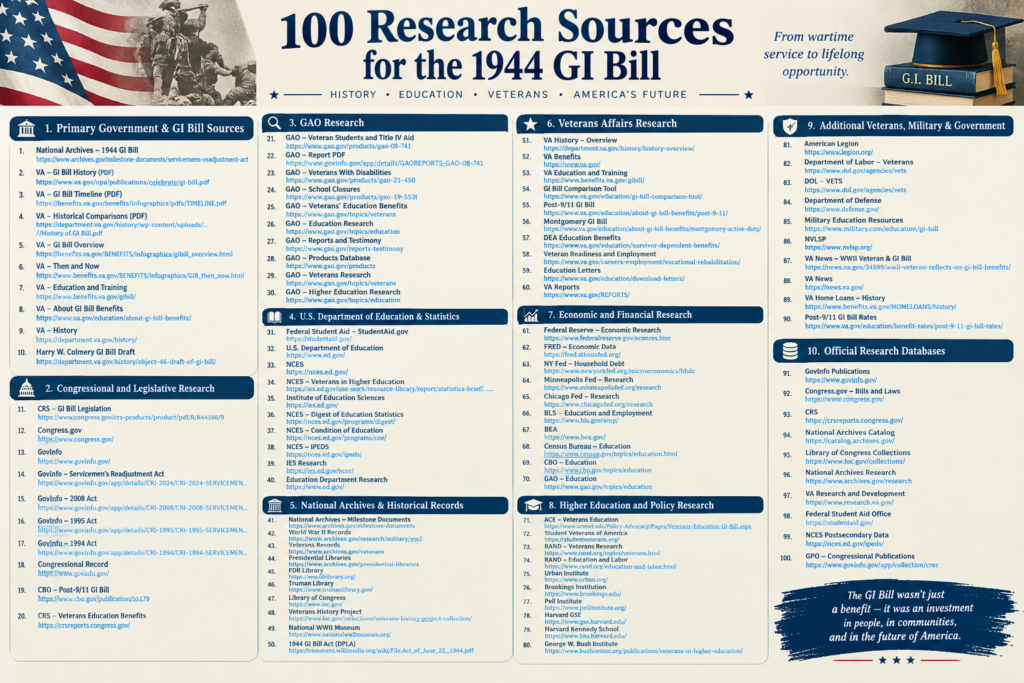
100 Research Sources for the 1944 GI Bill
Primary Government & GI Bill Sources
- National Archives — Servicemen’s Readjustment Act of 1944
National Archives — 1944 GI Bill - U.S. Department of Veterans Affairs — GI Bill History PDF
VA — GI Bill History PDF - U.S. Department of Veterans Affairs — GI Bill Timeline PDF
VA — GI Bill Timeline PDF - U.S. Department of Veterans Affairs — GI Bill Historical Comparisons PDF
VA — GI Bill Historical PDF - U.S. Department of Veterans Affairs — GI Bill Overview
VA — GI Bill Overview - U.S. Department of Veterans Affairs — GI Bill Then and Now
VA — GI Bill Then and Now - U.S. Department of Veterans Affairs — Education and Training
VA — Education and Training - U.S. Department of Veterans Affairs — About GI Bill Benefits
VA — About GI Bill Benefits - U.S. Department of Veterans Affairs — GI Bill History
VA History - U.S. Department of Veterans Affairs — Harry W. Colmery GI Bill Draft
Harry Colmery GI Bill Draft
Congressional and Legislative Research
- Congressional Research Service — GI Bill Legislation
CRS — GI Bill Legislation - Congress.gov — GI Bill Legislation
Congress.gov - U.S. Government Publishing Office — GovInfo
GovInfo - GovInfo — Servicemen’s Readjustment Act
GovInfo — Servicemen’s Readjustment Act - GovInfo — 2008 Servicemen’s Readjustment Act
GovInfo — 2008 Act - GovInfo — 1995 Servicemen’s Readjustment Act
GovInfo — 1995 Act - GovInfo — 1994 Servicemen’s Readjustment Act
GovInfo — 1994 Act - Congressional Record — GI Bill Research
Congressional Record via GovInfo - Congressional Budget Office — Post-9/11 GI Bill
CBO — Post-9/11 GI Bill - Congressional Research Service — Veterans Education Benefits
CRS Reports
GAO Research
- GAO — Veteran Students and Title IV Aid
GAO — Veteran Students and Title IV Aid - GAO — Veteran Students and Title IV Aid PDF
GAO Report PDF Record - GAO — Veterans With Disabilities Education Benefits
GAO — Veterans With Disabilities - GAO — Post-9/11 GI Bill School Closures
GAO — GI Bill School Closures - GAO — Veterans’ Education Benefits
GAO — Veterans Education Benefits - GAO — Education Research
GAO — Education - GAO — Reports and Testimony
GAO Reports - GAO — Products Database
GAO Products - GAO — Veterans Research
GAO Veterans Research - GAO — Higher Education Research
GAO Higher Education
U.S. Department of Education and Education Statistics
- Federal Student Aid — StudentAid.gov
Federal Student Aid - U.S. Department of Education
U.S. Department of Education - National Center for Education Statistics
NCES - NCES — Veterans in Higher Education
NCES — Veterans Higher Education - Institute of Education Sciences
IES - NCES — Digest of Education Statistics
NCES — Digest - NCES — Condition of Education
NCES — Condition of Education - NCES — IPEDS
IPEDS - Institute of Education Sciences — Research
IES Research - U.S. Department of Education — Education Research
Education Department Research
National Archives and Historical Records
- National Archives — Milestone Documents
National Archives Milestone Documents - National Archives — World War II Records
World War II Records - National Archives — Veterans Records
Veterans Records - National Archives — Presidential Libraries
Presidential Libraries - Franklin D. Roosevelt Presidential Library
FDR Presidential Library - Harry S. Truman Presidential Library
Truman Presidential Library - Library of Congress
Library of Congress - Veterans History Project — Library of Congress
Veterans History Project - National WWII Museum
National WWII Museum - Digital Public Library of America — 1944 GI Bill Act
Scanned 1944 GI Bill Document
Veterans Affairs Research
- VA History — Historical Overview
VA Historical Overview - VA Benefits
VA Benefits - VA Education and Training
VA Education and Training - VA GI Bill Comparison Tool
GI Bill Comparison Tool - VA Post-9/11 GI Bill
Post-9/11 GI Bill - VA Montgomery GI Bill
Montgomery GI Bill - VA Survivors and Dependents Education Assistance
DEA Education Benefits - VA Veteran Readiness and Employment
Veteran Readiness and Employment - VA Education Letters
VA Education Letters - VA Reports
VA Reports
Economic and Financial Research
- Federal Reserve — Economic Research
Federal Reserve Economic Research - Federal Reserve Bank of St. Louis — FRED
FRED Economic Data - Federal Reserve Bank of New York — Household Debt Research
New York Fed Household Debt Research - Federal Reserve Bank of Minneapolis — Research
Minneapolis Fed Research - Federal Reserve Bank of Chicago — Research
Chicago Fed Research - Bureau of Labor Statistics — Education and Employment
BLS Education and Employment - Bureau of Economic Analysis
BEA - U.S. Census Bureau — Education
Census Education Data - Congressional Budget Office — Education
CBO Education Research - Government Accountability Office — Education
GAO Education Research
Higher Education and Policy Research
- American Council on Education — Veterans Education
ACE — Veterans Education and GI Bill - Student Veterans of America
Student Veterans of America - RAND — Veterans Research
RAND Veterans Research - RAND — Education and Labor Research
RAND Education Research - Urban Institute — Veterans Research
Urban Institute - Brookings Institution
Brookings Institution - Pell Institute
Pell Institute - Harvard Graduate School of Education
Harvard Education Research - Harvard Kennedy School
Harvard Kennedy School - George W. Bush Institute — Veterans in Higher Education
Veterans in Higher Education Research
Additional Veterans, Military and Government Sources
- American Legion
American Legion - Department of Labor — Veterans Employment
Department of Labor Veterans Services - Department of Labor — VETS
DOL VETS - U.S. Department of Defense
Department of Defense - Military Education Resources
Military.com GI Bill Resources - National Veterans Legal Services Program
NVLSP - VA News — WWII Veteran GI Bill Story
VA News — WWII Veteran and GI Bill - VA News
VA News - VA Home Loans — History
VA Home Loan History - VA Post-9/11 GI Bill Rates
VA Post-9/11 GI Bill Rates
Additional Official Research Databases
- GovInfo — U.S. Government Publications
GovInfo Publications - Congress.gov — Bills and Laws
Congress.gov Bills and Laws - Congressional Research Service
Congressional Research Service - National Archives Catalog
National Archives Catalog - Library of Congress Digital Collections
Library of Congress Digital Collections - National Archives Research
National Archives Research - VA Research and Development
VA Research - U.S. Department of Education — Federal Student Aid
Federal Student Aid Office - National Center for Education Statistics — Postsecondary Data
NCES Postsecondary Data - U.S. Government Publishing Office — Congressional Publications
U.S. Government Publishing Office
