
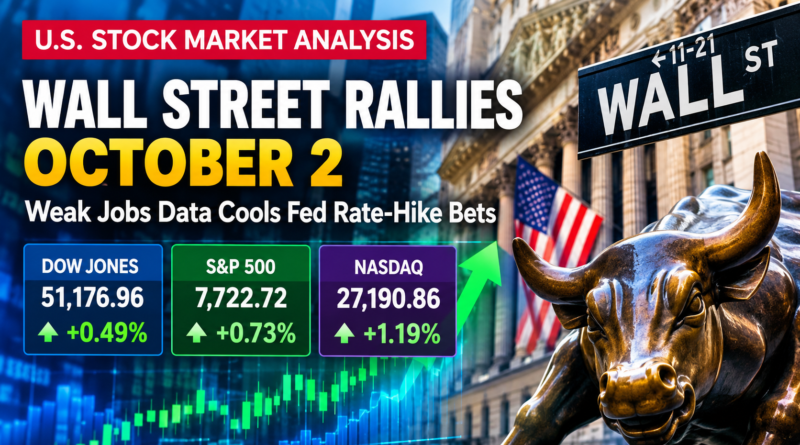
U.S. Stock Market Analysis: Dow, S&P 500 and Nasdaq Rally on October 2 as Weak Jobs Data Cools Fed Rate-Hike Bets
New York Finance Think (NYFT)
Website: New York Finance Think
Short brand: NYFT
Focus: U.S. Finance, Wall Street, Markets, Banking, Economy & Global Financial News.
Wall Street finished strongly higher on Friday, October 2, 2026, as a weaker-than-expected U.S. jobs report reduced expectations for another Federal Reserve rate hike. The Dow Jones Industrial Average, S&P 500 and Nasdaq Composite all moved higher, while technology stocks led the rally.
The market’s reaction was driven by a familiar but important dynamic: weaker economic data can sometimes be positive for stocks when investors believe it will encourage the Federal Reserve to maintain or eventually move toward a less restrictive monetary-policy stance.
The September jobs report showed that U.S. employers added only 29,000 jobs, well below economists’ expectations. The unemployment rate also increased to 4.2% from 4.1%. Previous employment figures were revised lower, adding to evidence that the labor market is losing momentum.
For Wall Street, the immediate reaction was clear. Investors reduced expectations for another Fed rate increase, Treasury yields initially moved lower and investors returned to technology and other growth-oriented stocks.
But the October 2 rally was more complicated than a simple “stocks up because of weak jobs” story. Treasury yields remained elevated, oil prices were near $100 a barrel and concerns about inflation, government borrowing, corporate valuations and AI-related stocks continued to shape investor sentiment.
For American investors, the key question is now whether the U.S. economy can slow enough to reduce inflation and Fed pressure without weakening corporate earnings.
October 2 U.S. Market Close
| Index | October 2 Close | Daily Change |
|---|---|---|
| Dow Jones Industrial Average | 51,176.96 | +0.49% |
| S&P 500 | 7,722.72 | +0.73% |
| Nasdaq Composite | 27,190.86 | +1.19% |
| Russell 2000 | 2,832.90 | About +0.9% |
The Nasdaq was the strongest major U.S. index on October 2, highlighting renewed demand for technology and growth stocks.
The S&P 500 also moved closer to its record level, while the Dow posted a more moderate gain.
The Russell 2000’s advance was also significant because smaller companies tend to be more sensitive to borrowing costs and domestic economic conditions.
1. Weak Jobs Report Changed the Market’s Fed Outlook
The biggest market catalyst on October 2 was the September employment report.
U.S. employers added only 29,000 jobs during the month, significantly below expectations. The unemployment rate increased to 4.2%, while earlier employment figures were revised lower.
The report indicated that the labor market is cooling.
Normally, a weak jobs report would be viewed as negative for the economy. But financial markets often respond differently when monetary policy is the dominant concern.
Investors interpreted the weak employment data as reducing the likelihood that the Federal Reserve would need to raise interest rates again in the near term.
That helped support stocks.
The reaction can be summarized simply:
Weak jobs data → lower Fed rate-hike expectations → lower policy pressure → stronger demand for stocks.
That was particularly helpful for technology companies and other growth-oriented investments.
2. Fed Rate-Hike Expectations Fell
Before the employment report, investors were concerned that persistent inflation, high energy prices and elevated Treasury yields could keep pressure on the Federal Reserve.
The jobs report changed that calculation.
Market expectations for an October Fed rate hike fell sharply.
This was important because interest-rate expectations have become one of the biggest drivers of daily stock-market movements.
When investors expect higher interest rates, future corporate earnings become less valuable in today’s calculations.
When expectations for interest rates fall, growth companies can receive a valuation boost.
This is one reason the Nasdaq outperformed the Dow on October 2.
3. Nasdaq Led the Rally
The Nasdaq Composite gained 1.19% and finished at 27,190.86.
Technology stocks benefited from the change in rate expectations.
Large technology companies and AI-related stocks remain among the biggest drivers of the U.S. equity market.
Investors continue to focus on artificial intelligence, semiconductors, cloud computing, data centers and enterprise technology spending.
The October 2 market action showed that investors remain willing to buy technology stocks when concerns about aggressive Federal Reserve policy decline.
However, investors should also remember that high-growth companies can be particularly sensitive to Treasury yields.
If long-term bond yields rise sharply again, technology valuations could come under pressure.
4. S&P 500 Moves Toward Record Territory
The S&P 500 gained 0.73% on October 2 and closed at 7,722.72.
The index remained close to its record level, showing that investors continue to maintain a relatively positive view of U.S. equities.
The S&P 500 is particularly important because it provides broad exposure to major U.S. companies across technology, financials, healthcare, industrials, consumer companies and other sectors.
The index’s performance suggests that the October 2 rally was broader than a move in only a few technology stocks.
However, the weekly performance was more mixed.
Friday’s rally helped recover some earlier losses, but the broader market still faced uncertainty over interest rates, inflation and economic growth.
5. Dow Jones Gains But Trails Technology Stocks
The Dow Jones Industrial Average gained 0.49% and closed at 51,176.96.
The Dow’s gain was smaller than the Nasdaq’s because the index has a different composition and is less concentrated in some of the technology companies that have driven the current AI investment cycle.
Still, the Dow’s advance showed that investors were willing to buy established large-cap companies as well.
The market therefore remained broadly positive rather than being limited to one narrow sector.
6. Russell 2000 Shows Increased Risk Appetite
The Russell 2000 also moved higher on October 2.
Small-cap companies can be particularly sensitive to interest rates because many rely more heavily on borrowing and domestic economic conditions.
When investors expect less restrictive Federal Reserve policy, small-cap stocks can benefit.
The Russell 2000’s gain therefore provided another indication that investors viewed the jobs report as reducing immediate monetary-policy pressure.
However, small companies face another risk.
If the labor market continues to deteriorate, smaller businesses could eventually experience weaker consumer demand and higher credit stress.
7. Treasury Yields Remain a Major Market Risk
The stock-market rally did not eliminate concerns in the bond market.
Treasury yields initially moved lower following the weak jobs report but later recovered.
The 10-year Treasury yield remained around the 5% area.
That is important because long-term Treasury yields influence borrowing costs throughout the U.S. economy.
Higher Treasury yields can affect:
- Mortgage rates
- Auto loans
- Corporate borrowing
- Commercial real estate
- Bond prices
- Stock valuations
- Consumer financing
Even if the Federal Reserve stops raising short-term rates, long-term Treasury yields can remain elevated because of inflation expectations, government borrowing and fiscal concerns.
This creates a challenge for equity investors.
8. Why a 5% Treasury Yield Matters
For ordinary investors, Treasury yields may appear unrelated to stocks.
They are not.
When investors can earn relatively attractive returns from U.S. government bonds, they may demand better valuations before purchasing riskier assets.
This is particularly important for growth stocks.
A company with strong future earnings prospects can still experience valuation pressure if the discount rate used by investors rises.
That is why technology investors should continue monitoring the 10-year Treasury yield.
The October 2 stock-market rally was helped by lower rate expectations, but a sustained increase in long-term Treasury yields could create a new challenge.
9. Oil Prices Remain an Inflation Risk
Oil prices also remain important.
Crude prices were near the $100-a-barrel area, keeping energy inflation firmly on investors’ radar.
Higher oil prices can create a difficult situation for the Federal Reserve.
Energy costs can push inflation higher while simultaneously reducing household purchasing power.
For consumers, higher gasoline and energy prices mean less money available for other spending.
For companies, higher transportation and production costs can reduce profit margins.
This means oil prices can influence both inflation and corporate earnings.
If crude prices remain elevated, investors may become more cautious about the Federal Reserve’s ability to ease monetary policy quickly.
10. The Labor Market Is Clearly Losing Momentum
The September employment report delivered an important economic message.
Hiring has slowed.
The economy added only 29,000 jobs, while the unemployment rate moved higher.
The labor market is therefore no longer providing the same degree of strength seen during stronger employment periods.
For the Federal Reserve, this matters.
A weaker labor market reduces the need for additional monetary tightening.
But investors should not assume that a weak labor report automatically means the stock market will continue rising.
The important question is whether the slowdown remains controlled.
A gradual cooling could support a soft landing.
A sharp deterioration could create recession fears.
11. Why Bad Economic News Can Be Good News for Stocks
The October 2 rally is a classic example of how markets can interpret economic data differently from ordinary consumers.
A weaker jobs report is generally bad news for workers and the economy.
But investors can initially view it positively if it reduces interest-rate pressure.
The relationship can be summarized in three stages.
Moderate slowdown
Employment slows, inflation cools and the Fed becomes less aggressive.
This can be positive for stocks.
Soft landing
Employment remains relatively stable, inflation declines and economic growth continues.
This would be an ideal scenario for investors.
Economic deterioration
Employment falls sharply, unemployment rises and corporate earnings weaken.
This could become negative for stocks.
The market is currently trying to determine which scenario is developing.
12. Technology and AI Remain Market Leaders
Artificial intelligence continues to be one of the biggest investment themes on Wall Street.
Investors are closely watching:
- AI chips
- Semiconductor companies
- Data centers
- Cloud computing
- AI software
- Networking infrastructure
- Enterprise AI spending
Companies connected to these trends have attracted substantial investor attention.
The October 2 rally showed that the AI trade remains powerful.
But investors should also consider valuation.
Strong technology growth does not automatically mean every technology stock is fairly priced.
The market eventually demands earnings.
That means investors should compare AI-related stock valuations with actual revenue growth, profit growth and cash flow.
13. Tesla and Growth Stocks Benefit
Tesla was another major stock-market mover during the session.
Growth companies often benefit when investors become less concerned about aggressive interest-rate increases.
Tesla remains closely watched because of its exposure to electric vehicles, autonomous driving, artificial intelligence, robotics and energy technology.
The broader lesson is that investors continue to favor companies associated with long-term technology themes when monetary-policy fears decline.
14. Not Every Company Participated in the Rally
A rising stock market does not mean every company performed well.
Several individual companies continued to experience significant selling pressure.
Nike was among the notable decliners, while some technology and storage-related companies also faced pressure.
This is important for investors because market indexes can sometimes hide substantial differences between individual stocks.
Investors should therefore avoid assuming that a strong Nasdaq automatically means every technology company is performing well.
Stock selection remains important.
15. The Weekly Market Picture Is More Complicated
Friday’s gains were impressive, but the weekly numbers provide additional context.
The S&P 500, Dow and Russell 2000 still faced weekly pressure, while the Nasdaq performed better.
This shows that October 2 was partly a rebound from earlier weakness.
The Nasdaq’s relative strength remains one of the most important features of the current U.S. market.
Technology continues to provide leadership, while traditional sectors are dealing with higher rates, energy costs and changing economic expectations.
16. 2026 Gains Remain Significant
Despite the short-term volatility, major U.S. indexes remained strongly higher for the year.
The Nasdaq was up approximately 17% year to date, while the Russell 2000 was up about 14.1%. The S&P 500 was up roughly 12.8%, and the Dow was up around 6.5%.
Those gains show that the October 2 rally occurred inside a generally strong market environment.
But strong gains can also create vulnerability.
When valuations become elevated, investors may react more strongly to negative surprises.
That means the fourth quarter could remain volatile even if the broader long-term market trend stays positive.
17. What October 2 Means for the Federal Reserve
The September jobs report creates a difficult policy environment for the Federal Reserve.
The central bank must balance employment and inflation.
A weakening labor market creates pressure to avoid additional rate increases.
But persistent inflation or higher oil prices could limit how quickly the Fed can move toward easier policy.
The Fed could therefore face a difficult situation:
Weak employment + persistent inflation.
That combination is particularly challenging because tightening policy could further weaken employment, while easing too quickly could allow inflation to remain elevated.
Investors should therefore watch Federal Reserve officials closely in the coming weeks.
18. What Investors Should Watch Next
The October 2 market move changes the short-term setup for investors.
Inflation data
Upcoming inflation reports will be critical.
If inflation continues to cool, stocks could receive additional support.
If inflation remains sticky, Treasury yields could rise.
Treasury yields
The 10-year Treasury yield remains one of the most important indicators for stock valuations.
A sustained move above 5% could put additional pressure on growth stocks.
Oil prices
Oil near $100 a barrel remains an important inflation risk.
Higher energy prices could complicate the Fed’s policy decisions.
Corporate earnings
Ultimately, stock prices depend on earnings.
If companies continue producing strong profits, stocks may remain resilient even during slower economic growth.
If earnings estimates begin falling, investors could become more defensive.
AI valuations
Technology stocks remain market leaders.
Investors should monitor whether AI-related revenue and earnings growth are strong enough to justify current valuations.
Employment
Another weak jobs report could increase recession concerns.
A stabilization in hiring would support the soft-landing argument.
19. What This Means for American Investors
The October 2 rally should not automatically lead investors to make aggressive short-term decisions.
The most important step is understanding what caused the rally.
Stocks rose primarily because investors believed weaker employment would reduce the likelihood of another Fed rate hike.
The rally was therefore driven by changing monetary-policy expectations rather than by evidence of stronger economic growth.
That distinction matters.
Long-term investors with diversified portfolios may not need to react dramatically to one employment report.
Short-term traders, however, will likely continue watching:
- Federal Reserve expectations
- Treasury yields
- Nasdaq momentum
- AI stocks
- Oil prices
- Employment data
- Inflation
These factors could create significant volatility during the coming weeks.
20. The Biggest Risk: When Bad News Stops Being Good News
The biggest risk for the current market is that investors eventually stop treating weak economic data as positive.
For now:
Weak jobs → lower Fed-hike expectations → stocks rise.
But the relationship can eventually change.
It could become:
Weak jobs → lower economic growth → weaker corporate earnings → stocks fall.
That transition is important.
A modest economic slowdown can support stocks if it reduces inflation and interest-rate pressure.
A severe economic slowdown can hurt stocks because companies earn less money.
Investors therefore need to watch the labor market carefully.
Conclusion
October 2, 2026, was a strong day for Wall Street.
The Dow Jones Industrial Average gained 0.49%, the S&P 500 advanced 0.73%, the Nasdaq Composite jumped 1.19%, and the Russell 2000 gained approximately 0.9%.
The main catalyst was the weaker-than-expected September jobs report.
The U.S. economy added only 29,000 jobs, while unemployment increased to 4.2%.
The weak labor-market data reduced expectations for another Federal Reserve rate hike and encouraged investors to buy stocks, particularly technology and other growth-oriented companies.
The Nasdaq was the clear leader, demonstrating that investors remain highly interested in AI and technology stocks.
But investors should not interpret the rally as proof that all economic risks have disappeared.
Treasury yields remain elevated. Oil prices remain a potential inflation problem. The labor market is weakening. Technology valuations remain important. And the Federal Reserve still has to balance inflation against employment.
For American investors, the central question is changing.
The market is no longer focused only on how high the Federal Reserve might raise interest rates.
The bigger question is now whether the U.S. economy can slow enough to reduce inflation without causing a significant decline in corporate earnings.
If employment stabilizes, inflation cools and Treasury yields decline, the October 2 rally could become the beginning of another move higher for U.S. stocks.
If employment continues deteriorating while inflation and oil prices remain elevated, investors could face a much more difficult fourth quarter.
The October 2 market rally therefore delivered an important message:
Wall Street currently views weaker economic data as positive when it reduces the risk of further Fed tightening. But that reaction will not last forever if economic weakness begins to threaten corporate profits.
For investors, the next phase of the market will depend on finding the balance between Fed policy, inflation, employment, Treasury yields, oil prices and corporate earnings.
Sources
- Reuters — U.S. Stock Market / Wall Street
https://www.reuters.com/business/wall-st-futures-gain-yields-oil-prices-ease-ahead-jobs-report-2026-10-02/ - U.S. Bureau of Labor Statistics — Employment Situation, September 2026
https://www.bls.gov/news.release/archives/empsit_10022026.htm - Reuters — U.S. Jobs Report
https://www.reuters.com/business/us-job-growth-slows-sharply-september-unemployment-rate-rises-42-2026-10-02/ - Associated Press — October 2, 2026 U.S. Market Close
https://apnews.com/article/48e9066481cba91a5d7c6688aa74a5cd - Reuters — Federal Reserve Rate-Hike Expectations
https://www.investing.com/news/economy-news/fed-seen-skipping-october-rate-hike-as-job-market-cools-4929866
