
U.S. Stock Market October 1, 2026: Treasury Yields, Oil and Fed Drive Wall Street
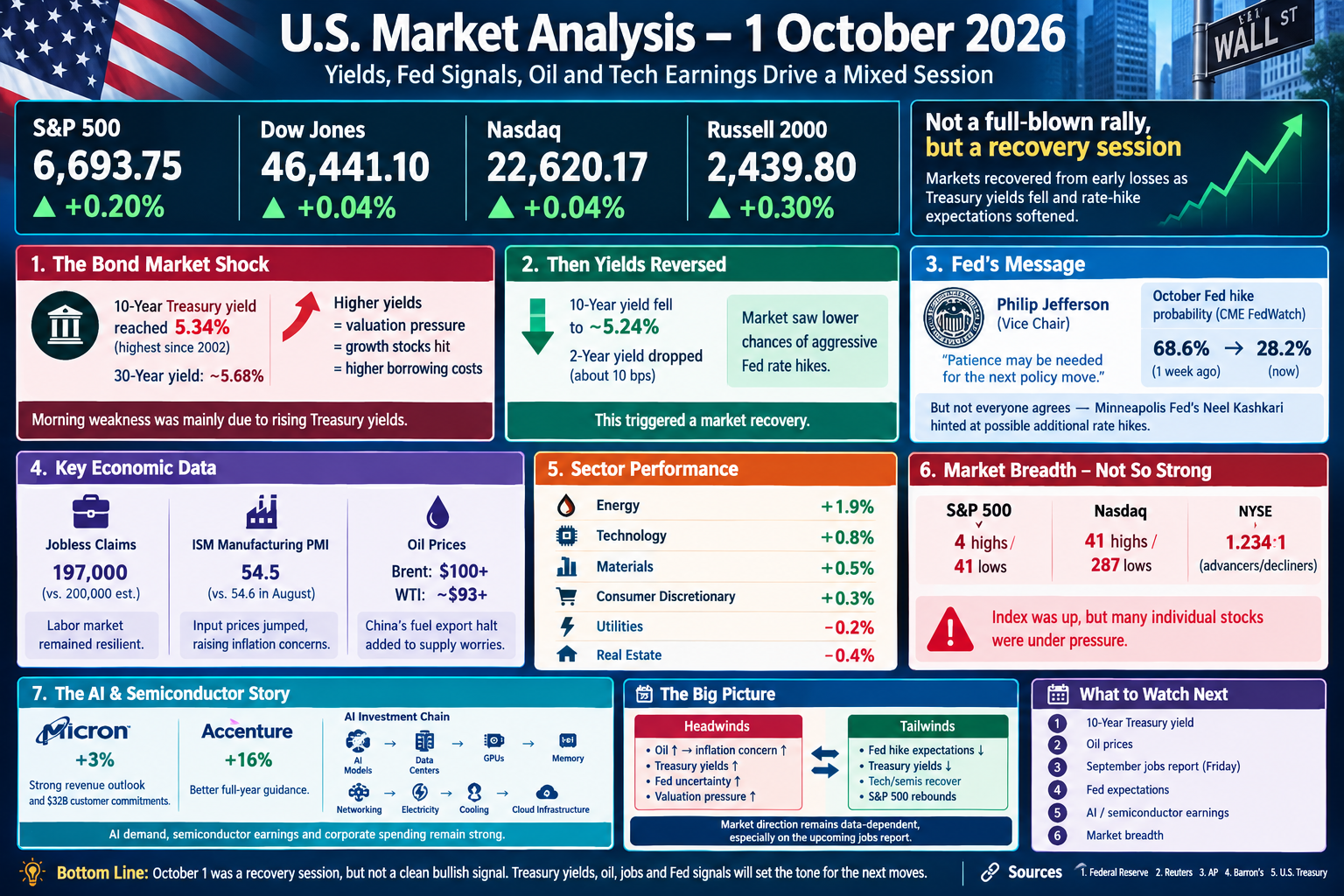
Wall Street started October with a volatile session as Treasury yields climbed to their highest level in more than two decades, oil prices moved above $100 a barrel, and investors reassessed the Federal Reserve’s next interest-rate decision. The market eventually recovered from its early weakness as Treasury yields eased and technology and semiconductor stocks helped support the major indexes.
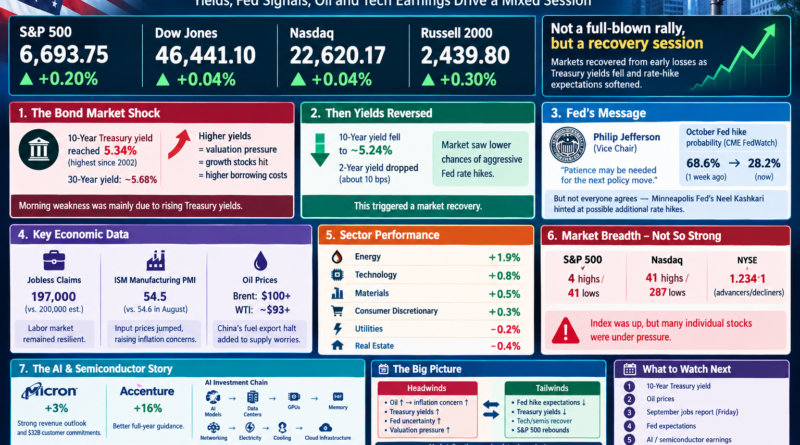
October 1 was not a simple “stocks went up” day. The more important story was the battle between rising borrowing costs and strong corporate earnings. The S&P 500 finished higher by 0.20%, while the Dow Jones Industrial Average and Nasdaq Composite each gained about 0.04%. The Russell 2000, which tracks smaller U.S. companies, gained about 0.3%. The S&P 500 also ended a three-session losing streak.
October 1 Market Snapshot
| Market Indicator | October 1, 2026 |
|---|---|
| S&P 500 | +0.20% |
| Dow Jones Industrial Average | +0.04% |
| Nasdaq Composite | +0.04% |
| Russell 2000 | +0.30% |
| 10-Year Treasury Yield | Around 5.24% late in session |
| Brent Crude | Above $100/barrel |
| U.S. Weekly Initial Jobless Claims | 197,000 |
| S&P 500 Energy Sector | About +1.9% |
Source: Reuters, AP and Federal Reserve market information.
What Happened on Wall Street?
The first major event was a sharp move in the U.S. Treasury market. The 10-year Treasury yield climbed to roughly 5.3% during the session, reaching its highest level since 2002. The 30-year Treasury yield also moved to a very high level. Higher Treasury yields are important for stock investors because they raise the return available from government bonds while also increasing the discount rate applied to future corporate earnings.
That initially created pressure on stocks, particularly companies whose valuations depend heavily on expectations for earnings far into the future. Technology and growth stocks are especially sensitive to changes in interest rates because a larger portion of their valuation can depend on future cash flows.
But the bond market later changed direction.
Treasury yields retreated from their intraday highs, and that helped stocks recover. The 10-year yield moved back toward approximately 5.24% by the later part of the session. The reversal in yields became one of the key reasons the early stock-market weakness did not turn into another major selloff.
Why Treasury Yields Were So Important
The Treasury market was effectively the center of the October 1 trading story.
When the 10-year yield rises, investors have to reconsider how much they are willing to pay for stocks. A company that is expected to produce large profits many years from now can become less attractive when the risk-free Treasury yield becomes substantially higher.
This does not automatically mean stocks must fall. Strong economic growth and strong corporate earnings can offset some of that pressure. But the October 1 session demonstrated how quickly stocks can react when Treasury yields move sharply.
The Federal Reserve’s official October 1 material also described the economy as being affected by several major forces, including artificial intelligence adoption, geopolitical developments, an energy shock, AI infrastructure investment and changes in trade policy.
Oil Prices Added Another Problem
The second major story was oil.
Brent crude moved above $100 a barrel, while U.S. crude also rose sharply. The increase came as the global energy market faced supply concerns, including China’s decision to halt fuel exports and continuing geopolitical uncertainty. Reuters reported that the energy sector became the strongest-performing major S&P 500 sector during the session.
For American consumers, higher oil prices matter because crude oil affects gasoline, transportation, heating and the cost of moving goods.
For the Federal Reserve, higher oil prices can become an inflation problem.
The basic chain is:
Oil prices rise → gasoline and transportation costs rise → business costs can rise → inflation pressure increases → interest-rate expectations can change.
That is why investors were watching oil and Treasury yields together rather than treating them as separate stories.
Energy Stocks Benefited
The higher oil price environment helped energy companies.
The S&P 500 energy sector gained approximately 1.9% on October 1, making it one of the strongest areas of the market.
This creates an important distinction for investors.
Higher oil prices can hurt airlines, transportation companies and many consumer businesses because their operating costs increase. At the same time, oil producers and other energy companies can benefit from higher selling prices.
Therefore, an oil shock does not affect every stock in the same direction.
Technology and Semiconductor Stocks Fight Back
Technology provided another important source of support.
Semiconductor stocks attracted attention following Micron Technology’s earnings report. Micron reported exceptionally strong quarterly revenue and provided a strong outlook, reinforcing investor interest in the AI and memory-chip investment cycle.
Accenture was another major technology-related winner. Its shares rose sharply after its earnings and outlook provided investors with another indication that corporate spending on technology and AI-related services remained strong. Barron’s reported Accenture as the best-performing individual stock in the S&P 500 during the session, gaining roughly 15.8%.
This was important because investors were facing two opposing forces:
Higher Treasury yields were pressuring technology valuations.
At the same time:
Strong technology earnings were supporting technology stocks.
The result was a much more complicated market than a simple risk-on or risk-off session.
What Happened With the Federal Reserve?
The Federal Reserve was another major piece of the October 1 story.
Federal Reserve Vice Chair Philip Jefferson spoke about the U.S. economy and monetary policy. His remarks emphasized the need for policymakers to assess changing economic conditions and allow time for additional information before deciding what comes next.
This helped calm some concerns that the Federal Reserve would immediately respond to inflation pressures with another rate increase.
Reuters reported that market expectations for an October rate increase fell substantially during the day. The probability implied by market pricing declined from much higher levels seen a week earlier.
For Wall Street, this mattered because interest-rate expectations can move stocks even when the Fed does not actually change rates.
The market trades not only on today’s interest rate, but also on what investors believe the interest rate will be several weeks or months from now.
The Jobs Market Also Mattered
Weekly initial jobless claims came in at 197,000 for the latest reported week, below the roughly 200,000 level economists had expected. That indicated that there was not an immediate collapse in labor-market conditions.
That data became especially important because investors were waiting for the September employment report.
The employment report matters because the Federal Reserve has two broad responsibilities: maintaining price stability and supporting maximum employment.
If employment remains strong while inflation remains elevated, the Fed has less reason to rush toward easier monetary policy.
If the labor market weakens substantially, the calculation can change.
Why Friday’s Jobs Report Became the Next Big Story
By the end of October 1, investors had largely moved their attention toward the next major economic release: the September employment report.
Expectations cited by market coverage were for approximately 84,000 jobs to have been added in September, compared with 162,000 in August.
But the headline payroll number will not be the only thing investors watch.
The market will also examine:
- Unemployment rate
- Average hourly earnings
- Labor-force participation
- Revisions to previous payroll numbers
- Private-sector employment
- Evidence of slowing or accelerating hiring
A weaker labor market could change expectations about future Fed policy, while stronger-than-expected employment could keep attention focused on inflation and Treasury yields.
The AI Investment Story Is Still Alive
One of the biggest structural stories behind the 2026 market remains artificial intelligence.
Investors continue to watch companies involved in:
- AI chips
- Data centers
- Cloud computing
- Memory chips
- Networking equipment
- AI software
- Enterprise AI services
- Electricity and infrastructure required for data centers
Micron’s results provided another example of how AI infrastructure spending is affecting semiconductor demand.
However, high Treasury yields create a challenge for companies with expensive valuations.
This means the market is increasingly asking two questions at the same time:
How much money will companies spend on AI?
and
Will the earnings generated by that spending justify the investment and current valuations?
That debate is likely to remain important throughout the fourth quarter.
What About Nvidia, Apple, Microsoft and Amazon?
The mega-cap technology companies remain central to the broader market because of their large weights in major indexes and their exposure to AI, cloud computing and consumer technology.
For Nvidia, investors remain focused on AI accelerator demand, data-center spending and whether customers continue expanding infrastructure investment.
For Microsoft, the key themes remain cloud growth, enterprise AI adoption and the financial return from its large AI infrastructure investments.
For Amazon, investors continue to watch AWS growth, cloud AI demand and consumer spending.
For Apple, the market remains more focused on iPhone demand, services revenue, margins and the company’s ability to participate in the next phase of AI-driven consumer technology.
The important point for October 1 is that the market’s direction was not determined by one mega-cap stock. Treasury yields, oil, Fed expectations and corporate earnings were all moving simultaneously.
Small-Cap Stocks Also Recovered
The Russell 2000 gained about 0.3% on October 1.
Small-cap companies can be particularly sensitive to borrowing costs because many smaller businesses rely more heavily on bank financing and floating-rate credit.
Therefore, a decline in Treasury yields can provide some relief.
The Russell’s performance was consequently another indication that the afternoon decline in yields helped broaden the market recovery.
What Investors Should Understand About October 1
The most important lesson from October 1 is that the U.S. stock market is increasingly being driven by the interaction between the bond market and corporate earnings.
Stocks can remain resilient even when Treasury yields are high if earnings are strong.
But if Treasury yields continue climbing while corporate earnings expectations weaken, the pressure on stock valuations could become more significant.
Oil adds another layer.
If oil stays above $100 for an extended period, inflation expectations could become more important again.
That would make the Fed’s job harder.
The October Market Equation
For ordinary U.S. investors, the October market can be understood through five major variables:
1. Treasury yields
Higher yields can pressure stock valuations.
2. Oil
Higher oil can increase inflation and energy-sector earnings.
3. Jobs
Labor-market strength influences the Fed’s policy decisions.
4. Corporate earnings
Strong earnings can support stocks even when rates are high.
5. AI investment
AI spending continues to influence semiconductor, cloud and technology companies.
These five factors are now closely connected.
October 1: The Full Story in Simple English
Wall Street entered October facing a difficult combination of high Treasury yields and expensive energy.
The 10-year Treasury yield climbed to its highest level since 2002, creating pressure on stocks. Oil also moved above $100 a barrel, raising fresh concerns about inflation.
Then the situation changed.
Treasury yields pulled back. Federal Reserve Vice Chair Philip Jefferson’s comments reduced some immediate fears about another rate increase. Technology and semiconductor stocks found support from strong corporate news, while energy stocks benefited from higher oil prices.
By the closing bell, the S&P 500 had gained 0.20%, the Dow was up 0.04%, the Nasdaq gained 0.04%, and the Russell 2000 rose about 0.3%.
So October 1 was not a major rally.
It was a market stabilization day after a sharp bond-market shock.
The biggest question now moves to the U.S. labor market and the Federal Reserve.
If the jobs data changes expectations for interest rates, Treasury yields could again become the main force moving Wall Street.
What U.S. Investors Should Watch Next
The next major market signals include:
Treasury yields
Watch whether the 10-year Treasury yield remains around the 5% area or continues moving higher.
Oil
Watch whether Brent remains above $100 or retreats.
Employment
Watch payroll growth, unemployment and wages.
Federal Reserve
Watch speeches and policy signals from Fed officials.
AI earnings
Watch semiconductor, cloud and technology companies for evidence that AI spending remains strong.
Consumer economy
Watch gasoline prices, credit costs, retail sales and household spending.
Final Takeaway
October 1, 2026 showed why Wall Street can move sharply even when the major indexes finish almost flat.
The market began the day under pressure because Treasury yields reached their highest level since 2002. Oil above $100 added another inflation concern. But falling Treasury yields later in the session, a more patient tone from Federal Reserve officials and strength in technology and energy stocks helped Wall Street recover.
The S&P 500 ended 0.20% higher, the Dow 0.04% higher, the Nasdaq 0.04% higher, and the Russell 2000 about 0.3% higher.
For American households and investors, the message is simple: interest rates, gasoline prices, jobs and corporate earnings are now tightly connected.
The next major test is the U.S. employment data. That report could provide a clearer picture of whether the Federal Reserve has room to wait or whether inflation and labor-market strength will keep interest-rate pressure on Wall Street.
New York Finance Think (NYFT) will continue tracking Treasury yields, oil, the Federal Reserve, jobs, inflation, technology stocks and the major U.S. indexes as the fourth quarter develops.
Sources
- Federal Reserve — Philip Jefferson, October 1, 2026
Federal Reserve Vice Chair Philip Jefferson’s remarks on the U.S. economy, inflation, monetary policy and the outlook for interest rates.
Federal Reserve — Philip Jefferson Speech - Reuters — U.S. Stock Market, October 1, 2026
Coverage of U.S. stocks, Treasury yields, oil prices, Micron, jobless claims and the market’s recovery during the session.
Reuters — U.S. Markets October 1, 2026 - Reuters — Global Markets, October 1, 2026
Coverage of the Treasury-market move, the 10-year yield reaching its highest level since 2002, oil prices and global market developments.
Reuters — Global Markets October 1, 2026 - U.S. Federal Reserve — Interest Rate Data
Official Federal Reserve data for U.S. Treasury and other interest-rate information.
Federal Reserve — Interest Rates - Associated Press — October 1, 2026 Market Results
Coverage of how the Dow Jones, S&P 500, Nasdaq and other major U.S. indexes performed during the session.
Associated Press — U.S. Stock Market October 1 - Barron’s — October 1 Market Review
Market coverage including Treasury yields, stocks, technology companies and the upcoming U.S. employment report.
Barron’s — October 1 Market Review
