
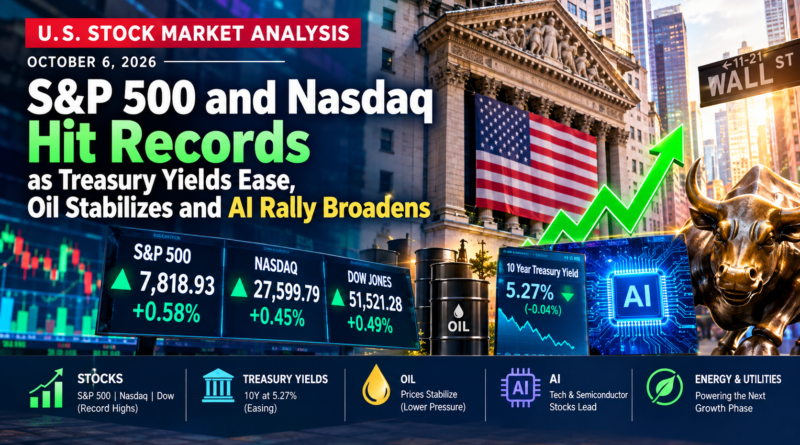
U.S. Stock Market Analysis — October 6, 2026: S&P 500 and Nasdaq Hit Records as Treasury Yields Ease, Oil Stabilizes and AI Rally Broadens
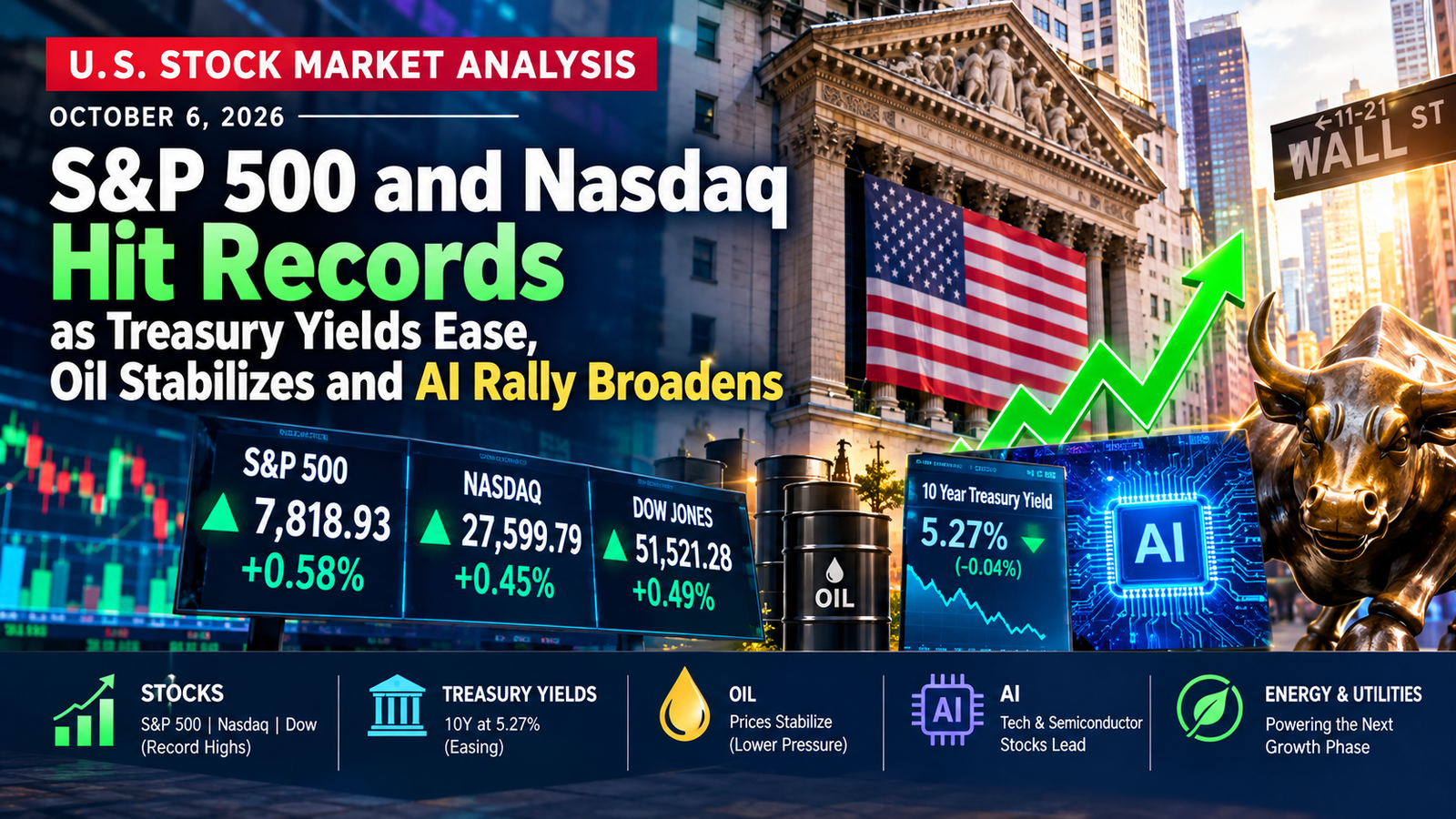
By New York Finance Think | October 6, 2026
Short Introduction
Wall Street finished Tuesday, October 6, 2026, with a message that looked simple on the surface but was much more complicated underneath:
Stocks went higher, Treasury yields eased, oil stabilized, artificial-intelligence shares remained strong, and investors began moving their attention from the recent interest-rate debate toward the coming corporate earnings season.
The S&P 500 closed at a record high near 7,819, while the Nasdaq Composite also finished at a record. The Dow Jones Industrial Average gained roughly half a percent, but it continued to sit more than 5% below its August record. Smaller companies were a different story: the Russell 2000 fell about 0.6%, showing that Tuesday’s rally was still heavily influenced by large technology, AI and utility-related companies.
The most important change was not simply that stocks rose.
It was that the bond market stopped fighting stocks as aggressively as it had in recent weeks.
The U.S. 10-year Treasury yield fell to about 5.27% on October 6 from 5.31% on October 5, according to the Treasury’s daily yield curve data. The 30-year yield declined to 5.64% from 5.66%. Those are small daily moves, but when valuations are high and investors are sensitive to interest rates, even modest changes in long-term yields can alter the tone of the equity market.
At the same time, oil prices moved lower or stabilized after the recent surge, helped by expectations of additional supply from the Middle East and emergency stockpile measures. That reduced some of the immediate fear that higher energy prices would feed into inflation and force the Federal Reserve into another rate increase.
This combination created a favorable environment for risk assets.
But Tuesday’s rally should not be interpreted as a clean victory over inflation, interest-rate risk or bond-market pressure.
There are still major questions.
Can the S&P 500 maintain record levels when valuations are elevated?
Can AI companies continue producing earnings strong enough to justify enormous capital spending?
Can Treasury yields remain under control?
Will oil remain near current levels if geopolitical tensions continue?
And perhaps most importantly for investors, will third-quarter earnings confirm the optimism already priced into the market?
Those are the questions behind the headline numbers.
KEY TAKEAWAYS
- S&P 500: Closed around 7,818.93, up about 0.58%, setting a new record.
- Nasdaq Composite: Closed around 27,599.79, up about 0.45%, also reaching a record.
- Dow Jones: Closed near 51,521, gaining about 0.49%.
- Russell 2000: Fell about 0.6%, showing that small caps did not participate fully in the rally.
- 10-year Treasury yield: About 5.27% on October 6 versus 5.31% on October 5.
- 30-year Treasury yield: About 5.64%, down from 5.66%.
- AI stocks: Nvidia, AMD, Marvell and other semiconductor names remained important market drivers.
- Energy and utilities: Strong performers, reflecting both oil dynamics and the growing electricity demand associated with AI data centers.
- Oil: Stabilization reduced immediate inflation fears.
- Fed: Markets increasingly leaned toward a pause at the October meeting, although the possibility of another hike later in the year remained important.
- Earnings: Investors are increasingly looking toward third-quarter corporate results, with analysts expecting strong S&P 500 earnings growth.
MARKET DATA TABLE
| Market Indicator | October 6, 2026 Close / Level | Daily Move | What It Means |
|---|---|---|---|
| S&P 500 | 7,818.93 | +0.58% | Record close |
| Nasdaq Composite | 27,599.79 | +0.45% | Record close |
| Dow Jones | 51,521.28 | +0.49% | Higher, but below August peak |
| Russell 2000 | 2,830.30 | -0.6% | Small caps lagged |
| U.S. 10-Year Treasury | ~5.27% | Lower | Some relief for equities |
| U.S. 30-Year Treasury | ~5.64% | Lower | Long-term yields eased |
| Oil | Around recent elevated levels | Stabilized/lower | Inflation pressure eased somewhat |
| Gold | Around $4,159/oz in market reporting | Higher | Continued demand for protection |
| S&P 500 YTD | About +14.2% | — | Strong 2026 performance |
| Nasdaq YTD | About +18.7% | — | Technology remains dominant |
Closing index data are based on Reuters/AP market reporting; Treasury yields are from the U.S. Treasury’s daily yield curve data.
WHAT HAPPENED ON WALL STREET?
Tuesday’s session was not a classic broad-based economic-growth rally.
It was more targeted.
Investors were buying companies and sectors where they could see a clear earnings story.
Technology remained strong.
AI infrastructure remained strong.
Utilities became increasingly interesting because of electricity demand.
Energy-related companies responded to the changing oil and geopolitical picture.
At the same time, small-cap stocks weakened.
That combination tells us something important about the market.
Investors are not blindly buying everything. They are choosing specific parts of the economy.
The S&P 500 gained 0.58% and reached a record close near 7,818.93. The Nasdaq rose about 0.45% to roughly 27,599.79, also a record. The Dow gained about 0.49% to 51,521.28.
The Russell 2000, however, dropped around 0.6%.
That difference matters.
Small companies are generally more sensitive to domestic borrowing costs because many have higher financing needs and less diversified revenue streams.
If long-term rates remain elevated, large technology companies with enormous cash flows and strong balance sheets can sometimes absorb the pressure better than smaller businesses.
So Tuesday’s market was not saying:
“Interest-rate risk is gone.”
It was saying something closer to:
“For now, investors are willing to look through the interest-rate risk because the earnings and AI story remains powerful.”
That is a very different message.
WHY THE S&P 500 REACHED A RECORD
The S&P 500’s new record was the headline achievement of the day.
But the reason behind the record is more important than the record itself.
The market is being supported by three major themes.
1. AI earnings expectations
Artificial intelligence remains one of the strongest investment narratives in global markets.
Companies building chips, servers, networking systems, data centers and electricity infrastructure are receiving enormous investor attention.
Nvidia remains at the center of this ecosystem.
On Tuesday, Nvidia gained further ground and moved closer to the symbolic $6 trillion market-value level. Reuters reported that Nvidia was among the important drivers of the technology rally.
The market is effectively asking:
How much economic value will AI create?
The second question is:
How much money will companies spend to build it?
Those two questions are closely connected.
If corporations continue spending heavily on AI infrastructure, chip demand can remain strong.
If chip demand remains strong, semiconductor companies can report strong revenue.
If earnings remain strong, investors may accept high valuations.
That cycle is currently supporting the market.
But it also creates risk.
If AI capital spending slows sharply, the same companies that led the rally could become the source of market weakness.
2. Treasury yields finally gave stocks some breathing room
For much of the recent market period, Treasury yields have been the uncomfortable background story.
Higher yields make stocks relatively less attractive because investors can earn more income from government bonds.
Higher yields also increase borrowing costs for companies and consumers.
They can pressure housing activity.
They can affect credit-card rates.
They can increase corporate financing costs.
They can reduce the present value of future corporate earnings.
That is why the decline in yields on Tuesday mattered.
The Treasury reported a 10-year yield of about 5.27% on October 6, down from 5.31% on October 5. The 30-year yield was around 5.64%, compared with 5.66% the previous session.
The move was modest.
But markets do not always need a dramatic change.
They sometimes just need the pressure to stop getting worse.
3. Oil prices stopped creating new inflation fear
Oil has become one of the most important variables in the current market.
The reason is simple.
Oil is not just an investment.
It is an input into almost everything.
Transportation depends on it.
Manufacturing depends on it.
Airlines depend on it.
Shipping depends on it.
Agriculture depends on energy.
Consumers feel oil prices through gasoline and transportation costs.
When oil rises sharply, investors immediately ask whether inflation will return.
That question matters because inflation affects Federal Reserve policy.
The recent stabilization in oil prices therefore gave stocks some relief.
Reuters reported that increased Middle Eastern crude exports and commitments to release emergency supplies helped ease some supply concerns.
But investors should not assume the oil problem has disappeared.
The market remains exposed to geopolitical developments.
A new disruption could quickly change the equation.
TREASURY YIELDS: THE MOST IMPORTANT “QUIET” STORY
The stock market gets most of the headlines.
The bond market often tells investors what is happening underneath.
Tuesday’s decline in Treasury yields was therefore important.
The U.S. Treasury’s daily data show:
| Treasury Maturity | Oct. 5 | Oct. 6 |
|---|---|---|
| 2-Year | 5.19% | 5.15% |
| 5-Year | 5.06% | 5.03% |
| 10-Year | 5.31% | 5.27% |
| 20-Year | 5.70% | 5.68% |
| 30-Year | 5.66% | 5.64% |
Source: U.S. Department of the Treasury.
The important point is that the decline occurred across several maturities.
That suggests Tuesday was not simply a move in one isolated part of the yield curve.
Still, yields remain historically important at these levels.
The 10-year yield near 5.27% is not a trivial borrowing cost.
For households, it can influence mortgage pricing.
For companies, it can influence financing.
For investors, it changes the competition between stocks and bonds.
THE FEDERAL RESERVE QUESTION
The Federal Reserve remains the market’s biggest policy variable.
Investors are trying to determine whether the Fed will:
- hold rates steady,
- raise rates again,
- or eventually move toward easing.
The market’s expectations have changed rapidly.
Only recently, the possibility of another rate increase was much more heavily discussed.
But softer labor-market information and changing oil expectations reduced the immediate probability of another hike.
Reuters reported that the probability assigned by markets to an October rate increase had declined sharply.
That shift matters because the market’s valuation depends heavily on the future path of interest rates.
But there is another complication.
Oil inflation can force the Fed to think differently.
If energy prices rise sharply again, inflation expectations could increase.
That would make it harder for policymakers to relax.
So investors are watching two opposing forces:
Slower economic momentum → potentially less need for rate hikes.
Higher oil prices → potentially more inflation pressure.
The Federal Reserve has to balance both.
FED MINUTES COULD BECOME THE NEXT MAJOR MARKET TEST
Investors are also looking toward the release of minutes from the Federal Reserve’s September meeting.
The minutes can provide clues about how policymakers viewed:
- inflation,
- employment,
- energy prices,
- economic growth,
- financial conditions,
- and future rate decisions.
Markets sometimes react more strongly to the tone of the minutes than to the headline policy decision itself.
If the minutes show that officials remain deeply concerned about inflation, Treasury yields could rise again.
If they show growing concern about economic weakness, yields could fall.
That could create another rotation between sectors.
THE AI TRADE IS NOT JUST ABOUT NVIDIA ANYMORE
One of the biggest changes in the market is that the AI investment story is expanding.
For the first phase of the AI rally, investors focused heavily on Nvidia.
Now the story includes:
- semiconductor designers,
- semiconductor manufacturers,
- networking companies,
- data-center operators,
- electricity producers,
- utilities,
- cooling systems,
- construction companies,
- cloud providers,
- software companies.
That creates a much larger economic chain.
Tuesday’s market action demonstrated this.
Marvell Technology rose sharply after raising its long-term revenue outlook, while AMD gained on expectations for continued AI-related chip demand.
The market is increasingly treating AI as infrastructure rather than simply software.
That is a major distinction.
NVIDIA: THE MARKET’S PSYCHOLOGICAL CENTER
Nvidia has become more than a semiconductor company in the eyes of the market.
It has become a measure of investor confidence in AI.
When Nvidia rises strongly, investors often interpret that as evidence that AI spending remains healthy.
When Nvidia falls sharply, the market begins asking whether AI valuations have gone too far.
On October 6, Nvidia continued higher and moved closer to a $6 trillion valuation.
That number itself is psychologically powerful.
The company is already enormous.
For it to continue growing at a rate capable of supporting its valuation, the underlying AI infrastructure cycle must remain extraordinarily strong.
That is why Nvidia’s next earnings report will be important far beyond Nvidia shareholders.
It could affect the entire technology sector.
AMD: ANOTHER AI DEMAND SIGNAL
AMD was another important name on Tuesday.
The company’s CEO Lisa Su said AMD plans to substantially increase chip supply in 2027 to meet strong AI demand, according to Reuters.
That is significant because semiconductor supply planning requires enormous capital investment.
Chipmakers do not simply increase production overnight.
They need:
- fabrication capacity,
- packaging,
- advanced manufacturing,
- equipment,
- power,
- data-center customers,
- and long-term contracts.
If companies are preparing for significantly higher AI demand in 2027, investors are looking beyond the current earnings cycle.
That is one reason the AI rally remains resilient.
MARVELL: WHY NETWORKING MATTERS
Marvell Technology also became one of Tuesday’s major market movers.
The company advanced about 5.8% after raising its longer-term revenue expectations, supported by demand for data-center chips.
This is an important part of the AI story that ordinary investors sometimes miss.
AI requires enormous amounts of computing power.
But computers also need to communicate.
That means networking infrastructure is critical.
The AI economy therefore creates demand not only for processors but also for:
- networking chips,
- optical connections,
- memory,
- storage,
- power systems,
- cooling,
- and data-center construction.
The investment opportunity is broadening.
CONSTELLATION ENERGY: THE AI-POWER CONNECTION
One of the most interesting market developments Tuesday happened outside traditional technology.
Constellation Energy surged after announcing a long-term nuclear power agreement with Google.
The companies announced a 20-year agreement involving 890 megawatts of new nuclear capacity for the PJM grid, while Reuters reported a broader 3,590-megawatt power arrangement.
Why does this matter to the stock market?
Because AI data centers require enormous quantities of electricity.
The next phase of the AI race is therefore partly an energy race.
Data centers cannot operate without power.
The United States is already facing questions about:
- grid capacity,
- transmission,
- generation,
- nuclear power,
- natural gas,
- renewable energy,
- and electricity prices.
That makes utility companies increasingly relevant to technology investors.
THE NEW AI TRADE: CHIPS + POWER
The market is beginning to connect two industries that historically were analyzed separately.
Technology companies need electricity.
Utilities need investment.
Data centers need power.
Power companies need customers.
This creates a new investment chain:
AI → Data Centers → Electricity Demand → Grid Investment → Power Generation
That is why companies such as Constellation Energy and other electricity producers can become part of the AI investment narrative.
It is one of the most important structural themes to watch over the next several years.
OPTION CARE HEALTH AND THE RETURN OF M&A
Tuesday was not only an AI story.
M&A activity also influenced individual stocks.
Option Care Health jumped more than 30% after McKesson and Clayton Dubilier & Rice agreed to acquire the infusion-therapy company in a transaction valued around $5.8 billion including debt.
This matters because mergers and acquisitions often accelerate when companies believe certain assets are undervalued or strategically important.
For investors, M&A creates two possibilities.
First, shareholders of the acquired company may receive a premium.
Second, the deal can signal that corporate balance sheets are strong enough to support major transactions.
If financing conditions improve, M&A activity could become another market-supporting theme.
THE TRADE DEFICIT: A WARNING UNDER THE SURFACE
Tuesday also brought important U.S. trade data.
The U.S. trade deficit widened sharply, with imports reaching a record level in August. Reuters reported that the deficit increased 13.7% and that imports rose to record levels.
At first glance, that may sound like a negative story.
But the details are more complicated.
Strong imports can indicate strong domestic demand.
Companies may be buying:
- machinery,
- technology equipment,
- industrial components,
- consumer goods,
- energy products,
- and capital equipment.
Reuters noted that capital-goods imports increased 4.4% in August.
That can be interpreted as evidence of investment.
But there is a downside.
Strong demand can also keep inflation pressure alive.
That creates a difficult environment for the Federal Reserve.
STRONG DEMAND CAN BE GOOD AND BAD
This is one of the most important concepts investors should understand.
If Americans and U.S. companies are buying more goods, that can support economic growth.
Companies sell more.
Workers remain employed.
Businesses invest.
Corporate earnings improve.
Stocks can rise.
But if demand becomes too strong while supply is constrained, prices can rise.
Then inflation becomes a problem.
The Federal Reserve may respond with higher interest rates.
So the same economic strength that helps corporate earnings can eventually hurt stock valuations.
That is the balancing act investors are facing.
SMALL CAPS TELL A DIFFERENT STORY
The Russell 2000’s decline on Tuesday was one of the most important details beneath the major-index records.
The S&P 500 and Nasdaq reached records.
Small caps fell.
That is not necessarily a crisis.
But it shows that the market is not equally comfortable with all types of risk.
Small companies generally have:
- less financial flexibility,
- greater dependence on bank financing,
- smaller cash reserves,
- greater exposure to domestic demand,
- and often higher sensitivity to interest rates.
If Treasury yields remain above 5%, those companies can face greater financial pressure.
That is why the Russell 2000 deserves attention.
If small caps eventually join the rally, it would indicate broader participation.
If they continue falling while mega-cap technology rises, the market may remain narrow.
MARKET BREADTH: A MIXED SIGNAL
Market breadth was not uniformly bullish.
Reuters reported that advancing stocks outnumbered declining stocks on the NYSE by about 1.93 to 1. On the Nasdaq, the ratio was roughly 1.01 to 1.
That difference is important.
The NYSE showed stronger participation.
The Nasdaq was much closer to balanced.
In other words, the Nasdaq’s record did not necessarily mean every technology stock was rising.
Investors should therefore distinguish between:
index strength
and
broad market strength.
They are not always the same thing.
SECTOR ROTATION: UTILITIES TAKE THE LEAD
Utilities were among Tuesday’s strongest sectors.
That may surprise investors who associate market rallies primarily with technology.
But utilities are increasingly connected to the AI story.
AI data centers consume electricity.
Electricity demand is rising.
Power-generation capacity needs investment.
Grid infrastructure requires expansion.
Nuclear energy is gaining renewed attention.
That creates a structural case for utilities and power producers.
At the same time, utilities can be sensitive to interest rates because investors often treat them as income-oriented investments.
So the decline in Treasury yields helped the sector.
TECHNOLOGY REMAINS THE MARKET ENGINE
Information technology remains one of the key drivers of the bull market.
Investors are looking for companies with:
- strong revenue growth,
- pricing power,
- high margins,
- large cash balances,
- AI exposure,
- and long-term demand visibility.
That explains why technology has been able to outperform despite high Treasury yields.
But high expectations create high standards.
A company can report strong earnings and still see its stock fall if the outlook is not strong enough.
This is especially true for mega-cap technology companies.
THE THIRD-QUARTER EARNINGS TEST
The next major test for the market is earnings.
Third-quarter earnings season begins next week, with major financial companies expected to be among the first large reporters.
Analysts expect strong aggregate S&P 500 earnings growth for the July-September quarter. Reuters cited LSEG expectations for approximately 30.6% year-over-year growth, led by energy and technology.
That is an extremely high expectation.
The market does not simply need companies to beat last year’s earnings.
It needs companies to justify today’s valuations.
That means investors will watch:
- revenue growth,
- earnings per share,
- margins,
- guidance,
- capital spending,
- AI spending,
- hiring,
- pricing,
- and customer demand.
Guidance may be more important than the headline earnings number.
BANKS COULD SET THE TONE
The financial sector will be particularly important.
Large U.S. banks can provide an early view of:
- consumer credit,
- business borrowing,
- loan demand,
- credit quality,
- investment banking,
- trading revenue,
- and the health of corporate America.
For ordinary Americans, bank earnings can also provide clues about credit-card balances, mortgage activity and consumer financial stress.
If banks report healthy consumers and businesses, the market may interpret that as confirmation of economic resilience.
If banks report rising delinquencies or weaker demand, investors could become more defensive.
WHAT AMERICANS SHOULD WATCH
A market record can feel disconnected from everyday life.
For many Americans, the questions are much simpler.
What happens to mortgage rates?
What happens to credit-card rates?
What happens to gas prices?
What happens to retirement accounts?
What happens to job opportunities?
What happens to household expenses?
These are the real-world consequences of financial markets.
WHAT HIGH TREASURY YIELDS MEAN FOR HOME BUYERS
The 10-year Treasury yield is not the same thing as a mortgage rate.
But it is an important market reference for longer-term borrowing costs.
When long-term Treasury yields rise, mortgage rates can face upward pressure.
That can make buying a home more expensive.
A household may qualify for a smaller mortgage.
Monthly payments may rise.
Home affordability can deteriorate.
Therefore, even if the S&P 500 is hitting records, a family shopping for a house may not feel particularly bullish.
This is one reason financial journalism should not treat the stock market as a perfect measure of the economy.
WHAT HIGH YIELDS MEAN FOR SAVERS
The other side of higher rates is savers.
People holding:
- Treasury securities,
- money-market funds,
- certificates of deposit,
- high-yield savings accounts,
may receive better returns than they did during the low-rate era.
That creates an important trade-off.
Higher rates can hurt borrowers.
Higher rates can help savers.
For investors, the question is not simply whether rates are “good” or “bad.”
It depends on where the money is positioned.
WHAT HIGH OIL PRICES MEAN FOR FAMILIES
Oil prices are especially important for consumers.
When crude prices rise, gasoline can become more expensive.
Transportation costs rise.
Airline expenses increase.
Shipping costs can increase.
Companies may pass some of those costs to consumers.
That is why investors pay close attention to oil even when they do not own energy stocks.
Tuesday’s stabilization was therefore positive for the broader market.
But the geopolitical risk remains.
THE GEOPOLITICAL RISK
The market remains exposed to geopolitical uncertainty, including the U.S.-Iran conflict and disruptions around the Strait of Hormuz.
Oil markets are particularly sensitive to the region.
The current market is receiving some relief because crude exports have remained stronger than feared and governments are discussing emergency supply measures.
But investors should understand the basic risk:
If supply is disrupted again, oil could rise quickly.
That could push inflation expectations higher.
Treasury yields could rise.
The Federal Reserve could become more cautious.
Technology valuations could face pressure.
Therefore, oil is still one of the most important market indicators.
GOLD AND THE SEARCH FOR PROTECTION
Gold has also remained elevated.
Gold does not generate earnings like a company.
It does not pay dividends.
But investors often use it as a hedge against:
- inflation,
- geopolitical risk,
- currency concerns,
- and financial uncertainty.
When gold rises while stocks rise, it can signal that investors are simultaneously optimistic about growth and cautious about macroeconomic risks.
That combination is visible in today’s market.
THE DOLLAR
The U.S. dollar also matters.
A stronger dollar can reduce the overseas value of U.S. companies’ foreign earnings when translated back into dollars.
A weaker dollar can help exporters and multinational corporations.
The dollar has recently been influenced by:
- interest-rate expectations,
- Treasury yields,
- geopolitical risk,
- global economic growth,
- and expectations for Federal Reserve policy.
A significant move in the dollar could therefore affect multinational technology and industrial companies.
WHY THE DOW IS LAGGING
The Dow gained Tuesday.
But it remains more than 5% below its August record.
That difference tells us the current market leadership is concentrated.
The Nasdaq is setting records.
The S&P 500 is setting records.
The Dow is still below its peak.
Small caps are falling.
This is a market where leadership matters.
Investors should therefore avoid saying simply:
“The stock market is up.”
The better question is:
Which stocks are actually driving the market higher?
Right now, technology, AI, utilities and selected corporate stories are doing much of the work.
WHAT COULD GO WRONG?
A serious market analysis must discuss the downside.
There are at least eight major risks.
Risk 1: Treasury yields rise again
If the 10-year yield moves substantially above recent highs, equity valuations could come under pressure.
Risk 2: Oil spikes
A renewed oil shock could increase inflation expectations.
Risk 3: Fed becomes more hawkish
If policymakers signal another rate increase, stocks could react negatively.
Risk 4: AI earnings disappoint
If Nvidia, AMD, Microsoft, Amazon or other major AI-linked companies provide weaker guidance, the technology rally could reverse.
Risk 5: Earnings expectations are too high
A 30% earnings-growth expectation creates a high hurdle.
Risk 6: Small-cap weakness spreads
Continued weakness in smaller companies could signal broader financial pressure.
Risk 7: Geopolitical escalation
A major disruption in energy supply could rapidly change market conditions.
Risk 8: Bond-market stress
Weak Treasury auctions or rising term premiums could push yields higher even without an immediate change in Fed policy.
Reuters has specifically highlighted Treasury auction “tails” as a bond-market risk that investors are watching.
WHAT COULD PUSH STOCKS EVEN HIGHER?
The bullish case is equally important.
Bullish factor 1: Strong earnings
If companies deliver strong results and raise guidance, stocks could continue climbing.
Bullish factor 2: AI investment
Continued AI infrastructure spending could support semiconductor and technology earnings.
Bullish factor 3: Lower oil prices
Cheaper energy could reduce inflation pressure.
Bullish factor 4: Stable Treasury yields
If long-term yields stop rising, investors may become more comfortable with equity valuations.
Bullish factor 5: Fed pause
A pause could remove some immediate policy uncertainty.
Bullish factor 6: Economic resilience
Strong consumer and business activity could support corporate earnings.
WHAT INVESTORS SHOULD WATCH NEXT
The next few sessions are likely to revolve around five themes.
1. Federal Reserve minutes
Investors will look for clues about the September meeting and the policy outlook.
2. Treasury auctions
The bond market is becoming increasingly important.
3. Oil
Any major move could change inflation expectations.
4. AI stocks
Nvidia, AMD, Marvell and other semiconductor companies remain key market indicators.
5. Earnings
The market’s biggest test is approaching.
MARKET SCENARIO TABLE
| Scenario | Treasury Yields | Oil | Stocks | Likely Market Reaction |
|---|---|---|---|---|
| Strong earnings + stable yields | Stable | Stable | Higher | Bullish |
| Strong earnings + falling yields | Lower | Stable | Strongly higher | Very bullish |
| Weak earnings + rising yields | Higher | Higher | Lower | Bearish |
| Oil spike + hawkish Fed | Higher | Higher | Lower | High-risk |
| Weak economy + Fed pause | Lower | Lower | Mixed | Defensive rotation |
| AI earnings beat | Stable/lower | Stable | Tech higher | Nasdaq leadership |
| AI earnings miss | Higher | Stable | Tech lower | Broad risk-off |
| Small caps recover | Stable | Stable | Broader rally | Healthier breadth |
WHAT THIS MEANS FOR RETIREMENT INVESTORS
For retirement investors, one day of record highs should not change a long-term plan.
A retirement portfolio is usually built around years or decades rather than one trading session.
The October 6 rally does, however, highlight the importance of diversification.
A portfolio concentrated entirely in a handful of AI stocks can perform extremely well when those companies are leading.
But concentration also creates risk.
If the AI trade reverses, a concentrated portfolio can fall much faster than the broader market.
Investors should therefore understand their exposure.
WHAT THIS MEANS FOR BEGINNER INVESTORS
A beginner may look at Tuesday’s market and think:
“Everything is going up.”
That is not exactly what happened.
The S&P 500 and Nasdaq reached records.
But the Russell 2000 fell.
Healthcare lagged.
Some technology stocks performed better than others.
Market breadth was mixed.
That is why beginners should avoid judging the entire market by one headline index.
A better approach is to understand:
Index → sector → company → earnings → valuation → risk.
THE BIGGER PICTURE: THIS IS AN EARNINGS MARKET NOW
The market spent much of the recent period worrying about:
- oil,
- inflation,
- Treasury yields,
- and the Federal Reserve.
Now the focus is moving toward earnings.
That transition is important.
If companies deliver strong results, the market may continue to tolerate elevated yields.
If earnings disappoint, investors may return immediately to the interest-rate story.
In other words:
Earnings can temporarily overpower macroeconomic fear.
But they cannot do so forever.
Eventually valuations must be supported by actual profits.
THE AI VALUATION QUESTION
The most important long-term question may be this:
How much of the future AI economy is already priced into today’s stock prices?
Investors are currently pricing in enormous growth.
That does not mean the growth is imaginary.
AI adoption is real.
Data-center construction is real.
Chip demand is real.
Electricity demand is real.
Corporate spending is real.
But stock prices reflect expectations about the future.
If reality grows faster than expectations, stocks can rise.
If reality grows more slowly than expectations, stocks can fall even when the underlying business remains healthy.
That is the difference between a good company and a good investment at a particular price.
THE ELECTRICITY ECONOMY
One of the most underappreciated themes in the current market is electricity.
AI models require data centers.
Data centers require power.
Power requires infrastructure.
Infrastructure requires capital.
That means the AI boom may influence:
- nuclear power,
- natural gas,
- transmission,
- utilities,
- industrial equipment,
- construction,
- cooling,
- and electrical components.
The Google-Constellation agreement is an example of this emerging relationship. The companies said the agreement will add 890 MW of new nuclear capacity and support grid reliability.
This is not simply a technology story.
It is an industrial story.
WHY UTILITIES COULD BECOME AN AI INVESTMENT THEME
For years, investors often treated utilities as slow-growth businesses.
That perception is changing.
If AI data centers create a major increase in electricity demand, utilities with access to reliable generation capacity could become strategically important.
The market may increasingly value electricity as an essential input into the digital economy.
That creates opportunities.
But it also creates risks.
Utilities require large capital investments.
Regulatory approvals can take years.
Grid construction is expensive.
Power prices matter.
Debt costs matter.
And higher interest rates can make infrastructure projects more expensive.
So the AI-power connection is promising but not risk-free.
A NOTE ON THE U.S. CONSUMER
The American consumer remains central to the market.
Consumer spending supports a large part of the U.S. economy.
If employment remains healthy and wages remain solid, consumers can continue spending.
But higher interest rates and elevated energy costs can gradually weaken household budgets.
The market therefore needs a balance:
Strong enough consumer spending to support earnings, but not so strong that inflation accelerates again.
That is another version of the same economic balancing act.
CREDIT CARDS AND HOUSEHOLD DEBT
High interest rates are particularly painful for consumers carrying revolving debt.
Credit-card rates can remain extremely high even when Treasury yields move modestly.
That means households with large balances can feel monetary policy much more directly than stock investors do.
If rates remain elevated for a long period, consumer debt service can become a larger economic issue.
Banks will therefore be closely watched during earnings season.
THE HOUSING MARKET
Housing remains another major transmission mechanism.
High mortgage rates can reduce affordability.
Existing homeowners may hesitate to sell because they do not want to replace a low-rate mortgage with a much higher one.
Builders face higher financing costs.
Buyers may wait.
That can create a strange economic environment where employment remains strong while housing activity remains constrained.
Again, this shows why a record stock market does not necessarily mean every part of the economy is booming equally.
WALL STREET VS. MAIN STREET
The October 6 market captures this difference perfectly.
Wall Street:
- S&P 500 record
- Nasdaq record
- AI stocks strong
- earnings optimism
Main Street:
- mortgage costs matter
- gasoline prices matter
- credit-card rates matter
- food prices matter
- job security matters
Both are real.
A good market report should explain both.
NYFT GROUND-REPORTING VIEW
If you look at Tuesday’s market like a reporter sitting with a notebook rather than simply reading an index screen, the picture becomes clearer.
The market was not celebrating one piece of good economic news.
It was responding to several small improvements arriving at the same time.
Treasury yields eased.
Oil stopped rising.
AI stocks stayed strong.
Corporate deal activity increased.
Utilities gained from the AI-power story.
Investors began anticipating earnings.
The Fed-rate-hike probability fell.
Put all of those together and the market had room to move higher.
But none of those risks disappeared.
That is the central finding from Tuesday’s session.
THE MARKET’S MESSAGE IN ONE SENTENCE
Investors are currently willing to pay for future corporate growth as long as Treasury yields and oil prices stop worsening.
That is the market’s current bargain.
If the bargain holds, stocks can continue rising.
If the bargain breaks, volatility could return quickly.
OCTOBER 7: WHAT INVESTORS SHOULD WATCH
The next trading session could be important.
Investors should watch:
- Federal Reserve minutes.
- Treasury yields.
- The 10-year Treasury auction.
- Oil prices.
- Nvidia and semiconductor stocks.
- Bank earnings expectations.
- Dollar movement.
- Gold.
- Small-cap performance.
- Market breadth.
The Treasury is scheduled to sell $39 billion of 10-year notes, according to Reuters’ market outlook.
That auction will matter because investors are increasingly focused on the demand for U.S. government debt.
WHY THE 10-YEAR AUCTION MATTERS
Treasury auctions provide a real-time test of investor demand for government debt.
If demand is strong, yields can remain contained.
If demand is weak, the government may need to offer higher yields to attract buyers.
That can push benchmark rates higher.
For the stock market, a weak auction can therefore create pressure.
A strong auction can provide relief.
This is why bond-market mechanics are becoming increasingly important for equity investors.
THE NEXT BIG QUESTION: CAN RECORDS CONTINUE?
The S&P 500 and Nasdaq have reached record closes.
That does not automatically mean the market is at a top.
Markets can reach records repeatedly during strong bull markets.
But record levels do change the risk-reward calculation.
When prices are high, expectations are high.
When expectations are high, earnings disappointments can create larger reactions.
Therefore, the market’s next phase will depend heavily on whether earnings catch up with valuations.
THREE POSSIBLE PATHS FOR THE MARKET
Bull Case
Oil remains stable.
Treasury yields remain contained.
The Fed pauses.
AI earnings remain strong.
Banks report healthy consumers.
Corporate guidance improves.
Under this scenario, the S&P 500 and Nasdaq could continue making new highs.
Base Case
Yields remain elevated but stable.
Oil remains volatile but does not surge.
AI companies continue to grow.
Earnings are strong but uneven.
Small caps remain under pressure.
Under this scenario, the market could continue rising but with greater volatility.
Bear Case
Oil rises sharply.
Treasury yields move higher.
The Fed becomes more hawkish.
AI earnings disappoint.
Credit conditions tighten.
Under this scenario, the Nasdaq could face a larger correction and investors could rotate toward defensive sectors.
FINAL MARKET VERDICT
October 6, 2026, was a strong day for U.S. stocks.
The S&P 500 reached a record.
The Nasdaq reached a record.
The Dow gained.
AI stocks remained powerful.
Utilities benefited from the growing electricity-demand story.
Oil stabilized.
Treasury yields eased.
Investors began shifting attention toward corporate earnings.
But the session should not be remembered simply as another record day.
The deeper story is about the changing relationship between stocks, bonds, oil, AI and Federal Reserve policy.
For weeks, investors worried that high Treasury yields and expensive energy would eventually damage equity valuations.
On Tuesday, those pressures temporarily eased.
That gave stocks room to climb.
The market is now entering a more important stage.
Corporate earnings will begin arriving.
The Federal Reserve will provide additional policy clues.
Treasury auctions will test investor demand.
Oil will remain tied to geopolitical developments.
And AI companies will have to prove that enormous capital spending can eventually produce enormous profits.
For U.S. investors, the lesson is straightforward:
The stock market is strong, but the reasons behind that strength are changing.
The market is moving from a story dominated by interest rates and oil toward a story increasingly dominated by earnings, AI investment and corporate profitability.
That transition could support the bull market.
It could also expose the market’s biggest weakness: extremely high expectations.
The next few weeks will tell investors which side wins.
FREQUENTLY ASKED QUESTIONS
Did the S&P 500 hit a record on October 6, 2026?
Yes. The S&P 500 closed at roughly 7,818.93, marking a new record close.
Did the Nasdaq also reach a record?
Yes. The Nasdaq Composite closed near 27,599.79 and reached another record high.
Why did stocks rise while Treasury yields remained high?
Treasury yields eased modestly from the previous session, while oil prices stabilized and investors became more optimistic about upcoming corporate earnings.
Why is Nvidia important to the market?
Nvidia is a central supplier to the AI infrastructure boom. Its earnings and outlook influence expectations for AI spending across the technology sector.
Why did utilities perform well?
Utilities are increasingly benefiting from expectations for higher electricity demand from AI data centers. The Google-Constellation nuclear power agreement highlighted this trend.
What is the biggest risk to stocks?
A combination of rising oil prices, higher Treasury yields, renewed Fed tightening expectations and weaker-than-expected corporate earnings could pressure stocks.
Are Treasury yields still high?
Yes. The October 6 Treasury data showed the 10-year yield around 5.27% and the 30-year yield around 5.64%.
Why did small caps fall?
The Russell 2000 declined about 0.6%, indicating that smaller companies remained more sensitive to elevated borrowing costs and market risk.
When does third-quarter earnings season become important?
Major U.S. companies, including large financial institutions, are expected to begin reporting third-quarter results in the following week.
Is the stock market guaranteed to continue rising?
No. Record highs do not guarantee future gains. Investors should continue evaluating earnings, valuations, interest rates, oil prices and economic conditions.
WHAT INVESTORS SHOULD REMEMBER
The October 6 market was bullish.
But bullish does not mean risk-free.
The strongest investors are not the people who simply celebrate record highs.
They are the people who understand why prices are rising and what could cause that reason to disappear.
Right now, the market’s formula looks like this:
AI growth + strong earnings expectations + stable oil + easing Treasury yields + reduced near-term Fed fears = bullish environment.
The risk formula is:
Oil shock + rising Treasury yields + hawkish Fed + earnings disappointment = market correction risk.
That is the framework investors should carry into the next session.
Financial Disclaimer
This article is for informational and educational purposes only and does not constitute investment, financial, tax or legal advice. Market prices, yields and economic expectations can change rapidly. Past market performance does not guarantee future results. Investors should conduct their own research and consider their individual financial circumstances and risk tolerance before making investment decisions.
Source base: U.S. Department of the Treasury, Federal Reserve, Reuters, Associated Press, Nasdaq and company investor-relations releases. Market data should be checked against official exchange and government sources before making investment dec
- Reuters — U.S. Stock Market Report — S&P 500/Nasdaq records, Treasury yields, oil, AI stocks earnings outlook.
- U.S. Department of the Treasury — Treasury yields U.S. government bond information.
- Federal Reserve — Fed policy, interest rates और FOMC information.
- Nasdaq — Nasdaq Composite और technology-market information.
- S&P Dow Jones Indices — S&P 500 index data और methodology.
- Federal Reserve Bank of New York — Market Intelligence — bond markets, financial conditions औरmarket expectations.
- FRED — U.S. Stock Market Indexes — historical S&P 500, Nasdaq other market data.
- Associated Press — October 6 Market Summary — major U.S. indexes daily market recap.
- NYSE — NYSE market trading information.
- Federal Reserve Bank of New York — Markets & Policy Implementation — Treasury-market operations, reference rates monetary-policy implementation.
