
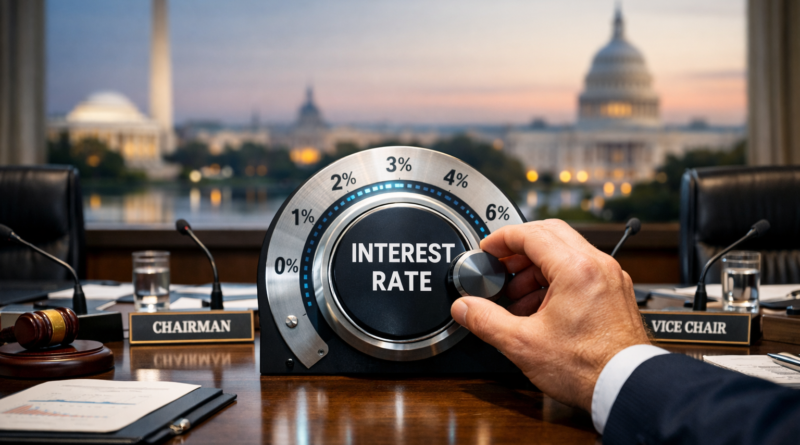
Federal Reserve Rate Decisions: Complete U.S. Guide to Fed Meetings, Rate Hikes, Cuts and Holds
Updated: October 8, 2026
By NYFT News Desk | New York Finance Think
Federal Reserve Rate Decisions Explained: What Every U.S. Investor and American Household Should Know
The Federal Reserve is one of the most important institutions in the U.S. economy.
When the Federal Reserve changes interest rates, financial markets immediately pay attention. But the impact does not stop with Wall Street. Fed decisions can eventually influence borrowing conditions, business investment, consumer spending, savings returns, bond markets, housing activity and the financial decisions of millions of Americans.
For investors, a Federal Reserve rate decision can change expectations for Federal Reserve changes interest rates, Treasury yields, banks, technology companies, small businesses and the broader economy.
For households, the same decision can influence the financial environment around mortgages, credit cards, auto loans, savings accounts and other forms of borrowing.
That is why the words “Federal Reserve rate decision” appear so frequently in U.S. financial news.
But understanding the Fed requires more than knowing whether policymakers raised, lowered or maintained interest rates.
Investors also need to understand why the Federal Reserve made the decision, what economic information policymakers considered, what the decision says about the future and how financial markets interpret the announcement.
This NYFT guide focuses specifically on Federal Reserve rate decisions.
It explains the Federal Reserve, the Federal Open Market Committee, or FOMC, the federal funds target range, rate hikes, rate cuts, rate holds, Fed statements, meeting minutes, voting, economic projections and the next steps investors should monitor.
The goal is simple:
Help ordinary Americans and beginning investors understand what a Fed decision actually means without the complicated Wall Street language.
PART 1: WHAT IS A FEDERAL RESERVE RATE DECISION?
A Federal Reserve rate decision is a monetary-policy decision made by the Federal Open Market Committee, commonly known as the FOMC.
The FOMC determines the appropriate stance of U.S. monetary policy and sets a target range for the federal funds rate.
The Federal Reserve explains that policymakers consider a broad range of economic information when making these decisions, including current economic data and information from consumers, businesses and financial-market contacts.
The federal funds rate is the interest rate that banks charge one another for overnight lending of balances held at Federal Reserve Banks.
That may sound like a technical banking issue.
It is not.
The federal funds rate is a key short-term interest-rate benchmark for the U.S. financial system.
Changes in the Fed’s policy stance can influence broader financial conditions.
That can eventually affect borrowing, spending, investment and economic activity.
In simple terms:
Federal Reserve decision → financial conditions → borrowing and spending decisions → business activity → employment and inflation.
The actual process is much more complicated than this simple chain, but the basic idea helps explain why Fed announcements receive so much attention.
WHAT IS THE FEDERAL RESERVE?
The Federal Reserve, often called the Fed, is the central bank of the United States.
It is responsible for important functions involving monetary policy and the financial system.
One of its most visible responsibilities is monetary policy.
The Federal Reserve says monetary policy is designed to help achieve two key goals established by Congress:
- Maximum employment
- Stable prices
These are commonly referred to as the Fed’s dual mandate.
The Federal Reserve does not simply try to make interest rates as low as possible.
It does not automatically raise rates whenever inflation increases.
And it does not automatically cut rates whenever the economy slows.
Instead, policymakers evaluate a large amount of information before determining the appropriate policy stance.
That is why every FOMC meeting is closely watched.
WHAT IS THE FOMC?
The Federal Open Market Committee, or FOMC, is the Federal Reserve body responsible for monetary-policy decisions involving the federal funds rate.
The Federal Reserve says the FOMC is a 12-person group and meets at least eight times each year.
The committee includes members of the Federal Reserve Board of Governors and Federal Reserve Bank presidents according to the FOMC’s membership and rotation structure.
The committee examines economic developments before deciding whether monetary policy should become:
- More restrictive
- Less restrictive
- Or remain at its current setting
The decision is communicated publicly after the meeting.
That communication is extremely important because financial markets do not react only to the numerical rate decision.
Markets also react to the language surrounding the decision.
WHY DOES THE FED MAKE RATE DECISIONS?
The Federal Reserve uses monetary policy to influence financial conditions and help move the economy toward its mandated goals.
One of the biggest considerations is inflation.
If inflation remains too high for too long, policymakers may decide that financial conditions need to be more restrictive.
Higher interest rates can make borrowing more expensive.
That can discourage some spending and investment.
If inflation is falling and economic conditions weaken, policymakers may eventually decide that less restrictive monetary policy is appropriate.
The important point is that Fed policy is about the overall economic environment, not one isolated statistic.
THE THREE BASIC TYPES OF FED RATE DECISIONS
When an FOMC meeting ends, there are three basic possibilities.
1. Rate Hike
The Fed increases the target range.
Example:
3.50%–3.75% → 3.75%–4.00%
This is a rate increase.
It generally represents tighter monetary policy.
2. Rate Cut
The Fed reduces the target range.
Example:
4.00%–4.25% → 3.75%–4.00%
This represents an easing of the policy rate.
3. Rate Hold
The Fed leaves the target range unchanged.
A hold does not mean the Fed has stopped paying attention.
A hold can be a deliberate policy decision while officials wait for more economic information.
A hold can also signal that policymakers believe the current policy stance is appropriate for the moment.
WHAT IS A FED RATE HIKE?
A Fed rate hike occurs when the FOMC raises the target range for the federal funds rate.
The purpose is generally to make monetary policy more restrictive.
Higher policy rates can affect financial conditions through several channels.
Borrowing can become more expensive.
Consumers may become more cautious.
Businesses may reconsider investment projects.
Financial markets may change their expectations for future growth and inflation.
The process is not immediate.
Monetary policy operates with lags.
That means policymakers must consider not only what is happening today but also how today’s policy could affect the economy later.
WHY WOULD THE FED RAISE RATES?
One major reason is persistent inflation.
Suppose prices are rising faster than policymakers believe is consistent with stable prices.
If demand remains strong, businesses may continue raising prices.
Workers may seek higher wages.
Consumers may continue spending.
Companies may continue investing.
The economy may remain strong enough to tolerate tighter financial conditions.
In that environment, policymakers may consider raising rates.
But a rate hike is not simply a punishment for consumers.
It is a monetary-policy tool.
The objective is to influence financial conditions.
WHAT DOES A 25-BASIS-POINT RATE HIKE MEAN?
Financial news frequently says:
“The Fed raised rates by 25 basis points.”
A basis point is one-hundredth of a percentage point.
Therefore:
- 25 basis points = 0.25 percentage point
- 50 basis points = 0.50 percentage point
- 75 basis points = 0.75 percentage point
- 100 basis points = 1.00 percentage point
A 25-basis-point increase is therefore a quarter-percentage-point increase.
For example:
3.50%–3.75%
could become:
3.75%–4.00%
That is a 25-basis-point increase.
THE LATEST FED RATE DECISION IN 2026
As of the October 8, 2026 update for this article, the latest completed FOMC decision was the September 15–16, 2026 meeting.
The Federal Reserve announced on September 16 that the committee raised the target range for the federal funds rate by 25 basis points to 3.75%–4.00%.
The decision passed by a 12–0 vote.
The Fed’s statement said economic activity was expanding at a solid pace, domestic spending remained resilient, productivity growth was strong and capital investment was robust.
The statement also said inflation remained elevated and that the policy action was intended to support a return toward the committee’s 2% inflation goal.
That is the latest official policy decision available at the time of this article’s October 8 update.
WHY THE LATEST DECISION MATTERS
The September 2026 decision is important because it shows that the Federal Reserve continued to use the federal funds rate as a tool for influencing monetary conditions.
But investors should not read the decision as a guarantee about the next meeting.
The next FOMC meeting is scheduled for October 27–28, 2026.
The Fed’s official calendar also lists a December 8–9 meeting.
Between meetings, economic data can change.
Inflation can change.
Employment conditions can change.
Consumer spending can change.
Financial markets can change.
Therefore, the next decision should be evaluated using information available closer to the meeting.
WHAT DOES THE FED LOOK AT BEFORE A RATE DECISION?
The Federal Reserve does not base policy on one number.
Officials review a wide range of information.
Important categories include:
Inflation
Policymakers monitor inflation trends and price pressures.
Employment
The labor market provides information about economic strength and maximum employment.
Consumer spending
Consumer demand is a major part of U.S. economic activity.
Business investment
Capital spending and productivity can influence the economic outlook.
Economic growth
GDP and other growth indicators help policymakers assess economic momentum.
Financial conditions
Treasury yields, credit conditions, stock markets and other financial variables can affect the economy.
International developments
Global developments can influence U.S. economic conditions.
The Federal Reserve explicitly says FOMC policymakers rely on a broad range of information when assessing policy.
FED RATE DECISIONS ARE NOT BASED ON ONE INFLATION REPORT
This is one of the most important lessons for beginning investors.
Suppose inflation comes in higher than expected.
That does not automatically mean:
“The Fed will raise rates at the next meeting.”
Likewise, a lower-than-expected inflation number does not automatically mean:
“The Fed will cut rates.”
Policymakers examine trends.
They consider whether inflation is broad or concentrated.
They examine services and goods prices.
They consider labor-market conditions.
They look at financial conditions.
They evaluate economic growth.
The Fed’s decision is therefore a judgment about the overall policy environment.
WHY EXPECTATIONS MATTER
Financial markets are forward-looking.
Investors do not wait until the Fed announces a decision to form expectations.
They are constantly estimating what policymakers might do.
That means a Fed decision can surprise markets in two different ways.
The first is the actual interest-rate change.
The second is the communication surrounding the decision.
Suppose investors expect a 25-basis-point cut.
The Fed delivers the cut.
At first glance, the decision appears exactly as expected.
But then policymakers communicate that future cuts may be limited.
The market could react negatively because the future path appears less supportive than investors expected.
This is why:
The Fed decision matters, but the expected path matters too.
WHY A RATE CUT IS NOT ALWAYS BULLISH
New investors often make a simple assumption:
Lower rates = good for stocks.
That can be true in some circumstances.
But it is not a rule.
Imagine the Fed cuts rates because inflation is falling while economic growth remains healthy.
Markets could interpret that as a positive development.
Now imagine the Fed cuts rates because unemployment is rising rapidly and the economy is entering a severe downturn.
The market response could be very different.
The reason for the rate cut matters.
Investors should therefore ask:
Why is the Fed cutting?
before asking:
Is the cut bullish?
WHY A RATE HIKE IS NOT ALWAYS BEARISH
The same principle works in reverse.
A rate hike can increase borrowing costs and put pressure on some asset valuations.
But a rate hike can also happen when:
- Economic growth is strong
- Consumer spending is resilient
- Corporate earnings are solid
- Employment remains healthy
- Inflation is elevated
If investors believe the economy can absorb tighter policy, the stock market does not necessarily have to fall simply because the Fed raises rates.
The market response depends on expectations, valuations, earnings and the economic outlook.
WHAT IS A RATE HOLD?
A rate hold occurs when the FOMC leaves the federal funds target range unchanged.
A hold can be one of the most important decisions a central bank makes.
Why?
Because policymakers may want to observe how previous rate changes are affecting the economy.
Suppose the Fed has already raised rates several times.
Those changes may not have fully affected households and businesses yet.
Policymakers may choose to hold rates while they gather more information.
A hold can therefore mean:
“We are waiting for more evidence.”
It does not necessarily mean:
“Nothing is happening.”
WHY THE FED MAY PAUSE AFTER RATE HIKES
Monetary policy operates with delays.
Imagine a company has an existing loan with a fixed interest rate.
A Fed hike does not immediately change that company’s financing cost.
The effect may become more visible when the company refinances.
The same principle can apply to households.
A homeowner with a fixed-rate mortgage does not suddenly see the mortgage payment change after a Fed hike.
A consumer with variable-rate debt may experience changes more quickly.
Because the economy adjusts at different speeds, the Fed may need time to see the full impact of previous decisions.
WHAT IS THE FEDERAL FUNDS TARGET RANGE?
The Fed does not normally announce one single number as the policy target.
It announces a target range.
For example:
3.75% to 4.00%.
This range represents the committee’s target for the federal funds rate.
The Federal Reserve uses policy tools to help keep short-term market rates aligned with its target range.
The Fed explains that tools including interest on reserve balances and the overnight reverse repurchase facility rate help implement monetary policy.
WHY DOES THE FED USE A RANGE?
A range allows policymakers to communicate a target area rather than requiring the market rate to remain at one exact number every moment.
The central bank uses its policy tools to influence short-term rates toward that range.
For ordinary Americans, the most important point is that the federal funds target range represents the Federal Reserve’s current monetary-policy setting.
FED RATE VS. YOUR PERSONAL INTEREST RATE
This distinction is critical.
The Federal Reserve does not set:
- Your exact mortgage rate
- Your exact credit-card APR
- Your exact auto-loan rate
- Your exact savings-account APY
- Your exact business-loan rate
Instead, Fed policy influences broader financial conditions.
Banks and lenders then price individual products based on multiple factors.
Those factors can include:
- Credit risk
- Market rates
- Loan maturity
- Competition
- Customer credit history
- Funding costs
- Economic conditions
Therefore, when the Fed raises rates by 25 basis points, your personal interest rate does not necessarily rise by exactly 25 basis points.
HOW A FED RATE DECISION TRAVELS THROUGH THE ECONOMY
The transmission mechanism can be simplified like this:
FOMC decision
↓
Federal funds target range
↓
Short-term market rates
↓
Bank and credit-market conditions
↓
Borrowing and saving decisions
↓
Consumer spending and business investment
↓
Economic growth and employment
↓
Inflation pressures
This process can take time.
It can also work differently across different parts of the economy.
A large corporation with access to bond markets may react differently from a small business relying on a bank loan.
A homeowner with a 30-year fixed mortgage may react differently from a renter considering a new home purchase.
A retiree with cash savings may benefit from higher short-term yields while a borrower may face higher financing costs.
That is why one Fed decision can have different effects on different Americans.
HOW THE FEDERAL RESERVE COMMUNICATES A RATE DECISION
The Fed does not simply announce:
“Rates are now X.”
It provides several forms of communication.
These can include:
- FOMC statement
- Implementation note
- Press conference
- Economic projections
- Meeting minutes
- Speeches by policymakers
Each source provides a different level of information.
For investors, reading the complete communication can be more useful than relying on a headline.
THE FOMC STATEMENT
The FOMC statement is one of the first documents investors examine after a decision.
It explains:
- What the committee decided
- How officials view economic activity
- What they see happening with inflation
- What they see happening in employment
- What risks they are considering
Small changes in language can attract significant market attention.
For example, investors may compare a new statement with the previous statement.
They look for words that have been added, removed or changed.
WHY ONE WORD CAN MATTER TO MARKETS
Suppose an earlier statement says inflation:
“remains elevated.”
Then a later statement says inflation:
“has eased.”
Investors may interpret the language change as evidence that policymakers see improving inflation conditions.
Similarly, a stronger description of economic growth may influence expectations about future policy.
The words themselves do not mechanically determine the next rate decision.
But they provide clues about policymakers’ thinking.
THE FED CHAIR’S PRESS CONFERENCE
After selected FOMC meetings, the Federal Reserve Chair holds a press conference.
This is another important source of information.
Reporters ask questions about:
- Inflation
- Employment
- Future policy
- Economic growth
- Financial conditions
- Risks
The Chair’s answers can clarify what the written statement means.
But investors should remember that policymakers generally avoid making promises about future decisions.
Economic conditions can change.
WHAT ARE FOMC MINUTES?
FOMC minutes provide more detail about the discussion at a policy meeting.
They can show:
- Areas of agreement
- Areas of disagreement
- Risks policymakers considered
- Arguments for different policy choices
- Views about inflation
- Views about employment
- Views about financial conditions
The minutes are therefore useful for understanding the debate behind the final decision.
The Federal Reserve released the minutes from the September 15–16, 2026 meeting on October 7, 2026.
WHY FOMC MINUTES MATTER TO INVESTORS
Imagine the Fed raises rates by 25 basis points.
The headline tells you what happened.
The minutes can help explain why.
They may reveal whether officials were broadly comfortable with the decision or whether there were significant differences in their assessment.
This can matter for expectations about future meetings.
But investors should not treat minutes as a direct forecast.
They describe the discussion around a particular meeting.
Economic conditions can change after the meeting.
WHAT IS THE FED DOT PLOT?
The term “dot plot” is commonly used for the Federal Reserve’s interest-rate projections.
It shows individual participants’ judgments about the appropriate level of the federal funds rate at specified future points.
The projections are not promises.
They are participants’ individual assessments.
The September 2026 projection materials include distributions of participants’ projections for the federal funds rate and other economic variables.
Investors often watch the median projection closely.
But the range of views can also be important.
A wide distribution may indicate uncertainty or disagreement about the economic outlook.
THE DOT PLOT IS NOT A PROMISE
This deserves emphasis.
If the Fed’s projections show a particular median rate for a future year, that does not mean the Federal Reserve has promised to set rates at that level.
Economic data can change.
Inflation can change.
Employment can change.
Financial conditions can change.
The appropriate policy response can therefore change.
Investors should treat projections as information about policymakers’ current views, not guaranteed outcomes.
HOW OFTEN DOES THE FED MEET?
The FOMC normally has eight regularly scheduled meetings each year.
Some meetings are associated with the Summary of Economic Projections.
The 2026 calendar lists meetings in January, March, April, June, July, September, October and December, with March, June, September and December designated as meetings associated with projections.
The remaining 2026 scheduled meetings are:
October 27–28, 2026
and
December 8–9, 2026.
These dates are important for investors because expectations can change significantly in the weeks leading into an FOMC meeting.
WHAT HAPPENS BEFORE AN FOMC MEETING?
The Fed does not make a rate decision in isolation.
Before a meeting, investors and policymakers receive new information.
Important economic reports can include:
- Inflation data
- Employment data
- Retail sales
- GDP data
- Consumer spending
- Producer prices
- Jobless claims
- Housing information
- Business surveys
Markets continuously update their expectations as new information arrives.
For example:
Inflation falls → expectations change.
Jobs weaken → expectations change.
Economic growth accelerates → expectations change.
Energy prices jump → expectations change.
That process continues until the FOMC makes its decision.
WHAT HAPPENS ON FED DECISION DAY?
A typical decision day attracts enormous attention from financial markets.
Investors watch the release time.
The FOMC statement is released.
Financial markets react.
Treasury yields can move.
Stocks can move.
The dollar can move.
Then, when scheduled, the Fed Chair’s press conference provides additional information.
Financial-news organizations immediately analyze the decision.
But the first market move is not necessarily the final market move.
WHY THE FIRST MARKET REACTION CAN CHANGE
Markets digest information rapidly.
The first reaction may be based on the headline.
Then investors read the statement.
Then they listen to the press conference.
Then they evaluate economic projections.
Then algorithms, institutions and individual investors reassess their positions.
As a result, the market can initially move in one direction and later reverse.
This is one reason inexperienced investors should be careful about making emotional decisions immediately after a Fed announcement.
WHAT IS A HAWKISH FED?
“Hawkish” is a common financial-market term.
It generally describes a policy stance that places greater emphasis on controlling inflation and may favor tighter monetary policy when appropriate.
A hawkish signal can mean investors expect:
- Higher rates
- Fewer rate cuts
- Rates staying elevated longer
- Greater concern about inflation
The term is informal market language.
It should not be confused with an official Federal Reserve classification.
WHAT IS A DOVISH FED?
“Dovish” is the opposite market term.
It generally describes a policy stance that places greater emphasis on economic support or employment risks and may be more comfortable with easier monetary policy when conditions justify it.
A dovish signal can mean markets expect:
- Lower rates
- More rate cuts
- Less restrictive policy
- Greater concern about economic weakness
Again, “dovish” is financial-market terminology rather than an official Fed label.
HAWKISH VS. DOVISH: SIMPLE EXAMPLE
Suppose the Fed holds rates steady.
That is the actual decision.
But policymakers say inflation remains a significant concern and additional tightening may be necessary if price pressures remain high.
Markets could interpret the communication as relatively hawkish.
Now imagine the Fed holds rates steady but says inflation is moving lower and officials are increasingly focused on labor-market risks.
Markets could interpret that communication as relatively dovish.
Same action:
Rate hold.
Different message:
Different market interpretation.
WHY THE FED MAY DISAGREE INTERNALLY
Economic data can be interpreted differently.
One policymaker may be more concerned about inflation.
Another may be more concerned about employment.
Another may believe financial conditions are already restrictive.
Another may believe the economy remains strong enough for tighter policy.
The FOMC decision represents the committee’s policy decision.
The minutes can provide more detail about differing views.
WHY THE VOTE MATTERS
Investors should look at the voting record.
A unanimous vote can show broad agreement with the decision at that meeting.
A divided vote can indicate that some policymakers preferred a different policy action.
But even a unanimous decision does not guarantee future unanimity.
Economic conditions can change.
The September 2026 decision was approved 12–0, according to the Federal Reserve.
WHAT DOES “NO CHANGE” REALLY MEAN?
Suppose the Fed leaves rates unchanged.
Financial headlines may say:
“Fed holds rates steady.”
But there can be significant changes underneath that headline.
The Fed could:
- Change its economic projections
- Change its inflation assessment
- Change its employment assessment
- Change its risk assessment
- Change its language
- Signal greater uncertainty
Therefore, investors should read the full statement.
FED RATE DECISIONS AND THE STOCK MARKET
The stock market reacts to Fed decisions because interest rates affect valuation, financing and economic expectations.
But there is no simple formula saying:
Rate hike = stocks down
or:
Rate cut = stocks up.
Stock prices reflect expectations about future corporate cash flows.
Interest rates affect the discount rate investors use to value those cash flows.
Higher rates can therefore put pressure on some valuations.
But stronger economic growth can increase corporate earnings.
That can offset some of the pressure.
The market is constantly balancing these forces.
FED RATE DECISIONS AND BOND MARKETS
Bond markets can react immediately to Fed decisions.
Short-term Treasury yields can be particularly sensitive to expectations about the federal funds rate.
Long-term Treasury yields respond to a broader combination of factors.
These include:
- Future interest-rate expectations
- Inflation expectations
- Economic growth expectations
- Treasury supply
- Demand for government bonds
- Term premium
- Global financial conditions
This is why a Fed rate change does not necessarily move every Treasury yield by the same amount.
FED RATE DECISIONS AND THE U.S. DOLLAR
Interest-rate expectations can influence the dollar.
When investors expect relatively higher U.S. rates, dollar assets can become more attractive under some circumstances.
Currency markets are also influenced by economic growth, global risk sentiment, central-bank policy in other countries and international capital flows.
Therefore, the dollar should not be viewed as a pure Fed-rate indicator.
FED RATE DECISIONS AND BANKS
Banks operate in an interest-rate environment shaped partly by Fed policy.
Higher rates can increase the yield earned on some loans and securities.
But higher rates can also increase deposit and funding costs.
Loan demand can change.
Credit quality can change.
The yield curve can change.
That means the effect of a Fed decision on a bank depends on the bank’s specific balance sheet and business model.
Investors should look beyond the headline rate.
FED RATE DECISIONS AND SMALL BUSINESSES
Small businesses can feel interest-rate changes through financing.
Consider a business owner planning to:
- Purchase equipment
- Open a second location
- Hire employees
- Refinance debt
- Build inventory
If financing costs rise, the economics of the project can change.
If financing becomes less expensive, some projects may become more attractive.
But business conditions vary widely.
A strong business may continue investing during a high-rate environment.
A highly leveraged business may face greater pressure.
FED RATE DECISIONS AND CONSUMERS
For consumers, the Fed matters because financial conditions influence the cost and availability of credit.
Areas that can be affected include:
- Credit cards
- Auto loans
- Home loans
- Home-equity borrowing
- Personal loans
- Savings products
However, the effect differs by product.
A fixed-rate mortgage is different from a variable-rate credit card.
A savings account is different from a long-term bond.
That is why Americans should not assume that every personal interest rate moves immediately after an FOMC decision.
FED RATE DECISIONS AND SAVERS
Higher interest rates can create opportunities for savers.
Banks may offer higher yields on some deposit products.
Money-market funds can also reflect changes in short-term rates.
Treasury bills can become more attractive when short-term yields are elevated.
But savers should compare actual yields.
A bank does not have to offer the same rate as the federal funds rate.
The federal funds rate is not the rate a consumer automatically earns on a checking or savings account.
FED RATE DECISIONS AND BORROWERS
Borrowers often have the opposite experience.
When rates rise, variable-rate debt can become more expensive.
New loans can also become more expensive.
Businesses may face higher refinancing costs.
Consumers carrying credit-card balances may pay more interest.
This is why high-rate periods can make debt management particularly important.
FIXED VS. VARIABLE INTEREST RATES
A key distinction for Americans is whether their debt has a fixed or variable rate.
Fixed rate
The interest rate is generally set for the agreed period.
Variable rate
The interest rate can change according to the terms of the financial product.
The impact of Fed policy can therefore be faster for some variable-rate borrowers than for people holding fixed-rate debt.
WHY THE FED CANNOT CONTROL EVERY INTEREST RATE
The Federal Reserve directly targets the federal funds rate.
But the U.S. economy contains thousands of financial products.
Mortgage lenders have their own pricing.
Banks have funding costs.
Corporate bonds have different maturities and credit risks.
Consumer loans depend on individual credit histories.
Treasury yields are determined in financial markets.
Therefore:
Fed rate ≠ every U.S. interest rate.
The Fed influences financial conditions.
It does not dictate every loan contract.
HOW INVESTORS SHOULD READ A FED STATEMENT
A useful method is to compare the newest statement with the previous one.
Look for changes in descriptions of:
Economic activity
Is growth described as strong, moderate, slowing or expanding?
Employment
Are job gains strong, slowing or weakening?
Inflation
Is inflation described as elevated, easing or persistent?
Risks
Has the Fed changed its assessment of economic risks?
Policy stance
Does the statement suggest that policy remains restrictive, is becoming less restrictive or may need adjustment?
This method is more useful than reading only the headline.
FIVE QUESTIONS TO ASK AFTER EVERY FED DECISION
Question 1:
What did the Fed actually do?
Question 2:
Was the decision expected?
Question 3:
What changed in the statement?
Question 4:
What did officials say about future policy?
Question 5:
What are Treasury yields and markets saying afterward?
These five questions provide a useful starting framework.
Financial markets generate enormous amounts of commentary around FOMC meetings.
Some headlines may say:
“Fed sparks market rally.”
Others may say:
“Fed shocks Wall Street.”
Investors should look beyond the headline.
Read the official decision.
Read the statement.
Check the vote.
Review the projections.
Listen to the press conference.
Then examine the market response.
This helps separate the actual policy decision from commentary.
FED RATE DECISIONS VS. MARKET EXPECTATIONS
This distinction is essential.
Federal Reserve decision
What the FOMC actually decided.
Market expectation
What investors believed the Fed would probably do.
Analyst forecast
An individual’s or institution’s estimate of what may happen.
Fed projection
The individual economic assessment of FOMC participants.
These are four different things.
They should not be mixed together.
WHY MARKETS CAN MOVE BEFORE THE FED MEETING
Markets do not wait for the FOMC.
Suppose investors increasingly believe inflation is falling.
They may start pricing in lower future rates.
Treasury yields can move before the Fed meeting.
Stocks can move before the Fed meeting.
The dollar can move before the Fed meeting.
Then the Fed may simply confirm what markets already expected.
In that case, the announcement itself may produce a smaller reaction.
“PRICED IN” — WHAT DOES IT MEAN?
Financial reporters often say:
“The decision was already priced in.”
This means investors had already incorporated an expected outcome into market prices.
Suppose almost everyone expects a 25-basis-point rate cut.
If the Fed delivers exactly that cut, there may be little surprise.
But if the Fed unexpectedly delivers no cut, markets may move sharply.
The bigger the surprise, the greater the potential for immediate market volatility.
WHY THE NEXT FED DECISION IS NEVER GUARANTEED
Even when markets appear confident about the next move, new information can change the outlook.
For example:
Inflation surprise
↓
Expectations change.
Or:
Employment weakens unexpectedly
↓
Expectations change.
Or:
Economic growth accelerates
↓
Expectations change.
This is why investors should treat forecasts as probabilities and expectations rather than facts.
THE FED’S 2026 MEETING CALENDAR
According to the Federal Reserve’s official calendar, the remaining scheduled FOMC meetings in 2026 are:
| Meeting | Date |
|---|---|
| October FOMC | October 27–28, 2026 |
| December FOMC | December 8–9, 2026 |
The October meeting is a two-day meeting with a press conference. December is also associated with updated economic projections.
These dates can change in unusual circumstances, so investors should always verify the latest official Fed calendar.
WHAT HAPPENS AFTER THE OCTOBER MEETING?
After the October 27–28 meeting, investors will receive the FOMC statement and press conference.
The minutes from that meeting are scheduled for release on November 18, according to the Federal Reserve’s monetary-policy calendar.
The December meeting is scheduled for December 8–9.
Because December is a projection meeting, investors will receive another update to the Fed’s economic projections.
WHY DECEMBER PROJECTIONS MATTER
Economic projections can help investors understand how policymakers currently see:
- Growth
- Inflation
- Unemployment
- Interest rates
But projections should never be treated as guaranteed outcomes.
The economy can change between projection releases.
A new inflation shock can change the outlook.
A change in employment can change the outlook.
A major financial-market event can change the outlook.
Therefore, projections are best understood as a snapshot of policymakers’ views at a particular point in time.
THE FED’S LONGER-TERM RATE OUTLOOK
The Federal Reserve’s projections also include longer-run estimates.
These can help investors understand how policymakers view the eventual policy environment.
But the long-run estimate should not be confused with a promise.
The neutral or longer-run interest-rate environment can change as the economy changes.
Productivity, demographics, inflation trends and other structural factors can influence the long-term economic outlook.
FED RATE DECISIONS AND FINANCIAL CONDITIONS
A central bank can change its policy rate while financial conditions move in a different direction.
For example, the Fed could hold rates steady while Treasury yields rise sharply.
That could tighten financial conditions.
Conversely, the Fed could hold rates steady while Treasury yields fall and credit conditions improve.
That could ease financial conditions.
This is why policymakers monitor more than just the federal funds rate.
WHAT ARE FINANCIAL CONDITIONS?
Financial conditions are a broad way of describing how easy or difficult it is for households, businesses and investors to obtain financing and take financial risk.
Factors can include:
- Interest rates
- Treasury yields
- Credit spreads
- Stock prices
- Exchange rates
- Lending conditions
A change in one area can influence another.
This is why a Fed decision can affect markets even when the policy rate itself moves only slightly.
WHY THE FED WATCHES CREDIT CONDITIONS
Banks and financial institutions determine how easily borrowers can obtain credit.
If banks become more cautious, businesses and consumers may have greater difficulty obtaining financing.
Even if the Fed has not changed rates, tighter credit conditions can slow economic activity.
Conversely, easier lending conditions can support economic activity.
The Fed therefore evaluates the broader financial environment.
FED RATE DECISIONS AND ECONOMIC GROWTH
Interest rates influence economic activity because borrowing costs affect decisions.
A company deciding whether to build a factory may compare the expected return with its financing cost.
A household deciding whether to purchase a home may compare the monthly payment with its income.
A consumer deciding whether to finance a vehicle may consider the loan rate.
When rates rise, some decisions become less attractive.
When rates fall, some decisions become more attractive.
But people and businesses do not all respond the same way.
WHY MONETARY POLICY HAS A LAG
This is one of the most important concepts in understanding the Fed.
A rate decision made today does not instantly change every part of the economy.
Existing loans may have fixed rates.
Businesses may have already committed to investment.
Consumers may have already planned spending.
Contracts may take months to expire.
Refinancing may occur later.
Therefore, monetary policy can take time to influence economic activity.
This creates a challenge for policymakers.
They must act based partly on where they think the economy is going—not only where it is today.
THE FED’S BIG POLICY CHALLENGE
The Fed has to balance multiple risks.
If inflation is too high:
Policy may need to remain restrictive.
If economic activity weakens substantially:
Policy may need to become less restrictive.
If both inflation and unemployment are high:
The policy trade-off becomes particularly difficult.
There is no single interest rate that is automatically correct forever.
The appropriate policy stance depends on economic conditions.
WHY FED DECISIONS CAN BE DIFFICULT
Economic data are imperfect.
They can be revised.
Different indicators can send different signals.
Inflation can fall while the labor market remains strong.
Employment can weaken while consumer spending remains resilient.
GDP can grow while some households feel financially pressured.
That is why Fed officials examine a broad collection of data.
FED RATE DECISIONS AND AMERICAN HOUSEHOLDS
A Fed decision may sound abstract.
But consider four Americans.
Person A: Homeowner with fixed mortgage
The existing mortgage payment may not change immediately.
Person B: Credit-card borrower
A variable APR may respond more quickly to changes in financial conditions.
Person C: Saver
Higher short-term rates may provide better opportunities for cash and short-term savings products.
Person D: Investor
Changes in interest-rate expectations can affect stocks and bonds.
The same Fed decision can therefore create different financial effects for different people.
FED RATE DECISIONS AND RETIREMENT INVESTORS
Retirement investors should be careful about reacting to individual FOMC announcements.
A retirement portfolio often has a long investment horizon.
Fed decisions can influence short-term volatility.
But retirement planning generally involves years or decades.
Investors should consider:
- Asset allocation
- Diversification
- Risk tolerance
- Income needs
- Time horizon
- Tax considerations
A single 25-basis-point decision should not automatically determine a long-term retirement strategy.
WHAT INVESTORS SHOULD WATCH ON FED DAY
A practical checklist:
Before the announcement
- Check the current federal funds target range.
- Review recent inflation data.
- Review employment data.
- Check Treasury yields.
- Review market expectations.
- Know the previous FOMC statement.
At the announcement
- Check the rate decision.
- Check the vote.
- Read the statement.
- Look for language changes.
During the press conference
- Listen for inflation comments.
- Listen for labor-market comments.
- Listen for future-policy guidance.
- Listen for risks.
After the meeting
- Check the 2-year Treasury yield.
- Check the 10-year Treasury yield.
- Check major stock indexes.
- Check the dollar.
- Read the full coverage.
- Avoid reacting solely to the first market move.
WHAT BEGINNER INVESTORS SHOULD NOT DO
Do not assume every Fed hike means sell everything.
The market is more complicated than that.
Do not assume every Fed cut means buy everything.
Economic conditions matter.
Check official sources.
Do not confuse market expectations with Fed decisions.
They are different.
Do not ignore Treasury yields.
The Fed funds rate is only one part of the interest-rate market.
Do not treat a projection as a promise.
Economic conditions can change.
FED RATE DECISIONS: A SIMPLE INVESTOR FRAMEWORK
Every FOMC decision can be organized around five questions:
1. What did the Fed do?
2. Why did the Fed do it?
3. What does the Fed say about the economy?
4. What does the Fed say about future policy?
5. How did markets interpret the message?
This framework can be used at every FOMC meeting.
A SIMPLE EXAMPLE
Imagine the Fed raises rates by 25 basis points.
The headline is:
“Fed raises rates.”
A beginner may immediately think:
“Stocks will fall.”
A better analysis asks:
- Was the hike expected?
- Why did the Fed hike?
- Is inflation falling?
- Is employment strong?
- Did the Fed signal more hikes?
- Did Treasury yields rise?
- Did stocks already price in the decision?
- What did the Fed Chair say?
Now the investor is analyzing the policy decision rather than simply reacting to it.
ANOTHER EXAMPLE: FED HOLDS RATES
Suppose the Fed leaves rates unchanged.
The headline says:
“Fed holds rates steady.”
Again, that is only the first layer.
An investor should ask:
- Is inflation improving?
- Is economic growth slowing?
- Is employment weakening?
- Does the Fed expect rates to remain high?
- Are future cuts becoming more likely?
- Did the dot plot change?
- What happened to Treasury yields?
A hold can contain a significant policy message.
ANOTHER EXAMPLE: FED CUTS RATES
Suppose the Fed cuts by 25 basis points.
An investor should ask:
Why?
If inflation is declining and economic growth remains healthy, the market may interpret the cut differently than if unemployment is rapidly increasing.
The same numerical rate cut can therefore produce very different market reactions.
WHY CONTEXT IS MORE IMPORTANT THAN THE HEADLINE
Financial news is often designed to be fast.
That means headlines simplify complex decisions.
A headline might say:
“Fed raises rates.”
But the real story could involve:
- Falling inflation
- Strong productivity
- Weakening employment
- Changing Treasury yields
- Shifting projections
- International risks
The responsible investor reads beyond the headline.
OFFICIAL FED DATA VS. MARKET COMMENTARY
For NYFT readers, it is useful to separate primary information from commentary.
Primary sources
- Federal Reserve
- FOMC statements
- FOMC minutes
- Fed projections
- Federal Reserve economic data
Government economic sources
- Bureau of Labor Statistics
- Bureau of Economic Analysis
- U.S. Treasury
Market reporting
- Reuters
- Associated Press
- Other established financial-news organizations
A good finance article should identify which information comes directly from the government and which represents analysis or market interpretation.
WHY OFFICIAL SOURCES MATTER
Federal Reserve decisions are policy decisions.
The official Fed statement is therefore the primary source for what the committee actually decided.
News articles can explain the decision.
Analysts can interpret it.
Economists can debate it.
But the official FOMC statement tells readers what the committee actually did.
For a finance website, that distinction is important.
NYFT’S APPROACH TO FED RATE COVERAGE
For Federal Reserve coverage, NYFT should clearly separate:
FACT
What the Federal Reserve officially announced.
DATA
What government economic reports show.
EXPECTATION
What financial markets or economists expect.
ANALYSIS
What the information could mean.
OUTLOOK
What investors should watch next.
This structure helps readers understand the difference between an official decision and an interpretation.
CURRENT 2026 FED RATE TIMELINE
The Federal Reserve’s official historical policy table shows that the federal funds target range was:
3.75%–4.00% after the September 2026 decision.
The September 2026 FOMC statement confirmed the 25-basis-point increase and 12–0 vote.
The next scheduled meeting is October 27–28.
The following scheduled meeting is December 8–9.
The September meeting minutes were released October 7.
This timeline should be updated after each new FOMC decision.
WHAT CAN CHANGE BEFORE THE NEXT FED MEETING?
Almost anything affecting the economic outlook can change the policy discussion.
Important developments include:
- Inflation surprises
- Employment surprises
- Wage growth
- Consumer spending
- GDP revisions
- Energy prices
- Financial-market stress
- Credit conditions
- Global economic developments
- Geopolitical developments
The Fed does not operate according to a fixed calendar of automatic rate hikes and cuts.
It evaluates the incoming information.
WHY INVESTORS SHOULD WATCH THE DATA BETWEEN MEETINGS
A Fed meeting may last two days.
But the policy debate continues between meetings.
Every major economic release can change the outlook.
For example:
Inflation report
↓
Changes inflation expectations.
Jobs report
↓
Changes labor-market expectations.
Retail-sales report
↓
Changes consumer-demand expectations.
Treasury-market move
↓
Changes financial-condition expectations.
These developments can all influence how investors think about the next FOMC meeting.
THE DIFFERENCE BETWEEN FED POLICY AND FED FORECASTS
The Federal Reserve makes an actual policy decision at an FOMC meeting.
Economic projections are different.
A projection says:
“This is how participants currently see the economy and appropriate policy.”
It does not say:
“This must happen.”
That distinction is especially important for headlines about future rate cuts.
WHY FED FORECASTS CAN CHANGE
Suppose policymakers previously expected inflation to decline.
Then an unexpected rise in prices occurs.
Officials may revise their projections.
Or suppose employment unexpectedly weakens.
They may revise their outlook in the opposite direction.
This is normal.
Economic forecasts are not contracts.
They are estimates based on information available at a particular time.
WHAT “HIGHER FOR LONGER” MEANS
Investors often use the phrase “higher for longer.”
It generally means interest rates may remain elevated for an extended period rather than quickly returning to very low levels.
This environment can affect:
- Borrowers
- Bond investors
- Growth stocks
- Real estate
- Banks
- Business investment
- Savings products
But “higher for longer” is market language.
The actual policy rate remains whatever range the FOMC has officially set.
WHAT “LOWER FOR LONGER” MEANS
The phrase “lower for longer” generally describes expectations that interest rates may remain relatively low for an extended period.
Such an environment can support borrowing and risk-taking.
But it can also reduce returns available on some cash and short-term savings products.
Again, the effects depend on the broader economy.
THE FED IS NOT THE ONLY CENTRAL BANK THAT MATTERS
The U.S. economy is connected to the rest of the world.
Other central banks make their own policy decisions.
These include institutions such as:
- European Central Bank
- Bank of England
- Bank of Japan
- Bank of Canada
Their decisions can affect currency markets, global bond yields and international capital flows.
That means the Fed’s policy cannot be analyzed completely in isolation.
WHY GLOBAL EVENTS CAN AFFECT THE FED
The U.S. economy can be affected by international developments.
For example:
- Energy shocks
- Global trade changes
- Foreign economic weakness
- Currency movements
- Financial-market stress
The Federal Reserve’s September 2026 statement specifically noted elevated uncertainty, including uncertainty related in part to geopolitical developments.
This illustrates why the Fed’s decision-making environment can change even when domestic economic data have not changed dramatically.
FED RATE DECISIONS AND MARKET VOLATILITY
FOMC days can produce increased volatility.
Stocks may move rapidly.
Treasury yields can change quickly.
The dollar can move.
Options markets can become more active.
This does not necessarily mean the underlying economy has changed dramatically in one afternoon.
Sometimes the market is simply repricing expectations.
That distinction is important.
WHY VOLATILITY IS NOT THE SAME AS RISK OF RECESSION
A sharp market move after an FOMC decision does not automatically mean the economy is entering a recession.
Markets can move because investors adjust expectations.
For example:
- Expected rate cuts may be reduced.
- Treasury yields may rise.
- Stock valuations may adjust.
- The dollar may strengthen.
These can create significant market moves without an immediate change in economic output.
FED RATE DECISIONS AND LONG-TERM INVESTING
Long-term investors should distinguish between:
policy news
and
long-term business fundamentals.
A company may face one difficult quarter but remain financially strong.
Another company may benefit from lower rates but have weak fundamentals.
Interest rates are important.
They are not a substitute for company analysis.
WHAT FED POLICY MEANS FOR VALUE INVESTORS
Value investors often examine current earnings, cash flows and balance sheets.
Interest rates still matter.
Higher rates can affect valuation multiples and financing costs.
But a company with strong current cash flow may respond differently from a company whose valuation depends primarily on distant future growth.
Therefore, the relationship between Fed policy and value stocks is not one-dimensional.
WHAT FED POLICY MEANS FOR GROWTH INVESTORS
Growth investors often pay close attention to interest rates because valuation depends heavily on expected future cash flows.
When discount rates rise, the present value of distant cash flows can decline.
That can create pressure on high-growth valuations.
But actual company growth, earnings surprises and technological developments can dominate interest-rate effects.
Again, investors should consider both macro and company-specific factors.
WHAT FED POLICY MEANS FOR BOND INVESTORS
Bond investors should pay close attention to:
- Fed policy
- Inflation
- Treasury yields
- Duration
- Credit quality
- Yield curve
Short-duration and long-duration bonds can respond differently to changes in interest-rate expectations.
Credit-sensitive bonds also have risks that Treasury securities do not have.
Therefore, “rates are falling” is not enough information to evaluate a bond investment.
WHAT FED POLICY MEANS FOR CASH INVESTORS
Cash and cash-like investments can behave differently from stocks and long-duration bonds.
When short-term interest rates are high, investors may receive relatively attractive yields from some cash products.
But if the Fed begins cutting rates, short-term yields may decline.
This creates an important trade-off:
Higher current yield vs. future reinvestment risk.
Investors should evaluate liquidity and time horizon rather than simply chasing the highest advertised rate.
THE MOST IMPORTANT FED TERMS TO KNOW
Federal Reserve
The U.S. central bank.
FOMC
The Federal Open Market Committee responsible for monetary-policy decisions.
Federal funds rate
The overnight rate at which banks lend balances to one another.
Target range
The range set by the FOMC for the federal funds rate.
Basis point
One-hundredth of a percentage point.
Rate hike
An increase in the target range.
Rate cut
A decrease in the target range.
Rate hold
No change to the target range.
Hawkish
Market language for a relatively tighter policy stance.
Dovish
Market language for a relatively easier policy stance.
Dot plot
A chart showing individual FOMC participants’ projections for the federal funds rate.
FOMC minutes
A detailed record of the policy meeting discussion.
Forward guidance
Communication about the likely policy outlook and economic assessment.
FED RATE DECISION CHECKLIST FOR NYFT READERS
Before publishing or reading a Fed decision article, check:
Current federal funds range
Decision date
Rate change
Vote
FOMC statement
Economic assessment
Inflation language
Employment language
Future-policy language
Economic projections, if released
Press conference
FOMC minutes when available
Treasury-yield reaction
Stock-market reaction
Dollar reaction
This checklist helps keep a Fed article factual and useful.
WHY THE FED’S OFFICIAL CALENDAR SHOULD BE BOOKMARKED
Investors should not rely on social media for FOMC dates.
The Federal Reserve publishes the official meeting calendar.
The 2026 calendar lists the remaining scheduled meetings as October 27–28 and December 8–9.
The Federal Reserve also publishes its monetary-policy materials, including statements, minutes and projections.
For a financial-news website, these official pages should be among the primary reference sources.
FED RATE DECISIONS: THE BIG PICTURE
The Federal Reserve’s interest-rate decisions are ultimately about monetary policy.
But their effects spread throughout the economy.
A rate hike can make financial conditions tighter.
A rate cut can make them less restrictive.
A hold can give policymakers time to evaluate previous decisions.
Markets then interpret the policy decision against expectations.
That interpretation can affect stocks, bonds, currencies and other assets.
Households experience the effects through borrowing, saving and investment conditions.
The process is complex, but the basic framework is understandable.
WHAT AMERICANS SHOULD REMEMBER
The Federal Reserve does not set every interest rate Americans pay.
It does not control stock prices.
It does not determine the price of every product.
It cannot directly control gasoline, rent or grocery prices.
Instead, the Fed influences financial conditions through monetary policy.
Those financial conditions can then affect decisions across the economy.
That is why the Fed matters.
WHAT INVESTORS SHOULD REMEMBER
Investors should avoid reducing every FOMC meeting to:
“Rate up = sell.”
or:
“Rate down = buy.”
The better approach is:
Understand the decision.
Understand the reason.
Understand expectations.
Understand the economic data.
Watch Treasury yields.
Watch earnings.
Watch financial conditions.
Then evaluate the market response.
FINAL TAKEAWAY
The Federal Reserve rate decision is one of the most important recurring events in U.S. finance.
But the headline number is only one part of the story.
A serious analysis should explain:
- What the Fed decided
- How much rates changed
- Why policymakers acted
- What the economic data showed
- How officials viewed inflation
- How officials viewed employment
- What the FOMC statement said
- What the vote showed
- What the projections indicated
- What the Fed Chair said
- What the minutes later revealed
- How markets interpreted the decision
As of the October 8, 2026 update, the latest FOMC decision raised the federal funds target range to 3.75%–4.00% in a unanimous 12–0 decision. The next scheduled FOMC meeting is October 27–28, 2026, followed by the December 8–9, 2026 meeting.
The most important lesson for U.S. investors is simple:
Do not watch only the Fed rate. Watch the entire economic picture around it.
The rate decision is the headline.
The economic reasoning behind the decision is the story.
Frequently Asked Questions
What is a Federal Reserve rate decision?
A Federal Reserve rate decision is an FOMC decision about the appropriate monetary-policy stance, including the target range for the federal funds rate.
What is the current Fed interest rate in October 2026?
The latest official federal funds target range is 3.75%–4.00%, following the September 2026 FOMC decision.
When is the next Fed meeting?
The next scheduled FOMC meeting is October 27–28, 2026.
When is the December 2026 Fed meeting?
The December FOMC meeting is scheduled for December 8–9, 2026.
What does a Fed rate hike mean?
A rate hike means the FOMC has increased the target range for the federal funds rate, generally making monetary policy more restrictive.
What does a Fed rate cut mean?
A rate cut means the FOMC has reduced the target range for the federal funds rate, generally making monetary policy less restrictive.
What does a Fed rate hold mean?
A rate hold means the FOMC leaves the target range unchanged at that meeting.
What is a basis point?
One basis point equals 0.01 percentage point. A 25-basis-point move equals 0.25 percentage point.
Does the Fed set mortgage rates?
No. The Federal Reserve sets the federal funds target range. Mortgage rates are determined by broader financial-market conditions and other factors.
Does a Fed rate cut guarantee lower mortgage rates?
No. Mortgage rates can move independently of the federal funds rate because they are influenced by long-term Treasury yields, mortgage-market conditions, inflation expectations and other factors.
Why do investors watch the Fed so closely?
Fed policy affects financial conditions, interest-rate expectations, borrowing costs and economic expectations. Those factors can influence stocks, bonds, currencies and other financial assets.
What is the FOMC?
The FOMC is the Federal Open Market Committee, the Federal Reserve body responsible for setting the stance of U.S. monetary policy.
What are FOMC minutes?
They provide a detailed record of the discussion and views expressed during an FOMC meeting.
What is the Fed dot plot?
The dot plot is a visual representation of individual FOMC participants’ projections for the federal funds rate at specified future points.
Is the Fed dot plot a promise?
No. It represents individual participants’ projections and can change as economic conditions change.
Editorial and Data Policy
New York Finance Think uses Federal Reserve materials as the primary source for official FOMC decisions.
For each new Fed decision, this article should be updated using the latest official:
- FOMC statement
- Implementation note
- Meeting calendar
- Economic projections
- Meeting minutes
- Federal Reserve economic data
Market commentary should be clearly distinguished from official Federal Reserve information.
Forecasts should not be presented as confirmed future decisions.
If market expectations are discussed, NYFT should identify them as expectations rather than official Fed policy.
Financial Disclaimer
This article is provided for general informational and educational purposes only.
It is not investment, financial, tax or legal advice.
Federal Reserve policy can affect financial markets, but individual investments and financial products can move for many different reasons.
Readers should conduct their own research and consider their personal financial circumstances before making investment, borrowing or savings decisions.
Past market performance does not guarantee future results.
Official Sources
Federal Reserve — Monetary Policy
Federal Funds Rate Historical Table
September 16, 2026 FOMC Statement
September 2026 FOMC Projections

