
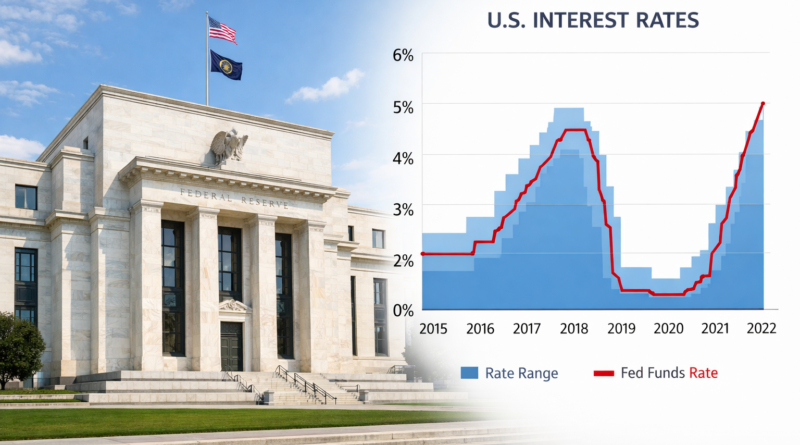
Federal Reserve Rate Decisions 2026: Live Fed Funds Rate, FOMC Meetings, Inflation and What U.S. Investors Should Watch
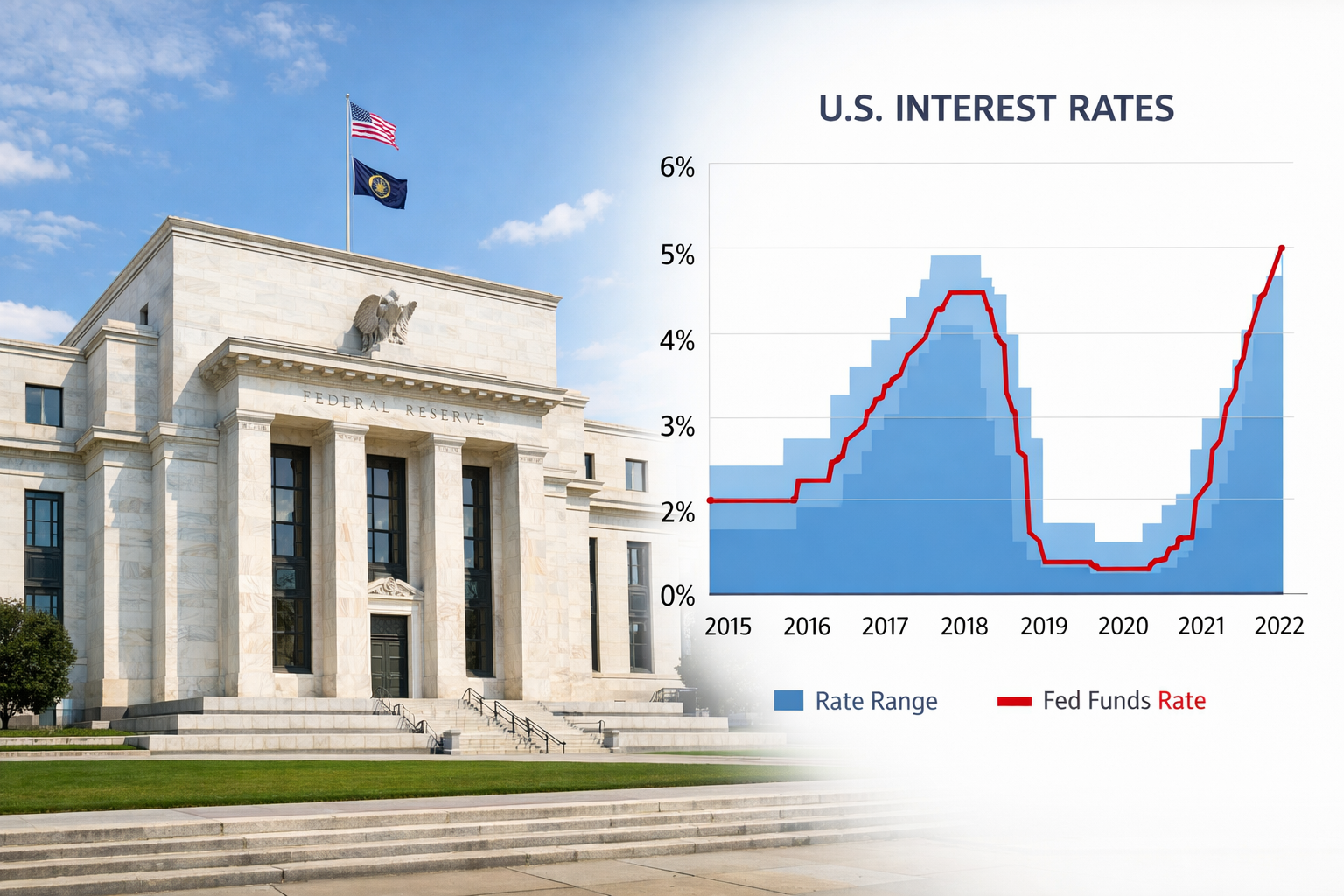
By New York Finance Think | Updated October 7, 2026
LIVE DATA STATUS: This page tracks Federal Reserve interest-rate decisions, FOMC meetings, official Fed projections, inflation concerns, employment conditions and the potential impact on U.S. consumers, borrowers, savers and investors.
Latest confirmed Federal Reserve rate: 3.75%–4.00%
Latest decision: September 16, 2026 — Rate increased by 25 basis points
Next scheduled FOMC meeting: October 27–28, 2026
Latest FOMC decision vote: 12–0 in favor of the September rate increase
Federal Reserve inflation target: 2% over the longer run
Federal Reserve Rate Decision Live Update
The Federal Reserve is once again at the center of the U.S. financial story.
For American households, businesses and investors, a Federal Reserve rate decision is not simply a number released from Washington. It can influence mortgage costs, credit-card rates, auto loans, business borrowing, savings accounts, Treasury yields, stock valuations and the value of the U.S. dollar.
As of October 7, 2026, the Federal Reserve’s target range for the federal funds rate is 3.75% to 4.00%.
That rate follows the Federal Open Market Committee’s September 15–16 meeting, when policymakers voted unanimously to raise the target range by one-quarter percentage point.
The Fed said economic activity was expanding at a solid pace, domestic spending remained resilient, productivity growth was strong and capital investment was robust. At the same time, the central bank said inflation remained elevated.
The September decision therefore delivered an important message to financial markets: the Federal Reserve is still willing to keep monetary policy restrictive enough to fight inflation.
The next scheduled FOMC meeting is October 27–28.
This page is designed as a continuing Federal Reserve rate-decision hub. When a new official decision, statement, projection, minutes release or major policy update is published, the relevant information should be updated here.
Federal Reserve Rate Decision: Latest Data
| Fed policy indicator | Latest confirmed information |
|---|---|
| Federal funds target range | 3.75%–4.00% |
| Latest decision | +25 basis points |
| Latest FOMC meeting | September 15–16, 2026 |
| Vote | 12–0 |
| Next scheduled meeting | October 27–28, 2026 |
| Long-run inflation goal | 2% |
| September 2026 median 2026 year-end federal funds rate | 4.1% |
| September 2026 median 2027 federal funds rate | 4.1% |
| September 2026 median 2028 federal funds rate | 3.9% |
| September 2026 median 2029 federal funds rate | 3.6% |
| September 2026 median 2026 PCE inflation | 3.7% |
| September 2026 median 2026 unemployment rate | 4.1% |
Important: The Federal Reserve’s projections are not guarantees. They represent policymakers’ individual assessments of the appropriate path for monetary policy based on information available at the time of the meeting.
What Did the Federal Reserve Decide?
The Federal Reserve raised the target range for the federal funds rate by 25 basis points at its September 15–16 meeting.
The new target range became:
3.75% to 4.00%
The decision was unanimous.
A 25-basis-point move means one-quarter of one percentage point.
For example:
- 3.50% becomes 3.75%
- 3.75% becomes 4.00%
- 4.00% becomes 4.25%
The September increase was important because it showed that inflation remained a major concern for policymakers.
The Fed’s official minutes said participants generally believed inflation was still elevated while the labor market appeared to be near full employment.
Policymakers also discussed the possibility that stronger demand, energy-market disruptions and other supply shocks could keep inflation above the central bank’s 2% objective.
That creates a difficult policy problem.
If the Fed raises rates too aggressively, it can weaken borrowing, investment, housing and employment.
If it does not respond strongly enough to persistent inflation, price pressures could become harder to control.
That tension is one of the biggest issues for investors heading into the final months of 2026.
Why the Federal Reserve Raises Interest Rates
The Federal Reserve has a dual mandate from Congress:
- Maximum employment
- Stable prices
In practice, the Fed watches a large collection of economic indicators before deciding whether monetary policy should become tighter, easier or remain unchanged.
The most important areas include:
- Inflation
- Core inflation
- Consumer spending
- Employment
- Unemployment
- Wage growth
- Economic growth
- Financial conditions
- Credit availability
- Housing activity
- Business investment
- Consumer expectations
- Global economic conditions
- Financial-market stability
When inflation is too high, higher interest rates can help slow demand.
When the economy becomes too weak or unemployment rises significantly, lower interest rates can provide support.
But monetary policy does not work instantly.
A rate change can take months to influence household and business decisions.
That is why Federal Reserve officials constantly evaluate where the economy may be heading rather than focusing only on the latest monthly number.
The Federal Funds Rate Explained in Simple Language
The federal funds rate is the interest rate at which banks lend reserve balances to one another overnight.
Most Americans do not directly borrow at the federal funds rate.
However, the rate influences the broader financial system.
When the Fed raises its target range, other borrowing costs can move higher.
That can eventually affect:
- Credit cards
- Home-equity lines
- Some auto loans
- Business loans
- Commercial borrowing
- Bank lending
- Treasury yields
- Mortgage rates
- Savings rates
- Stock valuations
The relationship is not always one-for-one.
For example, a Federal Reserve rate increase does not mean every mortgage rate immediately rises by exactly 0.25 percentage point.
Mortgage rates are influenced heavily by longer-term Treasury yields and mortgage-market conditions.
Likewise, savings-account rates can move differently depending on the bank and the competitive environment.
The Fed controls short-term monetary policy.
Markets determine many longer-term borrowing costs.
That distinction is important for investors.
Why the September 2026 Rate Decision Matters
The September decision matters because the Fed was dealing with a combination of relatively solid economic activity and elevated inflation.
The central bank’s September projections showed a median forecast for:
- 2.3% real GDP growth in 2026
- 4.1% unemployment in 2026
- 3.7% PCE inflation in 2026
- 3.4% core PCE inflation in 2026
- 4.1% federal funds rate at the end of 2026
The projections therefore describe an economy that is not expected to collapse, but also an inflation environment that remains considerably above the Fed’s 2% goal.
That combination can keep monetary policy restrictive.
For investors, the question is no longer simply:
“Will the Fed raise rates?”
The bigger questions are:
How long will rates stay high?
How many additional moves could happen?
What economic data would change the Fed’s view?
When could inflation move convincingly back toward 2%?
September 2026 FOMC Vote: 12–0
The September FOMC decision was approved unanimously.
All 12 voting participants supported raising the target range by one-quarter percentage point.
The official decision said the increase was intended to support the Federal Reserve’s dual mandate.
The Committee also said it would continue maintaining ample reserves in the banking system.
The statement described economic activity as expanding at a solid pace.
It also pointed to resilient domestic spending, strong productivity growth and robust capital investment.
At the same time, inflation remained elevated.
That combination helps explain why policymakers chose a higher policy rate.
Federal Reserve Inflation Problem
Inflation remains one of the most important variables in the Federal Reserve’s decision-making process.
The Fed has a longer-run inflation goal of 2%.
Its preferred inflation gauge is the Personal Consumption Expenditures price index, commonly called PCE inflation.
The September 2026 projections put the median 2026 PCE inflation forecast at 3.7%.
The median projection for 2027 was 2.3%.
The median projection for 2028 was 2.1%.
The median projection for 2029 was 2.0%.
That path tells an important story.
Fed officials expected inflation to decline over time, but not immediately.
The projected path suggests policymakers expected inflation to remain above target for a period before gradually moving closer to 2%.
For investors, this matters because a faster inflation decline could allow the Fed to ease policy sooner.
A slower decline could keep rates higher for longer.
A new inflation shock could create an entirely different policy path.
Core Inflation Is Especially Important
Investors should also watch core inflation.
Core PCE excludes food and energy prices.
The reason is not that food and energy are unimportant to American families.
They are extremely important.
The reason policymakers often examine core inflation is that food and energy prices can be volatile.
Core inflation can provide a clearer view of underlying price pressures.
The September projections showed a median core PCE inflation forecast of:
3.4% for 2026
2.5% for 2027
2.2% for 2028
2.0% for 2029
That remains a significant distance from the Fed’s long-run 2% objective in 2026.
What Could Make the Fed Raise Rates Again?
There is no automatic rule saying the Fed must raise rates at the next meeting.
Future decisions depend on incoming data.
Several developments could increase the pressure for additional tightening.
1. Persistent Inflation
If inflation remains significantly above 2%, policymakers could decide that monetary policy needs to remain restrictive.
2. Strong Consumer Spending
Strong consumer demand can keep upward pressure on prices.
If households continue spending aggressively, the Fed may worry that inflation will remain persistent.
3. Strong Labor Market
A very strong labor market can support household incomes and spending.
If wage growth remains strong while inflation remains elevated, policymakers may be cautious about cutting rates.
4. Energy Prices
A large increase in energy prices can raise headline inflation and potentially affect inflation expectations.
5. Financial Conditions
If financial conditions become unusually easy despite a high policy rate, the Fed could consider whether monetary policy is restrictive enough.
6. Inflation Expectations
The Federal Reserve wants inflation expectations to remain anchored.
If households and businesses begin expecting permanently higher inflation, policymakers could become more concerned.
What Could Make the Fed Hold Rates?
A rate hold could become more attractive if policymakers believe current monetary policy is sufficiently restrictive.
The Fed could watch for:
- Falling inflation
- Slowing consumer demand
- Softer employment
- Slower wage growth
- Lower business investment
- Tighter credit conditions
- Lower inflation expectations
- Weakening housing activity
- Slower economic growth
A hold does not necessarily mean the Fed is finished raising rates.
It can simply mean policymakers want more information.
That is one of the most important points for investors to understand.
What Could Make the Fed Cut Rates?
Rate cuts generally become more likely when inflation is moving toward target and economic or labor-market conditions weaken enough to justify easier policy.
A potential cutting environment could involve:
- Inflation moving sustainably lower
- Unemployment rising
- Consumer demand weakening
- Economic growth slowing sharply
- Credit stress increasing
- Business investment falling
- Financial conditions becoming restrictive
- Labor-market risks becoming more significant
But a rate cut is not automatically positive for stocks.
That is a common misconception.
The reason for the cut matters.
If rates fall because inflation is under control and economic growth remains healthy, markets may respond positively.
If rates fall because the economy is entering a severe recession, stocks could still decline.
Investors must therefore examine the reason behind the Fed’s decision.
Federal Reserve Rate Decisions and the Stock Market
The stock market constantly tries to anticipate Federal Reserve policy.
That is why stocks can move before an actual FOMC meeting.
Investors buy and sell based on expectations.
Suppose markets expect a rate increase.
If the Fed actually raises rates by 25 basis points, stocks may barely move because the decision was already priced in.
But if the Fed surprises investors with a larger increase or a more aggressive policy outlook, stocks can fall quickly.
The opposite can also happen.
If markets expect a rate hike but the Fed holds rates steady and signals that future tightening may be limited, stocks could rally.
This is why the headline decision is only part of the story.
Investors also examine:
- The policy statement
- Economic projections
- Press conference comments
- Voting pattern
- Inflation language
- Employment language
- Future rate projections
- Financial conditions
- Risks around the outlook
Why Treasury Yields Matter
Treasury yields are among the most important market indicators to watch around Federal Reserve decisions.
Short-term Treasury yields tend to be highly sensitive to expectations for Fed policy.
Longer-term Treasury yields are influenced by:
- Expected future short-term rates
- Inflation expectations
- Economic growth
- Treasury supply
- Demand for government bonds
- Term premiums
- Global capital flows
When Treasury yields rise sharply, stock valuations can come under pressure.
This is particularly important for growth stocks.
Technology companies often have cash flows expected far into the future.
When interest rates rise, those future cash flows become less valuable in present-value calculations.
That can pressure valuations even when the underlying company continues to grow.
Federal Reserve and the S&P 500
The S&P 500 contains many of America’s largest publicly traded companies.
Its performance is influenced by:
- Interest rates
- Corporate earnings
- Economic growth
- Consumer spending
- Energy prices
- Technology investment
- Global trade
- Inflation
- Investor sentiment
Federal Reserve policy can influence several of these factors at once.
Higher rates can increase financing costs.
They can also reduce demand.
At the same time, higher yields can make bonds more attractive relative to stocks.
But the relationship is not mechanical.
Stocks can rise during periods of higher interest rates if corporate earnings are strong enough.
That is why investors should not use the Fed rate alone to predict the S&P 500.
Federal Reserve and Nasdaq
The Nasdaq is particularly sensitive to changes in interest-rate expectations because it has substantial exposure to technology and growth companies.
Technology companies often depend heavily on:
- Capital investment
- Consumer demand
- Corporate spending
- AI investment
- Cloud computing
- Semiconductor demand
- Financing conditions
A sharp increase in Treasury yields can therefore create valuation pressure.
However, technology companies with strong balance sheets and powerful earnings growth can sometimes outperform even in higher-rate environments.
Investors should therefore separate:
high-quality growth
from
highly valued growth.
A company can have excellent business prospects while its stock still becomes expensive.
Federal Reserve and the Dow Jones
The Dow Jones Industrial Average has a different composition from the Nasdaq.
The Dow includes many mature companies from sectors such as:
- Industrials
- Financials
- Health care
- Consumer businesses
- Technology
- Energy
Financial companies can have a particularly complicated relationship with interest rates.
Higher rates can increase lending yields, but they can also increase funding costs and credit risks.
Therefore, investors should not assume that every bank or financial stock benefits automatically from higher Fed rates.
Federal Reserve and Small-Cap Stocks
Small-cap stocks can be particularly sensitive to interest rates.
Smaller companies may have:
- Higher borrowing needs
- Less cash on the balance sheet
- Greater refinancing risk
- More exposure to domestic demand
If borrowing costs rise significantly, smaller companies can face more financial pressure.
That is one reason investors often monitor the Russell 2000 when evaluating the broader impact of Fed policy.
A strong large-cap technology market combined with weak small-cap performance can sometimes indicate that investors are becoming more selective.
Federal Reserve and Mortgage Rates
The federal funds rate does not directly determine the 30-year mortgage rate.
Mortgage rates are influenced heavily by longer-term bond yields and mortgage-market conditions.
Still, Federal Reserve policy can influence mortgage rates indirectly.
When investors expect rates to remain high for longer, longer-term Treasury yields can rise.
That can place upward pressure on mortgage rates.
Higher mortgage rates can affect:
- Home affordability
- New home sales
- Existing home sales
- Refinancing
- Housing construction
- Consumer spending
For Americans trying to buy a home, the difference between a 6% and 7% mortgage can be significant.
That is why Federal Reserve decisions matter even to people who do not own stocks.
Federal Reserve and Credit Cards
Credit-card rates are generally variable and can be affected by changes in short-term interest rates.
When the Fed raises rates, borrowing costs for many consumers can rise.
For households carrying a credit-card balance, even a modest rate increase can add to interest expenses.
This is particularly important when consumers already face higher prices for housing, food, insurance and other essentials.
For consumers, the most important lesson is simple:
A higher Fed rate can make existing variable-rate debt more expensive.
People carrying high-interest credit-card balances should pay attention to their annual percentage rate rather than focusing only on the Fed’s headline number.
Federal Reserve and Savings Accounts
Higher rates can also benefit savers.
Banks and financial institutions may increase yields on certain savings products when short-term interest rates rise.
However, not every bank passes through rate increases equally.
Consumers should compare:
- Savings-account APYs
- Money-market rates
- Certificates of deposit
- Treasury securities
- Bank fees
- Withdrawal restrictions
The Fed raising rates does not automatically mean every savings account becomes attractive.
Consumers should check the actual annual percentage yield offered by their institution.
Federal Reserve and Auto Loans
Auto-loan rates are influenced by broader financial conditions, credit risk and lender competition.
Higher interest rates can make vehicle financing more expensive.
That matters because Americans may face higher monthly payments even if the sticker price of the vehicle does not change.
For consumers considering a major purchase, the Fed’s rate environment is therefore part of the total affordability calculation.
Federal Reserve and Business Investment
Companies constantly evaluate the cost of capital.
When interest rates are high, businesses may reconsider:
- New factories
- Equipment purchases
- Acquisitions
- Hiring
- Expansion
- Debt refinancing
- Share buybacks
However, strong companies may continue investing if expected returns remain high.
This is particularly relevant to artificial intelligence.
Companies are spending enormous amounts on data centers, chips, cloud infrastructure and AI-related capacity.
The Fed’s rate policy can affect the financing cost of those investments.
Artificial Intelligence and Federal Reserve Policy
AI has become an important part of the U.S. investment story.
Companies are investing heavily in:
- Data centers
- GPUs
- Networking equipment
- Cloud infrastructure
- Power generation
- Semiconductor manufacturing
- Software
- AI research
This creates an unusual relationship with monetary policy.
On one side, higher rates can increase financing costs.
On the other side, strong AI investment can support productivity and economic growth.
The September Fed minutes specifically discussed AI-related demand as one possible factor that could contribute to broader inflation dynamics if sector-specific price increases spread into the wider economy.
That means investors should not view AI solely as a technology story.
It is increasingly becoming a macroeconomic story.
Federal Reserve and Inflation From Energy Prices
Energy prices can complicate the Fed’s job.
Oil prices can affect:
- Gasoline
- Transportation
- Manufacturing
- Chemicals
- Air travel
- Shipping
- Household budgets
A sharp increase in oil prices can raise headline inflation.
The Fed cannot directly produce more oil.
However, policymakers can assess whether an energy shock is likely to create temporary inflation or become embedded in broader price expectations.
This distinction is important.
A temporary energy spike may eventually fade.
A prolonged energy shock combined with strong demand could be much more difficult.
Federal Reserve Rate Decisions and the U.S. Dollar
Interest rates can influence the value of the U.S. dollar.
When U.S. interest rates are relatively attractive compared with other countries, global investors may demand more dollar-denominated assets.
A stronger dollar can reduce the cost of imported goods.
That can help reduce some inflation pressure.
But a stronger dollar can also create challenges for multinational U.S. companies because overseas revenue becomes worth fewer dollars when converted back.
A weaker dollar can have the opposite effects.
Therefore, investors in multinational companies should watch both Fed policy and currency markets.
Federal Reserve and the Labor Market
The labor market is the other major part of the Fed’s dual mandate.
Policymakers watch:
- Payroll growth
- Unemployment
- Job openings
- Wage growth
- Labor-force participation
- Hiring trends
- Layoffs
- Hours worked
- Productivity
The September projections put the median 2026 unemployment rate at 4.1%.
That was lower than the Fed’s June median projection of 4.3%.
This indicates that policymakers’ September projections reflected a stronger labor-market outlook than their June projections.
But the Fed also evaluates risks.
If unemployment rises sharply, the balance between inflation and employment could change.
That could affect future rate decisions.
Federal Reserve Rate Decision Calendar for 2026
The Federal Reserve has eight regularly scheduled FOMC meetings in 2026.
The official calendar lists:
January 27–28
First scheduled FOMC meeting of 2026.
March 17–18
March meeting, accompanied by economic projections.
April 28–29
Spring policy meeting.
June 16–17
June meeting, accompanied by economic projections.
July 28–29
Summer policy meeting.
September 15–16
September meeting, accompanied by economic projections.
October 27–28
Next scheduled FOMC meeting after the September decision.
December 8–9
Final scheduled FOMC meeting of 2026, accompanied by economic projections.
The Federal Reserve can also hold unscheduled meetings if necessary.
What Investors Should Watch Before the October FOMC Meeting
The next major scheduled FOMC meeting is October 27–28.
Between now and then, investors should monitor several categories of data.
Inflation
Investors should watch whether inflation is accelerating, slowing or remaining sticky.
Labor Market
Employment data can influence how policymakers assess the second part of their dual mandate.
Consumer Spending
Strong spending can support growth but can also complicate inflation control.
Treasury Yields
Bond markets can provide clues about financial conditions and expectations for future Fed policy.
Oil Prices
Energy prices can affect headline inflation and household budgets.
Financial Conditions
Stocks, credit spreads, the dollar and bond yields all contribute to overall financial conditions.
Business Investment
AI spending and broader capital investment could remain important.
The Most Important Number May Not Be the Fed Rate
Investors often focus only on the federal funds rate.
That is a mistake.
The more important question can be the expected future path.
Suppose the Fed raises rates by 25 basis points but signals that no additional hikes are likely.
Markets could interpret the decision as less aggressive.
Now imagine the Fed raises rates by 25 basis points and signals that several more increases may be necessary.
The market response could be very different.
Therefore, investors should read the entire communication.
What Is the Fed Dot Plot?
The dot plot is part of the Federal Reserve’s Summary of Economic Projections.
It shows individual FOMC participants’ assessments of the appropriate federal funds rate at future points in time.
It is not a promise.
It is not a formal commitment.
It does not represent a single Federal Reserve forecast.
Instead, each participant provides an individual assessment.
The September 2026 projections showed significant variation among policymakers.
For 2026, the median projected federal funds rate was 4.1%.
But individual projections extended across a broader range.
That dispersion demonstrates an important point:
Fed officials do not necessarily agree on the exact future path of interest rates.
September 2026 Fed Projections: What They Show
The September Summary of Economic Projections provided a useful snapshot of policymakers’ views.
Real GDP Growth
Median:
- 2026: 2.3%
- 2027: 2.4%
- 2028: 2.2%
- 2029: 2.1%
Unemployment Rate
Median:
- 2026: 4.1%
- 2027: 4.1%
- 2028: 4.1%
- 2029: 4.1%
PCE Inflation
Median:
- 2026: 3.7%
- 2027: 2.3%
- 2028: 2.1%
- 2029: 2.0%
Federal Funds Rate
Median:
- 2026: 4.1%
- 2027: 4.1%
- 2028: 3.9%
- 2029: 3.6%
These numbers provide a useful framework for investors.
They suggest policymakers expected inflation to gradually decline while economic growth remained positive.
But the projections also contain substantial uncertainty.
Why Fed Forecasts Can Change
Federal Reserve projections are updated as new information becomes available.
A forecast made in September can change by December.
Reasons include:
- New inflation data
- Employment surprises
- Oil-price shocks
- Geopolitical events
- Fiscal policy
- Trade policy
- Consumer spending
- Financial-market conditions
- Productivity changes
- Business investment
Investors should therefore avoid treating the dot plot as a guaranteed roadmap.
The Fed itself emphasizes uncertainty around projections.
Live Federal Reserve Data Update Format for NYFT
For a live article, NYFT can use a simple update system.
LIVE UPDATE — CONFIRMED
Use this label when the Federal Reserve has officially announced a decision.
Example:
[CONFIRMED] September 16, 2026: The Federal Reserve raised the federal funds target range by 25 basis points to 3.75%–4.00%.
OFFICIAL PROJECTION
Use this label for the Fed’s Summary of Economic Projections.
Example:
[OFFICIAL PROJECTION] September 2026: The median projection for the federal funds rate at the end of 2026 was 4.1%.
MARKET EXPECTATION
Use this label for market pricing.
Example:
[MARKET EXPECTATION] Interest-rate futures and other market instruments may indicate how investors are pricing the probability of future Fed moves.
ANALYST FORECAST
Use this label for private-sector forecasts.
NYFT ANALYSIS
Use this label for New York Finance Think’s interpretation.
This system helps readers understand the difference between a Federal Reserve decision and a market prediction.
What Does “Live Data” Mean?
A financial website should be careful with the phrase “live data.”
True real-time market data often requires a licensed market-data provider.
A news article can be updated frequently, but that does not automatically make it a real-time market-data terminal.
For NYFT, the safer approach is:
Live Updates
rather than claiming:
Real-Time Market Data
unless the website actually has a licensed real-time data feed.
Federal Reserve announcements are official public information, but market prices can change every second.
The page should therefore display the exact update time for each market-related update.
Recommended NYFT Update Filter
Use these filters on the page:
FED DECISION
FED MINUTES
FED SPEECH
INFLATION
JOBS
TREASURY YIELDS
MARKET EXPECTATIONS
STOCK MARKET
CONSUMERS
ECONOMY
This allows readers to find the information they need quickly.
Federal Reserve Rate Decision: What Americans Should Watch
For ordinary Americans, the Fed’s decision can feel complicated.
The easiest way to understand it is to follow five questions.
1. Is inflation falling?
If yes, the Fed may eventually have more room to reduce rates.
2. Is the labor market weakening?
If employment conditions deteriorate significantly, the Fed may need to pay more attention to the employment side of its mandate.
3. Is economic growth strong?
Strong growth can give policymakers more room to keep rates high.
4. Are financial conditions tightening?
Higher bond yields, weaker stocks and tighter credit can effectively tighten financial conditions even without another Fed rate increase.
5. What is the Fed saying about the future?
The language surrounding the decision can be as important as the rate itself.
What a Higher Fed Rate Means for Investors
Higher interest rates can have several effects.
Bonds
Existing bond prices can fall when market yields rise.
Stocks
Higher discount rates can put pressure on valuations.
Growth Stocks
Long-duration growth stocks can be particularly sensitive.
Banks
Bank earnings can be affected through lending spreads, funding costs and credit quality.
Real Estate
Higher financing costs can pressure housing activity and commercial real estate.
Consumer Companies
Higher borrowing costs can affect household spending.
Utilities
Higher rates can make high-dividend alternatives more competitive.
Cash
Cash and short-term instruments can become more attractive when short-term yields are high.
What a Fed Rate Cut Means for Investors
A rate cut can reduce borrowing costs over time.
It can also change the relative attractiveness of stocks, bonds and cash.
But investors should ask:
Why is the Fed cutting?
A cut caused by falling inflation can be constructive.
A cut caused by recession can be much more complicated.
That is why the economic context matters.
Could the Fed Cause a Recession?
Monetary policy is designed to influence demand.
If rates remain too high for too long, borrowing and spending can weaken.
That can eventually affect:
- Business investment
- Hiring
- Housing
- Consumer spending
- Corporate earnings
However, monetary policy operates with lags, and the economy can remain resilient even when rates are elevated.
The Fed’s September projections did not show a recession as the central scenario.
The median 2026 GDP growth projection was 2.3%.
The median 2027 projection was 2.4%.
That is not a recession forecast.
Still, investors should monitor downside risks.
Soft Landing vs. Hard Landing
One of the biggest debates surrounding monetary policy is whether the economy can achieve a soft landing.
A soft landing means inflation declines without a severe recession or major increase in unemployment.
A hard landing would involve a much sharper economic slowdown.
The September projections were broadly consistent with a continued expansion.
But projections can change.
That is why incoming data remain important.
The Federal Reserve’s Biggest Policy Challenge
The Fed’s challenge can be summarized in one sentence:
Bring inflation down without unnecessarily damaging employment and economic growth.
That sounds simple.
In reality, it is extremely difficult.
If inflation remains high, policymakers risk losing credibility.
If rates remain too high for too long, economic activity can weaken.
If rates are cut too quickly, inflation could return.
The central bank must therefore constantly balance competing risks.
Why Investors Should Not Trade Every Fed Headline
Markets can become extremely volatile around Fed communications.
But investors should avoid reacting emotionally to every headline.
A single Fed official’s speech does not necessarily represent the policy of the entire Committee.
Similarly, one economic report does not establish a trend.
Investors should examine:
- The broader data
- The direction of the data
- The Fed’s official statement
- The minutes
- Economic projections
- Financial conditions
- Corporate earnings
Long-term investors should also distinguish between market volatility and changes to a company’s fundamental value.
What the October FOMC Meeting Could Mean
The October 27–28 meeting is the next scheduled policy meeting.
The decision will depend on information available before that meeting.
Investors should not assume the September decision automatically determines October.
Between meetings, economic conditions can change.
If inflation declines more quickly than expected, the policy discussion could change.
If inflation rises, policymakers could become more cautious.
If the labor market weakens substantially, the employment side of the Fed’s mandate could become more important.
If growth remains strong and inflation remains elevated, restrictive policy could persist.
December FOMC Meeting
The December 8–9 meeting will be another major event for investors.
It is accompanied by updated economic projections.
That means investors could receive a fresh look at:
- GDP forecasts
- Unemployment forecasts
- PCE inflation forecasts
- Core PCE inflation
- Federal funds rate projections
The December meeting can therefore become particularly important for understanding the Fed’s outlook heading into 2027.
Federal Reserve Rate Decision FAQ
What is the current Federal Reserve interest rate?
As of October 7, 2026, the federal funds target range is 3.75%–4.00%.
When was the latest Fed rate decision?
The latest confirmed decision came from the September 15–16, 2026 FOMC meeting.
Did the Fed raise rates in September 2026?
Yes. The Federal Reserve raised the target range by 25 basis points to 3.75%–4.00%.
Was the September decision unanimous?
Yes. The official vote was 12–0.
When is the next Fed meeting?
The next scheduled FOMC meeting is October 27–28, 2026.
What is the Fed’s inflation target?
The Federal Reserve’s longer-run inflation goal is 2%.
Does the Fed directly set mortgage rates?
No. Mortgage rates are influenced heavily by longer-term Treasury yields and other market conditions.
Does a Fed rate hike always make stocks fall?
No. Stock-market reactions depend on expectations, earnings, economic conditions and the reason for the rate change.
What is the federal funds rate?
It is the target rate for overnight borrowing of reserve balances among banks.
What is the Fed dot plot?
It is a collection of individual FOMC participants’ projections for the appropriate federal funds rate at future dates.
Is the dot plot a promise?
No. It represents individual projections and can change as economic conditions change.
Why does the Fed care about inflation?
Stable prices are part of the Federal Reserve’s congressional mandate.
Why does the Fed care about unemployment?
Maximum employment is the other part of its dual mandate.
Can the Fed control gasoline prices?
No. The Fed does not directly control oil or gasoline prices.
Can Fed rate hikes reduce inflation?
Higher interest rates can reduce demand and financial conditions, which can help reduce inflationary pressure over time.
Do higher Fed rates always benefit savers?
Not necessarily. Some savings products may offer higher yields, but rates vary significantly between institutions and products.
What Investors Should Watch Next
The Federal Reserve story is not finished with the September decision.
Investors should now monitor:
Inflation
Will inflation continue moving toward the Fed’s 2% goal?
Employment
Will the labor market remain resilient?
Treasury Yields
Will bond yields rise or fall as expectations change?
Consumer Spending
Will American households continue spending?
Corporate Earnings
Can companies maintain profit growth despite higher financing costs?
AI Investment
Will AI-related investment continue expanding rapidly?
Oil Prices
Could energy prices create another inflation shock?
The U.S. Dollar
Could changes in interest-rate expectations affect global capital flows?
Credit Conditions
Are banks and lenders becoming more cautious?
Fed Communication
Are policymakers becoming more hawkish, neutral or dovish?
Bull Case for U.S. Stocks
The bullish scenario would involve:
- Inflation declining
- Economic growth remaining positive
- Employment remaining relatively strong
- Corporate earnings continuing to grow
- AI investment producing productivity gains
- Treasury yields stabilizing
- Fed policy becoming less restrictive over time
In this environment, stocks could potentially benefit from a combination of earnings growth and improving rate expectations.
Bear Case for U.S. Stocks
The bearish scenario would involve:
- Inflation remaining stubborn
- Energy prices rising
- Treasury yields moving significantly higher
- Fed policy becoming more restrictive
- Consumer spending weakening
- Corporate borrowing costs increasing
- Earnings expectations falling
In that environment, expensive growth stocks could face valuation pressure.
Small-cap companies and highly leveraged businesses could also be vulnerable.
What Beginner Investors Should Know
Beginner investors should not attempt to predict every Fed decision.
Instead, focus on the long-term fundamentals of the investments they own.
Important questions include:
- Is the company profitable?
- Is revenue growing?
- Is debt manageable?
- Is cash flow strong?
- Is the valuation reasonable?
- Does the business have a competitive advantage?
- Is management allocating capital effectively?
Interest rates matter.
But they are only one part of the investment equation.
What American Households Should Do With This Information
Consumers should not panic because the Fed raised rates.
Instead, they should understand how the current rate environment affects their personal finances.
Households may want to review:
- Credit-card balances
- Variable-rate debt
- Auto loans
- Mortgage options
- Savings accounts
- Emergency funds
- Investment allocations
High-interest debt can become especially expensive when rates remain elevated.
At the same time, savers may find more attractive yields than during periods of extremely low interest rates.
The correct financial decision depends on the individual’s circumstances.
Federal Reserve Rate Decisions: The Bottom Line
The Federal Reserve entered the final months of 2026 with the federal funds target range at 3.75%–4.00% after its September rate increase.
The September decision was unanimous.
The central bank said inflation remained elevated while economic activity was expanding at a solid pace.
The September economic projections showed a median 2026 federal funds rate of 4.1%, 2026 PCE inflation of 3.7%, unemployment of 4.1% and GDP growth of 2.3%.
The next scheduled FOMC meeting is October 27–28.
For investors, the biggest issue is not simply whether the Fed raises, holds or cuts rates at the next meeting.
The bigger story is the path of monetary policy.
If inflation declines, the economy remains resilient and the labor market stays healthy, the Fed may eventually have more flexibility.
If inflation remains elevated, policymakers may keep rates restrictive.
If economic growth weakens sharply, the employment side of the Fed’s mandate could become more important.
That makes every major inflation, employment and economic-growth report increasingly important.
For American households, the Fed’s decisions can affect borrowing costs, savings yields, housing affordability and consumer finances.
For investors, the Fed can influence stock valuations, Treasury yields, the dollar, corporate financing and market sentiment.
The best approach is therefore to watch the data, not just the headlines.
NYFT Federal Reserve Live Update Checklist
Last confirmed rate: 3.75%–4.00%
Last decision: September 16, 2026
Decision: +25 basis points
Vote: 12–0
Next FOMC: October 27–28, 2026
December FOMC: December 8–9, 2026
Inflation target: 2%
2026 median Fed-rate projection: 4.1%
2026 median PCE inflation projection: 3.7%
2026 median unemployment projection: 4.1%
2026 median GDP growth projection: 2.3%
Editorial Data Policy
New York Finance Think should distinguish clearly between official Federal Reserve information and market forecasts.
Official Fed data includes FOMC decisions, official statements, minutes, economic projections and Federal Reserve publications.
Market expectations are not Federal Reserve decisions.
Analyst forecasts are not Federal Reserve decisions.
NYFT analysis represents editorial interpretation and should not be presented as an official forecast from the Federal Reserve.
When this article is updated, the editor should include:
Updated: October 7, 2026, 2:00 p.m. ET
Update type: [Fed Decision / Fed Minutes / Fed Speech / Inflation / Jobs / Market Expectations]
Source: Federal Reserve / official government source / clearly identified market source
This helps readers understand what changed and when.
Financial Disclaimer
This article is for informational and educational purposes only. It is not investment, financial, tax or legal advice. Federal Reserve decisions, economic data and financial-market conditions can change rapidly. Past market performance does not guarantee future results. Readers should conduct their own research and consider their financial circumstances and risk tolerance before making investment decisions. New York Finance Think does not guarantee the accuracy of third-party forecasts or market expectations and does not provide personalized investment recommendations.
Sources and Official Data
The primary source for this article is the Federal Reserve Board and Federal Open Market Committee. The latest September FOMC minutes confirm the 25-basis-point increase to a 3.75%–4.00% target range, the unanimous vote, the next October meeting and the policy discussion around inflation, employment and economic activity.
The Federal Reserve’s September 2026 Summary of Economic Projections provides the official GDP, unemployment, PCE inflation, core PCE inflation and federal-funds-rate projections used in this article.
The official Federal Reserve FOMC calendar confirms the 2026 meeting schedule, including October 27–28 and December 8–9.
20 Source Links —
- Federal Reserve
Federal Reserve - Federal Open Market Committee (FOMC)
FOMC - Federal Reserve Monetary Policy
Federal Reserve Monetary Policy - FOMC Meeting Calendar
FOMC Calendar - Federal Reserve News & Events
Federal Reserve News & Events - FRED Economic Data
FRED - Federal Reserve Bank of New York
New York Fed - Federal Reserve Bank of Atlanta
Atlanta Fed - Federal Reserve Bank of Chicago
Chicago Fed - U.S. Bureau of Labor Statistics
Bureau of Labor Statistics - U.S. Bureau of Economic Analysis
Bureau of Economic Analysis - U.S. Department of the Treasury
U.S. Treasury - U.S. Census Bureau
U.S. Census Bureau - Congressional Budget Office
Congressional Budget Office - U.S. Department of Labor
U.S. Department of Labor - Reuters
Reuters - Associated Press
Associated Press - CME Group
CME Group - U.S. Energy Information Administration
EIA - U.S. Securities and Exchange Commission
SEC
