
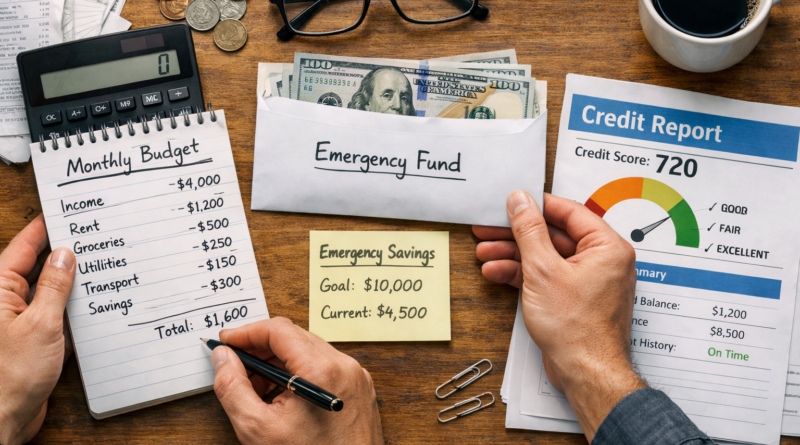
Budgeting, Emergency Funds, and Credit Scores: A Complete Guide to Building Financial Stability
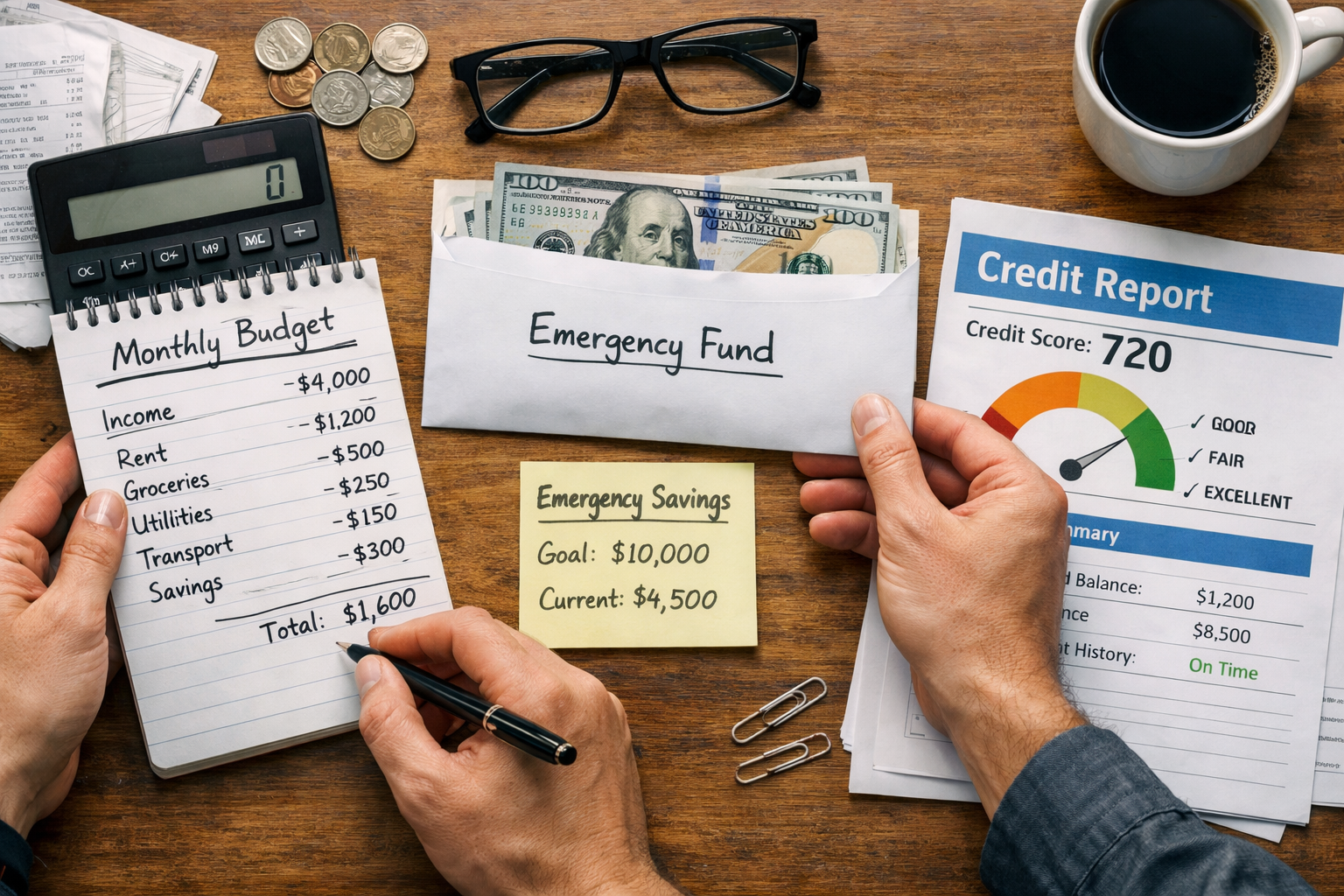
Introduction
Managing money effectively is about more than earning a paycheck. It involves understanding where your money goes, preparing for unexpected expenses, and maintaining a healthy credit history. Three important parts of this process are budgeting, emergency funds, and credit scores.
A well-planned budget helps you control spending and prioritize financial goals. An emergency fund provides a financial cushion when life takes an unexpected turn. A strong credit history can help you qualify for loans, credit cards, and potentially more favorable borrowing terms.
Although these concepts serve different purposes, they work together to support long-term financial stability. Understanding how they fit into your financial plan can help you make more informed decisions and reduce unnecessary financial stress.
1. What Is Budgeting, and Why Does It Matter?
Budgeting is the process of planning how you will use your income over a specific period, usually a month. It allows you to compare the money coming in with the money going out and decide how much to allocate toward necessities, discretionary spending, savings, and debt repayment.
Without a budget, it can be difficult to identify spending patterns or determine why your savings are not growing.
How to Create a Practical Monthly Budget
Start by calculating your monthly take-home income after taxes and payroll deductions. If your income varies, consider using a conservative estimate based on your recent earnings.
Next, list your regular expenses, including:
- Housing payments and utilities
- Groceries and transportation
- Insurance premiums and healthcare costs
- Loan payments and credit card bills
- Childcare and other essential family expenses
- Entertainment, dining out, and subscriptions
Once you have listed your expenses, compare the total with your take-home income. If your spending exceeds your income, identify expenses you can reduce. If money remains, assign part of it to savings and other financial goals.
Understanding the 50/30/20 Budget Rule
The 50/30/20 rule is a common budgeting framework that divides take-home income into three categories:
- 50% for needs: Housing, groceries, utilities, transportation, and other essential expenses.
- 30% for wants: Dining out, hobbies, entertainment, and nonessential purchases.
- 20% for savings and debt repayment: Emergency savings, retirement contributions, and additional payments toward debt.
For example, someone earning $4,000 per month after taxes could initially allocate $2,000 to needs, $1,200 to wants, and $800 to savings and debt repayment.
These percentages are guidelines rather than strict requirements. People facing high housing costs, substantial debt, or irregular income may need a different allocation.
The most useful budget is one you can maintain consistently and adjust when your circumstances change.
2. Emergency Funds: Your Financial Safety Net
An emergency fund is money reserved for unexpected and necessary expenses. It can help cover a sudden medical bill, an urgent car repair, a temporary loss of income, or another financial disruption.
Without accessible savings, an unexpected expense may force you to rely on credit cards or high-interest borrowing. That can make an already difficult situation more expensive.
How Much Should You Keep in an Emergency Fund?
A common long-term goal is to save enough to cover three to six months of essential living expenses.
Your target should reflect your personal circumstances. Someone with a stable salary and few dependents may need a different reserve from someone who is self-employed, supports a family, or has an unpredictable income.
Consider this example:
| Essential monthly expenses | Three-month reserve | Six-month reserve |
|---|---|---|
| $2,000 | $6,000 | $12,000 |
| $3,000 | $9,000 | $18,000 |
| $4,000 | $12,000 | $24,000 |
These figures are illustrative targets, not universal requirements.
If you are starting from zero, do not let the full target discourage you. Begin with a manageable milestone, such as $500 or $1,000, and gradually increase your savings.
Where Should You Keep Emergency Savings?
Emergency money should generally be safe and accessible when you need it. A savings account at an eligible, federally insured bank or credit union may be appropriate, depending on the account and institution.
Before opening an account, compare interest rates, fees, withdrawal conditions, and access to funds. Confirm applicable deposit insurance protections rather than assuming every financial product is insured.
Emergency savings generally should not depend on investments that can lose value just when you need cash.
How to Build Your Emergency Fund Consistently
A few practical habits can make saving easier:
- Automate a transfer from checking to savings after payday.
- Start with an amount that fits your current budget.
- Direct a portion of bonuses, tax refunds, or other extra income toward savings.
- Review your target when your rent, family responsibilities, or income changes.
- Replenish the fund after using it for a genuine emergency.
The objective is not to accumulate a large balance overnight. It is to build a reserve gradually and protect it for unexpected needs.
3. Credit Scores: Understanding Your Financial Reputation
A credit score is a numerical assessment based on information in your credit history. Lenders may use it, along with income, existing debt, and other application details, when evaluating credit applications.
In the United States, credit scores can influence access to credit cards, mortgages, auto loans, and personal loans. They may also affect the interest rates or terms a lender offers.
There is no single score used by every lender. Different scoring models can produce different results from the same underlying credit information.
What Factors Affect Your Credit Score?
The factors depend on the scoring model, but commonly include:
Payment history: Whether you have paid credit obligations on time is an important consideration in many scoring models.
Credit utilization: This measures how much of your available revolving credit you are using. For example, a $300 balance on a $1,000 credit limit represents 30% utilization. Lower utilization is generally preferable, although there is no single percentage that guarantees a particular score.
Length of credit history: The age of your accounts and the length of your credit history can affect certain scoring models.
Credit mix: Having experience with different types of credit may contribute to some scores, but opening unnecessary accounts solely to diversify credit is rarely a sensible strategy.
New credit applications: Applying for several accounts in a short period can generate multiple hard inquiries, which may affect some credit scores.
The relative importance of these factors varies by scoring model.
Practical Ways to Improve Your Credit Score
Building or improving credit usually requires consistent habits rather than quick fixes.
- Pay bills by their due dates. Consider automatic payments or reminders to reduce the risk of missing a payment.
- Keep credit card balances manageable relative to your available limits.
- Avoid applying for several credit accounts unnecessarily.
- Review your credit reports for inaccurate balances, unfamiliar accounts, and incorrect payment information.
- Dispute genuine reporting errors with the appropriate credit bureau and, where relevant, the company that supplied the information.
You do not need to carry a credit card balance or pay interest to demonstrate responsible credit use. Paying your statement balance in full by the due date can help you avoid interest on purchases when your card’s terms provide a grace period.
How to Check Your Credit Reports
Consumers can access their credit reports through the official AnnualCreditReport.com service. Checking your own credit report does not, by itself, hurt your credit score.
Remember that a credit report and a credit score are different. Your report contains information about your credit accounts and payment history, while a score summarizes certain aspects of that information using a scoring model.
If you find an error, investigate it and follow the relevant dispute process rather than paying a company that promises guaranteed score increases.
4. How Budgeting, Emergency Savings, and Credit Work Together
These three financial habits reinforce one another.
A budget helps you identify how much you can reasonably save each month. Emergency savings provide a source of cash when an unexpected expense occurs. Responsible credit management helps you avoid unnecessary borrowing costs and maintain a healthier credit profile.
For example, imagine that your car needs an unexpected repair. If your budget has helped you build an emergency reserve, you may be able to pay for the repair without adding a large balance to your credit card.
Without savings, you might need to borrow money and then find room in your budget to repay it. That repayment could make it harder to save for future emergencies.
The relationship works in the other direction, too. If high-interest debt is consuming a large portion of your income, you may need to adjust your budget and balance debt repayment with building a starter emergency fund.
There is no single plan that suits everyone. Your priorities depend on your income stability, interest rates, existing savings, household responsibilities, and upcoming expenses.
5. Common Personal Finance Mistakes to Avoid
Even well-intentioned financial plans can be undermined by a few common mistakes.
Ignoring small recurring expenses: Subscriptions, delivery fees, and frequent discretionary purchases can add up over time. Review recurring payments periodically.
Setting an unrealistic budget: A budget that leaves no room for irregular expenses or reasonable enjoyment may be difficult to maintain. Allow for annual bills, maintenance, and other predictable costs.
Investing money needed for emergencies: Money you may need immediately should not depend on favorable stock market conditions.
Missing payment deadlines: Late payments can create fees and may harm your credit history, depending on the account and reporting circumstances.
Treating credit limits as income: Available credit is borrowed money, not additional earnings.
Expecting instant credit improvement: Accurate negative information generally cannot be removed simply because it is inconvenient. Focus on consistent positive behavior and correcting genuine errors.
6. A Simple 30-Day Plan to Get Started
You do not need to change every financial habit at once. Use the next month to establish a manageable routine.
Week 1: Understand your cash flow
Review your take-home income, bank transactions, bills, debt payments, and recurring subscriptions. Identify your essential monthly expenses.
Week 2: Create a realistic budget
Choose spending limits that reflect your actual circumstances. Decide how much you can direct toward savings and debt repayment.
Week 3: Start building your emergency reserve
Open or identify an appropriate savings account and make your first contribution. Automate future transfers if your budget allows.
Week 4: Review your credit information
Check your credit reports, review payment due dates, and identify any reporting errors or balances that need attention. Create a routine for paying bills on time.
At the end of the month, review your progress. Adjust the plan if your expenses or income make the original targets unrealistic.
Frequently Asked Questions
Is budgeting necessary if I earn a high income?
Yes. A higher income does not automatically guarantee financial security. Budgeting can help you control lifestyle inflation, build savings, manage debt, and direct money toward long-term goals.
Should I pay off debt or build an emergency fund first?
The answer depends on the interest rate, the consequences of missing payments, and your available cash. Keeping up with required payments and establishing a small cash reserve can provide a useful starting point, while high-interest debt may deserve priority for additional payments.
How long does it take to build an emergency fund?
It depends on your savings target and monthly contributions. For example, saving $300 per month would take 20 months to accumulate $6,000, assuming no withdrawals or interest.
Does checking my own credit score hurt it?
Checking your own score or credit report is generally considered a soft inquiry and does not lower your credit score. Credit applications that generate hard inquiries are different.
Do I need to carry a balance to improve my credit score?
No. Carrying a balance and paying interest is not required to build credit. Paying on time and using credit responsibly are more useful habits.
Conclusion
Financial stability is built through consistent decisions, not a single financial milestone. Budgeting helps you understand your cash flow, an emergency fund prepares you for unexpected expenses, and responsible credit management can support access to borrowing when needed.
Start with a realistic monthly budget, choose an achievable savings goal, and establish a reliable routine for paying bills and checking your credit reports. As your income, expenses, and financial responsibilities change, revisit your plan and make adjustments.
Small, repeatable actions can help you develop stronger financial habits over time.
Sources and Further Reading
- Consumer Financial Protection Bureau (CFPB): https://www.consumerfinance.gov/
- Federal Deposit Insurance Corporation (FDIC): https://www.fdic.gov/
- AnnualCreditReport.com: https://www.annualcreditreport.com/
- Federal Trade Commission (FTC): https://www.ftc.gov/
Disclaimer: This article is for general educational and informational purposes only. It does not constitute individualized financial, investment, legal, or tax advice. Financial products, credit scoring models, and applicable rules can vary. Readers should verify current information and consider their individual circumstances before making financial decisions.
