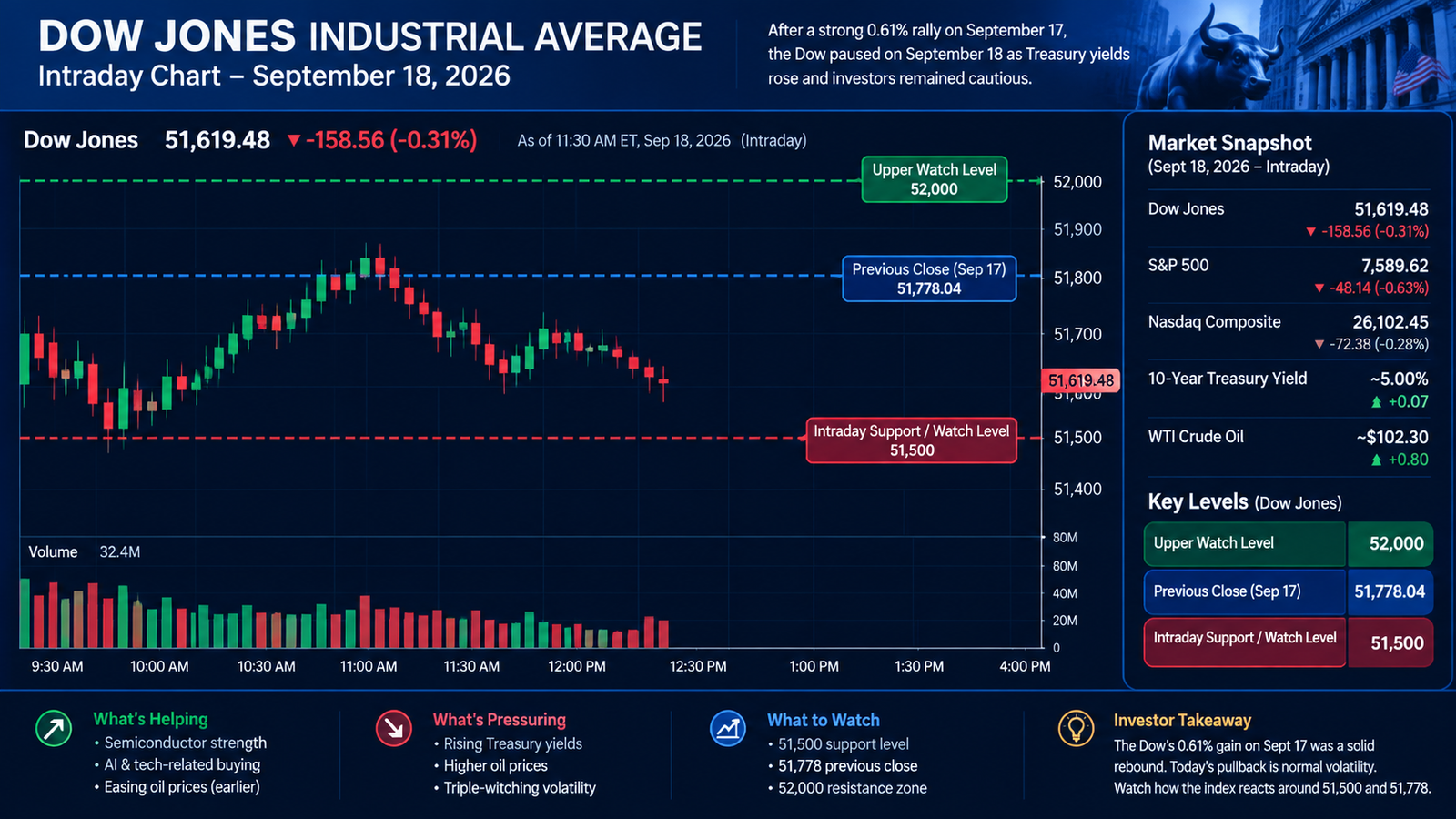
U.S. Finance Market Analysis October 20, 2026: Dow and Small Caps Lead Wall Street Higher

U.S. stocks finished mostly higher on Tuesday, October 20, 2026, as stronger corporate earnings helped support investor confidence. The Dow Jones Industrial Average and Russell 2000 posted the strongest gains, while the Nasdaq Composite ended slightly lower as weakness in several major technology stocks limited the broader advance.
The session was a good example of how different parts of the market can move in opposite directions. Traditional large-cap stocks and smaller companies gained ground, while some technology shares remained under pressure.
U.S. Market Snapshot — October 20, 2026
| Index | Close | Daily Change |
|---|---|---|
| Dow Jones Industrial Average | 52,495.88 | +1.02% |
| S&P 500 | 7,712.57 | +0.28% |
| Nasdaq Composite | 26,424.82 | -0.02% |
| Russell 2000 | 2,773.42 | +1.65% |
| 10-Year Treasury Yield | ~5.117% | Lower |
| Brent Crude | ~$108.97 | Lower |
The S&P 500 gained 21.84 points, while the Dow climbed 529.85 points. The Russell 2000 added 45.12 points, and the Nasdaq slipped only 6.07 points.
Dow Jones Leads the Market
The Dow was one of the strongest major U.S. indexes during the session, rising just over 1%.
Positive earnings reports helped support several companies and gave investors a reason to remain constructive despite concerns surrounding interest rates and oil prices. Equifax and Hasbro were among the companies highlighted for stronger-than-expected results.
The Dow’s performance also showed that investors were willing to move toward established companies while remaining more selective with high-growth technology stocks.
S&P 500 Posts a Moderate Gain
The S&P 500 rose 0.28% to 7,712.57.
Although the gain was smaller than the Dow’s advance, the index remained firmly positive for the session. The broader market benefited as oil prices moved lower from their intraday highs.
The S&P 500 remained below its October 6 record close of 7,818.93, according to market data compiled after Tuesday’s session.
Nasdaq Finishes Almost Flat
The Nasdaq Composite slipped 0.02% to 26,424.82.
The decline was small, but it contrasted with the stronger performance of the Dow and Russell 2000. Several major technology stocks, including Apple and Meta Platforms, weighed on the technology-heavy index.
This divergence is worth watching because technology companies have been a major driver of U.S. equity gains. Investors are increasingly focused on whether high valuations and elevated interest rates could affect future growth expectations.
Russell 2000 Outperforms
Small-cap stocks delivered one of the most notable performances of the session.
The Russell 2000 gained 1.65% to 2,773.42.
Small-cap performance can provide clues about investor confidence in the domestic economy. When smaller companies outperform, it can indicate that investors are becoming more comfortable taking on additional economic risk.
The Russell 2000’s gain therefore added breadth to Tuesday’s market rally.
Treasury Yields Remain Elevated
The 10-year U.S. Treasury yield finished around 5.117%, down from the previous session.
Even with the daily decline, a yield above 5% remains an important consideration for equity investors.
Higher Treasury yields can increase borrowing costs and make bonds more competitive with stocks. They can also place additional pressure on growth companies because the value investors assign to future earnings becomes more sensitive to interest rates.
Oil Prices Swing During the Session
Oil was another major market factor.
Brent crude briefly approached $112 per barrel during Tuesday’s trading before falling back below $109. The retreat helped U.S. stocks recover from earlier weakness.
The movement in crude prices remains important because higher energy costs can contribute to inflation and increase expenses for consumers and businesses.
At the close, Brent crude was around $108.97 in one market recap.
Earnings Become a Major Market Driver
Corporate earnings were one of the key reasons behind Tuesday’s positive market tone.
Strong results from companies such as Equifax and Hasbro helped reinforce the idea that corporate America can continue producing earnings growth despite a challenging interest-rate environment.
For investors, the next phase of earnings season could be particularly important. Markets are not simply reacting to whether companies beat estimates; investors are also examining guidance, costs, demand, and expectations for future quarters.
Market Leadership Is Changing
One of the clearest messages from October 20 was the difference between market segments.
The Dow gained more than 1%, while the Russell 2000 advanced 1.65%. At the same time, the Nasdaq was essentially flat.
That suggests investors were not abandoning stocks altogether. Instead, money appeared to be moving toward different areas of the market.
This type of rotation can happen when investors reassess valuations, economic growth, interest rates, or corporate earnings.
What Investors Should Watch Next
Several factors could shape the next trading sessions:
Interest rates: The direction of Treasury yields remains crucial for stock valuations.
Technology earnings: Investors will continue watching major technology and AI-related companies for signs of changing growth expectations.
Oil prices: Sustained strength in crude could renew concerns about inflation.
Small-cap stocks: Continued Russell 2000 strength could signal broader market participation.
Corporate earnings: Earnings guidance may become just as important as headline profit numbers.
U.S. Markets Remain Important Globally
Wall Street’s performance matters well beyond the United States.
Movements in the Dow, S&P 500 and Nasdaq can influence investor sentiment across Europe, Asia and emerging markets. Treasury yields can also affect global borrowing costs and capital flows.
For international investors, the U.S. dollar, oil prices, Treasury yields and U.S. equities therefore remain closely connected.
Final Takeaway
October 20, 2026, was a positive but uneven session for U.S. markets.
The Dow Jones rose 1.02%, the S&P 500 gained 0.28%, and the Russell 2000 jumped 1.65%, while the Nasdaq Composite slipped 0.02%.
The day’s action suggests that investors were willing to take on risk, but they were becoming more selective about where that risk was placed. Strong corporate earnings supported stocks, while technology weakness and elevated Treasury yields remained important concerns.
The next stage of the market will depend heavily on earnings, interest-rate expectations, oil prices, economic data and investor confidence.
Disclaimer: This article is for informational and educational purposes only. It is not financial, investment, or trading advice. Market conditions can change rapidly, and readers should conduct their own research or consult a qualified financial professional before making investment decisions.