
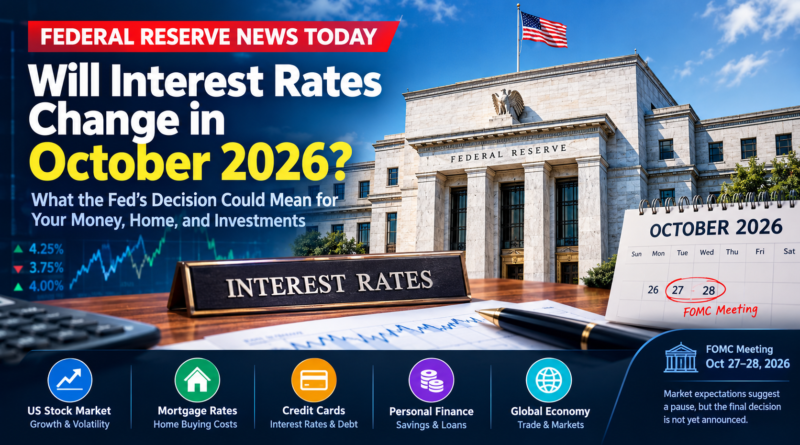
Federal Reserve News Today: Will Interest Rates Change in October 2026?
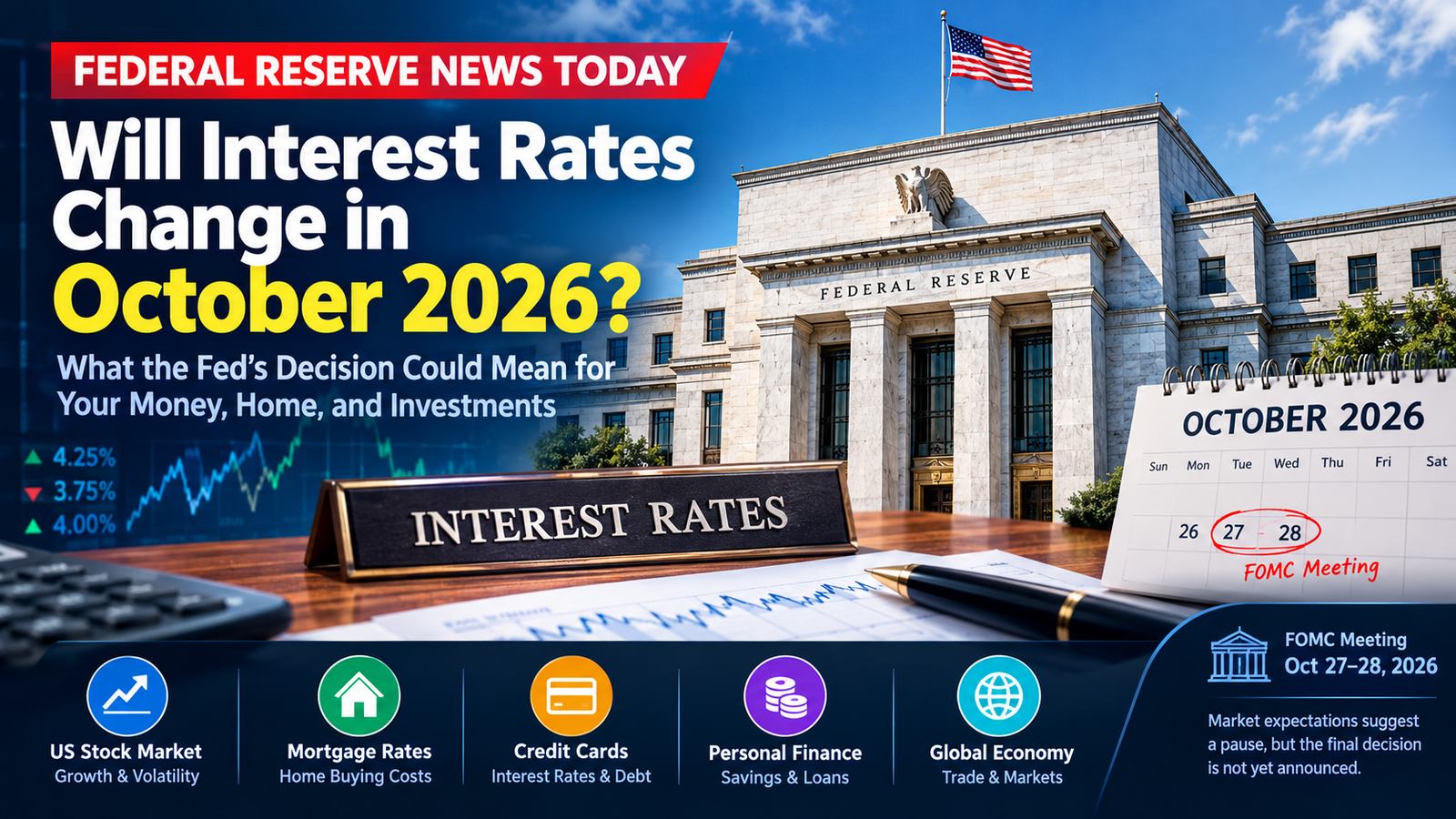
The Federal Reserve’s October 2026 interest rate decision is one of the biggest economic events for American households, investors, and businesses this week. With inflation still a concern and borrowing costs affecting everyday budgets, many people want to know whether the Fed will raise rates, lower them, or leave them unchanged.
The Federal Open Market Committee (FOMC) is scheduled to meet on October 27–28, 2026. As of October 26, the decision has not yet been announced. Economists widely expect the Fed to keep its benchmark interest rate unchanged at this meeting, although another increase later in the year remains a possibility. Reuters’ October 20 report describes the expectations gathered in its latest economist poll.
For Americans dealing with credit card balances, home loans, car payments, retirement investments, or rising living expenses, the decision matters beyond Wall Street. It can influence the cost of borrowing and shape expectations for the months ahead.
Here is what to know before the Fed announces its decision.
Federal Reserve Interest Rate Decision: What Do We Know?
The key question is whether policymakers believe inflation is cooling enough to leave interest rates unchanged or whether price pressures require further action.
As of October 26, the main points are:
- Next FOMC meeting: October 27–28, 2026.
- Expected October outcome: Economists broadly anticipate no change in the benchmark rate.
- Current policy target range reported ahead of the meeting: 3.75%–4.00%.
- Official October decision: Still pending as of October 26.
- What comes next: Investors will watch the Fed’s statement and its comments about inflation, employment, and future policy.
Reuters reported that 94 of 100 economists surveyed expected the Fed to hold rates at 3.75%–4.00% in October. That is a survey of expectations, not a guarantee of what policymakers will decide. Read the Reuters report.
For the latest official information, check the Federal Reserve website.
Did the Fed Increase Interest Rates?
The answer depends on which meeting you mean.
The Federal Reserve raised its benchmark interest rate by 0.25 percentage points at its September 2026 meeting, bringing the reported target range to 3.75%–4.00%. For the October meeting, however, policymakers have not yet announced their decision as of October 26.
This distinction is important because financial headlines often describe what markets expect before a decision is made. An expected rate hold is not the same as an official announcement.
A rate increase generally makes borrowing more expensive across parts of the economy. A rate cut can ease some borrowing pressures, while a decision to hold rates steady leaves the policy target unchanged but does not necessarily freeze every loan or savings rate.
Consumers should also remember that the federal funds rate is not the interest rate paid directly on every mortgage, credit card, or car loan. Lenders set their own rates based on factors such as funding costs, credit risk, loan terms, and broader market conditions.
Why Is the Fed Expected to Hold Rates in October?
The Fed faces a difficult balance. It wants inflation to move toward its 2% goal without unnecessarily damaging employment or economic activity.
If inflation remains stubborn, cutting interest rates too soon could risk keeping price pressures alive. But raising rates too aggressively can make borrowing more expensive for families and businesses, potentially slowing spending and investment.
Recent economic commentary points to two competing concerns.
1. Inflation has not disappeared
When prices rise persistently, households lose purchasing power. Even if the pace of inflation slows, everyday expenses such as groceries, utilities, insurance, transportation, and housing can remain high.
Higher energy costs can add to this pressure by raising transportation and production expenses. If businesses pass those costs on to customers, inflation can become harder to control.
The Fed must assess whether price increases are temporary or likely to continue. That judgment helps determine whether current rates are restrictive enough.
2. The economy continues to show resilience
Policymakers also consider employment, consumer spending, business investment, and economic growth.
If economic activity remains strong, the Fed may have more room to keep rates elevated while waiting for clearer evidence that inflation is cooling. At the same time, policymakers must avoid tightening financial conditions so much that growth weakens sharply.
That is one reason investors pay close attention not only to the decision itself but also to the Fed’s explanation.
3. Officials may want more time to assess the data
A pause does not automatically mean the Fed has finished raising rates. Policymakers may choose to hold the target steady while examining new inflation and employment figures.
Reuters’ October survey found that economists widely expected no increase in October but anticipated a possible rate hike in December. Those forecasts reflect the views of surveyed economists, not a commitment from the Fed. Source: Reuters.
What Could the October Decision Mean for American Households?
For many people, the practical question is simple: Will monthly bills become easier to manage?
The answer will depend on the type of debt they carry, the rates lenders offer, and how financial markets react.
Credit card interest rates
Credit card balances can be especially expensive when interest rates are high. Many cards have variable annual percentage rates, which can respond to changes in benchmark rates and lenders’ pricing decisions.
If the Fed holds rates steady, borrowers should not assume their credit card APR will immediately fall. A hold simply means the policy target has not changed. Existing card terms and issuer adjustments still matter.
What consumers can do: Pay more than the minimum whenever possible, avoid adding unnecessary balances, and compare lower-interest alternatives carefully. Before transferring a balance, check promotional periods, transfer fees, and the interest rate that applies after the offer ends.
Mortgage rates and home affordability
Mortgage rates do not move in lockstep with the federal funds rate. They are also influenced by Treasury yields, mortgage-backed securities, inflation expectations, and investor demand.
As a result, a Fed pause does not guarantee cheaper home loans.
Potential homebuyers should compare the annual percentage rate, closing costs, monthly payment, and loan terms offered by different lenders. Homeowners considering refinancing should calculate whether the savings justify the fees.
For households already stretching their budgets to afford housing, waiting for a particular Fed decision may not be enough. The full cost of ownership—including taxes, insurance, maintenance, and utilities—remains important.
Auto loans
Car buyers can also feel the effects of a high-rate environment. Financing costs depend on the lender, the borrower’s credit history, the loan term, the vehicle, and available promotions.
Even a modest difference in the interest rate can add up over a long loan.
Before visiting a dealership, consider getting preapproved for financing and comparing the total amount paid over the life of the loan. A lower monthly payment is not always a better deal if it comes from extending the repayment period.
Savings accounts and certificates of deposit
Higher interest rates can benefit savers because banks may offer more attractive yields on savings accounts and certificates of deposit.
However, banks do not all adjust rates at the same time or by the same amount. A Fed pause does not guarantee that savings rates will remain unchanged.
Compare the annual percentage yield, minimum balance requirements, withdrawal rules, and account fees. For certificates of deposit, make sure the term fits your expected need for the money.
How Could the Fed Decision Affect the U.S. Stock Market?
Investors often try to anticipate the Fed before the announcement. Stock prices may react to the decision, but they can also move sharply in response to the accompanying statement and press conference.
A rate hold that matches expectations may produce a limited market reaction if investors have already priced it in. The market could move more noticeably if policymakers sound more concerned about inflation or economic weakness than investors anticipated.
Technology and growth stocks
Technology companies and other growth businesses are often sensitive to interest-rate expectations because investors place substantial value on their anticipated future earnings.
When expected borrowing costs or market yields rise, valuations can come under pressure. But company earnings, product demand, investment spending, and business outlooks also matter.
A rate pause alone does not guarantee a rally in technology shares.
Banks and financial stocks
Banks can be affected by changes in lending demand, deposit costs, bond valuations, and the difference between the rates they earn and pay.
The effect of a rate decision is therefore not uniform across the financial sector. Investors should assess individual banks’ balance sheets and earnings rather than assuming that higher or lower rates benefit every institution equally.
Dividend stocks and bonds
When Treasury yields are relatively high, some investors may find government bonds more attractive compared with dividend-paying shares. If yields decline, that comparison can change.
Still, dividend stocks carry market risk, and bond prices can fall when yields rise. Neither asset class is automatically safe from losses.
For long-term investors, the more useful approach is to consider diversification, risk tolerance, time horizon, and the fundamentals of individual investments instead of reacting to one policy announcement.
What Could Happen to Treasury Yields and the U.S. Dollar?
Treasury yields reflect several forces, including expectations for future Fed policy, inflation, government borrowing, and demand for safe assets.
A decision to hold rates steady could have different effects depending on what the Fed says about future meetings. If its message is more hawkish than expected, longer-term yields may rise even without an immediate increase in the benchmark rate. If policymakers sound less concerned about inflation, some yields could move lower.
The U.S. dollar can also respond to changing expectations about American interest rates relative to those in other economies. But currency movements are affected by global growth, geopolitical developments, trade, and investor demand.
There is no reliable rule that a rate hold automatically makes the dollar stronger or weaker.
Will the Fed Cut Interest Rates in 2026?
A rate cut is possible only if policymakers judge that the economic outlook supports easing. The October meeting alone cannot establish the path for the rest of the year.
Several factors will matter:
- Whether inflation is moving sustainably toward the Fed’s 2% objective.
- Whether the labor market is cooling or remaining strong.
- Whether consumer spending and business investment are slowing.
- Whether energy prices create renewed inflation pressure.
- Whether financial conditions are already restrictive enough to bring inflation down.
Markets may change their expectations as new information arrives. Forecasts about a December rate increase or future cuts should therefore be treated as scenarios rather than confirmed policy.
For households, it is risky to make major financial commitments on the assumption that rates will fall by a particular date.
Three Possible Outcomes for the October Fed Meeting
Scenario 1: The Fed holds rates steady
This is the outcome widely anticipated by economists ahead of the meeting.
A hold would leave the benchmark target range unchanged. Markets would then look for clues about what could happen at the next meeting.
For borrowers, it would not automatically reduce monthly payments. For investors, the reaction would depend partly on whether the statement matches expectations.
Scenario 2: The Fed raises rates
An unexpected increase could signal that policymakers believe inflation risks require a stronger response.
Bond yields and stock prices could become volatile as investors adjust their forecasts. Borrowers with variable-rate debt may face higher costs over time, although the exact impact would depend on their loan terms and lenders.
A hike would not necessarily cause every stock or bond to fall. Market reactions depend on what investors had already anticipated and how the decision changes expectations.
Scenario 3: The Fed cuts rates
An unexpected cut could suggest that policymakers are more concerned about economic weakness or believe inflation has eased enough to allow monetary policy to become less restrictive.
Some borrowing costs might decline, but not necessarily immediately. Investors would also consider the reason for the cut: easing inflation can be welcomed, while a cut prompted by serious economic deterioration may create concern.
These scenarios are analytical possibilities, not predictions of the final decision.
What Should Americans Do Before the Fed Announcement?
The most useful response to interest-rate uncertainty is to review your own financial position instead of trying to predict every market move.
If you have credit card debt: Focus on repayment, compare interest rates, and avoid relying on a future Fed cut to make the balance affordable.
If you plan to buy a home: Compare multiple mortgage offers and calculate a payment you can comfortably manage. Do not base your decision solely on expectations about the next Fed meeting.
If you are shopping for a car: Compare the total financing cost, not just the advertised monthly payment. Check your credit report and explore preapproval options.
If you have savings: Review account yields and access rules. Make sure emergency funds remain accessible rather than locking away money you may need soon.
If you invest in stocks or bonds: Revisit your investment goals and risk exposure. Avoid making rushed portfolio changes based on a single headline.
If you run a small business: Review cash flow, debt repayment schedules, and financing needs. A stable policy rate does not guarantee stable lending terms.
Where to Check the Official Fed Rate Decision
The best source for the official outcome is the Federal Reserve’s own website. Its FOMC section publishes policy statements and meeting materials.
You can check the Federal Reserve’s official website and its FOMC meeting calendar.
When the announcement arrives, look for three things: the target range, the committee’s explanation of inflation and employment, and any change in its assessment of future risks.
Financial news reports can help explain the market reaction, but the official statement should be used to confirm what policymakers actually decided.
Final Thoughts: Will Interest Rates Change in October 2026?
As of October 26, 2026, the Federal Reserve has not announced its October rate decision. Economists widely expect policymakers to leave the benchmark rate unchanged at the October 27–28 meeting, while some forecasts point to the possibility of another increase later in the year.
The important distinction is between what markets expect and what the Fed ultimately does. Inflation, employment, economic growth, and financial conditions will all influence the policy outlook.
For American households, the practical priority remains the same: manage expensive debt, compare financial products carefully, maintain an emergency cushion, and avoid making major decisions based on an unconfirmed rate forecast.
This article is for informational and educational purposes only. It is not personalized financial, investment, tax, or legal advice.
