

Fed Interest Rate Decision October 2026: Why Markets Expect a Pause and What It Means for Americans
Published: October 25, 2026
Category: USA Finance, Federal Reserve, Economy, Stock Market Analysis
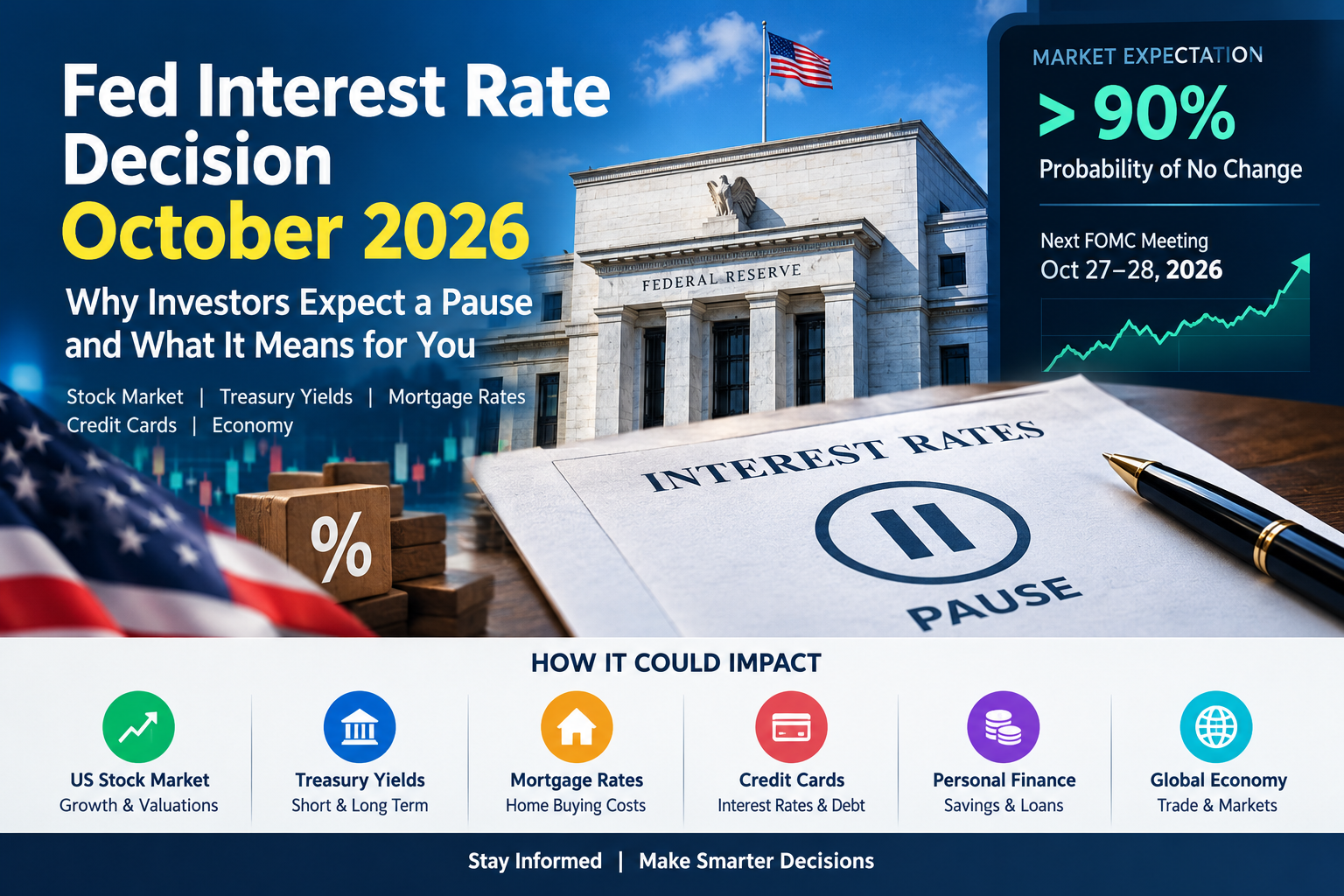
The US financial markets are heading into an important week as investors prepare for the Federal Reserve’s October interest-rate decision. Market commentary on October 25 indicated that investors assigned more than a 90% probability to the Fed leaving interest rates unchanged at its upcoming meeting. That expectation reflects financial-market pricing, not an announcement or guarantee from the Federal Reserve.
The Federal Open Market Committee (FOMC), the central bank’s policy-setting body, is scheduled to meet on October 27–28. Investors are watching closely because the decision could influence borrowing costs, stock prices, bond yields, mortgage affordability and the outlook for economic growth.
For ordinary Americans, the issue is much bigger than a number announced by the central bank. Interest rates affect the cost of carrying credit card balances, financing a car, buying a home and operating a small business. They also influence the returns savers receive from deposits and other interest-bearing products.
For investors, the question is whether a pause would provide stability or simply delay another period of tighter financial conditions. Even if the Fed leaves its policy rate unchanged, its statement and the chair’s press conference may influence how markets assess the next several months.
The important point is that a widely expected decision does not necessarily mean a quiet market. Prices often move when policymakers communicate something different from what investors had anticipated.
1. What Is Happening With the Fed’s October Interest-Rate Decision?
Investors are approaching the October meeting with a strong expectation that the Federal Reserve will keep its policy rate unchanged. Market commentary published on October 25 reported that the probability of a pause had moved above 90%.
This estimate comes from market pricing. Interest-rate futures allow investors to express expectations about future Federal Reserve decisions. Analysts use those prices to calculate the likelihood of different policy outcomes.
The estimate can change as new economic information arrives, trading conditions shift or investors reconsider the risks facing the economy.
It is therefore important to distinguish between three different things:
- Market expectations: What investors believe the Fed is most likely to do.
- Economic forecasts: What economists expect based on inflation, employment and growth data.
- The official decision: What the Federal Reserve actually announces after its meeting.
Only the third represents the central bank’s formal policy decision.
According to the Federal Reserve’s published calendar, the October FOMC meeting is scheduled for October 27–28. Until the official statement is released, investors should treat the anticipated pause as a forecast rather than a confirmed outcome.
Investors can follow the official schedule and policy statements through the Federal Reserve’s FOMC calendar.
Why does a 90% probability matter?
A probability above 90% tells investors that the market sees one outcome as considerably more likely than the alternatives. It does not mean that the outcome is certain.
If investors expect no change and the Fed delivers exactly that result, the announcement itself may cause only a limited reaction. Markets may have already adjusted prices in anticipation.
However, a decision that differs from expectations could produce a sharper response. An unexpected rate increase, for example, could lead investors to reconsider their assumptions about inflation, borrowing costs and future economic growth.
Even when the central bank leaves rates unchanged, its explanation can change market expectations.
That is why investors should not focus exclusively on the final rate decision. They should also examine the language used in the policy statement, the reasoning behind the decision and any comments about future risks.
2. Why Might the Federal Reserve Keep Rates Unchanged?
The Federal Reserve faces a difficult balancing act. It must work toward price stability while supporting maximum employment. Those goals can become harder to achieve when inflation remains elevated but economic activity continues to expand.
Keeping rates unchanged can give policymakers time to assess the effects of earlier decisions and evaluate incoming economic data.
A pause does not automatically mean that inflation has been defeated. Nor does it necessarily mean that the central bank is preparing to reduce rates.
Instead, it may represent a decision to wait for clearer evidence before making another move.
Inflation remains a central concern
Inflation measures how quickly prices for goods and services rise over time. When inflation stays high, households lose purchasing power because their income may not keep pace with the cost of living.
Higher interest rates are one way the Federal Reserve attempts to slow inflation. Expensive borrowing can discourage some forms of consumer spending and business investment, reducing demand across the economy.
However, monetary policy works with a delay. A rate increase does not immediately change every household’s spending decisions or every company’s investment plans.
Policymakers must therefore consider not only the latest inflation reading but also the direction of prices, wage growth, consumer demand and broader economic conditions.
If inflation remains persistent, officials may be reluctant to signal that borrowing costs will fall soon.
Economic growth also matters
A central bank cannot assess inflation in isolation. It must also consider the health of the labor market and the wider economy.
If businesses continue hiring, consumers keep spending and economic output remains strong, policymakers may have more room to maintain restrictive interest rates.
On the other hand, if employment weakens substantially or business activity slows, the case for keeping rates high may become less compelling.
The challenge is determining whether the economy is cooling enough to reduce inflation without experiencing an unnecessarily severe slowdown.
Previous policy decisions take time to work
Changes in interest rates influence the economy through several channels. Banks adjust lending rates, households reconsider major purchases, companies review expansion plans and investors reassess the relative attractiveness of different assets.
These adjustments do not happen simultaneously.
Some borrowers have fixed-rate loans that remain unchanged for years. Others face variable rates that respond more quickly to market conditions. Businesses also differ in how much debt they carry and when they must refinance.
A pause allows policymakers to observe more of these effects before deciding whether further action is necessary.
For investors, the practical lesson is simple: an unchanged rate is not the same as unchanged economic conditions.
3. What Does an Interest-Rate Pause Mean for the Stock Market?
The stock market often reacts to the relationship between interest rates, corporate earnings and investor expectations.
When borrowing costs are high, companies may face more expensive financing. Consumers may also reduce spending on products that require loans or credit. These pressures can affect revenue, profits and future growth estimates.
However, the relationship between rates and stocks is not straightforward. Some companies are more sensitive to interest rates than others, and strong earnings can sometimes offset the pressure of higher borrowing costs.
Growth stocks may remain sensitive to rates
Growth companies often derive a substantial portion of their estimated value from profits expected many years into the future.
When market interest rates rise, investors may place a lower present value on those future profits. This can put pressure on the prices of some technology and growth stocks.
If the Fed holds rates steady and investors believe future borrowing costs will remain stable, some growth stocks may receive support.
But the result is not guaranteed. Investors must also consider earnings forecasts, business spending, competition, valuations and the economic outlook.
A pause accompanied by concerns about persistent inflation could still leave growth stocks under pressure.
Financial stocks may respond differently
Banks and other financial companies are affected by interest rates through lending, deposits, funding expenses, credit quality and the shape of the yield curve.
Higher rates can improve the income earned on certain loans and securities. At the same time, banks may have to pay more to attract deposits, and borrowers may become less able to repay debt.
A stable policy rate may make some short-term funding costs easier to anticipate, but it does not eliminate these risks.
Investors evaluating financial stocks should pay attention to earnings reports, loan-loss provisions, deposit costs and management commentary rather than assuming that a pause automatically benefits banks.
Consumer companies face a different challenge
Household spending is important to many US companies. When credit card interest, auto financing and other borrowing costs remain high, consumers may have less money available for discretionary purchases.
Companies selling essential products may experience different demand patterns from businesses that depend on consumers making optional or expensive purchases.
A pause could reduce uncertainty about the immediate policy outlook, but it would not instantly lower the interest rates already charged on outstanding debts.
Investors should examine consumer spending, company margins, pricing power and earnings guidance to understand how higher borrowing costs are affecting businesses.
Why the market could fall even if rates stay unchanged
A common mistake is assuming that a widely expected pause must be positive for stocks.
Markets respond to the difference between expectations and new information. If investors expect a pause accompanied by reassuring comments but instead hear warnings about persistent inflation, stock prices could decline.
Likewise, if policymakers suggest that rates may need to stay restrictive for longer than investors had anticipated, long-term borrowing costs could remain elevated.
The lesson is that the policy decision and the policy message are separate sources of market risk.
4. How Could the Decision Affect Treasury Yields?
US Treasury securities are central to the global financial system. Their yields influence borrowing costs across many parts of the economy, including mortgages, corporate debt and other forms of financing.
Treasury yields do not move only in response to the Federal Reserve’s current policy rate. They also reflect expectations about future inflation, economic growth, government borrowing, demand for bonds and the compensation investors require for taking longer-term risks.
This distinction explains why Treasury yields can rise even when the Fed keeps its rate unchanged.
Short-term yields
Short-term Treasury yields are generally sensitive to expectations for the Federal Reserve’s policy rate.
If investors expect the Fed to maintain its current rate, short-term yields may remain relatively stable. But a change in expectations about the next meeting could quickly alter pricing.
For example, if incoming inflation data suggests that policymakers may need to tighten policy again, investors could revise their outlook for short-term rates.
Long-term yields
Long-term Treasury yields reflect a broader collection of expectations.
Investors consider future inflation, economic growth, the likely path of short-term interest rates and the supply of government debt. They also consider the additional yield they may require to hold longer-dated bonds.
As a result, long-term yields can remain high even during a period when the Fed is not changing its policy rate.
This matters because many household and business borrowing costs are influenced by longer-term market rates.
What investors should watch
During the October meeting, investors should observe whether Treasury yields move in the same direction as stocks or show a different pattern.
Rising yields alongside falling stock prices may indicate that investors are becoming more concerned about inflation or the prospect of tighter financial conditions.
Falling yields alongside rising stock prices may suggest that investors see a lower risk of further tightening, although other explanations are possible.
Neither pattern should be interpreted in isolation. Market reactions need to be considered alongside the policy statement, economic data and corporate earnings.
5. What Does the Fed Decision Mean for Mortgage Rates?
For Americans planning to buy a home, mortgage affordability is one of the most important consequences of the interest-rate outlook.
However, the Federal Reserve does not directly set the interest rate on a typical 30-year fixed-rate mortgage.
Mortgage rates are influenced by longer-term Treasury yields, mortgage-backed securities, lender funding costs, market expectations and the credit characteristics of individual borrowers.
This means mortgage rates can rise or fall even when the Fed leaves its policy rate unchanged.
Why homebuyers may still face high costs
A prospective homebuyer must consider more than the advertised mortgage rate.
The monthly payment also depends on the home price, down payment, property taxes, homeowners insurance and other housing expenses.
When mortgage rates are elevated, the same loan amount produces a larger monthly payment. Some households may respond by choosing a less expensive property, increasing their down payment or delaying their purchase.
For first-time buyers, the combination of high prices and borrowing costs can make it particularly difficult to enter the housing market.
Should buyers wait for the Fed meeting?
Waiting for a policy announcement may seem attractive, but a single meeting does not determine the direction of mortgage rates over the following months.
If the Fed holds rates unchanged and markets have already anticipated the decision, mortgage rates may barely move.
If the announcement changes expectations for future policy, mortgage rates could react before the meeting has concluded.
Buyers should therefore assess their own finances rather than attempting to predict every market movement.
A useful approach is to calculate whether the proposed monthly payment remains affordable under different interest-rate assumptions. Buyers can also compare loan offers, understand closing costs and avoid stretching their budgets simply to purchase a property sooner.
6. Credit Cards and Personal Loans: What Borrowers Need to Know
For households carrying revolving credit card balances, interest rates can have a direct and expensive impact on monthly finances.
Many credit cards have variable annual percentage rates. Depending on the account terms, these rates may be linked to a benchmark that responds to changes in the federal funds rate.
When borrowing costs remain elevated, carrying a balance can become expensive.
A pause does not erase existing interest costs
If the Fed keeps its policy rate unchanged, credit card interest rates will not automatically decline.
Even if a card’s rate eventually falls, the change may be limited and may not immediately produce meaningful savings for someone with a large balance.
For example, a person carrying $5,000 in credit card debt at a hypothetical 24% annual percentage rate would face approximately $100 in interest over one month if the balance remained unchanged for that month and interest were approximated using a simple annual-rate calculation.
The actual amount depends on the card’s balance calculation, daily periodic rate, payment timing and other account terms.
This example shows why borrowers should not wait for monetary policy to solve a personal debt problem.
Practical ways to reduce credit card debt
Consumers can take several steps regardless of what the Fed announces.
First, list every balance and interest rate. Knowing which debts are most expensive makes it easier to prioritize payments.
Second, pay more than the minimum whenever possible. Minimum payments can keep an account current, but they may leave the borrower paying interest for a long time.
Third, consider the highest-interest-first method. Continue making required minimum payments on all accounts while directing additional money toward the debt with the highest interest rate.
Fourth, contact the card issuer. Ask whether a lower interest rate, hardship program or more manageable repayment arrangement is available. Approval is not guaranteed, but asking may identify options.
Fifth, reduce new borrowing. Avoid adding unnecessary purchases to cards while trying to pay down existing balances.
Finally, build a small emergency reserve where possible. Without any cash buffer, an unexpected repair or medical bill can push a household back into expensive borrowing.
A Fed pause may offer no immediate relief to an indebted household. A consistent repayment strategy can still improve its financial position.
7. What About Auto Loans and Small Businesses?
The effects of monetary policy extend beyond mortgages and credit cards.
Auto loans, equipment financing, business credit lines and other forms of borrowing can be affected by changes in market interest rates and lender risk assessments.
The impact varies according to loan type, contract terms, borrower creditworthiness and the lender’s funding costs.
Car buyers
Higher financing costs can increase the total expense of buying a vehicle.
A buyer considering a car should compare the total amount payable, not merely the monthly installment. A longer loan term may reduce the monthly payment but increase the total interest paid and extend the period during which the borrower owes money.
Before purchasing, buyers should compare financing offers and determine whether the vehicle remains affordable if insurance, maintenance and other costs rise.
Small-business owners
Small businesses often have less financial flexibility than large corporations. Some depend on credit lines to cover payroll, inventory, equipment and seasonal expenses.
When financing costs remain high, business owners may postpone expansion, reduce discretionary spending or reconsider hiring plans.
A stable Fed rate can improve short-term planning, but businesses should not assume that lenders will reduce rates or loosen credit standards.
Owners can strengthen their finances by reviewing cash flow, negotiating supplier terms, controlling unnecessary costs and avoiding borrowing for projects without a clear repayment plan.
The goal is to ensure that a business can withstand a period of expensive financing even if monetary policy does not become more supportive.
8. Will the Fed Cut Rates Soon?
A pause and a rate cut are two different policy outcomes.
A pause means the central bank leaves its target rate unchanged at a particular meeting. A cut means it reduces the target rate.
Investors sometimes interpret a pause as the beginning of an easing cycle, but that conclusion is not automatic.
The Fed may keep rates steady because inflation is moving toward its objective, because it wants more information or because it believes current financial conditions are already restrictive.
It may also maintain rates because inflation risks remain too high to justify easing.
What would support a future rate cut?
A sustained decline in inflation could strengthen the case for lower rates, particularly if price pressures ease across a broad range of goods and services.
A significant deterioration in employment or economic activity could also influence the Fed’s assessment.
However, policymakers must consider the combination of these developments. Slower growth alone does not guarantee a rate cut if inflation remains stubbornly high.
What could delay rate cuts?
Persistent inflation, strong demand or renewed price pressures could encourage policymakers to keep rates elevated for longer.
If businesses continue passing higher costs on to consumers, or if inflation expectations become less stable, the Fed may be reluctant to loosen policy.
Investors should therefore avoid treating a single meeting as proof of the central bank’s longer-term direction.
The more reliable approach is to monitor several releases of inflation, employment and spending data before drawing conclusions.
9. Could the Fed Raise Rates Instead?
Although market commentary on October 25 pointed to a greater-than-90% probability of a pause, a less likely outcome cannot be ruled out before the official decision.
The possibility of an increase matters because investors have to assess not only the most likely scenario but also the potential consequences of alternatives.
A rate increase would generally indicate that policymakers believe additional restraint is necessary or that inflation risks justify stronger action.
Such a decision could lead investors to reassess stock valuations, bond yields and the outlook for borrowing costs.
However, market reactions would depend on the size of the move, the reasoning behind it and whether officials suggested further increases might follow.
It would be inaccurate to say that an increase must cause stocks to fall or that a pause must cause them to rise. Financial markets respond to new information, changing expectations and the economic circumstances surrounding a decision.
The key question is whether the announcement changes the outlook that investors had already priced into assets.
10. Three Scenarios Investors Should Prepare For
Rather than making a single prediction, investors can prepare for several plausible outcomes.
Scenario A: The Fed holds rates and sounds cautious
Under this scenario, policymakers leave rates unchanged but emphasize that inflation risks remain important.
The immediate rate decision may have limited impact if it matches expectations. However, the cautious message could discourage investors from assuming that cuts are close.
Treasury yields could remain elevated or rise if investors revise their expectations for future policy. Stocks could react differently depending on earnings, valuations and sensitivity to borrowing costs.
For households, the main implication would be that expensive borrowing may continue for some time.
Scenario B: The Fed holds rates and signals improving conditions
In this scenario, policymakers maintain the rate but express greater confidence that inflation is moving in the right direction.
Investors might interpret the message as reducing the likelihood of additional tightening.
That could support some stocks and improve sentiment toward interest-sensitive sectors. Bond yields might decline if markets anticipate lower rates in the future.
However, a more reassuring message would not guarantee an immediate improvement in household borrowing costs. Mortgage rates and other lending rates would still depend on broader market conditions.
Scenario C: The Fed delivers an unexpected increase
An unexpected increase could produce a more substantial market reaction because it would challenge the widely anticipated pause.
Investors might reassess valuations and the future cost of capital. Borrowers could face greater uncertainty, while companies dependent on cheap financing might come under pressure.
Yet even in this scenario, the eventual market response would depend on the explanation behind the decision and the outlook for subsequent meetings.
Investors should avoid making trades solely on the basis of a headline without examining the full policy message.
11. A Practical Plan for Long-Term Investors
The most useful response to an important Fed meeting is not necessarily to buy or sell immediately.
For long-term investors, a decision-making framework can help prevent emotional reactions to short-term price movements.
Review your investment time horizon
Money needed within the next few months should generally be treated differently from money intended for retirement decades away.
Short-term financial needs may justify greater emphasis on liquidity and stability. Long-term investment portfolios can often tolerate more short-term volatility, depending on the investor’s circumstances.
The correct allocation depends on financial goals, risk tolerance and the ability to withstand losses.
Check portfolio concentration
Investors heavily concentrated in a single sector may be more exposed to changes in interest-rate expectations.
For example, a portfolio dominated by highly valued growth stocks may respond differently from one spread across multiple sectors and asset classes.
Diversification cannot eliminate losses, but it can reduce dependence on a single company, sector or market outcome.
Avoid trading on probability headlines alone
A probability above 90% sounds decisive, but it is still an estimate derived from market pricing.
It does not guarantee the final decision, and it says nothing by itself about how stocks will respond afterward.
Investors should distinguish between the likelihood of a policy outcome and the likely market reaction to that outcome.
Keep an emergency reserve
Households with adequate emergency savings may be less likely to rely on credit cards or expensive short-term borrowing when unexpected expenses arise.
The appropriate reserve depends on income stability, essential expenses, dependents and other personal circumstances.
Building savings gradually can improve financial resilience regardless of whether the Fed cuts, holds or raises rates.
Rebalance according to a plan
Investors who maintain target allocations can periodically compare their actual holdings with those targets.
Rebalancing may help control risk, but it should take account of transaction costs, taxes and the investor’s overall strategy.
A single economic announcement is rarely a sufficient reason to abandon a carefully constructed long-term plan.
12. What Should Investors Watch After the Decision?
The Fed’s announcement is only one part of the economic picture.
Investors should pay attention to the following indicators over the coming days and weeks.
Inflation data: Consumer and producer price measures help investors assess whether price pressures are easing or becoming more persistent.
Personal consumption expenditures (PCE): The PCE price index is an important inflation measure for the Federal Reserve. Both headline and core readings can provide useful information about price trends.
Employment reports: Hiring, unemployment, wage growth and jobless claims help reveal the condition of the labor market.
Treasury yields: Movements in short- and long-term yields show how investors are adjusting their expectations for inflation, growth and future monetary policy.
Consumer spending: Retail sales and other spending measures help show whether households are maintaining demand despite borrowing costs and living expenses.
Corporate earnings: Company results can reveal how interest rates are affecting financing costs, consumer demand and profit margins.
Credit conditions: Lending standards, loan demand and delinquency trends help show whether higher borrowing costs are creating greater financial stress.
No single indicator provides a complete picture. The most useful conclusions emerge when several measures point in the same direction.
13. The Problem With Relying Too Heavily on Fed Predictions
Investors and consumers often focus intensely on predicting the next interest-rate decision. While monetary policy matters, trying to forecast every move can become distracting and expensive.
A prediction can be correct while an investment still loses money. For example, an investor may correctly anticipate a pause but pay too much for a stock before the announcement.
Likewise, a household may expect borrowing costs to fall but postpone a necessary financial decision for months without knowing when relief will arrive.
The solution is to separate what can be controlled from what cannot.
Investors cannot control the Fed’s decision, inflation releases or market reactions. They can control how much risk they take, whether they maintain diversification and whether they have enough liquidity for near-term needs.
Households cannot determine when interest rates will decline. They can compare loan terms, reduce expensive debt, improve savings habits and avoid taking on payments that their budgets cannot comfortably support.
Businesses cannot eliminate economic uncertainty. They can improve cash-flow planning, maintain appropriate reserves and stress-test their budgets against higher financing costs.
A plan built around financial resilience is generally more useful than a strategy that depends on predicting a single announcement correctly.
14. How American Households Can Prepare for a Period of Uncertain Rates
The practical consequences of monetary policy differ from one household to another.
Someone with a large variable-rate credit card balance may be more exposed to high rates than a saver holding interest-bearing deposits. A homeowner with a fixed-rate mortgage may experience little immediate change in their scheduled payment, while a prospective buyer may be highly sensitive to mortgage-rate movements.
There is no universal response to the Fed’s decision.
Households with expensive debt
Start by identifying debts with the highest interest rates. Create a realistic monthly repayment budget and avoid accumulating additional balances where possible.
If payments have become difficult, contact lenders before missing payments to ask about available assistance.
Households planning a home purchase
Calculate an affordable payment based on the total housing cost rather than relying on a hoped-for decline in mortgage rates.
Compare loan offers and avoid assuming that a Fed pause will immediately reduce mortgage financing costs.
Households building savings
Compare the rates and conditions offered by savings accounts and other appropriate low-risk products.
A stable policy rate does not mean every financial institution will offer the same return. Check fees, access restrictions, deposit protections and withdrawal conditions before choosing an account.
Households facing income uncertainty
Prioritize essential expenses, maintain liquidity where possible and avoid committing to large new payments without a clear financial plan.
If a household is already under pressure, reducing fixed expenses and addressing high-interest debt may be more important than trying to time the market.
15. Why the US Interest-Rate Decision Matters Globally
The Federal Reserve’s decisions are important beyond the United States because the dollar plays a major role in international trade, finance and investment.
Changes in US interest-rate expectations can affect currency markets, global bond yields, capital flows and financing conditions for governments and companies.
When US yields rise relative to those available elsewhere, some international investors may find dollar-denominated assets more attractive. The actual impact depends on currency expectations, perceived risk, market liquidity and other economic conditions.
Emerging markets can be particularly sensitive to changes in global financing conditions. Countries and companies with substantial dollar-denominated debt may face greater repayment pressure if borrowing costs rise or their local currencies weaken against the dollar.
However, the effect is not uniform. Individual countries differ in their external debt, foreign-exchange reserves, inflation, trade balances and domestic policy settings.
For international investors, the October meeting is therefore one piece of a broader global economic picture.
The dollar, international bond yields, commodity prices and regional central-bank decisions should all be considered when assessing the potential spillover effects.
16. Common Mistakes to Avoid During Fed Week
A major policy announcement often produces a flood of headlines, forecasts and confident predictions. Several common mistakes can make the situation harder to understand.
Mistake 1: Treating market expectations as an official decision. A probability is a market estimate, not a promise from policymakers.
Mistake 2: Assuming a pause means rate cuts are coming next. The Fed may keep rates unchanged for multiple meetings or change direction if economic conditions warrant it.
Mistake 3: Assuming all stocks react in the same way. Companies differ in their debt levels, earnings outlooks, valuations and sensitivity to interest rates.
Mistake 4: Ignoring the bond market. Treasury yields can influence mortgage rates and other borrowing costs even when the policy rate does not change.
Mistake 5: Making major financial decisions based on one headline. A single announcement cannot reveal every important feature of the economic outlook.
Mistake 6: Waiting for rate relief before managing debt. Households can begin improving their financial position now rather than relying on a future policy change.
Mistake 7: Confusing a lower policy rate with automatically affordable housing. Home prices, insurance, taxes, income and mortgage-market conditions also determine affordability.
Avoiding these mistakes can help investors and households respond more rationally to economic uncertainty.
17. What Could Change the Market Outlook in the Coming Weeks?
The October meeting will provide important information, but the economic outlook will continue to evolve.
If inflation readings remain high, investors may become less confident that the Fed can ease policy soon. That could put pressure on interest-sensitive assets and keep borrowing costs elevated.
If inflation cools while employment and spending remain resilient, investors may become more comfortable with the possibility that monetary policy can eventually become less restrictive.
If economic activity weakens sharply, the debate may shift toward how the Fed should balance inflation risks against a deteriorating labor market.
Unexpected developments can also alter the outlook. Changes in energy prices, geopolitical tensions, fiscal policy and financial conditions may influence both inflation and growth.
The important point is that market expectations are updated continuously. The probability quoted on October 25 should not be treated as a permanent forecast.
Investors should verify the latest information before making decisions and distinguish newly released data from earlier commentary.
18. Final Analysis: A Likely Pause Does Not End the Interest-Rate Debate
As of October 25, 2026, market commentary indicated that investors assigned more than a 90% probability to the Federal Reserve holding rates steady at its October meeting. The scheduled decision was still ahead, with the FOMC due to meet on October 27–28.
That expectation suggested that a pause was the market’s preferred outcome. It did not establish that the Fed had made its decision, nor did it guarantee that financial markets would react positively.
The larger question is how policymakers assess inflation, economic growth and the risks associated with maintaining or changing the current policy stance.
For stock investors, the policy statement and subsequent changes in expectations may matter as much as the decision itself. Treasury yields, corporate earnings and economic data will continue to influence asset prices.
For homebuyers and borrowers, a pause would not automatically make loans cheaper. Mortgage rates depend on broader bond-market conditions, while credit card and other lending rates depend on contract terms and lender pricing.
For savers, a period of stable policy rates may provide a more predictable backdrop, but returns will still vary across financial products.
For households facing financial pressure, the most useful response is to focus on the decisions they can control: manage high-interest debt, maintain a realistic budget, compare borrowing costs and build financial reserves where possible.
For long-term investors, a diversified portfolio and a clear risk-management plan are generally more reliable than making large changes based on one policy forecast.
The Federal Reserve’s October decision is important, but it is not the only factor shaping the US economy. Inflation, employment, consumer demand, business investment and financial conditions will all help determine what happens next.
Bottom line: Investors expect a pause, but the official decision remains separate from that expectation. The most useful signal will come from the Fed’s actual announcement and how its assessment of the economy compares with what markets had already priced in.
Sources and Further Reading
- Federal Reserve — FOMC Meeting Calendar
- CME Group — FedWatch Tool
- Barron’s — Markets Expect Fed Will Pause on Rates
- PIMCO — October Fed Meeting Preview
Disclaimer: This article is for general information and educational purposes only. It is not personalized financial, investment, tax or legal advice. Market probabilities can change, and the Federal Reserve’s actual decision may differ from expectations. Readers should verify official announcements and consider their own financial circumstances before making financial decisions.

