
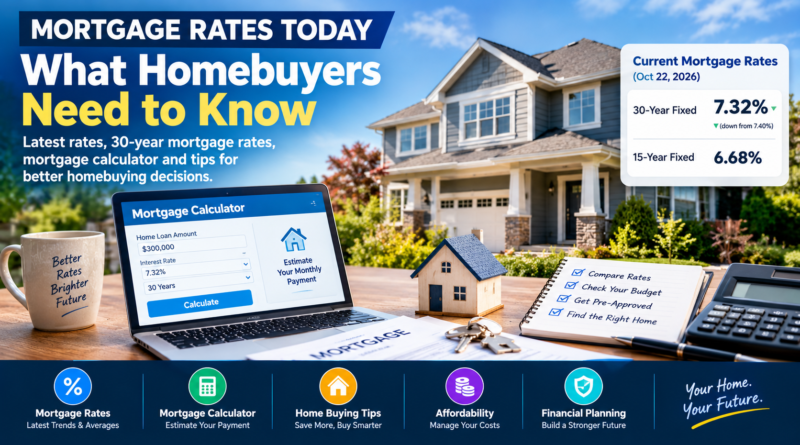
Mortgage Rates Today: The Latest Numbers
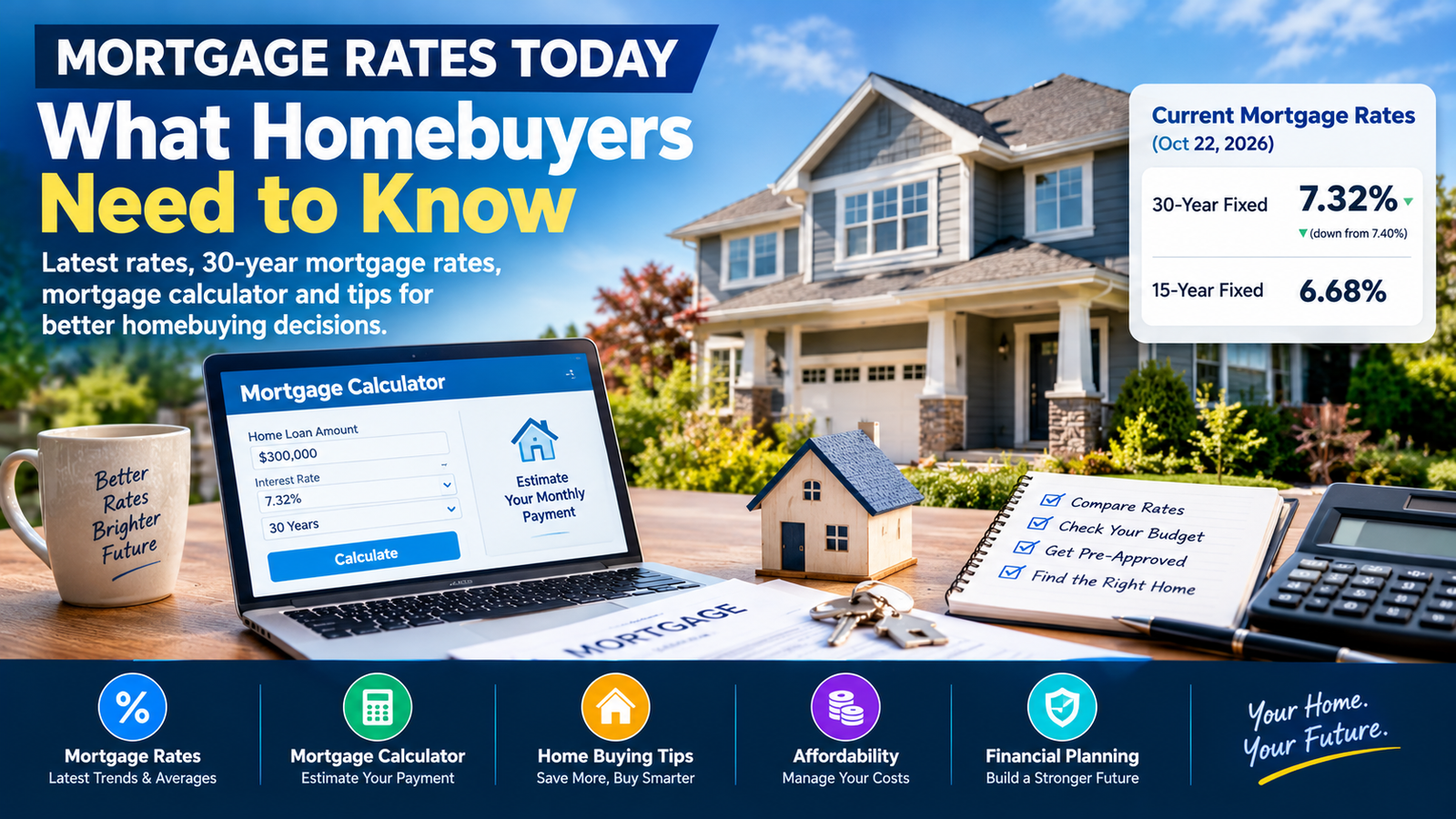
Here is the latest available weekly benchmark from Freddie Mac as of October 22, 2026.
| Mortgage type | Average interest rate |
|---|---|
| 30-year fixed-rate mortgage | 7.32% |
| 15-year fixed-rate mortgage | 6.68% |
Source: Freddie Mac Primary Mortgage Market Survey. These figures are national averages for a particular borrower and loan profile, not personalized quotes. Your actual rate may differ based on credit score, down payment, loan type, lender fees, and other factors.
The 30-year mortgage rate declined slightly during the latest reporting week, but it remained higher than a year earlier. For buyers, that means a small weekly improvement does not necessarily translate into an affordable home.
Why Are Mortgage Rates So Important?
A mortgage is often the largest financial commitment a household makes. The interest rate affects how much of each monthly payment goes toward interest and how much goes toward paying down the loan principal.
When rates rise, buyers generally need to spend more each month to borrow the same amount. Some respond by looking for a less expensive home, increasing their down payment, or postponing their purchase.
When rates fall, monthly payments on new loans may become more manageable. However, home prices can also change, and competition for properties may increase if more buyers return to the market.
The important point is that the interest rate and the home price work together. Neither one should be considered in isolation.
How Much Does a Mortgage Payment Cost?
Consider a buyer borrowing $300,000 through a 30-year fixed-rate mortgage.
The following examples estimate monthly principal and interest payments at different interest rates. They assume the same loan amount and term, with no extra payments.
| Interest rate | Estimated monthly payment |
|---|---|
| 6.00% | $1,799 |
| 6.50% | $1,896 |
| 7.00% | $1,996 |
| 7.32% | $2,063 |
| 7.50% | $2,098 |
These figures are illustrative calculations, not lender offers. They exclude property taxes, homeowners insurance, mortgage insurance, HOA fees, maintenance, and other ownership costs.
At 7.32%, the estimated principal-and-interest payment is approximately $264 more per month than at 6.00%. Over time, that difference can put pressure on a household budget.
It also shows why homebuyers should use a mortgage calculator before deciding how much to borrow.
How to Use a Mortgage Calculator
A mortgage calculator helps you estimate your monthly payment before contacting a lender or making an offer on a property.
Most calculators ask for four basic details:
- Home loan amount: How much you plan to borrow after your down payment.
- Interest rate: The annual rate you want to test.
- Loan term: For example, 15 or 30 years.
- Payment frequency: Usually monthly for a standard US residential mortgage.
After entering these details, compare several interest-rate scenarios. Test a higher rate as well as the rate you hope to receive. That way, you can see whether the payment would remain manageable if the final offer is less favorable than expected.
The Consumer Financial Protection Bureau’s homebuying resources explain how to estimate an affordable home price using your expected interest rate, down payment, and total monthly housing budget.
Remember that a basic mortgage calculator often shows only principal and interest. Your actual housing payment may be substantially higher after taxes, insurance, mortgage insurance, and HOA fees are included.
What Is the Difference Between a 30-Year and 15-Year Mortgage?
A 30-year fixed-rate mortgage spreads repayment across a longer period. This usually produces a lower required monthly principal-and-interest payment than a comparable 15-year loan.
A 15-year mortgage requires faster repayment. Monthly payments are generally higher, but the borrower pays off the balance sooner and will typically pay less total interest if the loan is held to completion.
Neither option is automatically right for everyone.
When a 30-year mortgage may make sense
A 30-year loan may suit buyers who want more room in their monthly budget. The lower required payment can leave money available for emergency savings, retirement contributions, childcare, and other priorities.
The trade-off is that interest can accumulate over a longer repayment period.
When a 15-year mortgage may make sense
A 15-year loan may appeal to borrowers with stable income who can comfortably afford a larger monthly payment. It can help them build equity faster and reduce the total interest paid over the life of the loan.
However, choosing a shorter term should not leave a household without adequate savings or the ability to handle unexpected expenses.
Compare the actual offers, including their rates, fees, and total payments, before making a decision.
What Determines the Mortgage Rate You Receive?
The national average is useful for understanding the market, but it does not tell you exactly what a lender will offer.
Several factors influence your personal mortgage rate.
Credit score and credit history
Lenders evaluate credit information when assessing a mortgage application. A stronger credit profile may help you qualify for more favorable terms, although the impact varies by loan program and lender.
Before applying, check your credit reports for errors, pay bills on time, and avoid taking on unnecessary new debt.
Down payment
A larger down payment reduces the amount you need to borrow. Depending on the loan program, it may also improve your loan terms or reduce the need for mortgage insurance.
However, using all your savings for a down payment can leave you vulnerable to emergency repairs, moving costs, or an unexpected loss of income. Keep enough cash available for other needs.
Loan type and term
Fixed-rate mortgages offer an interest rate that generally stays unchanged throughout the agreed loan term. Adjustable-rate mortgages can start with a fixed introductory rate before adjusting according to the loan’s terms.
An adjustable-rate mortgage may initially offer a lower payment, but borrowers need to understand how and when the rate can change and how high payments could become.
Lender fees and discount points
The advertised interest rate does not tell the whole story. Some offers include fees or discount points paid upfront to obtain a lower rate.
Compare the annual percentage rate (APR), lender charges, closing costs, and the time you expect to keep the loan. A lower rate may not be the better overall deal if it requires substantial upfront costs.
How the Federal Reserve Affects Mortgage Rates
The Federal Reserve influences the broader financial environment through monetary policy, but it does not directly set the interest rate on every 30-year mortgage.
Long-term Treasury yields, inflation expectations, investor demand for mortgage-backed securities, and other market conditions also affect mortgage pricing.
That is why mortgage rates can rise even when the Fed leaves its benchmark rate unchanged. They can also decline before a Fed rate cut occurs if financial markets anticipate lower inflation or future policy easing.
For homebuyers, this means waiting for the next Federal Reserve announcement is not a reliable way to predict the exact mortgage rate available in the future.
Instead, compare current offers, decide what payment you can afford, and consider whether buying now fits your financial circumstances.
Housing Affordability: Why Buying a Home Feels Difficult
Affordability is not simply a question of whether a lender approves a mortgage. It is about whether the total cost of owning the home fits your life without putting other financial goals at risk.
Several expenses can make homeownership more expensive than buyers initially expect.
1. High monthly borrowing costs
When mortgage rates are elevated, the same loan amount requires a higher payment than it would at a lower rate. Buyers may have to reduce their target home price or provide a larger down payment to stay within budget.
2. Property taxes and insurance
Property taxes and homeowners insurance can add hundreds of dollars to a monthly housing budget, depending on the property and location. Insurance premiums can also change over time.
Request realistic estimates before committing to a property.
3. Mortgage insurance and HOA fees
Some loans require mortgage insurance, particularly when the down payment is relatively small. Homes in planned communities or condominiums may also carry homeowners association fees.
These costs should be included when calculating affordability rather than treated as minor extras.
4. Repairs and maintenance
A home may need a new roof, plumbing work, appliance replacement, or other repairs. Even a property that looks ready to move into can create unexpected expenses.
Keep an emergency reserve after closing rather than spending every available dollar on the purchase.
5. Everyday household expenses
A mortgage payment must fit alongside groceries, utilities, transportation, childcare, medical expenses, debt payments, and savings.
The CFPB recommends focusing on what you can comfortably repay rather than simply buying the most expensive home a lender is willing to finance. Its home affordability guidance provides a useful starting point.
Five Practical Ways to Improve Home Affordability
1. Set a monthly payment limit first
Start with your household budget rather than the price of a home you like.
Estimate your take-home income and subtract essential spending, debt payments, savings, and other commitments. Decide how much remains for the full cost of housing.
Include principal, interest, property taxes, insurance, mortgage insurance, and HOA fees where applicable.
2. Compare at least three mortgage lenders
Rates and fees can vary between lenders. Request comparable quotes from several institutions and review the written Loan Estimates.
Compare the interest rate, APR, origination charges, closing costs, and estimated monthly payment. Ask each lender about the cost of locking the rate and how long that lock lasts.
3. Explore different home prices and down payments
A larger down payment can reduce the loan balance, but it should not eliminate your emergency savings.
Try different home prices and down-payment amounts in a mortgage calculator. The goal is to identify a combination that leaves room for other financial priorities.
4. Consider location and ongoing ownership costs
A less expensive home may be farther from work or require more transportation spending. A property with a lower purchase price may also have higher insurance, taxes, maintenance, or utility costs.
Compare the complete cost of living in each location rather than choosing based on the listing price alone.
5. Avoid rushing because of market predictions
Some buyers wait for mortgage rates to decline. Others purchase when they find a home that suits their needs and budget.
There is no way to know in advance exactly where rates or home prices will go. Waiting can bring a better rate, but it can also mean paying a different home price or continuing to rent.
Make the decision based on your financial readiness, how long you expect to stay in the home, and whether the payment is sustainable.
Should You Wait for Mortgage Rates to Fall?
There is no single answer that applies to every buyer.
Waiting may make sense if you need more time to build savings, improve your credit profile, pay down debt, or find a property that fits your budget.
Buying sooner may be reasonable if you have stable finances, enough money for the down payment and closing costs, and a payment you can comfortably manage at the rate currently available.
Avoid relying on refinancing as the only way to make a mortgage affordable. Refinancing later depends on future interest rates, your credit and equity position, lender approval, and closing costs.
A mortgage should make sense based on the terms you can secure today—not only on the possibility of better terms in the future.
A Simple Homebuyer Checklist
Before making an offer, ask yourself:
- Have I checked my credit report and corrected any errors?
- Do I have enough saved for the down payment and closing costs?
- Will I still have emergency savings after closing?
- Have I estimated property taxes, insurance, utilities, and maintenance?
- Have I compared written offers from multiple lenders?
- Can I afford the payment if other household costs increase?
- Do I understand the loan’s rate, fees, and repayment terms?
- Does the purchase fit my plans for the next several years?
If several answers are uncertain, take time to gather the information before committing to a large loan.
Final Thoughts
Mortgage rates remain a major factor in the US housing market. Freddie Mac’s October 22, 2026, survey put the average 30-year fixed mortgage rate at 7.32%, below the previous week’s average but above the level recorded a year earlier.
For homebuyers, the challenge is balancing the purchase price, interest rate, down payment, and ongoing ownership costs. A lower rate can help, but it cannot make every home affordable. Similarly, a larger down payment is not always the best choice if it leaves too little money for emergencies.
Use a mortgage calculator to test different scenarios, compare lender offers carefully, and set a realistic monthly payment before shopping for a home.
The best mortgage is not necessarily the one with the lowest advertised rate or the largest approved loan. It is the one whose full cost fits your budget and allows you to maintain financial stability after moving in.
Disclaimer: This article is for general educational purposes only and is not individualized financial, mortgage, tax, or legal advice. Mortgage rates and loan terms change, and actual offers depend on the borrower’s circumstances and lender criteria.
