
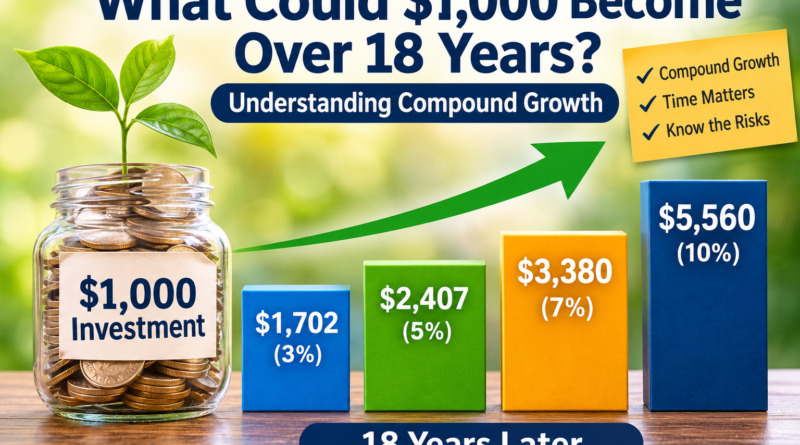
What Could $1,000 Become Over 18 Years? Understanding Compound Growth
Introduction: Can $1,000 Really Make a Difference?
Imagine putting $1,000 into an investment account and leaving it there for 18 years. You do not add another dollar. You do not withdraw money when the market falls. You simply give the investment time to grow.
How much could that original $1,000 become?
The answer depends on the investment, its returns, fees, taxes, and market conditions. At a hypothetical average annual return of 7%, for example, $1,000 could grow to approximately $3,380 after 18 years, assuming annual compounding and no additional contributions.
That means the original investment would have generated about $2,380 in growth.
This is the basic idea behind compound growth: your money can earn returns, and those returns can generate additional returns over time.
For American families thinking about a child’s financial future, the example is especially interesting. Eighteen years is a meaningful investment period. It can provide time for a small starting balance to grow, although it cannot eliminate the risk of losing money.
Let’s examine what different returns could mean, how compounding works, and what investors should understand before making long-term investment decisions.
1. What Is Compound Growth?
Compound growth occurs when an investment earns returns on both its original balance and the returns accumulated over previous periods.
Consider a simple example.
You invest $1,000 and earn 5% during the first year. Your investment generates $50, bringing the balance to $1,050.
During the second year, the 5% return is calculated on $1,050 rather than the original $1,000. That produces $52.50, increasing the balance to $1,102.50.
The process continues as long as the money remains invested and returns are reinvested.
This is different from simple interest, where earnings are calculated only on the original principal.
The Consumer Financial Protection Bureau explains compound interest using the same basic principle: interest can accumulate on both the original deposit and previously earned interest.
2. What Could a $1,000 Investment Become After 18 Years?
The following examples show how a one-time $1,000 investment could grow at different hypothetical average annual returns.
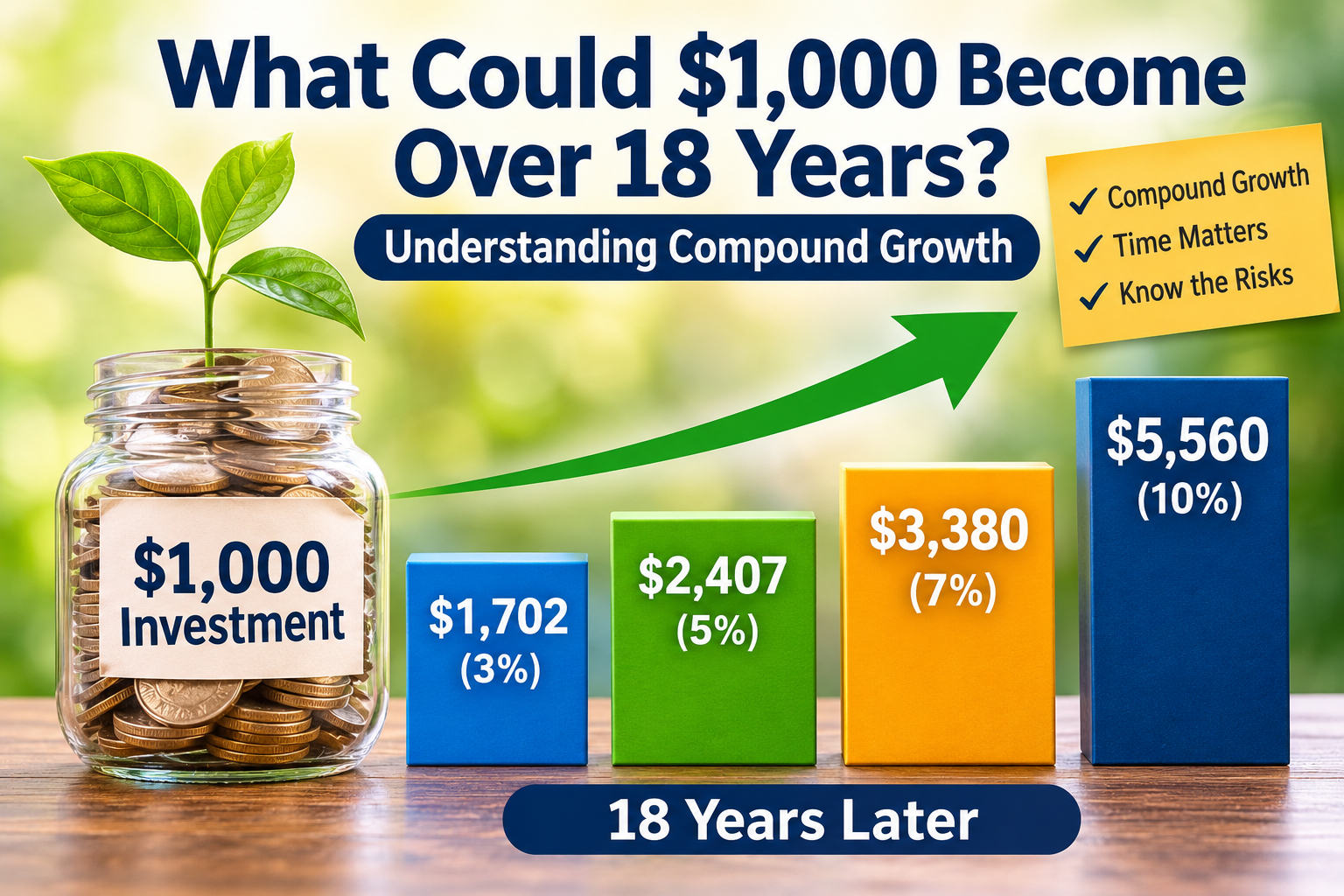
Illustrative results after 18 years
| Hypothetical annual return | Value after 18 years | Investment growth |
|---|---|---|
| 3% | $1,702 | $702 |
| 5% | $2,407 | $1,407 |
| 7% | $3,380 | $2,380 |
| 10% | $5,560 | $4,560 |
These calculations assume:
- An initial investment of $1,000.
- No additional deposits or withdrawals.
- Annual compounding.
- A constant hypothetical return each year.
- No taxes, investment fees, or inflation adjustments.
Important: These are mathematical examples, not forecasts. Actual investment returns vary. An investment could finish above or below these amounts, and it could even be worth less than the original $1,000.
The difference between the scenarios shows how strongly the assumed rate of return affects the final balance. A higher return produces a larger projected value, but investments with greater potential returns generally involve greater risk.
3. How the $1,000 Grows Year by Year at 7%
To understand the process, consider the 7% example.
| Year | Illustrative investment value |
|---|---|
| Starting balance | $1,000 |
| 1 | $1,070 |
| 2 | $1,145 |
| 3 | $1,225 |
| 4 | $1,311 |
| 5 | $1,403 |
| 6 | $1,501 |
| 7 | $1,606 |
| 8 | $1,718 |
| 9 | $1,838 |
| 10 | $1,967 |
| 11 | $2,105 |
| 12 | $2,252 |
| 13 | $2,410 |
| 14 | $2,579 |
| 15 | $2,759 |
| 16 | $2,952 |
| 17 | $3,159 |
| 18 | $3,380 |
The balance does not increase by the same dollar amount every year. As the investment grows, the same percentage return applies to a larger balance.
That is why compounding can become more noticeable over longer periods.
4. Why Time Matters More Than Many New Investors Expect
When people first start investing, they often focus on how much money they can contribute. That is important, but time is another major factor.
A $1,000 investment earning a hypothetical 7% annually would grow to approximately:
| Investment period | Estimated value |
|---|---|
| 5 years | $1,403 |
| 10 years | $1,967 |
| 15 years | $2,759 |
| 18 years | $3,380 |
| 20 years | $3,870 |
| 25 years | $5,427 |
| 30 years | $7,612 |
The longer the investment remains untouched, the more opportunities it has to compound.
This is one reason financial education often encourages people to begin saving and investing early, when appropriate for their goals and ability to accept risk.
However, time alone does not guarantee a positive result. An investment’s performance, costs, and the timing of withdrawals still matter.
5. What If You Add $25 Every Month?
A one-time $1,000 investment is only one possible approach. Regular contributions can make a substantial difference.
Suppose an investor starts with $1,000 and adds $25 at the end of every month for 18 years.
The investor would contribute:
- Initial investment: $1,000
- Monthly contributions: $25
- Number of monthly contributions: 216
- Total additional contributions: $5,400
- Total money contributed: $6,400
At a hypothetical 7% effective annual return, compounded monthly using the equivalent monthly rate, the ending value would be approximately $10,600.
This is an illustration, not a guaranteed result. Actual returns would fluctuate, and fees, taxes, and inflation could change the outcome.
The important lesson is that consistent contributions can work alongside compounding. A family does not necessarily need a large starting balance to begin building an investment habit.
6. Where Could Someone Invest $1,000 for an 18-Year Period?
There is no single investment that is right for everyone. The appropriate choice depends on the investor’s age, financial goals, time horizon, risk tolerance, and account rules.
Here are several broad categories worth understanding.
Broad-market index funds
Index funds aim to track a market index. A broad US stock-market fund may hold shares across many companies and industries.
This can provide diversification compared with buying shares in only one company. However, a diversified stock fund can still lose value when the broader market declines.
Exchange-traded funds (ETFs)
ETFs trade on exchanges and can hold baskets of stocks, bonds, or other assets.
Some ETFs follow broad market indexes, while others focus on specific industries, investment strategies, or regions. Investors should examine what a fund actually owns rather than assuming every ETF is diversified.
Bonds and bond funds
Bonds are debt investments issued by governments, municipalities, and companies. They may provide interest payments, but they also carry risks, including interest-rate risk and credit risk.
Bond funds can fluctuate in value and are not the same as guaranteed bank deposits.
Savings accounts and certificates of deposit
For money that needs greater stability, insured bank savings accounts and certificates of deposit may be worth considering.
They generally offer less exposure to stock-market fluctuations, but their interest rates can change or may not keep pace with inflation. Deposit insurance limits and account eligibility rules apply.
The right choice depends on whether the priority is long-term growth, preservation of principal, access to the money, or a combination of these goals.
7. What Happens If the Stock Market Falls During Those 18 Years?
Long-term investing does not mean the market rises every year.
A portfolio may experience:
- A strong year with positive returns.
- A year with little or no growth.
- A market correction.
- A severe decline during an economic crisis.
- A recovery that takes months or years.
For example, an investment worth $2,000 that falls 20% becomes $1,600. It would then need to gain 25% just to return to $2,000.
This is why investors should understand the possibility of losses before choosing an investment.
A long time horizon can provide more opportunity to recover from temporary declines, but it does not guarantee recovery. The risk also depends on what the investment holds and when the money will be needed.
The SEC’s Investor.gov guidance emphasizes that asset allocation should reflect an investor’s time horizon and willingness to accept risk.
8. Why Investment Fees Matter Over 18 Years
Fees can quietly reduce investment growth.
An investment fund may charge an expense ratio. A brokerage account or adviser may also involve other costs.
Even a seemingly small annual fee can have a meaningful effect when it is deducted year after year.
For example, imagine two otherwise identical investments earning the same market return before fees. The investment with lower ongoing costs would generally leave more money in the account over time.
Before investing, check:
- The fund’s expense ratio.
- Account maintenance charges.
- Trading commissions, if any.
- Advisory fees.
- Other costs disclosed by the provider.
The SEC’s investor bulletin on fees and expenses explains why investment costs reduce the amount of money that remains invested and available to generate returns.
9. Inflation: Will $3,380 Buy as Much as It Does Today?
A future account balance is not the same as future purchasing power.
Inflation reduces what money can buy over time. If prices rise over an 18-year period, $3,380 in the future may purchase less than $3,380 purchases today.
For illustration, if inflation averaged 2.5% annually for 18 years, prices would rise by approximately 56% over that period.
That means the purchasing power of a future $3,380 would be roughly equivalent to about $2,170 in today’s dollars.
This is only an illustration. Actual inflation will not necessarily average 2.5%, and the cost of education, housing, healthcare, and other expenses can rise at different rates.
Investors should consider both the future account balance and what that balance may be able to buy.
10. The Connection to Children’s Investment Accounts
An 18-year period is particularly relevant when parents think about saving for a child.
A child who receives an eligible investment contribution early in life may have many years for the money to remain invested before adulthood.
For families researching Trump Accounts, it is important to understand that these accounts have specific federal rules. They are not ordinary brokerage accounts, and their contribution, investment, distribution, and tax requirements must be followed.
The $1,000 example in this article is a general compound-growth illustration. It should not be interpreted as a promise that a particular government account, ETF, or stock-market investment will produce a specific balance.
Parents should review current IRS guidance and account terms before making decisions.
11. The Compound Growth Formula
Investors can estimate future value using a basic compound-growth formula:
Future Value = Initial Investment × (1 + Annual Return)^Number of Years
For this example:
- Initial investment = $1,000
- Annual return = 7%, or 0.07
- Investment period = 18 years
The calculation is:
$1,000 × (1.07)^18 = approximately $3,380
This formula assumes the same annual return every year. Real investments do not normally deliver identical returns year after year.
For a more detailed calculation, investors can use the SEC’s free Investor.gov Compound Interest Calculator. It allows users to enter an initial investment, regular contributions, investment period, estimated interest rate, and compounding frequency.
12. What American Parents Should Consider Before Investing
Before putting money into a long-term investment, parents should ask a few practical questions.
What is the purpose of the money?
Is it intended for education, a first car, a home deposit, or general financial support when the child becomes an adult? The goal can influence the account and investment choice.
When will the money be needed?
An 18-year time horizon is different from a three-year time horizon. Money needed soon may not be suitable for a highly volatile investment.
Can the family afford to leave the money invested?
Parents should avoid investing money that may be needed for rent, essential bills, emergency expenses, or high-interest debt payments.
What are the account’s rules?
Tax-advantaged accounts may have contribution limits, eligibility requirements, and restrictions on withdrawals. Those rules can be just as important as the investment’s potential return.
Are the costs reasonable?
Fees reduce the amount that remains invested. Comparing costs can help families make more informed decisions.
13. Common Mistakes to Avoid
A long investment period can be useful, but it does not make every investment decision a good one.
Avoid these common mistakes:
- Assuming a fixed return: A 7% example is not a guaranteed annual return.
- Ignoring investment risk: Stock funds can lose value, sometimes sharply.
- Choosing investments only because of past performance: Previous returns do not guarantee future results.
- Overlooking fees: Small costs can accumulate over many years.
- Forgetting inflation: A larger account balance may have less purchasing power than expected.
- Investing money needed for emergencies: Long-term investments may be difficult to sell at a favorable price during a market downturn.
- Failing to understand account rules: Tax advantages often come with conditions and restrictions.
A sensible investment plan begins with understanding the goal and the risks, not chasing the highest number in a calculator.
14. Frequently Asked Questions
How much could $1,000 become in 18 years at 5%?
At a hypothetical 5% annual return compounded once a year, $1,000 would grow to approximately $2,407 after 18 years, before taxes, fees, and inflation.
How much could $1,000 become in 18 years at 7%?
At a hypothetical 7% annual return compounded once a year, $1,000 would grow to approximately $3,380. This is an illustration, not a guaranteed investment result.
Can $1,000 turn into $5,000 in 18 years?
It could under a sufficiently high average return. A $1,000 investment would need to earn approximately 9.3% annually, compounded yearly, to reach $5,000 in 18 years. Such a return is not guaranteed, and pursuing higher returns generally involves greater risk.
Is compound growth guaranteed?
No. Compound growth describes how accumulated returns can generate further returns. Investment returns themselves are not guaranteed. Stocks, bonds, and funds can lose value.
Is investing $1,000 for a child a good idea?
It may be a useful starting point if the family can afford to invest the money, understands the risks, and chooses an account appropriate for its goals. Parents should also consider account ownership, tax treatment, fees, and withdrawal restrictions.
Is a savings account better than a stock-market investment?
It depends on the purpose and time horizon. An insured savings account may be more suitable when preserving money and maintaining access are priorities. A diversified stock-market investment may offer greater long-term growth potential, but it can also lose value.
Where can I calculate compound growth?
The SEC’s Investor.gov website provides a free Compound Interest Calculator. You can enter an initial investment, monthly contributions, time period, estimated return, and compounding frequency.
Conclusion: The Value of Giving Money Time
A one-time $1,000 investment may not appear life-changing at the beginning. But over 18 years, compound growth can make a meaningful difference.
At a hypothetical 5% annual return, it could become approximately $2,407. At 7%, it could reach about $3,380. At 10%, it could reach approximately $5,560.
These figures are not promises. Markets fluctuate, fees reduce returns, inflation affects purchasing power, and investors can lose money.
The bigger lesson is that time, consistency, costs, and informed decisions all matter. For families thinking about a child’s future, learning how compound growth works can be a valuable first step toward better financial planning.
Disclaimer: This article is for educational and informational purposes only. It is not personalized investment, tax, or legal advice. Investment returns are not guaranteed, and you may lose some or all of your invested money. Review official account rules and consider speaking with a qualified financial or tax professional before making investment decisions.
Sources and References
The following trusted sources provide additional information about compound growth, investment returns, diversification, and long-term financial planning:
- Consumer Financial Protection Bureau (CFPB) – How Does Compound Interest Work?
https://www.consumerfinance.gov/ask-cfpb/how-does-compound-interest-work-en-1683/ - U.S. Securities and Exchange Commission (SEC) – Compound Interest Calculator
https://www.investor.gov/financial-tools-calculators/calculators/compound-interest-calculator - SEC Investor.gov – Introduction to Investing
https://www.investor.gov/introduction-investing - SEC Investor.gov – Asset Allocation and Diversification
https://www.investor.gov/introduction-investing/getting-started/asset-allocation - SEC Investor.gov – Diversify Your Investments
https://www.investor.gov/introduction-investing/investing-basics/save-and-invest/diversify-your-investments - Federal Deposit Insurance Corporation (FDIC) – Consumer Resources
https://www.fdic.gov/consumer-resource-center
Source and Calculation Note
The investment projections in this article are mathematical illustrations based on a hypothetical initial investment of $1,000 and different assumed annual rates of return. They use the standard compound-growth formula and do not represent guaranteed investment results or forecasts from the organizations listed above.
Actual investment performance may vary because of market conditions, investment fees, taxes, and inflation. Readers should consult official financial resources and qualified professionals before making investment decisions.
Disclaimer: This article is for educational and informational purposes only. It does not constitute financial, investment, or tax advice.
