

Trump’s Child Investment Plan: Economic Benefits, Risks and Questions for American Families
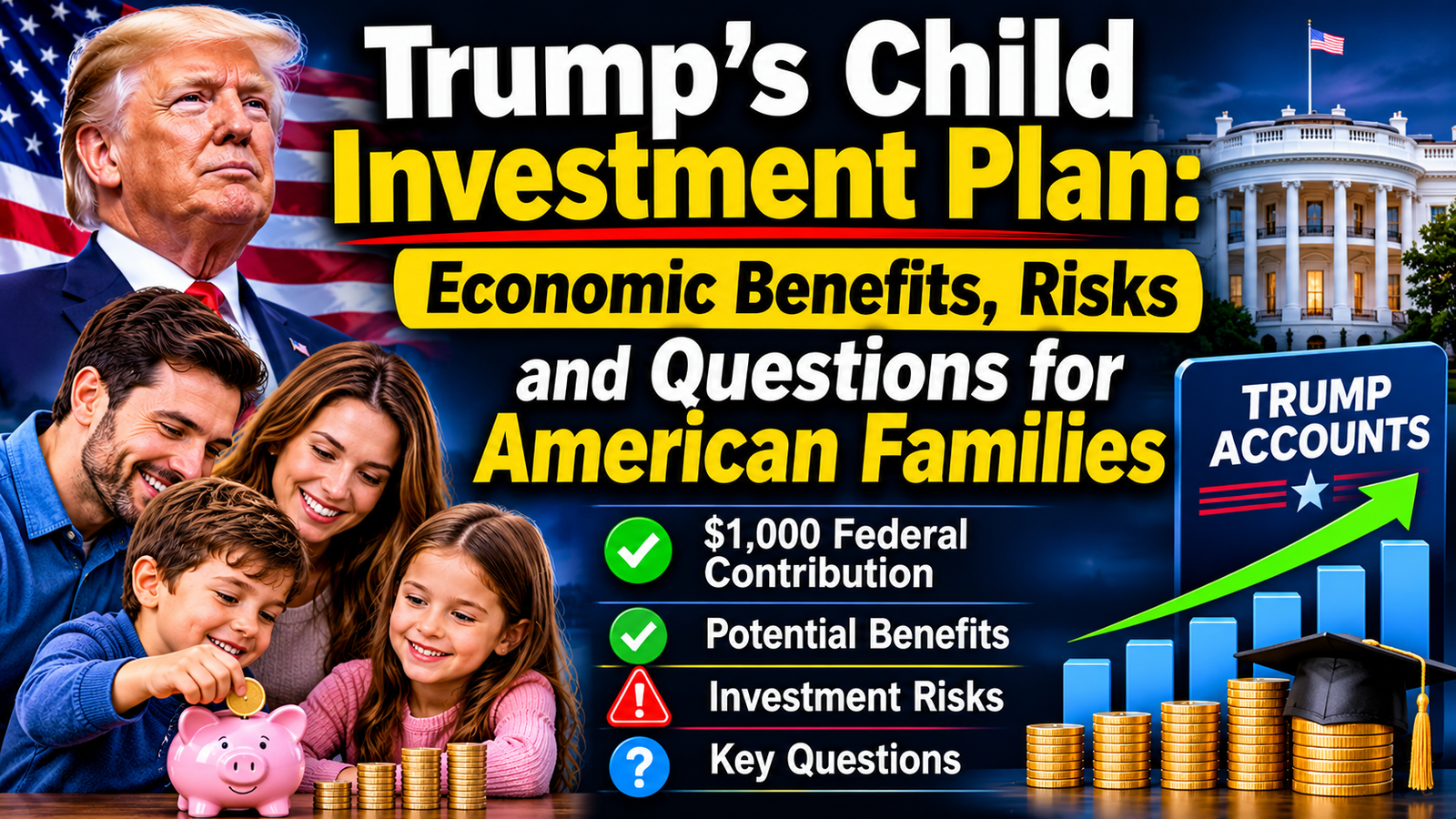
A Deep Analysis of Trump Accounts, Children’s Wealth Building and the Future of American Families
Introduction: A New Financial Starting Point for American Children
For many American families, building wealth for a child begins with a savings account, a college fund or a small investment portfolio. Parents may put aside $25, $50 or $100 every month, hoping that the money will eventually help pay for education, a first home or another important milestone.
But millions of families struggle to save consistently. Housing, healthcare, childcare, food, transportation and debt payments can consume much of a household’s income. For parents living paycheck to paycheck, even a modest monthly contribution can be difficult.
This is the financial problem behind the debate over Trump’s child investment plan, officially known as Trump Accounts.
The program creates a new type of tax-advantaged investment account for eligible American children. It also includes a one-time federal pilot contribution of $1,000 for qualifying children born between January 1, 2025, and December 31, 2028.
The idea is straightforward: give children an opportunity to own investments earlier in life and allow those investments to potentially grow over many years.
However, the economic implications are more complicated.
Can a government-funded initial deposit help children build meaningful financial assets? Will families with limited incomes be able to benefit? Could the program encourage a new generation of American investors? What happens when children turn 18? And could the program unintentionally increase wealth differences between families who can afford additional contributions and those who cannot?
These questions matter because a children’s investment account is not simply a savings product. It is also a public policy decision involving taxation, federal spending, household behavior, financial markets and the distribution of wealth.
This analysis examines the potential benefits, financial risks and unanswered questions surrounding Trump Accounts.
1. What Is Trump’s Child Investment Plan?
Trump Accounts are a new type of traditional individual retirement account created under Section 530A of the Internal Revenue Code.
The legal foundation came from the legislation commonly called the One Big Beautiful Bill Act, signed into law on July 4, 2025.
Unlike an ordinary bank savings account, a Trump Account is designed for long-term investment. During the account’s growth period, the money must generally be invested in eligible mutual funds or exchange-traded funds that track broad U.S. equity indexes.
An account belongs to the child. A parent, guardian or another authorized individual can serve as the responsible party during the child’s minority.
The account is intended to give children an early financial asset that may remain invested for many years.
Who can have a Trump Account?
The account eligibility rules and the federal $1,000 pilot contribution rules are different.
Generally, an individual under age 18 with a Social Security number can qualify for a Trump Account, subject to the statutory election and establishment requirements.
The separate $1,000 pilot contribution is available for qualifying U.S. citizens born between January 1, 2025, and December 31, 2028, when the required election is made.
This distinction is important. A child may qualify for an account without qualifying for the federal $1,000 payment.
What is the $1,000 federal contribution?
The federal pilot program provides a one-time $1,000 contribution to the Trump Account of each qualifying child.
It is not a monthly government payment. It is not an annual payment. It is not a guaranteed $1,000 contribution for every child under 18.
The money is intended to be invested rather than simply handed to parents as cash.
For an eligible child, the initial contribution could provide a starting investment balance without requiring the family to contribute the entire amount itself.
That is potentially meaningful for households that have little room in their monthly budgets.
Have accounts been established automatically?
The Treasury Department announced the completion of automatic enrollment for eligible children on October 1, 2026.
However, automatic establishment does not mean parents should assume every account is fully claimed, reviewed and ready for their preferred use. Parents and guardians should check the official account process, confirm the child’s details and follow the instructions for claiming and managing the account.
Families should use official government information rather than relying on social media posts or unofficial account-opening websites.
2. Why Is the Government Encouraging Investment for Children?
The policy reflects a larger economic idea: wealth building becomes easier when people have time.
A child who receives an investment account early in life may have many years for the account to remain invested. If the investments perform well, returns can potentially generate additional returns.
This is known as compound growth.
The government is also trying to encourage a culture in which more Americans become familiar with investment ownership.
In the United States, millions of households participate in financial markets through retirement plans, mutual funds, exchange-traded funds and individual brokerage accounts. But access to financial assets is not equally distributed.
Some children grow up in households where investing is discussed regularly. They may learn about retirement accounts, index funds, stocks and compound interest from their parents.
Other children may reach adulthood without ever having owned an investment.
A government-supported account could introduce more children to the concept of financial ownership.
However, opening an account does not automatically create financial knowledge. Children still need education, responsible adult guidance and a clear understanding of investment risk.
The long-term success of the program will depend on more than the initial deposit.
3. How the $1,000 Contribution Could Grow Over Time
The most attractive feature of the program is the possibility of long-term investment growth.
Consider a child who receives a $1,000 initial contribution and leaves the money invested.
The following examples show what that amount could become over different periods under hypothetical annual returns.
| Hypothetical annual return | After 10 years | After 18 years |
|---|---|---|
| 4% | About $1,480 | About $2,025 |
| 5% | About $1,629 | About $2,407 |
| 7% | About $1,967 | About $3,379 |
| 9% | About $2,367 | About $4,717 |
Important assumptions: These are mathematical illustrations using annual compounding, with no additional contributions. They exclude taxes, fees and inflation. They are not forecasts, and actual investment results can be lower, including a loss of principal.
The difference between the examples illustrates why time and investment performance matter.
At a hypothetical 4% annual return, $1,000 grows to approximately $2,025 after 18 years.
At 9%, it grows to approximately $4,717.
But a higher assumed return should never be treated as a promise. Stock markets do not produce the same return every year. They can rise sharply, fall significantly and remain below previous highs for extended periods.
A child’s account could be worth less than the original contribution at a particular point in time.
What if parents contribute additional money?
The potential financial impact becomes larger when families add their own contributions.
For example, consider a hypothetical account that begins with $1,000 and receives an additional $50 every month for 18 years.
Assuming a hypothetical 7% annual return, compounded monthly, with contributions made at the end of each month, the account could grow to approximately $24,000.
That is an illustration, not a guaranteed outcome.
The family’s own contributions would total $10,800 over 18 years, in addition to the original $1,000. The remaining projected value would come from hypothetical investment growth.
The example also highlights an important issue: the federal pilot contribution is only a starting point. The amount a child eventually accumulates may depend heavily on whether family members can afford to contribute more.
4. The Potential Economic Benefits for American Families
Trump Accounts could produce several economic benefits if families understand the rules and the accounts are managed responsibly.
Benefit 1: An early financial asset for children
A child who receives a qualifying federal contribution starts with an investment balance without needing to earn the money personally.
For families with limited savings, this could provide an initial financial asset that might otherwise not exist.
The contribution does not solve every financial challenge a child may face, but it creates an opportunity to begin investing earlier.
Benefit 2: Encouraging long-term investment habits
Children who learn about their accounts may become more familiar with financial concepts.
They may learn the difference between saving and investing, understand why investment values move up and down, and discover how long-term ownership differs from short-term trading.
That education could be valuable when they eventually manage their own financial decisions.
But parents should not confuse an investment account with a complete financial education program. Children still need practical lessons about budgeting, debt, taxes, emergency savings and retirement planning.
Benefit 3: Potential support for future financial goals
A long-term investment balance could help a young adult when they begin making important financial decisions.
Depending on the applicable rules, the account may eventually provide access to money for certain purposes.
However, Trump Accounts are not ordinary college savings accounts. They are structured as traditional IRAs, and the rules governing withdrawals and taxation matter.
Families should not assume the account can be used freely for tuition, rent, a car or a first home without checking the applicable tax rules.
Benefit 4: Greater exposure to the U.S. investment market
The investment structure encourages ownership of funds that track broad U.S. equity indexes.
This may introduce more children to companies and sectors that form part of the American economy.
A child might eventually become familiar with businesses involved in technology, healthcare, financial services, manufacturing, consumer products and other industries.
The broader potential benefit is a generation with greater familiarity with investment markets.
Whether this leads to higher stock market participation as adults remains an open question. It will depend on account usage, financial education, market performance and what beneficiaries choose to do after turning 18.
Benefit 5: A possible starting point for family financial conversations
Parents can use the account as a reason to discuss money with their children.
They can explain why money is invested, why account balances fluctuate, what an index fund does and why investing for long-term goals is different from trying to make quick profits.
These conversations may be more valuable than the initial balance alone.
5. The Biggest Risk: Investment Returns Are Not Guaranteed
One of the most important points families should understand is that Trump Accounts are investment accounts, not guaranteed bank deposits.
A bank savings account and an equity investment fund operate differently.
A qualifying bank deposit may be protected by federal deposit insurance within applicable limits and ownership rules. An investment in an equity ETF is not protected against market losses by FDIC deposit insurance.
The value of an equity investment can rise or fall.
If the stock market experiences a major downturn, a child’s account may lose value.
Why market risk matters
Imagine an account has grown from $1,000 to $2,000.
If the underlying investment falls by 25%, the account would decline to approximately $1,500.
The original investment would still have increased in value compared with the starting balance, but the family would have experienced a substantial reduction from the previous account value.
Now consider a child who reaches adulthood during a market downturn.
The timing of the market decline could affect the value of the account when the beneficiary begins making decisions about the money.
Long-term investing can help investors remain focused beyond temporary market movements, but it cannot eliminate investment risk.
Why diversification matters
A broad index fund may spread investments across many companies, reducing the risk associated with relying on one individual business.
However, a fund tracking U.S. equities still carries stock market risk.
If the overall U.S. equity market declines, a broad-market fund may also decline.
Diversification across companies is not the same as diversification across all asset classes.
Families should understand the difference before treating an index fund as a safe or guaranteed investment.
6. Could Trump Accounts Increase Wealth Inequality?
This is one of the most important economic questions surrounding the program.
The federal pilot contribution gives qualifying children an initial amount. But the financial outcomes may differ substantially depending on how much additional money families can contribute.
Consider two hypothetical families.
Family A has enough income to contribute $200 every month.
Family B is struggling with rent, childcare, food and debt payments. It cannot afford regular contributions.
Both children may begin with the same qualifying federal contribution, but their account balances could eventually become very different.
The difference would not necessarily result from the investment account itself. It could result from the financial resources available to each household.
This creates a policy question: does the program meaningfully reduce the wealth gap, or does it mainly provide another investment opportunity for families that already have the resources to save?
The importance of additional contributions
Families with higher incomes may be more likely to contribute additional money, while lower-income households may find it difficult to do so.
That could create a gap between children who receive the same initial contribution.
There is also a tax-policy question. The value of tax-deferred investment growth can differ according to a beneficiary’s future tax circumstances.
The ultimate distributional effect will depend on account participation, private contributions, employer contributions, investment performance and the tax treatment of distributions.
What could make the program more inclusive?
Several factors could improve access:
- Clear and simple account-claiming procedures.
- Accurate information for families with limited financial knowledge.
- Strong consumer protections and transparent fees.
- Accessible financial education.
- Clear explanations of investment risk.
- Support for families who cannot afford additional contributions.
- Reliable account-management services.
A policy designed to help children build wealth should be evaluated by how well it serves families across different income levels—not only by how much money wealthier households can invest.
7. The $5,000 Annual Contribution Limit: What Parents Should Understand
During the growth period, the law generally limits non-exempt contributions to $5,000 per calendar year, subject to the applicable rules and future inflation adjustments.
This is not necessarily a $5,000 limit on every type of money entering the account.
Certain contributions are treated differently under the law, including qualified general contributions and the federal pilot program payment.
For ordinary family contributions, parents should understand that contributions made before the calendar year in which the beneficiary turns 18 are not deductible under the normal traditional IRA contribution deduction rules.
This is an important distinction.
Parents should not assume that putting money into a Trump Account automatically creates a tax deduction on their federal income tax return.
Before making large contributions, families should review the latest IRS guidance and the account provider’s procedures.
8. What Happens When a Child Turns 18?
The age-18 transition is one of the most important features of the program.
Trump Accounts have special rules during their growth period. That period generally ends on December 31 of the calendar year in which the beneficiary turns 17.
Beginning January 1 of the calendar year in which the beneficiary turns 18, most of the special Trump Account rules no longer apply, and traditional IRA rules generally take over.
This does not mean the account automatically pays out its entire balance on the child’s 18th birthday.
The money does not simply become a regular checking account.
Instead, the beneficiary enters a new stage in which the traditional IRA tax and distribution rules become important.
Can the young adult withdraw the money?
The general rules for traditional IRAs may apply after the growth period.
A withdrawal may be subject to income tax, and an additional 10% early-distribution tax may apply before age 59½ unless an exception is available.
Certain distributions may qualify for exceptions to the additional tax, including some eligible higher education expenses and qualifying first-time homebuyer distributions, subject to the relevant requirements.
An exception to the additional 10% tax does not necessarily mean the withdrawal is income-tax-free.
This distinction is important for young adults who may be considering using their accounts for education, housing or other expenses.
Why financial education matters at age 18
A young adult who suddenly gains responsibility for a long-term investment account may face difficult decisions.
Should the money remain invested? Should part of it be withdrawn for education? Should the account be transferred or rolled over where permitted?
The best decision will depend on the individual’s circumstances and the tax rules.
The account may be more valuable if the beneficiary understands the long-term consequences before making a withdrawal.
9. Trump Accounts Versus 529 College Savings Plans
Parents may wonder whether Trump Accounts should replace a traditional 529 college savings plan.
These accounts have different purposes and rules.
| Feature | Trump Account | 529 College Savings Plan |
|---|---|---|
| Main structure | Traditional IRA with special child-account rules | Education-focused savings plan |
| Primary purpose | Long-term investment and wealth building | Qualified education expenses |
| Federal pilot contribution | $1,000 for qualifying children born 2025–2028 | No equivalent universal federal pilot payment |
| Investment structure | Eligible funds during the growth period | Investment options depend on the plan |
| Tax treatment | Tax-deferred growth under applicable rules | Tax-free qualified withdrawals under federal rules |
| Access to money | Restricted during growth period; traditional IRA rules generally apply afterward | Withdrawals generally tax-free for qualified education expenses |
| Main concern | Retirement-account tax and withdrawal rules | Nonqualified withdrawal tax and penalty rules |
A 529 plan is specifically designed to help families prepare for qualified education expenses.
A Trump Account is a different kind of investment account, with a long-term retirement-account structure.
Families should compare their goals before choosing where to put additional savings.
For a household focused mainly on college costs, a 529 plan may remain an important option.
For a family interested in a child’s longer-term investment ownership, a Trump Account may provide a separate opportunity.
The accounts should not be treated as interchangeable.
10. Could Trump Accounts Change the U.S. Stock Market?
The program could introduce a large number of children to stock market ownership.
That does not mean it will immediately transform the financial markets.
The economic effect depends on several factors:
- How many accounts are successfully established and claimed.
- How much money is deposited into them.
- How the money is invested.
- How investment balances change over time.
- Whether beneficiaries retain their accounts after turning 18.
- Whether account holders continue investing as adults.
A large number of accounts could increase the number of Americans with some exposure to equity investments.
But the total amount invested is just as important as the number of account holders.
An account containing a small balance has a different economic effect from a large retirement portfolio.
The program’s influence on capital markets should therefore be evaluated through actual account balances, contributions and long-term ownership data rather than headline enrollment numbers alone.
Will children become lifelong investors?
Possibly, but this outcome is not automatic.
A child who learns about index funds and long-term investing may be more comfortable with financial markets as an adult.
Another beneficiary may withdraw money when legally permitted and never invest again.
The account’s long-term effect will depend on education, family circumstances and the financial decisions made after the child becomes an adult.
11. The Federal Budget Question: Who Pays for the Program?
The federal pilot contribution is financed by the U.S. government.
It is not a personal payment from Donald Trump, nor is it a private donation from a business owner.
The federal government makes the qualifying contribution under the statutory program.
The broader economic cost also includes tax-related provisions and administrative expenses associated with the program.
It is important not to confuse the cost of the $1,000 pilot payments with the full fiscal impact of all Trump Account provisions.
The government may face costs through direct contributions and through tax revenue that is not collected because of tax-advantaged treatment.
Those costs matter because federal resources are limited.
Every major tax or spending policy raises questions about priorities, borrowing, future revenue and the distribution of public benefits.
Why federal cost matters to families
The program may provide an initial investment asset to eligible children, but the public cost must also be evaluated.
Policymakers should consider:
- How much the federal pilot payments cost.
- How much tax revenue is forgone.
- Whether the program encourages additional private savings.
- Whether the benefits reach children across income levels.
- Whether administrative costs remain reasonable.
- Whether the long-term economic benefits justify the public expense.
The central question is not simply whether children receive money.
It is whether the program produces enough long-term social and economic value to justify its cost.
12. Could Employers and Private Donors Add More Money?
Trump Accounts are not limited to the federal pilot contribution.
The legal framework includes other potential sources of funding, including family contributions, certain employer contributions and qualified general contributions.
This creates the possibility of a broader funding system.
For example, an employer may choose to contribute to an eligible employee’s child’s Trump Account under the applicable rules.
Private donors may also support qualified general contributions, subject to the requirements governing those contributions.
This could create a new way for employers, philanthropies and other organizations to support children’s financial assets.
However, families should not assume that every employer offers this benefit or that every child will receive additional private funding.
The availability and size of additional contributions will depend on the relevant program rules and the decisions of employers and donors.
13. What American Parents Should Consider Before Contributing
A new government-supported account may sound attractive, but parents should evaluate it within their broader financial situation.
A family should not put money into a long-term investment account while ignoring immediate financial needs.
First: Build a household emergency reserve
An emergency fund can help a family manage unexpected expenses such as car repairs, medical bills or temporary income loss.
Without emergency savings, parents may be forced to rely on credit cards or high-interest loans.
Second: Review high-interest debt
Credit card debt can carry expensive interest charges.
For some households, reducing high-interest debt may provide a more certain financial benefit than making additional investments with uncertain returns.
Third: Protect retirement savings
Parents should be careful not to sacrifice their own retirement security to fund a child’s account.
Children may have decades to build wealth through their own future income. Parents have a more limited working-life timeline.
Fourth: Understand the account’s investment rules
Before contributing, parents should understand:
- The eligible investment choices.
- The fees and expenses.
- The risks of equity-market losses.
- The contribution limits.
- The rules for withdrawals.
- The age-18 transition.
- The tax treatment of distributions.
Fifth: Avoid treating the account as guaranteed money
The federal pilot contribution may provide an initial balance, but the future value depends on investment performance and applicable rules.
Parents should avoid making education, housing or retirement plans based on an assumed future account balance.
14. What Could Go Wrong? Seven Important Risks
A balanced evaluation should consider the possibility that the program does not deliver all the benefits its supporters expect.
Risk 1: Market losses
The account is exposed to investment risk. A major decline in U.S. equities could reduce the account balance.
Risk 2: Unequal family contributions
Families with more disposable income may contribute more money, potentially creating larger differences in account balances over time.
Risk 3: Limited financial education
An account does not automatically teach a child how to manage money. Without education, beneficiaries may not understand the investment or tax consequences of their decisions.
Risk 4: Confusion about withdrawals
The account is not a flexible savings account. Families may misunderstand the rules and assume they can withdraw money without tax consequences.
Risk 5: Administrative difficulties
Account establishment, identity verification, claiming procedures, recordkeeping and provider services must work reliably.
If families experience confusing procedures, some may fail to claim or properly manage accounts.
Risk 6: Overreliance on U.S. equities
Broad U.S. stock index funds provide diversification across companies, but they do not eliminate the risk of a broad market decline.
Risk 7: Public cost and policy uncertainty
The program’s full long-term fiscal impact and distributional effects deserve continued scrutiny.
Future economic conditions, regulatory changes and investment results may influence how the program performs.
15. What Questions Still Need Answers?
The program is new, and many of its long-term outcomes cannot yet be measured.
Several questions will become more important as the accounts mature.
Will families claim their children’s accounts?
Account creation and active family engagement are different things. Policymakers should measure how many families actually claim, review and manage the accounts.
Will low-income families receive meaningful benefits?
The initial contribution may help, but the ability to add private money differs across households.
Will beneficiaries keep their accounts after turning 18?
The answer will influence whether the program produces long-term investment ownership or mainly creates a temporary balance.
Will financial education improve?
The account could become a useful teaching tool, but education requires more than an account statement.
Will investment fees remain low?
Low fees can help protect long-term returns. Families should be able to understand the expenses associated with their investments.
Will the program reduce wealth inequality?
The answer depends on the distribution of initial contributions, private contributions, investment performance and tax benefits.
Will the public cost be justified?
The program should eventually be evaluated using measurable results, including participation, account balances, costs and the distribution of benefits.
16. What Success Should Look Like by 2030 and Beyond
The success of Trump Accounts should not be measured only by the number of accounts created.
A more meaningful evaluation would consider several indicators.
| Measure | Why it matters |
|---|---|
| Account establishment and claiming rates | Shows whether eligible families can access the program |
| Participation by household income | Reveals whether benefits reach families across income levels |
| Average account balances | Measures the amount of money accumulated |
| Additional private contributions | Shows whether the program encourages family and employer saving |
| Investment fees | Helps determine how much account value is consumed by costs |
| Beneficiary financial knowledge | Measures whether children learn useful money-management skills |
| Account retention after age 18 | Shows whether early ownership continues into adulthood |
| Federal fiscal cost | Helps evaluate whether the public expense is sustainable |
The government and independent researchers should publish clear data that allow families and policymakers to evaluate the program.
A program can have a large number of accounts and still fail to produce meaningful financial outcomes if balances remain small, families do not understand the rules or beneficiaries withdraw the money quickly.
Long-term results matter more than early headlines.
17. The Bigger Economic Picture: Can Early Investment Build a Stronger Financial Future?
The most important idea behind Trump’s child investment plan is not the $1,000 payment by itself.
It is the possibility of introducing children to financial ownership early in life.
In a country where household financial security depends increasingly on savings, investments and retirement planning, early exposure to these concepts may be useful.
Children who understand the difference between spending and investing may approach money differently as adults.
They may become more comfortable with long-term planning, learn to evaluate risk and understand why financial decisions made early can affect later opportunities.
But these outcomes require education and responsible financial management.
An investment account cannot replace a stable household income, affordable housing, good education, accessible healthcare or a strong retirement system.
It can only be one part of a family’s financial picture.
The program’s real economic value will depend on whether it helps children build assets without creating unrealistic expectations or exposing families to risks they do not understand.
Conclusion: An Opportunity, Not a Guaranteed Financial Future
Trump Accounts represent a significant new approach to children’s financial asset building in the United States.
The federal pilot contribution could give qualifying children an initial $1,000 investment. The account structure may encourage long-term investment ownership, introduce children to the U.S. financial markets and create opportunities for additional family, employer and private contributions.
But the program also comes with important limitations.
Investment values can fall. Family contributions may differ substantially. The account has specific tax and withdrawal rules. The federal government must account for the cost, and families need reliable information before making financial decisions.
For American parents, the most sensible approach is to understand the account, verify eligibility, review the investment choices and consider it alongside other financial priorities.
For policymakers, the challenge is larger: ensuring that a program designed to build children’s wealth actually reaches children across income levels and delivers measurable long-term benefits.
The ultimate test will not be how much attention the program receives in its first year.
It will be whether today’s children become financially informed adults with stronger opportunities to save, invest and build lasting economic security.
Frequently Asked Questions
1. What is Trump’s child investment plan?
It is officially called Trump Accounts. These are traditional IRA-type accounts established under Section 530A of the Internal Revenue Code for eligible children, with special contribution and investment rules during the growth period.
2. Does every American child receive $1,000?
No. The one-time $1,000 federal pilot contribution is for qualifying U.S. citizens born between January 1, 2025, and December 31, 2028, subject to the required election and other rules.
3. Can children outside the 2025–2028 birth period have Trump Accounts?
Generally, eligible individuals under age 18 with a Social Security number may qualify for an account, subject to the statutory requirements. They do not automatically qualify for the $1,000 pilot payment.
4. Is the $1,000 contribution paid directly to parents?
No. It is intended as a contribution to the eligible child’s Trump Account, not an unrestricted cash payment to the parent.
5. Can parents contribute additional money?
Yes. Family contributions are permitted under the applicable rules. Non-exempt contributions during the growth period are generally subject to a $5,000 annual limit, with future inflation adjustments as provided by law.
6. Are family contributions tax-deductible?
Contributions made before the first day of the calendar year in which the beneficiary turns 18 are not deductible under the normal traditional IRA contribution deduction rules.
7. Can the account lose money?
Yes. Trump Accounts are investment accounts. Their value can rise or fall depending on the performance of the underlying investments.
8. Can parents use the money for college?
The account is not a 529 plan. Withdrawal and tax rules are different. Certain higher education distributions may qualify for an exception to the additional early-distribution tax, but income tax may still apply.
9. What happens when the child turns 18?
Most special Trump Account rules end after the growth period. Traditional IRA rules generally apply. The account does not automatically pay out its entire balance simply because the beneficiary turns 18.
10. Should parents choose a Trump Account instead of a 529 plan?
Not automatically. A 529 plan is designed for qualified education expenses, while a Trump Account has a traditional IRA structure. Parents should compare their goals, tax treatment, investment choices and withdrawal rules.
11. Is the federal $1,000 contribution guaranteed to grow?
No. The initial contribution is a qualifying federal payment, but its future investment value is not guaranteed. Market losses are possible.
12. Where can families find official information?
Families should begin with the IRS, U.S. Treasury and Investor.gov resources listed below. They should verify current eligibility, account-claiming procedures and investment information before taking action.
Official Sources and Further Reading
For accurate and updated information, consult these primary sources:
- IRS – Trump Accounts: https://www.irs.gov/trumpaccounts
- IRS – Trump Accounts Frequently Asked Questions: https://www.irs.gov/trumpaccounts/faq
- IRS – Trump Account Regulations, Internal Revenue Bulletin 2026-44: https://www.irs.gov/irb/2026-44_irb
- U.S. Code – Section 530A, Trump Accounts: https://uscode.house.gov/us/usc/119-118/t26/s530A/
- U.S. Treasury – Investment Lineup for Trump Accounts: https://home.treasury.gov/news/press-releases/sb0551
- U.S. Treasury – Official Launch of Trump Accounts: https://home.treasury.gov/news/press-releases/sb0554
- SEC Investor.gov – Trump Accounts: https://www.investor.gov/introduction-investing/investing-basics/investment-accounts/tax-advantaged-accounts/trump-accounts
- Congressional Research Service – Trump Accounts: Overview and Policy Considerations: https://www.everycrsreport.com/reports/R48910.html
- SEC – Staff Statement on Trump Accounts: https://www.sec.gov/newsroom/speeches-statements/im-corpfin-statement-trump-accounts-093026
- Washington University Center for Social Development – Toward Inclusive Child Wealth Building: https://repository.library.washu.edu/csd_research/1026/
Editorial Disclaimer: This article is for informational and educational purposes only. It is not individual investment, tax or legal advice. Trump Account eligibility, contribution limits, investment rules and withdrawal treatment are subject to applicable law and official guidance. Investment returns are not guaranteed, and investors may lose money.
