
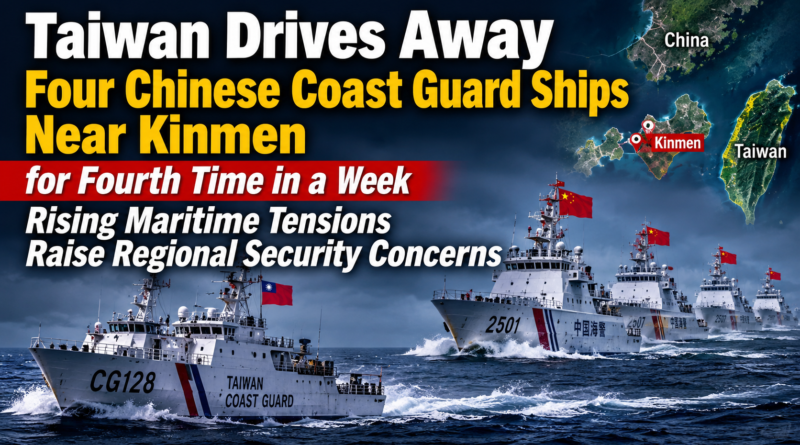
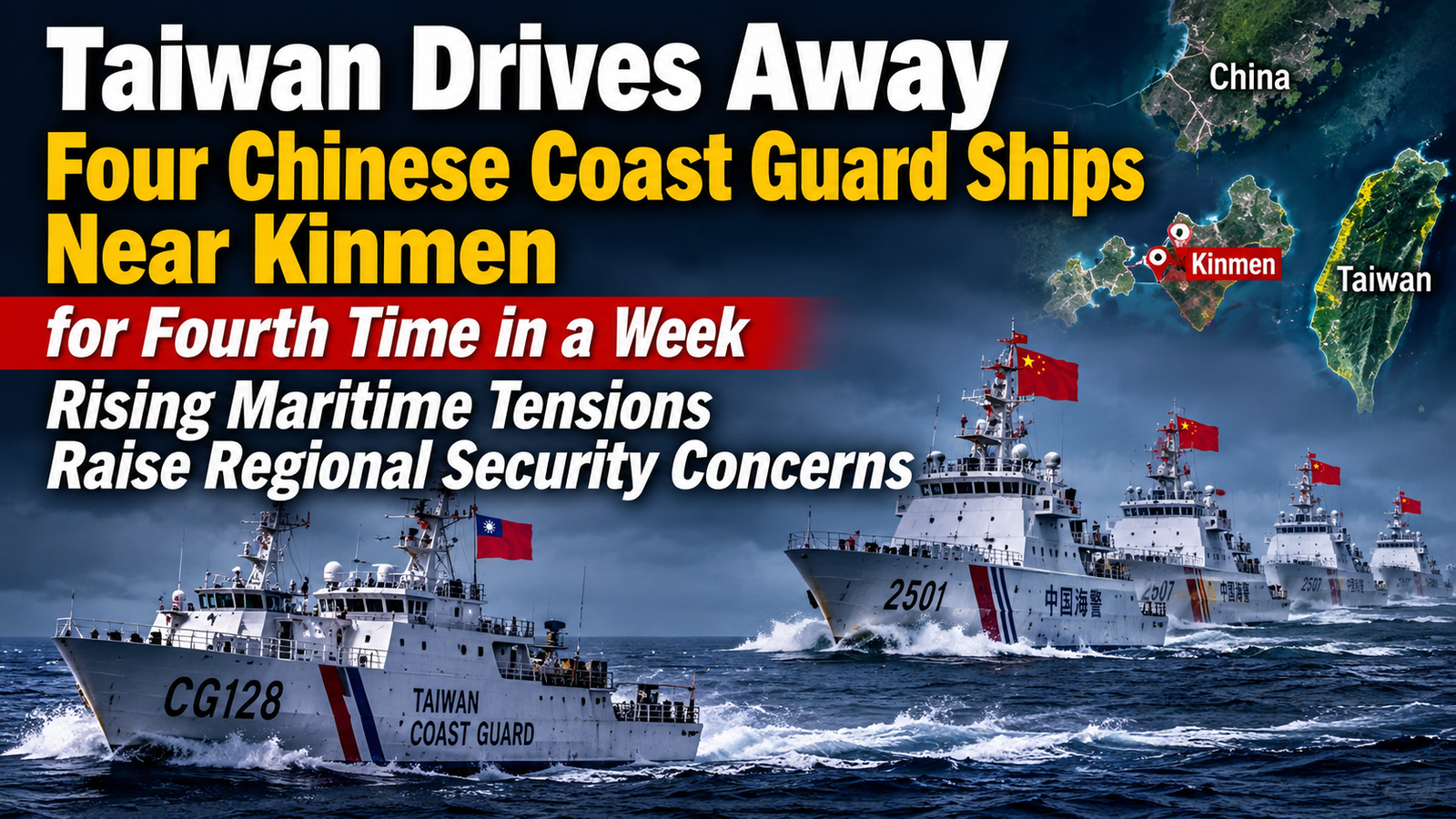
Taiwan Drives Away Four Chinese Coast Guard Ships Near Kinmen for Fourth Time in a Week: Rising Maritime Tensions Raise Regional Security Concerns
By NewYorkFinanceThink.com Editorial Desk
Date: November 5, 2026
The waters surrounding Taiwan have once again become a focal point of regional security concerns after Taiwanese Coast Guard patrol boats reportedly escorted four Chinese Coast Guard vessels out of restricted waters near the Kinmen Islands. The latest confrontation marks the fourth similar incident within approximately one week, highlighting the increasingly frequent maritime encounters between Beijing and Taipei.
Although the latest incident did not develop into a military confrontation, the repeated presence of Chinese government vessels in waters administered by Taiwan raises important questions about maritime security, regional stability and the future of cross-strait relations. What may appear to be a routine encounter between coast guard vessels could have much broader implications for the security environment across East Asia.
What Happened Near Kinmen?
According to reports from Taiwan, four Chinese Coast Guard vessels entered restricted waters near the Kinmen Islands. Taiwan’s Coast Guard Administration detected the approaching formation and deployed patrol boats to monitor the Chinese vessels.
The Taiwanese patrol boats reportedly sailed alongside the Chinese ships, maintained close surveillance and issued radio warnings instructing them to change course and leave the restricted waters.
The operation continued for more than two hours. Eventually, all four Chinese Coast Guard vessels departed the area following the Taiwanese patrol operation.
The incident was particularly significant because it represented the fourth reported encounter of this kind within approximately one week. The repeated incidents demonstrate that maritime pressure around Taiwan is not limited to military aircraft or naval exercises. Government-operated coast guard vessels are also becoming an important part of the wider strategic competition between the two sides.
Why Kinmen Is Strategically Important
Kinmen occupies a particularly sensitive position in the relationship between China and Taiwan. The island group is administered by Taiwan but lies extremely close to the Chinese mainland, near the coastal city of Xiamen in Fujian Province.
Its geographical position makes Kinmen one of the most sensitive locations in the Taiwan Strait. Unlike Taiwan’s main island, which is separated from mainland China by a considerably wider stretch of water, Kinmen is located only a short distance from the Chinese coast.
This geographical reality gives the surrounding waters considerable strategic importance. Fishing activity, commercial navigation, maritime law enforcement and security patrols all take place in an environment where political disagreements can quickly become operational challenges.
For Taiwan, maintaining effective patrols around Kinmen is important for protecting maritime order and demonstrating its ability to administer the waters surrounding the islands.
For Beijing, coast guard operations form part of its broader position regarding its claims over Taiwan and surrounding maritime areas.
The result is a sensitive maritime environment in which even relatively small encounters can attract considerable political and international attention.
China’s Coast Guard Strategy and the Gray-Zone Challenge
One of the most important aspects of the latest incident is the growing significance of what security analysts describe as gray-zone tactics.
Gray-zone activity refers to actions that create pressure on another government without crossing the threshold of an openly declared military conflict. Such operations can include frequent maritime patrols, coast guard deployments, surveillance activities, air operations and other forms of state pressure.
The strategic objective may be to maintain a continuous presence, test another side’s response capabilities and influence perceptions of control over a disputed area.
Coast guard vessels are particularly important in this environment because they operate under a law-enforcement identity rather than the traditional military role of naval warships. This can make encounters politically complicated.
A government may describe its deployment as routine law enforcement, while the opposing government may view the same activity as an attempt to challenge its authority.
Taiwan has repeatedly expressed concerns about Chinese Coast Guard activities around its offshore islands. Beijing, meanwhile, maintains its own claims regarding Taiwan and surrounding maritime areas.
This difference in interpretation is central to the continuing maritime tensions.
Why Repeated Maritime Encounters Matter
The frequency of these encounters is becoming as important as the individual incidents themselves.
A single coast guard encounter may end peacefully without significant consequences. However, repeated confrontations increase the possibility of miscommunication, navigational accidents or unexpected escalation.
When ships from two governments operate close to one another, even a relatively small operational mistake can create a serious situation. A sudden change of direction, an unexpected maneuver or a communication failure could produce a collision or a confrontation requiring intervention from higher authorities.
The danger is not necessarily that either side wants an immediate military conflict. The greater concern is that repeated operations can gradually normalize a more confrontational maritime environment.
For Taiwan, the challenge is to maintain its presence without creating unnecessary escalation. For China, frequent maritime operations can reinforce its claims and demonstrate that it intends to maintain an active presence around the island.
This creates a difficult strategic balance in which both sides have incentives to demonstrate determination while avoiding a confrontation that could become difficult to control.
Taiwan’s Coast Guard Faces Growing Responsibilities
Taiwan’s Coast Guard Administration has an increasingly important role in protecting the islands and responding to maritime pressure.
Unlike conventional military operations, coast guard missions require a combination of maritime surveillance, communication, law enforcement and careful operational judgment.
In the latest Kinmen incident, Taiwanese patrol boats reportedly used parallel monitoring, radio warnings and continuous observation to encourage the Chinese vessels to leave the restricted waters.
This approach demonstrates the importance of non-military responses in managing maritime confrontations.
Taiwan also faces a resource challenge. Its coast guard must maintain surveillance across extensive maritime areas while responding to fishing disputes, smuggling, illegal activities, maritime accidents and potential security threats.
The Taiwanese government has therefore placed increasing emphasis on strengthening maritime monitoring, patrol capabilities and operational readiness.
The broader challenge is ensuring that coast guard personnel have sufficient resources to respond to repeated encounters without unnecessarily turning routine maritime operations into military confrontations.
Could the Situation Affect the United States and Its Allies?
The latest incident also deserves attention beyond the immediate relationship between Beijing and Taipei.
The Taiwan Strait is strategically important to international shipping, regional trade and the security architecture of East Asia. Developments around Taiwan are closely watched by the United States, Japan and other countries with economic and security interests in the region.
The United States has a longstanding interest in maintaining peace and stability across the Taiwan Strait. Its Taiwan policy includes arms sales and other forms of support, while its official position emphasizes the peaceful resolution of cross-strait differences.
Japan also has significant interests in the surrounding waters. The country’s southwestern islands are geographically close to Taiwan, making developments in the Taiwan Strait relevant to Japanese maritime and national security planning.
If Chinese and Taiwanese vessels continue encountering one another around Kinmen, regional governments may become increasingly concerned about the possibility of an accidental confrontation.
For Washington and its partners, the challenge is to discourage destabilizing behavior while avoiding actions that could intensify tensions.
The Economic Consequences of Rising Taiwan Strait Tensions
The Taiwan Strait is not simply a geographical dividing line between two political systems. It is part of a region that plays a major role in global manufacturing, technology production and international trade.
Taiwan is particularly important to the semiconductor industry. Its manufacturing ecosystem supports the production of advanced chips used in smartphones, computers, artificial intelligence systems, automobiles and industrial equipment.
Any serious disruption to Taiwan’s economic activity could have consequences far beyond East Asia.
Financial markets would likely pay close attention to developments that threaten regional stability. Investors could reassess exposure to semiconductor companies, technology manufacturers, shipping businesses and firms dependent on Asian supply chains.
Shipping companies could also face higher insurance costs if maritime security risks increased significantly. Even without an actual blockade or military confrontation, sustained uncertainty could affect business confidence and investment decisions.
However, it is important to distinguish between a coast guard incident and a major disruption to international trade. The reported incident does not establish that shipping routes have been interrupted or that semiconductor production has been affected.
The economic concern is primarily about the potential consequences of a wider escalation, rather than evidence of immediate commercial disruption.
At the heart of the Kinmen incidents lies a fundamental disagreement about political authority and jurisdiction.
Taiwan operates its own government, military and coast guard. Its authorities administer Kinmen and maintain maritime enforcement activities around the islands.
The People’s Republic of China considers Taiwan part of its territory and rejects the idea that Taiwan is an independent sovereign state. Beijing also maintains maritime claims that conflict with Taiwan’s position.
These competing political and legal interpretations create an environment in which coast guard operations become more than ordinary maritime patrols.
When Chinese vessels enter waters that Taiwan considers restricted, Taipei sees the activity as a challenge to its administrative authority. Beijing may frame similar activity as a legitimate exercise of its own jurisdiction.
The disagreement makes practical maritime communication particularly important. Without reliable communication channels, routine encounters can become politically sensitive incidents.
Why the Fourth Incident in One Week Is Significant
The most important feature of the latest report is the frequency of the encounters.
Four similar incidents within approximately one week suggest a sustained pattern of maritime activity rather than an isolated confrontation.
For Taiwan, repeated deployments require continued operational attention and resources. Coast guard personnel must identify approaching vessels, assess their movements, issue warnings and document activities.
For China, repeated patrols create a visible maritime presence close to Taiwan-administered territory.
The long-term significance depends on whether these activities continue, increase in frequency or become more aggressive.
A repeated pattern could gradually change the operating environment around Kinmen. It could also make maritime encounters increasingly routine, raising the possibility that both sides become accustomed to operating under persistent tension.
That is a potentially dangerous development because normalization of confrontational activity does not necessarily mean that the situation is becoming safer.
What Happens Next?
The immediate question is whether the latest encounter will remain an isolated maritime episode or become part of a longer pattern of pressure around Kinmen.
Taiwan is likely to continue monitoring Chinese Coast Guard movements and deploying patrol vessels when necessary. Beijing may also continue maritime operations as part of its broader approach to Taiwan.
Several developments will be important to watch.
First, additional Chinese Coast Guard patrols could indicate that the current pattern is continuing. Second, Taiwan’s response will demonstrate how its authorities intend to manage repeated maritime encounters. Third, any simultaneous increase in Chinese military aircraft or naval activity could raise wider security concerns.
Regional diplomacy will also matter. The United States, Japan and other regional partners will continue watching developments because stability in the Taiwan Strait is closely connected to wider East Asian security.
Finally, financial markets and international businesses will monitor whether continuing tensions begin to influence investor confidence, shipping costs or technology supply-chain decisions.
The coming weeks could provide a clearer indication of whether the current pattern is temporary or part of a sustained strategic approach.
Editorial Opinion: Taiwan’s Maritime Security Is Becoming a Regional Concern
The repeated Chinese Coast Guard incidents near Kinmen deserve attention because they demonstrate how geopolitical competition can develop without a conventional military confrontation.
Modern strategic competition does not always begin with missiles, military exercises or naval battles. Sometimes it develops through repeated patrols, administrative disputes, surveillance operations and competing interpretations of maritime jurisdiction.
Taiwan’s challenge is to protect its administered waters while avoiding unnecessary escalation. China’s challenge is to pursue its political objectives without creating a crisis that could damage regional stability and international economic confidence.
Neither side benefits from an uncontrolled maritime confrontation. The economic and security consequences of a major crisis could extend throughout East Asia and affect businesses, investors and consumers around the world.
The international community should therefore pay close attention to developments around Kinmen. Maintaining communication channels, avoiding dangerous maneuvers and respecting maritime safety are essential to preventing an otherwise manageable encounter from becoming a much larger crisis.
The central issue is not simply which coast guard vessel leaves the waters first. It is whether Beijing and Taipei can prevent repeated maritime confrontations from becoming a permanent source of instability in one of the world’s most strategically important regions.
NewYorkFinanceThink.com Editorial Desk
Editorial note: This article distinguishes reported events from geopolitical analysis. Readers should consult official Taiwan Coast Guard announcements and independently verified reporting for the latest developments.
