China and the Middle East: Why Beijing Wants a Bigger Role in Gulf Diplomacy
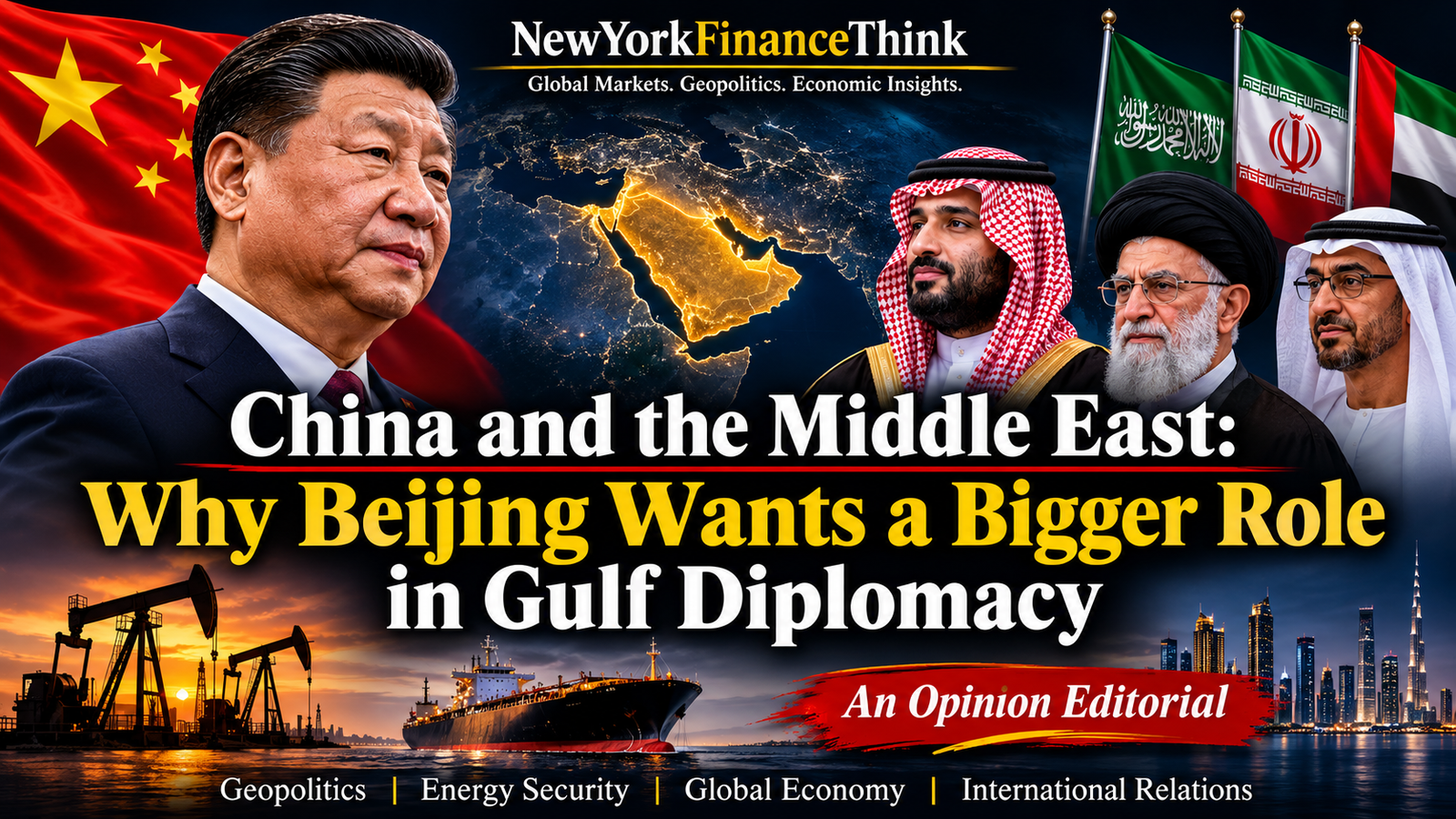
An Opinion Editorial on China’s Growing Influence, Gulf Energy Security, Iran Relations, Saudi Arabia and the Changing Global Balance of Power
Publication Date: November 5, 2026
By: NewYorkFinanceThink Editorial Team
Website: NewYorkFinanceThink.com
Introduction: China’s Middle East Strategy Is Changing
The Middle East has long been one of the most strategically important regions in international politics. Its oil and gas resources, major shipping routes and complicated political relationships have made it a centre of global competition for decades. Traditionally, the United States has played the leading external security role in the Persian Gulf, maintaining military partnerships, defence agreements and diplomatic relationships with several Arab governments. China, meanwhile, built much of its regional influence through trade, energy purchases, infrastructure investment and commercial partnerships. That balance is gradually changing.
Beijing increasingly wants a stronger diplomatic role in the Middle East. China understands that regional instability can affect its energy supplies, industrial production, international trade and long-term economic ambitions. A conflict involving Iran, Israel, the United States or Gulf countries is no longer simply a regional security issue. It can influence oil prices, shipping insurance, manufacturing costs, inflation and financial markets across the world.
China’s diplomatic ambitions are therefore connected to both economic security and international influence. Beijing wants to protect its commercial relationships while demonstrating that it can contribute to negotiations and regional stability. However, becoming a recognised diplomatic participant is not the same as having the power to stop a war. China’s relationships provide access, but whether that access can produce meaningful political results remains uncertain.
Why the Persian Gulf Matters to China
For China, the Persian Gulf is not a distant geopolitical concern. It is connected directly to energy security and economic stability. China is one of the world’s largest energy importers, and Middle Eastern oil remains an important part of its energy supply system. Any serious disruption to shipping through the Strait of Hormuz could increase transportation costs, complicate supply arrangements and create uncertainty for international energy markets.
The Strait of Hormuz connects the Persian Gulf with the Gulf of Oman and the wider Indian Ocean. It is one of the world’s most important energy shipping routes. Disruption can affect Asian economies, European importers, international energy traders and manufacturing companies that depend on predictable fuel supplies.
China has built an industrial economy deeply connected to global trade. Its factories, logistics networks, transportation companies and exporters all depend on reliable energy and shipping systems. A prolonged Gulf crisis could increase costs for Chinese businesses even if China manages to obtain oil from alternative suppliers.
For Beijing, protecting regional stability is therefore a practical economic priority. It is not simply about diplomatic prestige. It is also about ensuring that energy supplies can move, commercial contracts remain dependable and global trade does not face repeated disruptions.
China Wants Influence Without Becoming the Gulf’s Security Guarantor
China’s approach to the Middle East differs from the traditional American model. Washington has developed extensive defence relationships across the region, including military cooperation, weapons sales and security partnerships. Beijing has generally focused more heavily on trade, investment, technology, infrastructure and diplomatic engagement.
This difference is important. Gulf governments may welcome Chinese investment and technology while continuing to depend on American security cooperation. Buying Chinese technology does not automatically mean abandoning American defence relationships. Similarly, maintaining security ties with Washington does not prevent Gulf countries from expanding commercial relations with Beijing.
China appears to prefer a strategy in which it benefits from regional stability without taking responsibility for defending every partner or guaranteeing every shipping route. This reduces the risk of becoming directly involved in conflicts that could damage its broader international interests.
But the approach creates a difficult question. If Beijing wants to be recognised as a major diplomatic power, regional governments may eventually expect more than statements supporting dialogue. They may ask what practical contribution China is prepared to make when negotiations fail and security deteriorates.
Iran: A Strategic Relationship With Limits
Iran is an important part of China’s Middle East strategy. Beijing has maintained economic and diplomatic relations with Tehran, and China has been a major buyer of Iranian crude oil. These relationships provide China with access to an influential regional government and channels for diplomatic communication.
However, economic relationships should not be confused with political control. Iran has its own national security priorities, domestic political considerations and regional interests. China’s commercial importance does not mean that Beijing can automatically persuade Iranian leaders to change their policies.
China must also protect its relationships with Saudi Arabia, the United Arab Emirates, Qatar, Oman and other Gulf states. These governments are important partners in energy, infrastructure, investment and international trade.
A policy that appears to support one side too strongly could damage Beijing’s wider regional relationships. This is why China has an incentive to encourage negotiations, maintain communication with different governments and avoid becoming directly involved in military confrontation.
The challenge is not simply bringing officials into a meeting. It is finding a diplomatic arrangement that addresses security concerns and offers enough practical value for all major parties to accept.
Saudi Arabia and the Gulf Monarchies: China’s Other Strategic Partners
China’s Middle East strategy would be incomplete without the Arab Gulf states. Saudi Arabia, the United Arab Emirates, Qatar, Oman, Kuwait and Bahrain are important partners because they combine energy resources, investment capital, strategic geography and expanding economic ambitions.
Saudi Arabia has a particularly important position. Its energy sector remains central to global oil markets, while its economic transformation plans are creating opportunities in infrastructure, technology, manufacturing, tourism and renewable energy. China wants access to these expanding markets, while Saudi Arabia wants to diversify its international economic relationships.
The United Arab Emirates is another significant partner. Its role in logistics, ports, aviation, finance and technology makes it an important connection between Asian markets, the Gulf, Africa and Europe.
Oman occupies a highly strategic geographical position near the entrance to the Strait of Hormuz. Its diplomatic relationships have also made it an important channel for regional communication.
For Beijing, stronger relationships with these governments offer economic opportunities and diplomatic access. For Gulf governments, closer relations with China provide additional investment and international options.
The wider lesson is that Gulf countries are not necessarily choosing between China and the United States. They are trying to maintain relationships with several international powers while protecting their national interests.
The 2023 Saudi-Iran Agreement Gave China Diplomatic Credibility
China’s role in helping Saudi Arabia and Iran restore diplomatic relations in 2023 was an important moment in Beijing’s regional strategy. It demonstrated that China could use its relationships with two regional rivals to support a diplomatic breakthrough.
The agreement did not eliminate every political disagreement or guarantee permanent reconciliation. However, it created an opening for communication and strengthened China’s image as a country capable of contributing to regional diplomacy.
The current regional crisis is a much more difficult test. Restoring diplomatic relations is not the same as negotiating an end to an active military confrontation involving multiple countries, maritime threats and competing security demands.
The challenge requires more than encouraging officials to meet. It requires practical arrangements that address military escalation, shipping security, economic restrictions and the concerns of governments exposed to retaliation.
China’s diplomatic credibility will depend on whether its efforts contribute to measurable progress rather than simply producing additional meetings and statements.
The United States Remains Central to Gulf Security
China’s growing presence does not mean that the United States has disappeared from the Gulf. American military capabilities, defence relationships and security cooperation remain significant to regional governments.
Washington has major interests in protecting international shipping, preventing wider regional escalation and maintaining relationships with Gulf partners.
However, Gulf governments also have their own concerns about regional security and long-term economic development. They may disagree with particular American policies while continuing to value American defence cooperation.
China has not established a Gulf-wide security system comparable to the United States’ network of military partnerships. Its diplomatic and economic relationships are substantial, but they do not amount to a mutual-defence structure.
This distinction matters. If Gulf governments ask Beijing to use its influence with Tehran, they may receive diplomatic engagement and economic arguments for de-escalation. They should not assume that China will automatically provide the military protection traditionally associated with American security partnerships.
For Washington, China’s expanding diplomatic role creates a strategic challenge. But the Gulf is not a simple contest in which every Chinese investment represents a loss of American influence.
Oil, Shipping and the Global Economy
The economic consequences of Gulf instability extend far beyond crude oil prices. The region is connected to international shipping, petrochemicals, aviation, manufacturing, insurance and global trade.
When maritime security deteriorates, companies can face higher insurance premiums, longer routes, delayed deliveries and uncertainty about whether cargoes will reach their destinations.
For China, these risks are particularly important because its industrial economy depends on imported energy and extensive international supply chains. A prolonged disruption around Hormuz could increase costs for refineries, chemical producers, transport operators and manufacturers.
The impact would not be limited to China. Japan, South Korea, India and other Asian economies also depend on international energy shipping routes. European economies can experience indirect effects through global oil prices and inflation expectations. American consumers may face changes in gasoline and transportation costs.
This is why China’s diplomatic push is connected to economic self-interest. Beijing wants to protect the commercial routes and relationships that support its economic growth.
However, investors should not assume that every diplomatic announcement will immediately lower oil prices. Markets respond to actual supply conditions, shipping data, inventories, production decisions, currencies and expectations about future risks.
China’s Technology and Infrastructure Strategy
Energy is only one part of the China-Gulf relationship. The next stage of cooperation increasingly involves technology, industrial development, logistics, digital infrastructure and renewable energy.
Gulf governments are seeking to reduce their long-term dependence on oil revenues. Their development programmes increasingly emphasise artificial intelligence, advanced manufacturing, tourism, financial services, clean energy and modern transportation.
Chinese companies have experience in large-scale infrastructure, telecommunications equipment, solar manufacturing, batteries, electric vehicles and industrial supply chains.
These areas create opportunities for cooperation. Chinese firms can gain access to expanding markets, while Gulf governments can attract investment and technology that supports economic diversification.
However, technology cooperation can also create geopolitical complications. The United States has national-security concerns involving certain sensitive technologies, data systems and strategic infrastructure. Gulf governments must therefore balance their interest in Chinese technology with their relationships with Washington and other international partners.
The future of China-Gulf cooperation will depend partly on how governments manage these competing economic and security priorities.
Why Beijing Is Cautious About Confronting Washington
China’s diplomatic ambitions in the Gulf cannot be separated from its wider relationship with the United States. The two powers compete in trade, technology, military influence and international diplomacy. Yet both also have reasons to avoid an uncontrolled confrontation that could damage global economic stability.
Beijing may criticise American military actions and call for negotiations, but directly confronting Washington over the Gulf could create wider diplomatic and economic costs.
China has extensive international trade interests. A prolonged regional conflict could increase its energy costs, disrupt shipping and weaken global business confidence.
It would therefore be misleading to assume that Beijing automatically benefits whenever Washington faces a foreign-policy challenge. Instability can create strategic opportunities, but it can also impose serious costs on China’s own economy.
The more practical Chinese objective is to increase its diplomatic relevance without taking actions that create a direct military confrontation with the United States.
The Risk of Overestimating China’s Diplomatic Power
There is a difference between being welcomed into a diplomatic process and being able to determine its outcome.
China has economic relationships with important regional actors, but those relationships are not unlimited instruments of pressure. Iran has its own calculations. Saudi Arabia has its own security concerns. Oman has its own diplomatic priorities. The United States has its own military and political objectives.
Beijing must also manage the possibility that its calls for neutrality may be interpreted differently by different parties. If it is seen as too supportive of Tehran, some Arab governments may question its ability to act as a balanced mediator. If it criticises Iran too strongly, it could weaken a relationship that provides China with economic and diplomatic access.
The challenge becomes especially clear when maritime security is involved. China can urge all parties to protect commercial shipping, but a diplomatic appeal is not the same as a naval security guarantee.
China’s influence should therefore be measured not only by the number of diplomatic meetings it holds, but by whether those meetings contribute to reduced attacks, renewed negotiations, safer shipping and more reliable energy flows.
What This Means for American Investors and Businesses
For American investors, China’s expanding Gulf diplomacy matters because geopolitical developments can influence several important areas of the global economy.
Oil prices, shipping costs, defence spending, currency movements and inflation expectations can all respond to changes in regional risk.
Energy companies may benefit from higher crude prices in some circumstances, but higher prices can also increase operating costs for airlines, transportation businesses, manufacturers and consumer companies.
Gold may attract investor demand during periods of uncertainty, although its performance also depends on interest rates, the dollar and broader market conditions.
Defence companies may receive additional attention when governments increase military budgets, but their stock performance still depends on contract execution, earnings, valuations and expectations already reflected in share prices.
American investors should therefore follow developments in the Gulf without treating every headline as an automatic trading signal. The important question is whether political statements are followed by measurable improvements in security and economic activity.
Three Possible Futures for China’s Gulf Diplomacy
Scenario One: China Becomes a More Influential Diplomatic Partner
In this scenario, Beijing maintains communication with Iran, Saudi Arabia and Oman while supporting negotiations involving Washington and other relevant governments. If these efforts contribute to reduced hostilities and safer shipping, China could strengthen its reputation as a diplomatic participant.
Gulf states might also expand economic and technological cooperation with Beijing. This would not necessarily replace America’s security role, but it could give China a more established position in regional decision-making.
Scenario Two: China Gains Economic Influence but Limited Political Leverage
This outcome may involve continued growth in trade, investment and technology cooperation without a major diplomatic breakthrough.
Beijing could remain an important partner for Gulf governments while failing to persuade the principal parties to accept a lasting settlement. China would retain commercial influence, but its ability to shape regional security decisions would remain constrained.
Scenario Three: Regional Escalation Exposes the Limits of Beijing’s Strategy
If military confrontation continues and maritime disruptions deepen, China’s preference for diplomacy without direct security commitments could face serious criticism.
Gulf governments may seek more immediate protection from established defence partners, even while maintaining economic relationships with Beijing. China could face higher energy costs and commercial disruption without having the practical tools to guarantee regional stability.
None of these scenarios is certain. The future will depend on decisions made by regional governments, Washington, Tehran and other international actors.
What Readers Should Watch Next
The following developments will help indicate whether China’s growing diplomatic activity is producing practical results:
- China’s special envoy visits: Whether meetings in Iran, Oman and Saudi Arabia lead to concrete diplomatic proposals.
- Iran’s response: Whether Tehran demonstrates willingness to participate in negotiations and address regional security concerns.
- Saudi Arabia’s position: Whether Riyadh supports a larger Chinese diplomatic role while maintaining its existing security partnerships.
- Oman’s mediation: Whether Muscat can help establish communication between parties that remain in conflict.
- Strait of Hormuz shipping: Whether commercial vessels can resume reliable passage and shipping insurance costs begin to stabilise.
- U.S.-China communication: Whether Washington and Beijing can maintain dialogue on regional de-escalation.
- China-Gulf investment: Whether cooperation in artificial intelligence, energy, logistics and manufacturing continues despite political uncertainty.
These indicators matter more than diplomatic photographs or statements alone. A successful diplomatic process must eventually produce practical improvements in security, trade and regional confidence.
The Bigger Picture: A Gulf Region With More International Partners
The most important development may not be China’s attempt to replace the United States. It may be the growing determination of Gulf governments to maintain relationships with several major powers at the same time.
Saudi Arabia, the UAE, Qatar and Oman have economic reasons to work with China. They also have security, financial and technological reasons to maintain relationships with the United States and other international partners.
China benefits because its economic presence creates opportunities for diplomatic access. The United States remains important because security relationships cannot be replaced simply through commercial agreements. Other countries, including India, Japan and European states, also have major interests in Gulf stability and energy networks.
The region is therefore becoming an increasingly important centre of international diplomacy, where economic cooperation and security partnerships overlap without necessarily following the same political direction.
For Beijing, the objective is to become an indispensable participant in regional conversations. For Gulf governments, the objective is to preserve national independence, economic development and security while navigating competition between major powers.
Editorial Conclusion: China’s Ambition Is Growing, but Influence Must Be Earned
China’s growing diplomatic role in the Middle East reflects a wider transformation in international relations. Beijing has become too economically important to the Gulf to remain a secondary participant in every major regional discussion.
Its relationships with Iran, Saudi Arabia, Oman and other Gulf governments provide diplomatic access that would have been difficult to imagine several decades ago.
But access is not the same as authority. China’s economic relationships give it reasons to encourage stability and channels through which it can communicate with regional leaders. They do not give Beijing automatic control over Iran’s decisions, the policies of Arab governments or the military calculations of Washington.
The current crisis is therefore a defining test of China’s ambitions. If Beijing can help bring parties back to negotiations, support safer maritime trade and encourage a more durable regional arrangement, it may strengthen its international reputation.
If diplomatic activity produces little practical progress, the gap between China’s economic influence and its ability to shape security outcomes will remain clear.
For the United States, the lesson is that Gulf diplomacy is no longer shaped exclusively through traditional security relationships. For China, the lesson is that a major economic presence creates expectations that cannot always be met through statements and trade agreements. And for Gulf governments, the lesson is that maintaining multiple international partnerships can offer opportunities, but it also requires careful management of competing interests.
The future of the Middle East will not be determined by China alone, or by the United States alone. It will depend primarily on the decisions of the countries living with the consequences of regional conflict.
Beijing wants a bigger role in that future. Whether it can turn its commercial importance into lasting diplomatic influence remains one of the central questions facing the Gulf and the wider global economy.
About This Editorial
This opinion editorial is published by NewYorkFinanceThink.com. It examines China’s diplomatic ambitions, Gulf economic relationships, energy security and the changing balance of international influence in the Middle East.
Disclaimer: This article is for informational and educational purposes. It presents geopolitical and economic analysis, not investment advice. Diplomatic developments and conflict-related claims can change quickly. Readers should consult current reporting and official statements when assessing new developments.
Sources and Further Reading
- Reuters – China wants a seat at the Gulf table, November 4, 2026.
- Al Jazeera – China steps up Middle East diplomacy with Iran and Oman meetings, November 2, 2026.
- Reuters – China’s Wang urges Middle East dialogue in meetings with Iranian and Saudi officials, November 2, 2026.
- Middle East Council on Global Affairs – China-GCC Relations in an Emerging Multipolar Order, July 2026.
- Reuters – Can China restrain Iran? Gulf states test Beijing’s influence, July 30, 2026.