
Trump, Xi and Putin Meet in Shenzhen: What the Historic Three-Power Summit Means for Global Peace, Trade and Financial Markets
By New York Finance Think Global News Desk
November 19, 2026
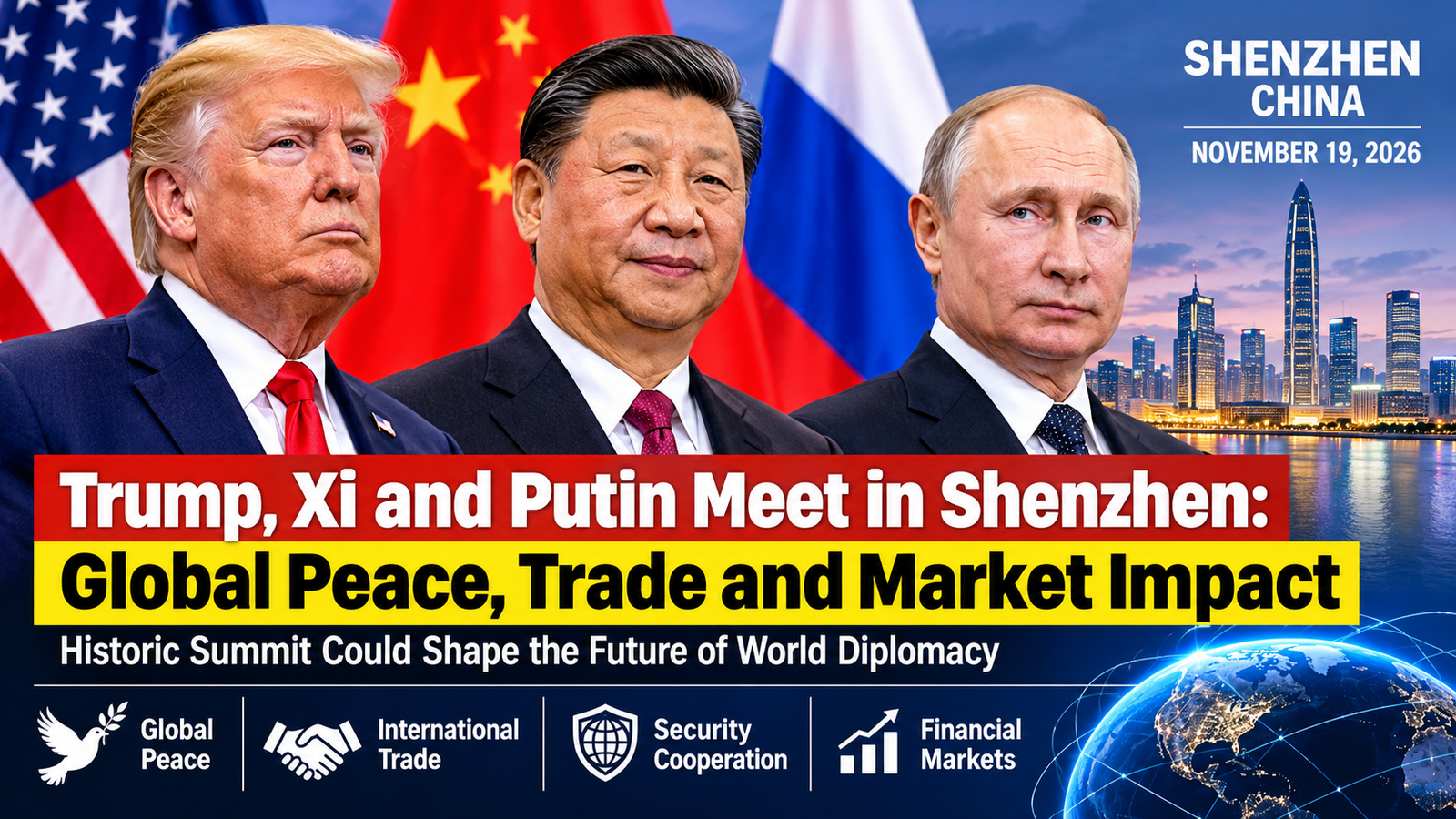
The world is watching Shenzhen as U.S. President Donald Trump, Chinese President Xi Jinping and Russian President Vladimir Putin come together for an unprecedented trilateral summit that could influence the direction of international diplomacy, global security and the world economy.
The meeting, held on November 19 alongside the Asia-Pacific Economic Cooperation (APEC) summit in Shenzhen, China, brings three of the world’s most influential political leaders into the same diplomatic conversation. Their discussions come at a time when international relations are being shaped by trade disputes, military conflicts, energy security concerns and growing competition over advanced technologies.
For Washington, Beijing and Moscow, the summit represents an opportunity to communicate directly on issues that have traditionally been addressed through separate bilateral negotiations. However, bringing three competing strategic interests to the same table does not automatically mean that meaningful agreements will follow.
The central question for international observers is straightforward: Can these three governments find enough common ground to reduce global tensions without compromising their individual national interests?
Contents
- 1. A Historic Meeting at a Sensitive Moment
- 2. What Did the Three Leaders Discuss?
- 3. Why the Shenzhen Summit Matters to the American Economy
- 4. Wall Street’s Perspective: What Investors Should Watch
- 5. China’s Strategic Position
- 6. Russia’s Diplomatic Priorities
- 7. What Happens Next?
- 8. New York Finance Think Analysis: A Diplomatic Opening, Not a Guaranteed Turning Point
A Historic Meeting at a Sensitive Moment
The Shenzhen summit is particularly significant because the United States, China and Russia have different priorities in the current international environment.
The Trump administration has emphasized negotiations involving nuclear weapons, international security and economic relations. China is seeking to maintain its position as a major global economic power while managing its relationship with Washington. Russia, meanwhile, continues to face international pressure over its war in Ukraine and its broader relationship with Western governments.
According to China’s Foreign Ministry, Xi Jinping hosted Trump and Putin for the trilateral summit on November 19.
The gathering took place against the background of the APEC leaders’ meeting, giving the discussions an additional international dimension.
The three governments have significant disagreements, but they also share an interest in preventing a direct military confrontation between major nuclear powers.
That shared interest makes communication important, even when the countries disagree over the solutions.
What Did the Three Leaders Discuss?
The summit focused on several important areas of international cooperation.
1. Nuclear Security and Global Stability
Nuclear security was among the most important subjects surrounding the meeting.
The United States and Russia possess the world’s two largest nuclear arsenals, while China has been expanding its nuclear capabilities.
Trump has expressed interest in discussions about reducing nuclear risks and pursuing broader nuclear arms arrangements involving all three countries.
Following the summit, the three governments reaffirmed that nuclear war must never be fought and agreed to conduct dialogue on reducing nuclear risks and preventing nuclear proliferation.
However, an agreement to continue dialogue should not be confused with a completed nuclear disarmament treaty.
The difficult questions remain: How would future reductions be verified? What limits would each country accept? How could an agreement account for differences in nuclear capabilities?
These issues will require further negotiations.
2. U.S.-China Trade and Economic Relations
The relationship between Washington and Beijing remains one of the most important influences on the global economy.
American companies depend on international supply chains that involve Chinese manufacturing, while Chinese businesses remain connected to the U.S. consumer market, financial system and technology industry.
Trade restrictions, tariffs, semiconductor controls and competition over artificial intelligence continue to create uncertainty for businesses.
Any improvement in U.S.-China communication could help reduce uncertainty surrounding international trade and investment.
However, investors should not assume that a diplomatic meeting automatically signals the end of trade restrictions or technology disputes.
Companies will continue to monitor actual policy announcements, regulatory decisions and commercial agreements.
3. Russia, Ukraine and Western Relations
Russia’s relationship with Western countries remains a major international security concern.
The war in Ukraine continues to influence European security, military spending, energy policy and diplomatic relations.
The presence of Putin at the Shenzhen summit creates an opportunity for direct communication with the American president. Nevertheless, Ukraine’s absence from the trilateral discussions raises important questions about how any future diplomatic process involving the conflict could develop.
A meeting between major powers does not itself establish a peace agreement.
Any lasting settlement would involve difficult questions concerning sovereignty, security guarantees, territorial issues and the interests of the parties directly involved.
4. Energy Security and International Oil Supplies
Energy markets are another important part of the discussion.
The United States, Russia and China are major participants in the global energy system, although their positions in production, consumption and international trade differ.
Following the meeting, the three countries expressed support for increasing the production and supply of refined petroleum products and maintaining stable energy flows.
For international markets, energy policy matters because changes in supply expectations can influence oil prices, transportation expenses, industrial costs and inflation.
However, actual price movements will depend on production levels, demand, shipping conditions, geopolitical developments and other market fundamentals.
Why the Shenzhen Summit Matters to the American Economy
For American households and businesses, international diplomacy is not simply a matter of presidential meetings and political statements.
Foreign policy decisions can eventually influence the cost of goods, employment, investment, borrowing and financial market sentiment.
Consider five important economic connections.
Consumer prices: Changes in international trade relationships can affect the cost of imported electronics, machinery, industrial components and other consumer products.
Energy costs: International oil supply conditions can influence gasoline prices, transportation costs and business operating expenses.
Stock market confidence: Investors monitor geopolitical risks because uncertainty can affect corporate earnings expectations, investment decisions and market valuations.
Technology investment: U.S.-China competition over semiconductors, artificial intelligence and advanced manufacturing remains important for American technology companies.
Interest rates and inflation: Geopolitical developments can influence energy prices and supply chains, potentially affecting inflation expectations and the Federal Reserve’s economic outlook.
None of these effects is automatic. Investors will need to distinguish diplomatic announcements from changes that actually affect economic activity.
Wall Street’s Perspective: What Investors Should Watch
The Shenzhen meeting could become an important subject for international investors, particularly those following American equities and global commodity markets.
However, a diplomatic summit is not a reliable standalone indicator of whether stocks will rise or fall.
Investors should monitor several areas.
The S&P 500: Watch how companies with international operations respond to developments in trade and geopolitical risk.
The Nasdaq Composite: Semiconductor manufacturers, artificial intelligence companies and technology businesses may be particularly sensitive to U.S.-China technology policy.
The Dow Jones Industrial Average: Industrial, financial and multinational companies could be affected by changes in international trade expectations.
Crude oil: Any meaningful change in energy supply expectations could influence West Texas Intermediate (WTI) and Brent crude prices.
Gold: Gold demand may respond to changes in geopolitical uncertainty, inflation expectations, currency movements and real interest rates.
The U.S. dollar: International diplomatic developments can influence currency sentiment, although Federal Reserve policy and economic data remain major drivers.
For long-term investors, the more important question is whether the summit leads to measurable policy changes rather than temporary improvements in diplomatic language.
China’s Strategic Position
Hosting the meeting gives Beijing an opportunity to present Shenzhen as a location for international economic and diplomatic engagement.
China has an important interest in maintaining access to international markets, protecting its technology sector and preserving stable economic relations with major trading partners.
At the same time, Beijing must manage its long-standing relationship with Moscow and its complicated strategic relationship with Washington.
These interests do not always point in the same direction.
China’s approach to the summit therefore needs to be understood within a broader context of trade, national security, regional stability and its position in the global economic system.
Russia’s Diplomatic Priorities
For Moscow, direct discussions with the American president and the Chinese leader provide an opportunity to address international security questions and reinforce Russia’s role in major diplomatic negotiations.
Energy exports, sanctions, relations with Western governments and the war in Ukraine remain important considerations.
However, diplomatic visibility does not necessarily translate into changes in sanctions, international recognition or economic restrictions.
Those outcomes depend on subsequent decisions by governments and international institutions.
What Happens Next?
The most important test of the Shenzhen summit will be what happens after the leaders leave the negotiating table.
The three governments have announced their intention to continue dialogue on nuclear risks. They have also expressed support for United Nations reform, stable energy supplies and principles concerning the jurisdiction and immunity of state officials.
These announcements provide a framework for further discussions, but they do not resolve the underlying disagreements among the three countries.
Future diplomatic progress will depend on whether officials can convert broad commitments into specific agreements, implementation mechanisms and verifiable actions.
For financial markets, the same principle applies: policy changes matter more than political headlines.
New York Finance Think Analysis: A Diplomatic Opening, Not a Guaranteed Turning Point
The Shenzhen summit represents an important moment in relations among the United States, China and Russia.
It demonstrates that communication remains possible even when the governments involved have significant disagreements over security, trade, technology and regional conflicts.
But expectations should remain grounded in what was actually achieved.
The leaders’ agreement to continue dialogue on nuclear risks is relevant. Their statements on energy supplies and international institutions are also significant areas for further observation.
Nevertheless, no single meeting can resolve the complicated economic and geopolitical relationships connecting these three countries.
For the United States, the long-term implications will depend on whether diplomatic engagement produces greater strategic stability, more predictable trade relationships and reduced risks of international conflict.
For American investors, businesses and households, the practical impact will become clearer through future government decisions, commodity prices, corporate earnings and economic data.
The bottom line: Shenzhen has created a new diplomatic chapter involving Washington, Beijing and Moscow. Whether that chapter becomes a meaningful step toward international stability will depend not on the symbolism of the meeting, but on the decisions and actions that follow.
New York Finance Think will continue monitoring developments involving U.S.-China relations, Russia, international trade, energy markets and their implications for the American economy.
Editorial note: This article is an independent news analysis. It does not constitute investment advice or a prediction of stock market performance.
