
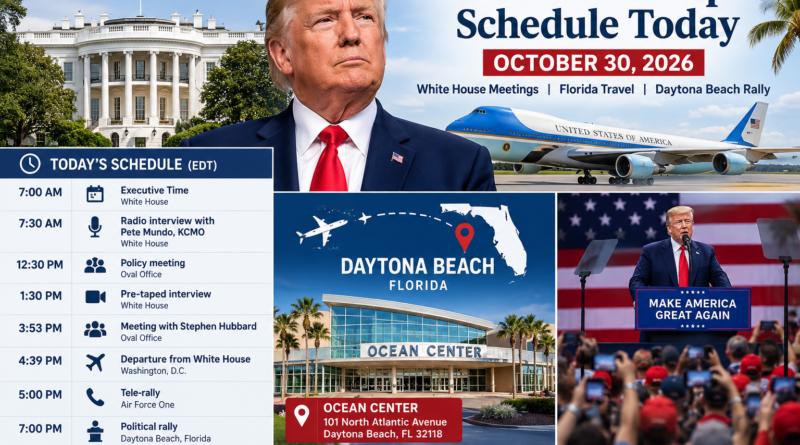
President Trump’s Schedule Today, October 30, 2026: White House Meetings, Florida Travel and Daytona Beach Political Rally
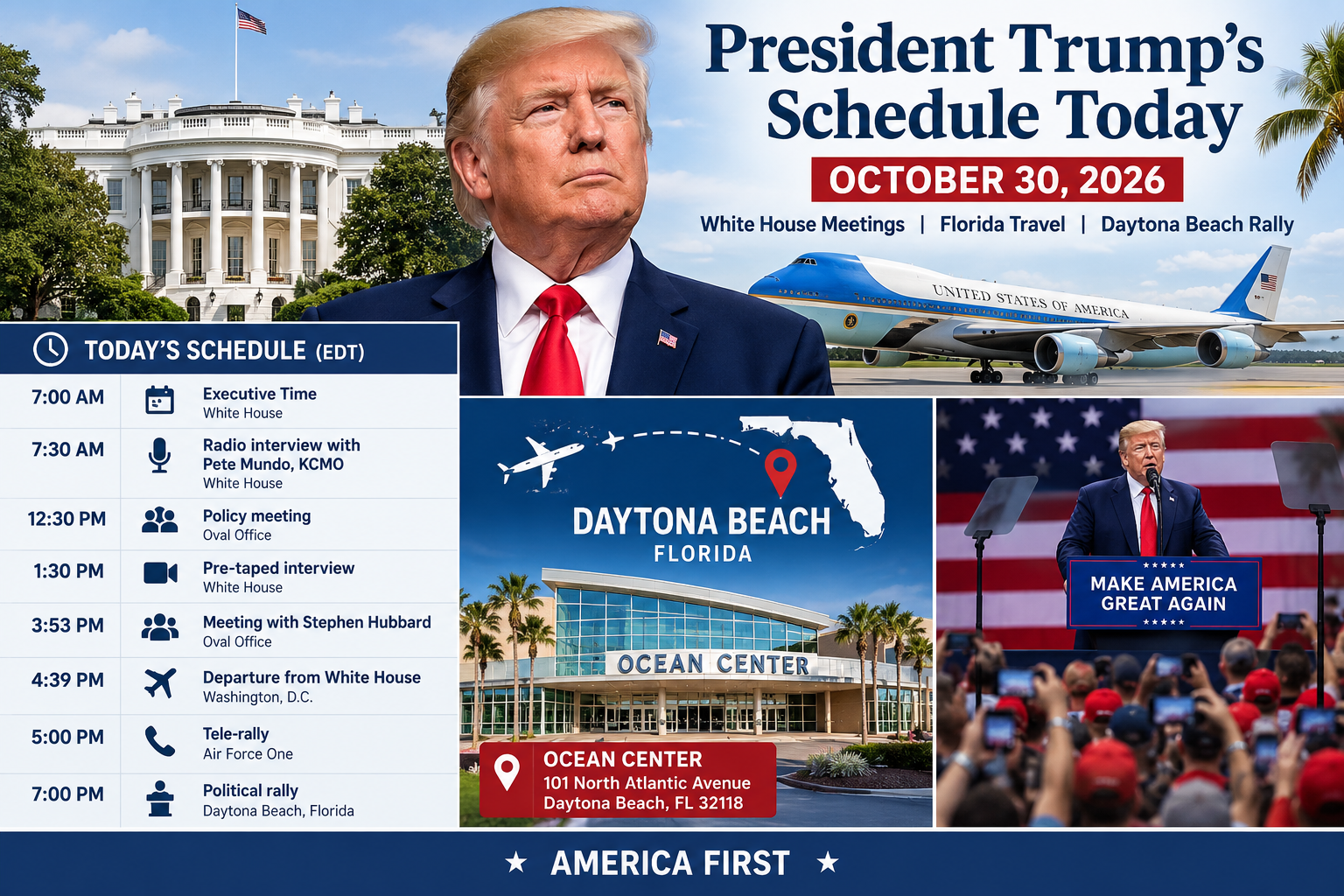
Washington, D.C.:- President Donald Trump’s schedule for Friday, October 30, 2026, includes White House meetings, a radio interview, a pre-recorded interview, a tele-rally and an evening political event in Daytona Beach, Florida. The President is expected to deliver remarks at the Ocean Center at 7:00 p.m. Eastern Daylight Time as the United States approaches the November 2026 midterm elections.
President Donald Trump is travelling from Washington, D.C., to Florida on Friday for a political rally at the Ocean Center in Daytona Beach. The visit comes during an important period in American politics, with candidates, political organizations and voters preparing for the November midterm elections.
The day’s schedule begins at the White House with Executive Time at 7:00 a.m. and a radio interview with Pete Mundo of KCMO at 7:30 a.m. The President is also scheduled to participate in a policy meeting in the Oval Office, complete a pre-taped interview and meet with Stephen Hubbard before departing Washington.
Later in the afternoon, Trump is scheduled to participate in a tele-rally before travelling to Daytona Beach for his evening appearance.
The political event is scheduled to take place at the Ocean Center, a major convention and event venue in Daytona Beach. The venue has listed the October 30 event as a midterm rally featuring President Donald J. Trump.
For Americans following the White House, the Florida visit is worth watching because it brings together several important subjects: presidential activity, election campaigning, political communication, economic concerns and the issues that may influence voters during the final days before Election Day.
President Trump’s Full Schedule for Friday, October 30, 2026
The White House schedule provides a picture of the President’s planned activities throughout the day. All times below are Eastern Daylight Time (EDT).
| Time (EDT) | Scheduled activity | Location |
|---|---|---|
| 7:00 AM | Executive Time | White House |
| 7:30 AM | Radio interview with Pete Mundo, KCMO | White House |
| 9:00 AM | In-Town Pool Call Time | White House |
| 12:30 PM | Policy meeting | Oval Office |
| 1:30 PM | Pre-taped interview | White House |
| 2:30 PM | Out-of-Town Travel Pool Call Time | Washington |
| 3:53 PM | Meeting with Stephen Hubbard | Oval Office |
| 4:39 PM | Departure from the White House | Washington, D.C. |
| 5:00 PM | Tele-rally | Air Force One |
| 7:00 PM | Political rally and remarks | Ocean Center, Daytona Beach |
The expanded presidential schedule also records the President’s journey through Joint Base Andrews and Daytona Beach International Airport.
These times describe the published schedule, not necessarily the exact time at which every activity was completed. Presidential schedules can change because of travel, security requirements, meetings and other official responsibilities.
1. Executive Time: How the President’s Day Begins
President Trump’s scheduled day begins at 7:00 a.m. with Executive Time at the White House.
Executive Time is a familiar entry in presidential schedules. It generally refers to a period reserved for presidential work that is not necessarily presented as a public event.
The White House does not provide a detailed public description of every activity taking place during this period. Consequently, it would be inaccurate to assume that the President is conducting a particular meeting, reviewing a specific document or making a particular policy decision during this time.
However, the broader responsibilities of the presidency provide useful context.
The President’s daily work involves receiving information, reviewing government priorities, communicating with advisers and considering matters that may require executive attention.
The federal government operates across numerous policy areas, including economic management, national security, immigration, international relations, energy, trade and domestic administration.
Presidential work also involves communication with members of the administration, congressional leaders and outside political or policy figures.
Not every presidential responsibility appears on the public calendar. Some meetings are private, some are classified, and others are part of routine executive operations.
That distinction matters when readers examine a presidential schedule. A public calendar shows selected activities, but it does not provide a complete account of everything happening inside the White House.
On October 30, the morning schedule moves from Executive Time to a radio interview, followed by the day’s policy and interview commitments.
2. Trump Radio Interview With Pete Mundo on KCMO
At 7:30 a.m. EDT, President Trump is scheduled to participate in a radio interview with Pete Mundo of KCMO.
Radio interviews remain an important part of American political communication.
Unlike a traditional press conference, a radio interview can provide an opportunity for a political figure to speak directly to listeners through a familiar broadcast format.
Local and regional radio audiences may include people who follow national politics, local economic developments, public policy and election campaigns.
The KCMO interview is particularly relevant because Trump’s schedule places the conversation before his planned Florida appearance.
However, the published schedule confirms the interview appointment, not the specific questions asked or answers given.
Readers should distinguish between a scheduled interview and a published interview transcript. Without a recording or transcript, it is not possible to establish exactly what subjects were discussed.
The interview could provide an opportunity to address national political developments, but the actual subjects should be established from the broadcast itself.
For people following the White House, the interview is another example of how presidential communication takes place outside formal government announcements.
A president’s public message reaches Americans through television, radio, online interviews, press briefings and social media. Each platform reaches a different audience and provides a different way of discussing public issues.
3. Policy Meeting in the Oval Office at 12:30 PM
The President’s next major scheduled commitment is a policy meeting at 12:30 p.m. in the Oval Office.
The Oval Office is the President’s principal working office and one of the most recognisable locations in American government.
Policy meetings are an important part of presidential administration because they provide an opportunity to consider government priorities and discuss issues requiring executive attention.
The meeting listed on October 30 is not accompanied by a publicly detailed agenda in the schedule information reviewed for this article.
Therefore, the specific policy subjects should not be assumed.
In general, policy discussions at the presidential level can involve domestic economic conditions, federal spending, regulatory decisions, trade, national security and other matters within the responsibilities of the executive branch.
For American households, the policy decisions made by the federal government can have consequences beyond Washington.
Federal policies may influence taxation, government programmes, employment conditions, infrastructure investment, energy markets and the regulatory environment for businesses.
However, a scheduled policy meeting does not automatically mean that a new policy will be announced.
There is an important difference between discussing a subject, reviewing a proposal and officially implementing a government decision.
Any new announcement should be evaluated through an official statement, executive action, agency publication or other reliable documentation.
The October 30 meeting is therefore an important part of the President’s published schedule, but its specific outcome remains a separate question.
4. Pre-Taped Interview Scheduled for 1:30 PM
At 1:30 p.m., Trump is scheduled to participate in a pre-taped interview at the White House.
A pre-taped interview differs from a live broadcast.
In a live interview, the conversation is transmitted as it happens. A pre-recorded interview is captured in advance and may be broadcast or published later.
This format is widely used in political communication because it allows broadcasters and interviewers to prepare material for a scheduled programme.
The schedule confirms that the interview is planned, but it does not establish the publication time, broadcaster or final content.
The distinction is particularly important for online news readers. A video appearing on social media at a later time should not automatically be described as a live presidential statement.
The original recording date, publication date and context should be checked before reporting its contents.
In a political environment where short video clips can circulate rapidly, the complete interview often provides more useful context than a short excerpt.
A statement taken from a longer conversation may lose important details if the surrounding question and answer are not included.
For that reason, reporting on the pre-taped interview should rely on the full recording or an authenticated transcript whenever possible.
5. Meeting With Stephen Hubbard at 3:53 PM
The expanded presidential calendar records a meeting with Stephen Hubbard at 3:53 p.m. in the Oval Office.
This appointment appears shortly before the President’s scheduled departure from the White House.
The publicly available schedule identifies the meeting and its timing but does not provide sufficient information to establish its purpose, discussion topics or outcome.
It would therefore be inappropriate to attach a policy announcement or political development to the meeting without further documentation.
For readers, the important point is that the President has another scheduled Oval Office commitment before beginning his Florida travel.
Presidential calendars sometimes include meetings with officials, advisers, outside individuals and other visitors. The name of a meeting participant alone does not establish the nature of the discussion.
Any additional information about the meeting should be checked against White House pool reports, official statements or a verified transcript.
6. Departure From the White House and Travel to Florida
At approximately 4:39 p.m. EDT, the expanded schedule records the President’s departure from the White House.
The journey includes a transfer to Joint Base Andrews, followed by travel aboard Air Force One to Daytona Beach.
The detailed calendar records an arrival at Joint Base Andrews at approximately 4:47 p.m. and departure for Daytona Beach at approximately 5:01 p.m.
The President is listed as arriving at Daytona Beach International Airport at approximately 6:35 p.m.
At approximately 6:51 p.m., the schedule records his departure from the airport for the Ocean Center.
The arrival at the venue is listed at approximately 7:04 p.m.
These are schedule entries and should be treated as reported itinerary times rather than a guarantee that every movement occurred exactly as planned.
Presidential travel requires extensive coordination involving aviation, transportation, security personnel and local authorities.
When a sitting President visits a city, the arrangements extend beyond the aircraft.
Local law enforcement, federal security personnel, airport authorities, event organisers and public agencies may all have responsibilities associated with the visit.
The effect is often visible to residents through traffic restrictions, road closures, changes in parking arrangements and additional security screening.
For Daytona Beach, the visit creates a major public event in the city’s central coastal area.
7. The 5:00 PM Tele-Rally
The published schedule also lists a tele-rally at 5:00 p.m. EDT.
The expanded calendar associates this activity with Air Force One during the President’s journey.
A tele-rally is a political event conducted remotely through telephone or electronic communication rather than through a traditional in-person appearance before a crowd.
Political campaigns use remote events to communicate with supporters, campaign organisations and selected audiences without requiring the political figure to be physically present at the event location.
Such formats can be particularly useful during busy travel schedules.
A tele-rally may allow a candidate or political figure to speak to supporters in another location while travelling or attending other commitments.
The published schedule confirms the planned tele-rally but does not, by itself, establish the full list of participants, the subject of the discussion or the exact audience reached.
The event is separate from the evening appearance at the Ocean Center.
Together, the two scheduled activities illustrate how modern political communication can combine remote outreach with traditional public rallies.
8. President Trump at Daytona Beach’s Ocean Center
The main public event on Friday’s schedule is the political rally at the Ocean Center in Daytona Beach, Florida.
Trump is scheduled to deliver remarks at 7:00 p.m. EDT.
The Ocean Center is located at:
Ocean Center
101 North Atlantic Avenue
Daytona Beach, Florida 32118
The venue’s official event information lists October 30 as a midterm rally featuring President Donald J. Trump.
The event is part of the political activity surrounding the November 2026 midterm elections.
A presidential appearance at a campaign event can attract national attention because it brings together the President’s public message, party campaigning and local political interests.
It also creates an opportunity for supporters to hear directly from the President.
At the same time, a political rally is not the same as a formal White House policy announcement.
The purpose of a campaign rally is generally political communication and voter outreach. Statements delivered at the event should therefore be reported in their campaign context.
For journalists, this means identifying the specific policies, candidates, issues and claims mentioned in the President’s remarks rather than assuming what the speech will contain before it takes place.
The complete speech, when available, will be the appropriate basis for reporting what Trump actually said.
9. Why Daytona Beach Matters During the 2026 Midterm Election Period
The timing of the Florida visit is important.
The United States is approaching the November 2026 midterm elections, scheduled for November 3.
Midterm elections take place between presidential elections and determine control of seats in Congress, including the House of Representatives and the Senate.
They also include elections for governors, state legislatures and numerous local offices.
The results can influence the political environment in Washington for the remainder of a presidential term.
Congress plays a central role in federal lawmaking, government spending, oversight and the confirmation process for certain government appointments.
Consequently, the balance of power in Congress can affect the legislative priorities of a sitting President.
For this reason, presidential travel during a midterm campaign period can attract attention from national media and political observers.
The Daytona Beach rally is taking place only a few days before Election Day.
That timing makes the event relevant to the broader campaign calendar, although the schedule alone does not establish which candidates will be discussed or what electoral effect the rally may have.
Florida is also a politically important state because it has a large population, a substantial economy and a diverse range of regional communities.
The state’s voters include residents of large metropolitan areas, coastal communities, smaller cities and rural counties.
Their economic and public-policy concerns are not necessarily identical.
Housing costs, insurance, employment, healthcare, transportation, education and retirement security can all be relevant subjects in Florida’s public debate.
A political event in Daytona Beach provides a setting where national campaign messages can be presented to a local audience.
The actual relevance of those messages to Florida residents will depend on the policies discussed and the evidence supporting the claims made.
10. The Economy: An Important Subject for American Voters
The American economy is one of the major subjects that deserves attention during the 2026 election period.
Households evaluate economic conditions through their everyday financial experiences.
For many Americans, the most immediate questions concern the cost of groceries, housing, healthcare, transportation, electricity, insurance and borrowing.
A strong headline economic indicator does not necessarily mean that every household feels financially secure.
Economic growth, inflation, employment and consumer confidence measure different aspects of the economy.
For example, gross domestic product measures the overall value of goods and services produced in the country.
Inflation measures changes in the general price level.
Employment statistics provide information about labour-market conditions.
Consumer confidence surveys measure how households view their financial circumstances and the broader economy.
These indicators should be considered together rather than treated as interchangeable measurements.
A political speech discussing economic performance should also be examined carefully.
If the President refers to economic growth, readers should ask which quarter is being discussed and whether the figure represents an annualised quarterly rate or another measurement.
If he discusses inflation, it is important to identify whether the statement refers to the Consumer Price Index, the Personal Consumption Expenditures price index or another measure.
The distinction matters because different inflation measures use different methodologies and may produce different readings.
For households, the most important question is often whether income is keeping pace with essential expenses.
A family may experience financial pressure even when the national economy is expanding.
For example, a household with a mortgage renewal, higher insurance premiums and rising childcare costs may face a difficult financial situation despite positive national economic growth.
This is why economic reporting should connect national data with the practical experiences of American households.
11. Housing Affordability and Mortgage Costs
Housing remains a central financial concern in many parts of the United States.
Homebuyers consider several factors before purchasing a property.
These include the purchase price, mortgage interest rate, down payment, property taxes, homeowners insurance, maintenance costs and monthly household income.
Even a modest change in mortgage rates can affect the amount a buyer pays over the life of a loan.
For existing homeowners, insurance costs and property taxes may also influence monthly budgets.
In Florida, homeowners insurance is an especially relevant subject because coastal exposure, severe weather risks and property-insurance conditions can affect housing expenses.
However, housing conditions vary considerably across the state.
A market in Miami may have different pricing and supply conditions from a market in Daytona Beach, Orlando, Jacksonville or a smaller inland community.
Therefore, national housing statistics should not be used to describe every local market as if conditions were identical.
The housing question is also connected to the wider economic debate.
When housing becomes more expensive, families may have less money available for savings, retirement contributions, education and other spending.
Renters can experience similar pressure when rents increase faster than household income.
For younger Americans, the difficulty of saving for a down payment can delay homeownership.
For older homeowners, property maintenance, insurance and tax expenses may affect retirement budgets.
If housing is discussed during the Daytona Beach rally, the specific proposals and their expected effects should be examined separately.
A political promise should not be confused with an implemented housing programme.
12. Inflation and the Cost of Living
Inflation is another important issue for American households.
The cost of living is not determined by a single price or economic statistic.
Families make purchasing decisions across a wide range of categories.
Food, rent, electricity, fuel, healthcare, transportation and insurance can all influence household spending.
When prices increase, the effect depends on the household’s income, spending patterns and financial commitments.
A family spending a large portion of its income on rent may be more exposed to housing-cost increases than a homeowner with a fixed-rate mortgage.
A commuter who drives long distances may be more sensitive to gasoline prices than someone who works from home or uses public transportation.
This is why inflation can feel different from one household to another.
The rate at which prices are rising also needs to be distinguished from the overall price level.
If inflation slows, it generally means prices are increasing more slowly. It does not necessarily mean that prices have returned to their earlier levels.
That difference is frequently misunderstood in public economic discussions.
For consumers, a slower inflation rate can still leave the cost of everyday necessities significantly higher than it was several years earlier.
Any presidential statements about inflation should therefore be compared with official data and the relevant time period.
13. Employment, Wages and Business Conditions
Employment is another area where national policy and household experience intersect.
Workers are concerned not only about whether jobs are available but also about wages, working conditions, job security and opportunities for career advancement.
Businesses, meanwhile, consider labour costs, financing conditions, consumer demand, taxation and regulatory requirements when making hiring decisions.
Small businesses can face particular challenges when operating costs rise.
These may include rent, employee wages, insurance, inventory, utilities and borrowing expenses.
Larger companies may have more resources to manage changes in demand or financing conditions, although they also face their own economic pressures.
Employment statistics can provide useful information about the overall labour market, but they do not tell the complete story of individual workers.
A national unemployment rate does not reveal every difference between industries, age groups, regions or types of employment.
The quality of jobs also matters.
A worker who moves from a stable full-time position to temporary work may experience financial uncertainty even if that person remains employed.
Similarly, a household with two working adults may still face budget pressure if wages do not keep pace with essential expenses.
During the midterm campaign period, claims about job creation and wage growth should be examined against official Bureau of Labor Statistics data.
The relevant questions include how many jobs were created, which industries experienced changes, how wages performed after inflation and whether employment gains were broadly distributed.
14. Federal Policy and the Role of Congress
One reason midterm elections attract national attention is that Congress has substantial influence over the federal government’s legislative agenda.
The House of Representatives and the Senate perform different constitutional functions, but both participate in the federal lawmaking process.
Congress considers legislation, debates spending priorities and conducts oversight of the executive branch.
The President may propose policies and request legislation, but a presidential proposal is not automatically federal law.
Bills generally need to pass both chambers of Congress and be presented to the President for approval or veto, subject to the constitutional process.
The relationship between the White House and Congress can therefore affect how quickly a policy proposal moves forward.
For voters, this makes congressional elections relevant even when the President is not personally running for office.
The November 2026 elections will determine the composition of Congress for the next congressional term.
The consequences will depend on the election results, the policy priorities of elected representatives and the negotiations that follow.
A rally speech may discuss legislation, government spending or congressional priorities.
Those statements should be evaluated against the actual legislative process.
A proposal, an introduced bill, an approved bill and an implemented federal programme are different stages of government action.
Accurate political reporting should identify which stage has been reached.
15. Why Presidential Rallies Attract National Attention
Political rallies are a long-established feature of American elections.
They provide an opportunity for candidates and political figures to communicate with supporters in person.
Rallies also create opportunities for media coverage, public speeches and campaign mobilisation.
A presidential rally can attract particular attention because the President has a national platform and can influence the direction of political discussion.
Supporters may attend to hear the President speak, show political support or participate in campaign-related activities.
Media organisations may attend to report the speech, examine policy claims and document the political atmosphere.
People who do not attend can still follow the event through television, online video, news websites and social media.
The audience at a rally, however, should not be treated as a representative sample of all American voters.
People attending political events are generally more directly engaged with the campaign than the broader voting population.
The views expressed by rally attendees can help illustrate the experiences of participants, but they cannot establish what every resident of Florida or every American believes.
That distinction is essential for understanding political coverage.
A large crowd may demonstrate public participation at a particular event, but it does not independently establish the outcome of an election.
Similarly, a well-attended rally does not prove that every person in the surrounding community supports the political message.
A careful news report should distinguish the event itself from broader conclusions about public opinion.
16. Daytona Beach: Local Impact of the Presidential Visit
The President’s arrival creates practical considerations for people living in and travelling through Daytona Beach.
Major political events involving a sitting President generally require additional security and transportation coordination.
The Ocean Center’s location on North Atlantic Avenue places the event in an area where traffic and pedestrian movement may be affected.
Local authorities have advised residents and visitors to prepare for congestion and road restrictions.
Volusia County’s October 30 event guidance identifies several important arrangements.
The Ocean Center doors are scheduled to open at 3:30 p.m.
Attendees are expected to enter through the building’s west entrance.
The Blue Lot is scheduled to open at 6:00 a.m. for people waiting to enter, while other parking areas are scheduled to open later.
Admission is first come, first served, and attendees should expect security screening.
The county also advises people to allow extra time for parking, transportation and entry.
These details matter because a presidential event affects more than the people inside the venue.
Residents, local businesses, hotel guests, workers and people travelling through the area may all experience changes to normal traffic patterns.
People who do not plan to attend may wish to avoid the immediate Ocean Center area during the event period.
The local authorities’ guidance should take priority over assumptions based on ordinary traffic conditions.
17. Road Closures and Security Arrangements
Security planning is a significant part of presidential travel.
For the October 30 event, local reporting has identified planned road restrictions in the Ocean Center area.
The arrangements reported by FOX 35 Orlando include restrictions affecting Atlantic Avenue, Earl Street and Peninsula Drive.
The timing and extent of closures can change as security requirements develop.
Drivers should therefore check the latest information from Daytona Beach authorities and Volusia County before travelling.
The presence of additional security should not be interpreted as evidence of a particular threat.
Presidential visits routinely require security measures because of the office held by the visitor and the size of the public event.
For people attending, the county has also published guidance about prohibited items and bag sizes.
Backpacks and bags larger than 18 inches by 13 inches by 7 inches are not permitted under the published event guidance.
Attendees should review the complete list of prohibited items before leaving home.
Following the venue’s instructions can reduce delays at the entrance and help organisers manage the crowd.
For local residents, the most practical consideration is to plan journeys around the expected restrictions.
A short journey near the event area may take substantially longer than usual.
Airport passengers should also allow additional time because the presidential visit can affect road access around Daytona Beach International Airport.
18. What Should Americans Watch for During Trump’s Speech?
The President’s 7:00 p.m. appearance will provide an opportunity to hear his actual remarks.
Several subjects may be relevant to the broader political environment, but they should not be presented as confirmed speech topics before the event.
The most useful approach is to examine the speech through specific policy and political questions.
Economic performance: If Trump discusses the economy, which indicators does he use? Are the figures supported by official economic releases?
Inflation: Does he discuss the current inflation rate, the cost of everyday goods or the broader price level?
Employment: Are claims about jobs and wages supported by labour-market data?
Housing: Does he address mortgage costs, housing supply, insurance or affordability?
Healthcare: Does the speech include specific proposals or general political statements?
Immigration: Are any policy changes described, and have they been formally announced?
Congress: Does the President discuss particular candidates, legislative priorities or the relationship between the White House and Congress?
Florida: Does he address issues with particular importance to Florida residents, such as insurance, coastal communities, tourism, transportation or employment?
These questions can help readers move beyond campaign slogans and understand the substance of the remarks.
A useful political report should identify what was said, explain the relevant policy background and distinguish a new announcement from a previously stated position.
19. The Difference Between Campaign Promises and Government Decisions
Political speeches often contain promises, proposals and descriptions of past achievements.
These categories should not be confused.
A campaign promise describes something a political figure says they intend to pursue.
A policy proposal provides a more specific outline of an intended government action.
A formal government decision may involve an executive order, signed legislation, an agency regulation or another recognised legal process.
Implementation is another stage.
Even after a policy is formally approved, agencies may need to issue guidance, allocate funding or establish procedures before the policy affects the public.
For example, a proposal to reduce a household expense does not automatically reduce that expense the following day.
Its impact depends on the legal authority, funding, implementation and the economic conditions surrounding it.
This distinction is particularly important during an election campaign.
Voters deserve clear information about what has already happened, what has been proposed and what remains uncertain.
The same standard should apply regardless of which political party makes the statement.
20. What the Daytona Beach Rally Means for Florida Residents
Florida is a large and economically diverse state.
Its residents include homeowners, renters, retirees, students, small-business owners, tourism workers, healthcare professionals and people employed in manufacturing, construction and other industries.
Their priorities can differ depending on their location and financial circumstances.
For a homeowner, insurance premiums may be a major concern.
For a renter, monthly housing costs may be more important.
For a tourism worker, employment opportunities and seasonal business activity may have a direct effect on income.
For a retired household, healthcare costs, savings and living expenses may be central concerns.
The political issues discussed at the Ocean Center should therefore be considered in the context of these different experiences.
National policy can affect Florida, but the impact of a policy may vary by county, industry and household.
A national economic statistic cannot fully describe the financial condition of every Florida family.
Likewise, a political statement about a statewide issue should be compared with the available state and local evidence.
The rally may provide a platform for discussing Florida’s place in national politics, but its actual content must be assessed after the President speaks.
21. The Importance of Independent Reporting
Presidential schedules and political events generate a large amount of information.
Some details come from official government documents, while others come from local authorities, journalists, campaign organisations and event organisers.
These sources do not always serve the same purpose.
A White House schedule identifies planned presidential activities.
A local government announcement provides practical information about road closures and event arrangements.
A campaign announcement may describe the political purpose of a rally.
A news organisation may independently report what happened and provide additional context.
Readers should understand these differences when evaluating information.
For example, an official event listing can confirm that a rally is scheduled, but it does not establish what the President will say.
A campaign statement may describe a policy as successful, but the claim should be checked against independent data.
A news report may contain eyewitness information, but its details should still be evaluated in context.
The strongest reporting combines primary documents, reliable journalism and verifiable public information.
22. What Happens After the Daytona Beach Event?
The rally is one part of the President’s published schedule for October 30.
The expanded calendar records the planned journey from Washington to Daytona Beach and the evening appearance at the Ocean Center.
The public event is scheduled to take place only a few days before the November 3 midterm elections.
After the event, several developments will be worth following.
The first is the full content of the President’s remarks.
The second is whether any specific policy announcement is made.
The third is how the speech addresses the candidates and issues connected with the midterm elections.
The fourth is how the administration communicates any formal policy decisions following the event.
The fifth is how local authorities manage the event’s traffic and security arrangements.
These developments should be reported separately rather than combined into a single political conclusion.
The speech may generate further political discussion, but its significance will depend on what is actually said and the subsequent actions of the administration and political organisations.
23. Key Facts About Trump’s October 30, 2026 Schedule
| Detail | Information |
|---|---|
| President | Donald J. Trump |
| Date | Friday, October 30, 2026 |
| Main location | White House and Daytona Beach, Florida |
| Radio interview | Pete Mundo, KCMO |
| Policy meeting | Oval Office |
| Pre-taped interview | White House |
| Evening event | Political rally |
| Rally venue | Ocean Center |
| Rally location | Daytona Beach, Florida |
| Scheduled remarks | 7:00 PM EDT |
| Election context | November 3, 2026 midterm elections |
Conclusion: A White House Day That Ends With a Florida Political Rally
President Donald Trump’s schedule for Friday, October 30, 2026, combines routine presidential responsibilities with political outreach in Florida.
The day begins with Executive Time and a radio interview, followed by a policy meeting in the Oval Office and a pre-taped interview.
The expanded schedule then records a meeting with Stephen Hubbard, the President’s departure from Washington and a tele-rally during the journey.
The final major public commitment is the political rally at Daytona Beach’s Ocean Center, where Trump is scheduled to deliver remarks at 7:00 p.m. EDT.
The event takes place during the final days before the November 3 midterm elections, giving the Florida appearance a clear political context.
For Americans following the administration, the most important information will come from the President’s actual remarks and any verifiable policy announcements.
For Florida residents, the immediate practical concerns include traffic restrictions, parking, security screening and travel arrangements around the Ocean Center.
For voters nationwide, the larger questions concern the economy, housing, inflation, employment, healthcare and the direction of federal policy.
A presidential rally can bring these issues into the national conversation, but the claims made at the event should be evaluated against public records, official statistics and the actual details of government decisions.
As the country approaches Election Day, understanding the difference between campaign messaging, presidential announcements and implemented policies remains essential.
President Trump’s October 30 visit to Daytona Beach is therefore an important event to follow as part of the wider American political calendar, with the Ocean Center rally serving as the day’s principal public appearance.
Sources
The presidential schedule for Friday, October 30, 2026, is based on the published White House Daily Guidance and Press Schedule and the President’s Public Schedule archive maintained by Roll Call’s Factba.se.
Sources:
- The White House – Official website for presidential announcements, statements and press releases: https://www.whitehouse.gov/
- Roll Call – Factba.se – President Donald Trump’s Public Schedule, October 2026: https://rollcall.com/factbase/trump/calendar/
- Daily Guidance and Press Schedule – Friday, October 30, 2026 – Published schedule reproduced by TradingView: https://www.tradingview.com/news/macenews%3A66c5c48fc094b%3A0-friday-white-house-schedule-president-trump-travels-to-daytona-beach/
Note: The detailed timetable is cross-referenced with the published presidential schedule. The White House website is provided as the official government source; the full timetable is available in the schedule archive linked above.
