
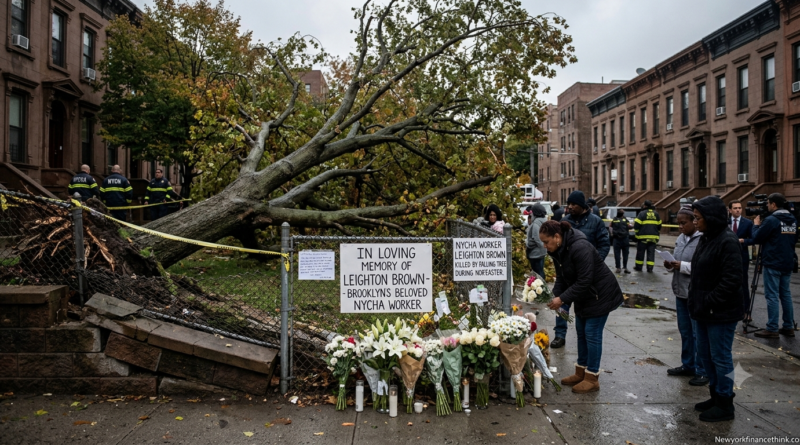
Brooklyn Storm Tragedy: Beloved NYCHA Worker Leighton Brown Killed by Falling Tree During Nor’easter
By Dr. Abhishek Bhatt
NewYorkFinanceThink.com
September 28, 2026
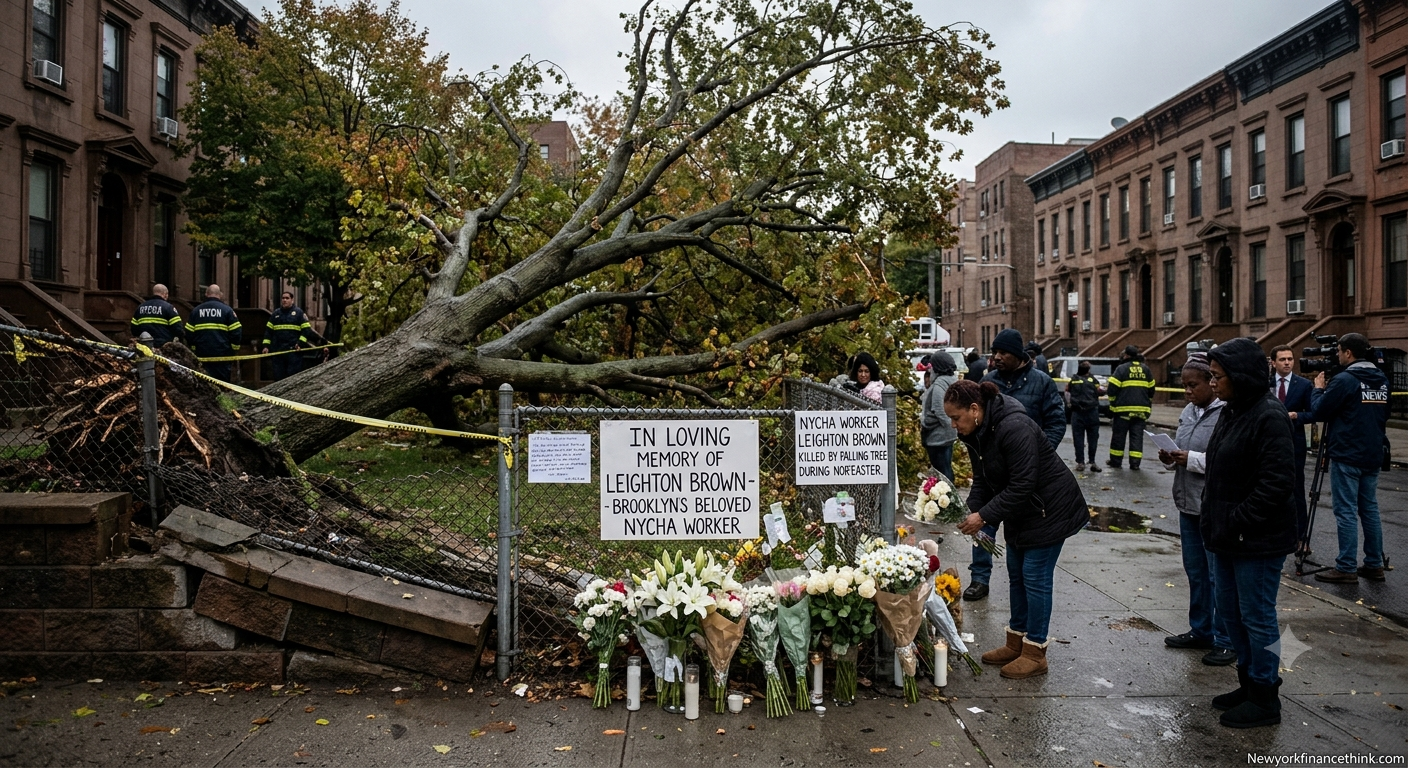
A powerful late-September nor’easter brought heavy rain, dangerous winds and widespread tree damage across New York City over the weekend. In Brooklyn, the storm also brought a deeply personal tragedy to the Cypress Hills community.
Leighton Brown, a 56-year-old New York City Housing Authority employee, was killed Saturday after a large tree fell on him at the Cypress Hills Houses in East New York.
Brown was in a parking lot near the NYCHA complex on Euclid Avenue when the tree came down at about 3:30 p.m., according to police and local news reports. Emergency responders rushed to the scene and worked to free him before he was transported to Brookdale Hospital, where he was later pronounced dead.
His death has left residents, coworkers, friends and neighbors grieving a man they describe as hardworking, friendly and deeply connected to the community he served.
The tragedy happened as New York City was dealing with one of the most difficult weather weekends of the season. Strong winds brought down trees in neighborhoods across the city, damaged property and created dangerous conditions for residents and workers alike.
For Brown’s friends and the people who knew him at Cypress Hills, however, the storm is now remembered for something much more painful.
It took the life of a man many residents knew simply as someone they could count on.
A Saturday Afternoon That Turned Tragic
The incident occurred at the Cypress Hills Houses in East New York, Brooklyn.
According to police and local reports, Brown was walking through a parking lot around 3:30 p.m. Saturday when a large tree fell and struck him. The exact circumstances surrounding the tree’s collapse remain part of the developing picture of the incident.
ABC7 reported that the deadly incident occurred during the nor’easter and that damaging wind gusts were present in the area, although authorities had not established that wind alone caused the tree to fall.
News 12 reported that the tree came down at the Cypress Hills development and pinned Brown to the ground. First responders arrived quickly, with emergency crews working at the scene before Brown was transported to Brookdale Hospital.
The emergency response was a frightening scene for people living nearby.
A falling tree is dangerous under ordinary circumstances. During a major storm, however, the danger can increase dramatically because saturated ground, weakened branches and powerful gusts can create unpredictable hazards.
Residents were already dealing with the sounds and sights of a city under pressure from the storm.
Then came another emergency call.
This time, someone had been struck by a tree.
And the victim was not a stranger to the community.
He was a NYCHA worker.
He was someone many residents recognized.
He was someone they had spoken with before.
And, according to people who knew him, he was someone who took pride in helping others.
The Man Behind the Tragedy
Leighton Brown was 56.
But the early reporting about his death quickly became more than a story about a storm casualty.
Residents began talking about who Brown was.
News 12 reported that longtime Cypress Hills residents remembered him as a hardworking and friendly man. One resident described him as funny and said he would stop to talk when they saw him.
Spectrum News NY1 reported that tenant association president James Alcivar described Brown as one of the best employees at the Cypress Hills development.
Residents knew where to find him when something needed to be fixed.
They knew his face.
They knew his work.
They knew his presence around the development.
That familiarity matters in public housing communities.
A maintenance worker is often more than an employee performing a job.
Maintenance staff can become part of the everyday rhythm of a neighborhood.
They enter buildings.
They respond to problems.
They hear complaints.
They fix doors, lights, plumbing problems and other issues.
They speak with residents who may have lived in the same development for years.
They see families grow.
They become familiar faces.
That is why the death of a worker such as Brown can feel different from a distant tragedy.
Residents are not simply hearing about a person they never knew.
They are mourning someone whose face may have been part of their daily lives.
The Extra Shift
One of the most painful details surrounding Brown’s final day came from a friend who said Brown had returned to work after being asked to come in for an extra shift.
ABC7 reported that Brown’s neighbor and friend said he had seen Brown shortly before the fatal incident and that Brown told him he had to return to work because he had taken an extra shift.
That account has become one of the most heartbreaking parts of the story.
At the same time, reporting has cautioned that it was not immediately clear whether Brown was officially on duty when the tree struck him. NBC New York reported that Brown was walking through a parking lot and that his duty status at the moment of the incident had not initially been established.
That distinction is important.
In a developing news story, details can emerge gradually. Statements from friends, witnesses, police, employers and officials may describe different parts of an incident.
What is clear is that Brown was a NYCHA employee, that he was at the Cypress Hills Houses when the tree fell, and that he died after being struck.
NYCHA confirmed his employment and expressed condolences to his family and the wider NYCHA community.
For the people who knew him, the circumstances make his death especially difficult to process.
A person leaves home.
They tell someone they are going back to work.
They expect to return later.
And then an ordinary workday becomes a final day.
The Storm Over New York City
Brown’s death occurred during a powerful nor’easter that affected New York City and the broader Tri-State region.
The storm brought heavy rain, strong winds and coastal flooding concerns.
New York officials warned residents about dangerous conditions as the storm intensified.
News 12 reported that winds were expected to reach up to 60 mph at the height of the storm, while flooding remained a major concern in low-lying areas.
Brooklyn saw numerous examples of the storm’s destructive force.
Trees came down.
Branches broke.
Roadways became difficult to navigate.
Flooding affected parts of the city.
Emergency workers were called to multiple locations.
For residents, the storm was an inconvenience.
For emergency workers and maintenance crews, it was a working environment filled with hazards.
And for Brown, that hazardous environment became fatal.
Hundreds of Tree Problems Across the City
The scale of the storm’s tree damage shows why officials were so concerned.
New York City’s Parks Department reported hundreds of service requests involving damaged or fallen trees.
NBC New York reported that by 6 p.m. Saturday, the Parks Department had received 979 service requests involving damaged or fallen trees, including 356 reports of downed trees. Officials noted that some reports could be duplicates.
News 12 separately reported that Brooklyn had received 121 service requests involving fallen trees by 7 p.m. Saturday, although those reports could also include duplicates.
Those numbers tell only part of the story.
Every fallen tree can create a chain of problems.
A tree can block a street.
It can bring down power lines.
It can damage a parked vehicle.
It can hit a house.
It can block sidewalks.
It can trap people.
And in the worst cases, it can kill someone.
That is why trees become one of the most dangerous parts of a major windstorm.
The danger is not always visible before the tree falls.
A tree may look stable.
A branch may appear healthy.
The ground around the roots may seem normal.
But strong winds can expose weaknesses that are difficult to see from the ground.
The Human Cost of Storm Response
The public often sees emergency workers after a storm.
We see firefighters clearing debris.
We see sanitation crews moving through flooded streets.
We see utility workers restoring electricity.
We see Parks Department crews cutting fallen trees.
We see police officers managing traffic.
But behind every storm response is a person who has to physically enter a dangerous environment.
That worker has a family.
That worker has friends.
That worker has a home.
That worker has plans for the next day.
Storm response is necessary.
Cities cannot simply stop functioning when bad weather arrives.
Housing developments still need maintenance.
Elevators still need attention.
Buildings still need inspections.
Water leaks still need repairs.
Residents still need assistance.
Emergency calls still have to be answered.
But Brown’s death is a reminder that the people doing that work are exposed to the same hazards that officials are warning the public about.
They do not get to watch the storm from a safe window.
They are often outside in it.
Cypress Hills Remembers
For the Cypress Hills community, Brown’s death was immediate and personal.
Neighbors gathered around the scene.
Emergency vehicles arrived.
The normal sounds of the development were replaced by sirens and emergency activity.
Residents watched as first responders worked to reach Brown.
News 12 reported that a nearby resident described Brown as hardworking, friendly and someone residents knew well.
NY1 reported that tenant association president James Alcivar said Brown was someone residents relied on when they needed work done in their homes.
That kind of reputation is not created in one day.
It comes from repeated interactions.
A worker earns trust by showing up.
By answering questions.
By fixing problems.
By treating people with respect.
By doing the job even when the work is difficult.
The community’s reaction suggests that Brown had built that kind of relationship over time.
A Promotion That Will Never Be Celebrated
Another detail reported after Brown’s death adds another layer of sadness.
According to ABC7, friends said Brown had been excited because he was approaching his final week at the NYCHA complex after receiving a promotion.
A promotion usually represents progress.
It means recognition.
It means a new chapter.
It means a worker has something to look forward to.
For Brown, that future was suddenly taken away.
Instead of celebrating a professional transition, friends and neighbors are now remembering him.
The contrast is painful.
One week can contain plans for the future.
The next can contain grief.
That is one of the hardest realities of sudden death.
There is no gradual goodbye.
There is no final meeting.
There is simply a normal day that ends in tragedy.
The Last Conversation
For one of Brown’s friends, the memory of his final conversation has become particularly difficult.
ABC7 reported that Brown’s neighbor said he had spoken with him shortly before Brown returned to work.
The friend remembered Brown saying that he had to go back because he was working an extra shift.
The conversation seemed ordinary at the time.
That is what makes it so painful afterward.
Most final conversations do not sound like final conversations.
People talk about work.
They talk about plans.
They talk about dinner.
They talk about tomorrow.
They say goodbye without knowing that the goodbye will become permanent.
The friend also recalled Brown saying words that now carry a different meaning.
Those memories are likely to stay with the people closest to him for years.
Another Brooklyn Tree Accident
Brown’s death was not the only serious tree-related incident during the storm.
Later Saturday, four people were injured when a falling tree struck near Kelly Park Playground in Brooklyn.
FDNY officials said the incident occurred around 5:30 p.m. in the area of East 14th Street and Avenue S in the Homecrest section. The injured people were taken to Maimonides Medical Center with minor injuries, according to local reporting.
The two incidents demonstrated how quickly storm conditions could turn ordinary public spaces into dangerous areas.
A playground.
A parking lot.
A sidewalk.
A street.
Any location with large trees can become hazardous when wind conditions deteriorate.
That is why authorities repeatedly urge people to avoid unnecessary travel during severe weather and to stay away from damaged trees and downed power lines.
Questions About Tree Safety
The tragedy is also raising questions among some residents about tree maintenance.
News 12 reported that some residents said trees around the Cypress Hills development had been marked with X’s, apparently indicating that they may have been scheduled for removal because of safety concerns.
It remained unclear whether the tree that killed Brown was among those marked.
That distinction is important.
The fact that a tree may have been marked does not by itself establish that officials knew it was dangerous, that it was scheduled for removal, or that its fall could have been prevented.
Those questions require investigation and evidence.
A fallen tree does not automatically mean someone was negligent.
Storms can cause trees to fail unexpectedly.
At the same time, communities have legitimate reasons to ask whether dangerous trees were previously identified and whether appropriate inspections and maintenance procedures were followed.
Those are questions for officials, investigators and relevant agencies to answer.
The responsible approach is to separate those questions from the confirmed facts of Brown’s death.
What Officials Know So Far
The basic facts reported by authorities are straightforward.
Brown was 56 years old.
He was a NYCHA employee.
He was at the Cypress Hills Houses in East New York.
A tree fell on him around 3:30 p.m. Saturday.
He was transported to Brookdale Hospital.
He died from the incident.
NYCHA confirmed his employment and expressed condolences.
The incident occurred during a major nor’easter affecting New York City.
The exact cause of the tree’s failure has not been publicly established in the reports reviewed for this article.
That last point matters.
It is tempting after a tragedy to immediately assign blame.
But good journalism requires patience.
Investigators need to determine what happened.
Was the tree healthy?
Was there prior damage?
Was the ground saturated?
Were there previous complaints?
Was the tree inspected?
Was it already scheduled for maintenance?
What were the exact wind conditions at the location?
Was Brown working at the time?
Was he traveling between work locations?
Was he simply walking through the parking lot?
Those questions may take time to answer.
NYCHA’s Response
The New York City Housing Authority confirmed that Brown was an employee.
In a statement reported by multiple outlets, NYCHA said it was deeply saddened by the loss and extended condolences to Brown’s family and the NYCHA community.
That response reflects the fact that Brown’s death affects more than his immediate family.
It affects coworkers.
It affects residents.
It affects the people who knew him.
It affects the larger public housing workforce.
Every employee lost in a workplace-related tragedy leaves behind colleagues who have to continue doing their jobs while processing grief.
For a maintenance team, that can be particularly difficult.
The people who worked alongside Brown may return to the same buildings.
They may walk through the same hallways.
They may see the same tools.
They may receive the same kinds of maintenance requests.
But one familiar person will no longer be there.
A City Built Around Trees
New York City is one of the world’s largest urban environments, but it is also a city filled with trees.
Trees line residential streets.
They surround parks.
They grow beside public housing developments.
They stand near schools.
They occupy sidewalks and courtyards.
Most of the time, trees are a valuable part of urban life.
They provide shade.
They improve neighborhood appearance.
They provide habitat for birds and insects.
They can help reduce urban heat.
They contribute to the character of neighborhoods.
But trees also require maintenance.
A large urban tree can become a significant hazard if it becomes diseased, structurally compromised or destabilized by weather.
Extreme weather can make that risk much greater.
Why Wind Makes Trees Dangerous
Strong wind puts enormous physical stress on trees.
The branches act like sails.
The trunk has to absorb movement.
The root system has to hold the entire structure in the ground.
If the soil becomes saturated, the stability of the root system can change.
If branches are already damaged, wind can break them.
If a tree has internal decay, its structural strength may be lower than its appearance suggests.
That is why severe wind can produce sudden failures.
And once a large tree begins to fall, people nearby may have only seconds to react.
Brown’s death demonstrates the seriousness of that risk.
He was walking through a parking lot.
There was no indication that he had time to anticipate what was coming.
Then the tree fell.
The Importance of Storm Awareness
The tragedy also offers a broader reminder for New Yorkers.
During severe wind events, people should take warnings seriously.
That means avoiding unnecessary trips.
It means staying away from large trees during the strongest winds.
It means avoiding damaged trees after the storm.
It means staying away from downed electrical wires.
It means reporting dangerous conditions.
And it means understanding that the danger may continue after the rain stops.
A tree that has partially fallen can remain unstable.
A broken branch may still be hanging overhead.
A tree that looks damaged but standing can collapse later.
For that reason, residents should not attempt to cut or move large storm-damaged trees themselves.
Emergency and municipal crews have equipment and procedures for dealing with these situations.
The Work of Storm Crews
While the public is encouraged to remain indoors during dangerous conditions, city workers have another responsibility.
They have to respond.
News 12 reported that Parks Department crews were working 12-hour shifts during the nor’easter to respond to downed trees and other storm-related hazards.
That work is physically demanding.
It can involve chainsaws, heavy branches, blocked roads, damaged sidewalks and unstable trees.
Workers must assess whether a tree is safe to approach.
They must secure an area.
They must remove debris.
They must protect pedestrians.
They must coordinate with other agencies.
The public often notices the finished result — a clear road, a clean sidewalk, a restored park.
What is less visible is the danger involved in making that restoration possible.
Brown’s death puts that hidden risk into focus.
The Meaning of Public Service
There is a larger lesson in the way residents described Brown.
People remembered him not because of a title.
They remembered him because he helped people.
That is often how public service is experienced at the neighborhood level.
A resident may never meet the head of an agency.
They may never speak with a mayor.
They may never attend a city government meeting.
But they know the maintenance worker who fixes their apartment door.
They know the cleaner who keeps the building functioning.
They know the worker who responds when something breaks.
They know the person who shows up.
Brown was apparently one of those people.
His service was local.
It was practical.
And it mattered.
Grief Inside a Public Housing Community
Public housing communities are neighborhoods.
They are not simply buildings.
Residents create relationships with each other.
Workers become familiar.
Children grow up knowing staff members.
Older residents may depend on familiar employees for help with routine problems.
That creates a sense of community.
When someone dies suddenly, especially under traumatic circumstances, the impact can spread quickly.
People tell stories.
They remember conversations.
They share photographs.
They talk about the person’s personality.
They remember small acts of kindness.
They ask what happened.
And they wonder how such a tragedy could happen in a place they know so well.
The grieving process can be particularly intense when the victim was someone people saw regularly.
The Family Left Behind
Beyond the workplace and the community is Brown’s family.
News reports have focused largely on the circumstances of the accident and the reactions of neighbors and coworkers.
But behind every news story about a sudden death is a family facing an entirely different reality.
A family does not experience a tragedy as a headline.
They experience it as an empty chair.
A phone that will not ring.
A routine that has changed.
A future that has suddenly become uncertain.
The public may eventually move on to the next story.
The family does not.
For them, the storm will likely always be associated with September 2026.
A date.
A place.
A phone call.
A memory.
A Final Week That Became a Final Day
The reported promotion makes the loss particularly difficult.
Brown was reportedly looking forward to moving into a new professional chapter.
He had work ahead of him.
Friends said he was excited.
There were plans.
There was a future.
Then a tree fell.
The tragedy reminds us that the future is never guaranteed.
It also reminds us why workers deserve recognition not only when something goes wrong, but every day.
The people who maintain housing developments, streets, parks and public facilities are essential to the functioning of a city.
Their work may not always make headlines.
But without it, everyday life would quickly become much harder.
What Happens Next?
Authorities and agencies will continue examining the circumstances surrounding the death.
Questions about the tree, the weather, the location and Brown’s work status may become clearer as officials review the incident.
If additional information is released, it should be evaluated carefully.
At this stage, it is important not to turn unanswered questions into established facts.
The public deserves accurate information.
Brown’s family deserves accurate information.
His coworkers deserve accurate information.
And the community deserves to know what happened.
If an investigation identifies a specific problem, officials can then determine whether changes are necessary.
That could involve tree inspections.
Maintenance schedules.
Storm protocols.
Worker safety procedures.
Emergency communication.
Or other measures.
But those conclusions should follow evidence.
Remembering Leighton Brown
In the immediate aftermath, however, the most important thing is not speculation.
It is remembrance.
Leighton Brown was 56.
He worked for NYCHA.
He served residents at Cypress Hills.
People who knew him described him as hardworking, friendly and dependable.
Friends remembered conversations with him.
Residents remembered his willingness to help.
Coworkers lost a colleague.
A community lost a familiar face.
A family lost someone they loved.
And a city lost a worker who was doing the kind of everyday public service that often goes unnoticed until the person is suddenly gone.
The storm will eventually pass.
The trees will be cleared.
Roads will reopen.
Floodwaters will recede.
Power will be restored.
The city will return to its normal rhythm.
But for the people who knew Brown, there will be no return to normal.
There will simply be a new normal without him.
The Human Story Behind a Storm
Weather stories are often reported through numbers.
Wind speed.
Rainfall totals.
Flood levels.
Power outages.
Downed trees.
Emergency calls.
But behind those numbers are people.
A tree is not simply a fallen tree when it lands on someone’s life.
A storm is not simply a weather system when it takes away a father, friend, neighbor or coworker.
That is why Brown’s death deserves to be remembered as more than another statistic from a difficult weather weekend.
He was a person.
He had a job.
He had relationships.
He had plans.
He had people who cared about him.
And according to friends, he was still thinking about work and his future on the very day his life ended.
A Reminder for New York
The tragedy should also encourage a broader conversation about urban storm preparedness.
New York is increasingly familiar with severe weather.
Heavy rain events can produce flooding.
Strong winds can bring down trees.
Coastal storms can disrupt transportation.
Extreme weather can place enormous pressure on city infrastructure.
Preparedness therefore cannot stop with warnings.
It also involves maintenance.
Inspection.
Communication.
Emergency response.
Worker protection.
Public awareness.
And coordination between agencies.
No system can eliminate every risk.
But cities can learn from tragedies.
Each serious incident provides information about where systems worked and where additional questions need to be asked.
Brown’s death is now part of that conversation.
A Community Says Goodbye
There is something especially painful about the way Brown’s story unfolded.
He was not a tourist caught in an unfamiliar city.
He was not a stranger passing through.
He was part of the neighborhood.
People knew him.
People spoke with him.
People relied on him.
That is why his death feels so close to home for Cypress Hills residents.
The man who had been part of their daily lives was suddenly gone.
The parking lot where people once walked without thinking about danger became the site of a tragedy.
The tree that had stood there became the center of an investigation.
And a storm that had already disrupted the city became permanently connected to the memory of one man.
Final Thoughts
Leighton Brown’s death is a painful reminder of how quickly a severe storm can change a life.
He was 56 years old.
He was a NYCHA employee.
He was killed after a falling tree struck him at the Cypress Hills Houses in East New York during the September 26 nor’easter.
Emergency responders rushed to help him, but he later died at Brookdale Hospital.
His neighbors and friends remember him as hardworking, friendly and committed to his work.
One friend said Brown had returned for an extra shift, although reporting also noted that his official duty status at the moment of the incident had not initially been established.
The details of the storm will eventually fade.
The wind speeds will become old weather data.
The photographs of fallen trees will disappear from front pages.
The city will clean up.
But Brown’s name will remain with the people who knew him.
His coworkers will remember him.
Residents will remember him.
His friends will remember him.
His family will remember him.
And Cypress Hills will remember the day when a familiar worker went out during a dangerous storm and never came home.
That is the human side of severe weather.
It is not only about wind, rain, flooding and damaged trees.
It is about people.
And this weekend, Brooklyn lost one of its own.
May Leighton Brown rest in peace.
NewYorkFinanceThink.com extends its condolences to the Brown family, his friends, coworkers, and the entire NYCHA and Cypress Hills community.
