

Federal Reserve Interest-Rate Cuts and Hikes 2026: What They Mean for Investors, Borrowers and the U.S. Economy
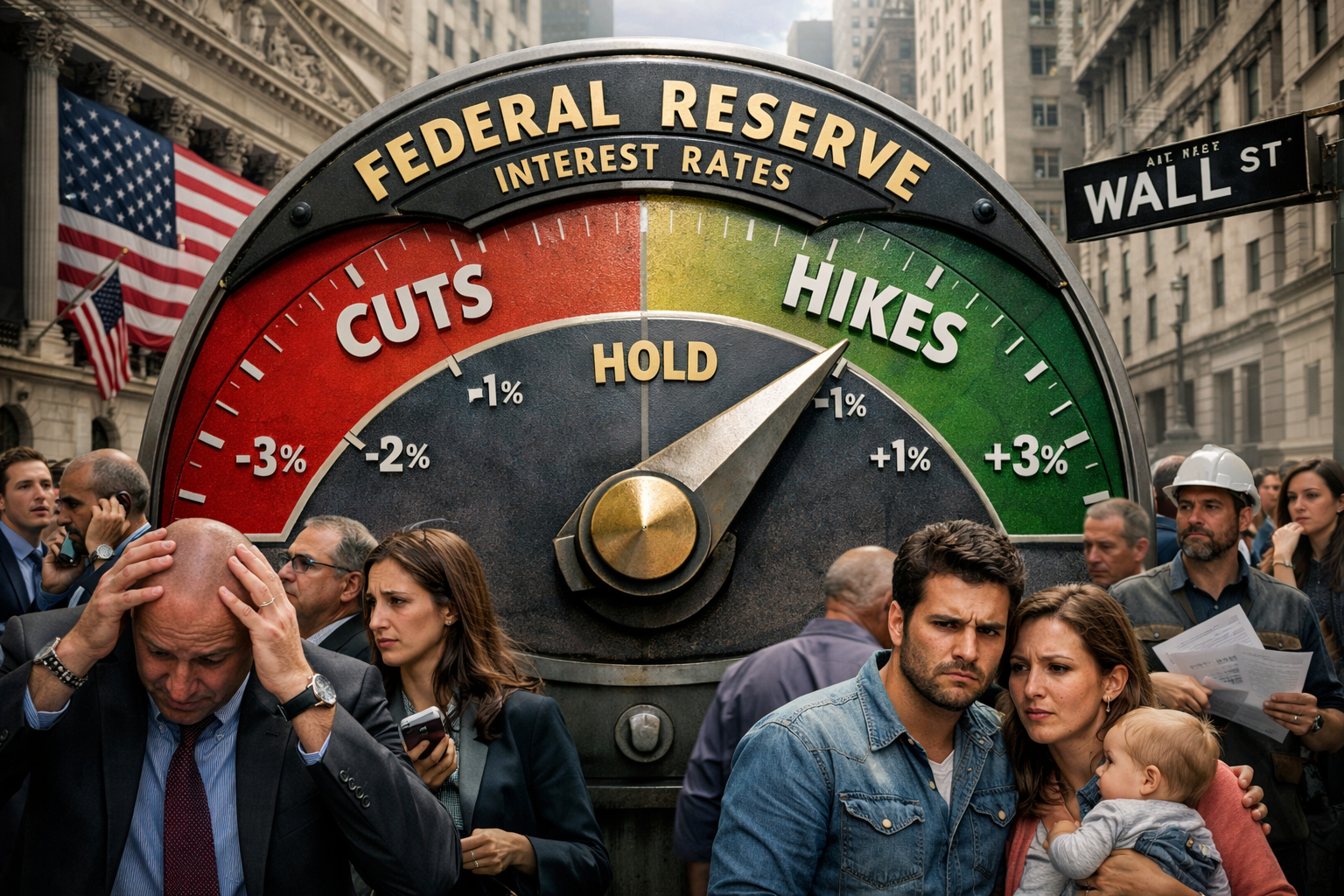
Part 3 of 6 — Fed & Interest Rates Series
Updated: October 8, 2026
By: NYFT News Desk
Introduction
When the Federal Reserve changes interest rates, the decision can look like a small number on a financial-news screen.
A quarter-point move may appear insignificant.
For American households, investors, businesses and financial markets, however, it can have consequences that stretch across the economy.
A Federal Reserve rate hike can make borrowing more expensive. It can eventually reduce demand, slow inflation and influence the prices of stocks, bonds, homes and other assets.
A rate cut can work in the opposite direction. Lower rates can reduce some borrowing costs, support economic activity and make financial conditions easier. But a rate cut is not automatically good news. Sometimes the Fed cuts because the economy is weakening, unemployment is rising or financial risks are becoming more serious.
That is why investors should never look at a rate cut or hike in isolation.
The important questions are:
- Why did the Federal Reserve change rates?
- What was happening with inflation?
- What was happening with jobs?
- Was economic growth strengthening or weakening?
- Was the decision expected?
- What did Fed officials signal about future decisions?
- How quickly will the change affect consumers and businesses?
- What does the decision mean for stocks, bonds and the U.S. dollar?
This guide explains the entire process in simple language.
As of October 8, 2026, the Federal Reserve’s latest completed FOMC decision came on September 16, when policymakers raised the federal funds target range by 25 basis points to 3.75%–4.00%. The decision was unanimous, with a 12–0 vote.
The next scheduled FOMC meeting is October 27–28, 2026.
Key Takeaways
- A rate hike generally makes borrowing more expensive and is normally used when the Fed wants to reduce inflationary pressure.
- A rate cut generally makes financial conditions easier and can support borrowing, spending and investment.
- One basis point equals 0.01 percentage point.
- A 25-basis-point move equals 0.25 percentage point.
- The federal funds rate does not directly determine every consumer interest rate.
- Mortgage rates, credit-card rates, auto-loan rates and business-loan rates can respond differently and at different speeds.
- Stock markets react not only to the Fed’s decision but also to expectations about future policy.
- A rate hike does not automatically mean stocks will fall.
- A rate cut does not automatically mean stocks will rise.
- The economic reason behind a policy move is often more important than the move itself.
- The Fed’s September 2026 projections showed a median federal funds rate of 4.1% for the end of 2026, 4.1% for 2027, 3.9% for 2028 and 3.6% for 2029. These are projections, not promises.
1. What Is a Federal Reserve Interest-Rate Decision?
The Federal Reserve conducts monetary policy through the Federal Open Market Committee, commonly called the FOMC.
The FOMC decides the target range for the federal funds rate.
The federal funds rate is the interest rate at which banks lend balances held at the Federal Reserve to one another, generally overnight.
Although ordinary consumers do not normally walk into a bank and borrow money at the federal funds rate, changes in this benchmark can influence broader financial conditions.
That is where the important connection begins.
A Fed decision can influence:
- short-term borrowing costs,
- bank lending rates,
- credit-card rates,
- business financing,
- consumer loans,
- savings rates,
- bond yields,
- mortgage markets,
- stock valuations,
- the U.S. dollar,
- investment decisions,
- economic growth,
- employment,
- inflation expectations.
The Fed therefore does not simply change “the interest rate.”
It changes an important part of the financial environment in which the American economy operates.
2. What Is a Rate Hike?
A rate hike occurs when the Federal Reserve raises its target range for the federal funds rate.
For example, suppose the target range moves from:
3.50%–3.75%
to:
3.75%–4.00%
That is a 25-basis-point increase.
The Fed made exactly this type of move in September 2026, raising the target range to 3.75%–4.00%.
A rate hike generally makes financial conditions tighter.
That can mean:
- borrowing becomes more expensive,
- consumers may reduce discretionary spending,
- businesses may delay investment,
- demand may cool,
- inflationary pressure may decline over time.
The objective is not necessarily to hurt the economy.
The objective is to prevent the economy from overheating or to bring inflation back toward the Fed’s longer-run 2% objective.
3. Why Does the Fed Raise Interest Rates?
The most common reason is inflation.
Imagine an economy in which prices are rising too quickly.
Consumers are spending strongly.
Businesses are raising prices.
Workers are demanding higher wages.
Housing costs are increasing.
Energy prices are rising.
Businesses are competing aggressively for labor and materials.
If inflation becomes persistent, the Federal Reserve may decide that demand needs to cool.
Higher interest rates are one way to accomplish that.
The basic chain
Fed raises rates → borrowing becomes more expensive → demand may slow → price pressure may ease → inflation may move lower.
But monetary policy works with a delay.
A rate hike made today does not instantly reduce the price of groceries tomorrow.
The effect can spread through the economy over months.
4. What Is a Rate Cut?
A rate cut occurs when the Federal Reserve lowers its target range for the federal funds rate.
For example:
4.50%–4.75% → 4.25%–4.50%
would represent a 25-basis-point reduction.
The Federal Reserve can cut rates when policymakers believe financial conditions are too restrictive or when the economy needs additional support.
Possible reasons include:
- weakening economic growth,
- rising unemployment,
- declining inflation,
- financial stress,
- recession risks,
- deteriorating credit conditions,
- an excessive slowdown in demand.
But there is an important point beginners should remember:
A rate cut is not automatically bullish.
If the Fed cuts because inflation is falling while economic growth remains healthy, markets may view the decision positively.
If the Fed cuts because unemployment is rising sharply and recession risks are increasing, markets may react negatively.
The same 25-basis-point cut can therefore have completely different meanings.
5. What Does 25 Basis Points Mean?
Financial markets use the term basis point, or bp, to describe small changes in interest rates.
1 basis point
= 0.01 percentage point
25 basis points
= 0.25 percentage point
50 basis points
= 0.50 percentage point
75 basis points
= 0.75 percentage point
100 basis points
= 1 percentage point
This is why a news headline might say:
“Fed raises rates by 25 basis points.”
It means the rate increased by 0.25 percentage point.
6. Why Does the Fed Sometimes Move by 25, 50 or 75 Basis Points?
The size of the move can communicate how seriously policymakers view economic conditions.
A 25-basis-point move is often considered a relatively standard adjustment.
A 50-basis-point move is larger.
A 75-basis-point move is substantially larger.
The Fed does not have a rule saying it must always move by 25 basis points.
Policymakers consider:
- inflation,
- employment,
- economic growth,
- financial conditions,
- credit markets,
- global developments,
- inflation expectations,
- financial stability risks.
The larger the move, the stronger the policy adjustment.
7. The Difference Between Restrictive and Accommodative Policy
One of the most important terms in Fed analysis is restrictive monetary policy.
When rates are high enough to slow economic activity, policy is generally described as restrictive.
The opposite is accommodative monetary policy.
Accommodative policy means financial conditions are designed to support economic activity.
Think of it this way:
Restrictive = applying the brakes
Accommodative = pressing the accelerator
The Fed does not literally control the entire economy with one rate.
Instead, monetary policy influences financial conditions that affect households, companies and investors.
8. How a Rate Hike Moves Through the Economy
The process is not instantaneous.
Consider a simplified chain:
Step 1: The Fed raises its policy rate
The FOMC increases the federal funds target range.
Step 2: Short-term financial rates respond
Money-market rates and other short-term rates can adjust.
Step 3: Banks and lenders reassess pricing
Some lending rates increase.
Step 4: Borrowing becomes less attractive
Consumers and businesses may decide to postpone borrowing.
Step 5: Spending can slow
Less borrowing can mean less spending.
Step 6: Business investment can slow
Companies may delay expansion projects if financing becomes more expensive.
Step 7: Demand can cool
Slower demand can reduce pricing pressure.
Step 8: Inflation may eventually decline
The final objective is to bring inflation toward price stability without causing unnecessary damage to employment and economic growth.
9. How a Rate Cut Moves Through the Economy
A rate cut can work in the opposite direction.
Step 1
The Fed lowers the federal funds target.
Step 2
Short-term financial conditions can become easier.
Step 3
Some borrowing costs decline.
Step 4
Consumers may find borrowing more attractive.
Step 5
Businesses may become more willing to invest.
Step 6
Housing activity can improve if mortgage rates also decline.
Step 7
Demand can strengthen.
Step 8
Economic growth may receive support.
Again, the process is not guaranteed.
Banks still consider credit risk.
Mortgage rates depend heavily on longer-term bond markets.
Consumers may remain cautious.
Businesses may not borrow if they do not expect sufficient demand.
Therefore, a Fed cut does not automatically produce a boom.
10. Why the Fed Does Not Simply Keep Rates Low Forever
At first glance, low interest rates sound attractive.
Cheap loans.
Cheap mortgages.
Cheap business financing.
Strong stock markets.
More economic activity.
But there is a problem.
If money remains too cheap while demand is already strong, inflation can become difficult to control.
Consumers may spend aggressively.
Businesses may raise prices.
Asset prices may rise rapidly.
Credit growth can become excessive.
The economy can begin running beyond its sustainable capacity.
The Fed therefore has to balance two major objectives.
Price stability
The Fed wants inflation to return to its 2% longer-run goal.
Maximum employment
The Fed also wants labor-market conditions consistent with maximum employment.
This is commonly called the Fed’s dual mandate.
The September 2026 FOMC decision explicitly referred to supporting the Fed’s dual mandate.
11. Why the Fed Does Not Simply Raise Rates Until Inflation Hits Zero
Because zero inflation is not the Fed’s stated long-run goal.
The Federal Reserve has a 2% longer-run inflation goal, measured by the annual change in the Personal Consumption Expenditures price index.
The objective is price stability, not permanently falling prices.
Deflation can create its own economic problems.
Consumers may postpone purchases.
Business revenue can weaken.
Debt becomes harder to repay in real terms.
Wages can come under pressure.
Economic activity can deteriorate.
Therefore, the Fed generally aims for stable, low inflation rather than zero inflation.
12. What Happened in September 2026?
The September 15–16, 2026 FOMC meeting provides an important current example.
The Federal Reserve raised the target range by 25 basis points to:
3.75%–4.00%.
The vote was:
12–0.
The Fed said economic activity was expanding at a solid pace, domestic spending remained resilient, productivity growth was strong and capital investment was robust.
At the same time, the Fed said inflation remained elevated.
That combination is important.
The economy was not being described as collapsing.
Instead, policymakers were concerned that inflation remained above the desired level.
13. Why September 2026 Matters
The September decision demonstrates why investors should look beyond the headline.
The headline was:
Fed raises rates by 25 basis points.
But the deeper message involved several issues.
The minutes said policymakers saw:
- elevated inflation,
- a labor market near maximum employment,
- solid economic activity,
- resilient domestic spending,
- strong productivity,
- robust capital investment,
- risks from energy prices,
- potential inflation risks from tariffs,
- potential demand pressure related to AI investment.
The minutes also said some participants believed the policy rate was not restrictive or was only mildly restrictive.
That is much more informative than the rate number alone.
14. How Rate Hikes Affect Inflation
Inflation is one of the biggest reasons investors follow Fed policy.
Suppose consumer demand is growing faster than the economy’s ability to produce goods and services.
Businesses may raise prices.
If higher rates reduce demand, businesses may have less ability to keep increasing prices.
This can eventually reduce inflation.
But there are complications.
Not every inflation problem is caused by excessive demand.
Inflation can also come from:
- energy shocks,
- supply shortages,
- tariffs,
- transportation disruptions,
- geopolitical conflicts,
- food-price shocks,
- housing shortages.
Interest rates cannot directly produce more oil, semiconductor chips or housing units.
That is why monetary policy can be powerful but not perfect.
15. Rate Hikes and Employment
Higher rates can affect employment indirectly.
If consumers spend less, businesses may experience slower sales.
If companies face weaker demand, they may slow hiring.
If borrowing becomes expensive, companies may reduce expansion.
Over time, job creation can weaken.
That creates a difficult problem for the Fed.
If inflation is high but employment is strong, the Fed may tolerate tighter policy.
If inflation falls but unemployment rises quickly, policymakers may become more concerned about the labor market.
The balance changes over time.
16. Rate Cuts and Employment
Rate cuts can support employment by making financial conditions easier.
A company that previously postponed an expansion may reconsider.
A household may become more comfortable buying a home.
A consumer may refinance debt.
A business may borrow to purchase equipment.
Those activities can support economic demand.
Stronger demand can encourage businesses to hire.
But again, rate cuts cannot guarantee job growth.
If consumers and businesses are deeply worried about the economy, they may not borrow even when rates fall.
17. Rate Hikes and GDP Growth
GDP measures the value of goods and services produced in the economy.
Higher interest rates can slow GDP growth by reducing:
- consumer spending,
- residential construction,
- business investment,
- credit growth,
- interest-sensitive purchases.
The goal is not necessarily to eliminate growth.
The goal is to slow excessive demand when necessary.
18. Rate Cuts and GDP Growth
Rate cuts can support GDP by encouraging:
- consumer borrowing,
- business investment,
- housing activity,
- refinancing,
- capital expenditure.
However, the impact depends on why the Fed is cutting.
A cut during a healthy disinflationary environment can support a “soft landing.”
A cut during a recession can be more defensive.
This is why market participants study the reason for the cut.
19. What Is a Soft Landing?
A soft landing occurs when the Federal Reserve manages to reduce inflation without causing a severe recession.
In simple language:
Inflation comes down + economic growth continues + unemployment does not surge.
That is one of the most difficult outcomes for a central bank to achieve.
If the Fed tightens too little, inflation may remain high.
If it tightens too much, economic growth may weaken excessively.
The challenge is finding the right balance.
20. What Is a Hard Landing?
A hard landing generally refers to a sharp economic slowdown or recession following aggressive monetary tightening.
Possible symptoms include:
- rising unemployment,
- declining business investment,
- falling consumer spending,
- weak housing activity,
- tighter credit,
- declining corporate profits.
A hard landing is not guaranteed after a rate-hiking cycle.
The economy can sometimes absorb higher rates without a major recession.
21. Why Interest Rates Matter for the Stock Market
Stocks represent ownership in companies.
Company values depend partly on expected future profits.
Interest rates affect those valuations in several ways.
Higher rates can:
- increase financing costs,
- reduce demand,
- lower profit expectations,
- increase the attractiveness of bonds and cash,
- raise the discount rate applied to future earnings.
Lower rates can have the opposite effect.
But stock prices depend on many variables beyond Fed policy.
These include:
- earnings,
- economic growth,
- oil prices,
- geopolitical developments,
- technology investment,
- consumer demand,
- corporate guidance,
- valuations,
- investor sentiment.
Therefore:
Fed cut ≠ guaranteed stock-market rally
and
Fed hike ≠ guaranteed stock-market crash.
22. Why Growth Stocks Can Be Sensitive to Interest Rates
Growth companies often have valuations based heavily on earnings expected many years into the future.
When interest rates rise, the present value of those future earnings can decline.
That can put pressure on high-valuation growth stocks.
Technology companies are therefore often closely watched during Fed cycles.
But technology stocks can still rise during a hiking cycle if:
- earnings are extremely strong,
- demand remains robust,
- productivity improves,
- investors expect long-term growth,
- valuations already reflect higher rates.
This is why rate analysis should never be reduced to a simple “rates up, tech down” rule.
23. Rate Hikes and Banks
Banks have a complicated relationship with interest rates.
Higher rates can increase the rates banks charge borrowers.
That can support interest income.
But higher rates can also create problems.
Borrowers may struggle with debt.
Loan demand can weaken.
Bond portfolios can lose value when yields rise.
Deposit costs can increase.
Credit losses can rise if economic conditions deteriorate.
Therefore, investors should not assume that every bank automatically benefits from a Fed hike.
24. Rate Cuts and Banks
Rate cuts can reduce lending rates.
That may support loan demand.
But banks can also see their interest income pressured.
The result depends on:
- deposit costs,
- loan pricing,
- asset mix,
- credit quality,
- yield curve conditions,
- economic growth.
Bank stocks therefore require deeper analysis than simply looking at the Fed’s decision.
25. Rate Hikes and Small-Cap Stocks
Smaller companies can be especially sensitive to borrowing conditions.
Many small businesses depend heavily on bank loans or credit lines.
When financing costs rise, their expenses can increase.
That can affect:
- profit margins,
- expansion,
- hiring,
- inventory,
- capital investment.
This is one reason small-cap stocks can sometimes react strongly to changes in financial conditions.
26. Rate Cuts and Small Businesses
Lower rates can improve financing conditions.
A restaurant might finance new equipment.
A manufacturer might purchase machinery.
A technology company might expand operations.
A construction company might finance a new project.
But the benefit depends on demand.
Cheap financing does not help much if customers stop buying.
27. How Interest Rates Affect Housing
Housing is one of the most interest-rate-sensitive areas of the economy.
Higher rates can make mortgages more expensive.
That can reduce purchasing power.
For example, a household that can comfortably afford a certain monthly payment may qualify for a smaller loan when mortgage rates rise.
As a result:
Higher mortgage rates → lower purchasing power.
But housing prices do not necessarily fall immediately.
Supply shortages can keep prices elevated.
Local employment conditions matter.
Population growth matters.
Inventory matters.
Regional differences matter.
28. Mortgage Rates Are Not the Same as the Fed Funds Rate
This is a very important beginner concept.
The Fed controls the federal funds target range.
It does not directly set the rate on every 30-year mortgage.
Mortgage rates are influenced by longer-term bond yields, mortgage-backed securities markets, inflation expectations and other financial-market conditions.
Therefore, a Fed cut does not guarantee that mortgage rates will fall by the same amount.
Similarly, a Fed hike does not necessarily cause mortgage rates to rise one-for-one.
29. Credit Cards and Fed Policy
Credit cards are often more directly connected to short-term interest-rate conditions than fixed-rate mortgages.
Many credit-card rates are variable.
When benchmark rates rise, borrowing costs for consumers can rise.
That means a household carrying a credit-card balance can face higher interest expenses.
This is especially important when rates remain elevated for a long period.
A small change in the monthly payment may seem manageable.
Over years, however, high interest can become expensive.
30. Auto Loans
Auto loans can also respond to broader interest-rate conditions.
Higher financing costs can make a vehicle more expensive to finance.
A consumer may respond by:
- buying a cheaper vehicle,
- delaying the purchase,
- making a larger down payment,
- choosing a longer loan term.
Lower rates can make financing easier.
But vehicle prices, manufacturer incentives and credit scores also matter.
31. Student Loans
The effect depends on the type of student loan.
Federal student loans generally have rules and rates that are not simply reset every time the Fed changes its policy rate.
Private student loans can have variable or fixed structures depending on the loan.
Therefore, borrowers should identify the specific type of loan before assuming a Fed move will immediately change their payment.
32. Savings Accounts and CDs
Rate hikes can be beneficial for savers.
Banks may raise rates on:
- savings accounts,
- money-market accounts,
- certificates of deposit.
But the adjustment varies by institution and product.
Some banks pass through rate changes quickly.
Others do not.
When the Fed cuts rates, savings yields can eventually decline.
This creates a trade-off.
Borrowers generally prefer lower rates.
Savers often prefer higher rates.
33. Who Usually Benefits From Higher Rates?
Potential beneficiaries can include:
- people holding cash,
- savers,
- some money-market investors,
- investors buying newly issued higher-yielding bonds,
- certain financial institutions.
But even savers face inflation risk.
A 4% savings yield is not necessarily a 4% real return if inflation is also high.
The important number for purchasing power is the difference between the nominal return and inflation.
34. Who Can Be Hurt by Higher Rates?
Potentially affected groups include:
- borrowers,
- highly leveraged companies,
- homebuyers,
- consumers carrying variable-rate debt,
- businesses dependent on credit,
- some high-growth companies,
- companies with large refinancing needs.
The impact varies significantly from person to person.
35. Who Can Benefit From Lower Rates?
Potential beneficiaries include:
- borrowers,
- homebuyers,
- businesses,
- companies refinancing debt,
- consumers with variable-rate loans,
- interest-sensitive sectors,
- some growth stocks.
But again, the reason for the cut matters.
36. Why Investors Care About Fed Expectations
Financial markets are forward-looking.
Investors do not simply ask:
“What did the Fed do today?”
They ask:
“What will the Fed do next?”
Suppose investors expect three rate cuts.
If the Fed delivers one cut and signals that more cuts are likely, stocks may respond positively.
But suppose investors expected three cuts and the Fed delivers one while signaling only one additional move.
The same one-cut decision could disappoint markets.
The difference is expectations.
37. Expected Versus Surprise Rate Moves
This is one of the most important concepts in market analysis.
Expected move
The market largely anticipated it.
Surprise move
The market did not fully anticipate it.
A surprise can produce much larger price movements.
For example:
Expected 25-bp hike + actual 25-bp hike
may generate a relatively modest reaction.
But:
Expected hold + surprise 50-bp hike
could cause a much larger market reaction.
38. Why the Fed’s Language Can Matter More Than the Rate
Sometimes the actual rate decision is already priced into financial markets.
In that situation, investors focus on:
- the statement,
- economic projections,
- the dot plot,
- the Chair’s press conference,
- the meeting minutes.
The words surrounding the decision can change expectations about the next meeting.
This is why professional market coverage continues after the headline announcement.
39. What Is a Hawkish Fed?
“Hawkish” generally means policymakers are more concerned about inflation and are more willing to maintain or increase restrictive policy.
A hawkish message can include language suggesting:
- inflation remains too high,
- rates may remain elevated,
- additional hikes are possible,
- policymakers need more evidence before cutting.
A hawkish signal can put upward pressure on some bond yields and borrowing costs.
40. What Is a Dovish Fed?
“Dovish” generally means policymakers are more focused on economic weakness or employment risks and are more comfortable with easier monetary policy.
A dovish message may suggest:
- inflation is moving closer to target,
- economic growth is weakening,
- unemployment risks are increasing,
- rate cuts could become appropriate.
Again, these labels are shorthand.
The actual FOMC language should always be examined.
41. Why a Rate Cut Can Be Bad News
This sounds contradictory, but it is important.
Suppose the Fed cuts rates because inflation has fallen gradually and economic growth remains healthy.
That could be positive.
Now consider a different situation.
Unemployment is rising rapidly.
Corporate profits are falling.
Consumers are reducing spending.
Banks are tightening lending standards.
The Fed responds by cutting rates.
The rate cut itself is supportive.
But the reason for the cut is negative.
Therefore, markets can fall even when the Fed is cutting rates.
The lesson:
Never analyze the rate move without analyzing the economy behind it.
42. Why a Rate Hike Can Sometimes Be Good News
A rate hike can signal that the economy is strong enough to handle tighter policy.
If the Fed raises rates while:
- employment remains healthy,
- consumer spending remains strong,
- business investment is robust,
- corporate earnings are solid,
investors may conclude that the economy remains resilient.
That can sometimes offset the negative valuation effect of higher rates.
Again:
Rate hike ≠ automatic recession.
43. The 2022 Hiking Cycle: A Major Modern Example
The Federal Reserve began raising rates in March 2022.
The target range moved from near-zero levels.
The Fed then delivered several large increases.
In 2022:
- March: +25 basis points
- May: +50 basis points
- June: +75 basis points
- July: +75 basis points
- September: +75 basis points
- November: +75 basis points
- December: +50 basis points
The target range reached 4.25%–4.50% by December 2022.
This period is a useful example of aggressive monetary tightening.
44. What 2022 Teaches Investors
The 2022 cycle demonstrates that interest-rate policy can change quickly when inflation becomes a major concern.
It also shows why investors should watch the speed of tightening.
A single 25-basis-point hike is one thing.
Several hikes over a short period create a completely different financial environment.
The cumulative effect matters.
45. The 2024 Cutting Cycle
The Fed began reducing rates in September 2024 with a 50-basis-point cut, moving the target range to 4.75%–5.00%.
It then delivered 25-basis-point cuts in November and December.
By the end of 2024, the target range was 4.25%–4.50%.
This provides another important lesson.
A rate cycle is not defined by one decision.
It is a sequence.
Investors need to understand where the economy is in that sequence.
46. The 2025 Rate-Cut Cycle
Federal Reserve records show additional 25-basis-point cuts in:
- September 2025,
- October 2025,
- December 2025.
The target range ended 2025 at 3.50%–3.75%.
That means the policy rate moved substantially from the restrictive levels reached earlier in the decade.
47. The 2026 Shift
The September 2026 decision was particularly notable because the Federal Reserve raised rates by 25 basis points after the rate-cut cycle of 2024 and 2025.
The official Fed rate history lists the September 17, 2026 implementation at 3.75%–4.00%.
That is an important signal for investors.
It shows that monetary policy can change direction.
A cycle of cuts does not guarantee that cuts will continue indefinitely.
If inflation becomes more persistent, the Fed can reverse course.
48. What the September 2026 Projections Show
The September 2026 Summary of Economic Projections provides another layer of information.
The median projections were:
| Indicator | 2026 | 2027 | 2028 | 2029 | Longer Run |
|---|---|---|---|---|---|
| Real GDP growth | 2.3% | 2.4% | 2.2% | 2.1% | 2.0% |
| Unemployment | 4.1% | 4.1% | 4.1% | 4.1% | 4.2% |
| PCE inflation | 3.7% | 2.3% | 2.1% | 2.0% | 2.0% |
| Federal funds rate | 4.1% | 4.1% | 3.9% | 3.6% | 3.2% |
These are median projections from individual FOMC participants, not guarantees of future policy.
The projections suggest policymakers expected inflation to decline over time while the federal funds rate also gradually moves lower.
But the September decision itself was a hike.
That distinction matters.
Current policy and future projections are not the same thing.
49. What the September 2026 Fed Minutes Tell Investors
The minutes provide additional insight into the debate inside the FOMC.
Officials discussed persistent inflation, energy-price risks, tariffs and strong demand associated with AI investment.
They also discussed the labor market.
Participants generally judged the labor market to be near maximum employment, while some noted unusually low labor-market dynamism.
This illustrates why Fed analysis requires more than reading a single headline.
The central bank is constantly balancing competing risks.
50. How Rate Hikes Affect Treasury Bonds
Bond prices and yields generally move in opposite directions.
When market interest rates rise, existing fixed-rate bonds can become less attractive compared with newly issued bonds.
Their prices can therefore fall.
When yields decline, existing bonds with higher coupons can become more attractive.
Their prices can rise.
The relationship is more complicated in real markets, because Treasury yields also depend on:
- inflation expectations,
- economic growth,
- government borrowing,
- global demand,
- risk sentiment,
- Fed expectations.
A future part of this series will examine Treasury yields in much greater depth.
51. How Rate Changes Affect the U.S. Dollar
Interest-rate expectations can influence the U.S. dollar.
If U.S. interest rates are expected to rise relative to rates elsewhere, dollar-denominated assets can become more attractive.
That can support demand for the dollar.
If U.S. rates are expected to fall, the dollar can face downward pressure.
But currency markets are global.
The dollar also depends on:
- European Central Bank policy,
- Bank of Japan policy,
- global growth,
- geopolitical risk,
- trade flows,
- investor demand for safe assets.
So the relationship is not automatic.
52. How Rate Changes Can Affect Oil and Commodities
Interest rates can influence commodity markets through several channels.
Higher rates can strengthen the dollar.
A stronger dollar can make dollar-priced commodities more expensive for international buyers.
Higher rates can also reduce economic demand.
Lower rates can support economic activity and risk appetite.
However, commodities are heavily influenced by supply.
For oil, for example, investors must consider:
- OPEC+ policy,
- geopolitical conflicts,
- production levels,
- inventories,
- transportation,
- global demand.
The Fed is only one factor.
53. What Happens to Consumers After a Rate Hike?
The impact differs by household.
A person with:
- a fixed-rate mortgage,
- no credit-card debt,
- substantial savings,
may experience a very different effect from someone with:
- variable-rate debt,
- credit-card balances,
- an adjustable-rate loan,
- plans to purchase a home.
This is why economic headlines can feel very different from one household to another.
54. What Happens to Consumers After a Rate Cut?
Borrowers may eventually see some relief.
Potential effects include:
- lower variable borrowing costs,
- improved refinancing opportunities,
- lower financing costs for some purchases,
- stronger housing affordability if mortgage rates decline,
- potentially stronger consumer spending.
But consumers should not assume every rate will immediately fall.
Lenders price loans according to their own costs and risk.
55. What Businesses Watch
Businesses closely monitor Fed policy because financing affects investment decisions.
A company deciding whether to build a new factory may consider:
- loan rates,
- bond yields,
- expected sales,
- labor costs,
- expected return on investment.
When rates are high, some projects may no longer meet the company’s required return.
When rates fall, additional projects can become financially attractive.
56. Corporate Debt and Refinancing Risk
Interest rates matter particularly for companies with large amounts of debt.
Suppose a company issued debt years ago at a low interest rate.
If that debt matures during a high-rate environment, the company may need to refinance at a much higher cost.
That can reduce profits.
Investors should therefore look beyond the Fed headline and examine corporate balance sheets.
Important metrics include:
- total debt,
- interest expense,
- debt maturity schedule,
- cash flow,
- refinancing requirements.
57. Why Rate Hikes Can Hurt Highly Leveraged Companies
A highly leveraged company has more debt relative to its financial resources.
When borrowing costs rise, interest expenses can increase.
If revenue does not grow enough to offset those costs, profitability can decline.
This is one reason investors often examine debt levels during hiking cycles.
58. Why Rate Cuts Can Help Companies Refinance
Lower borrowing costs can allow businesses to refinance existing debt at more favorable rates.
That can improve cash flow.
A company might use the savings to:
- hire employees,
- expand operations,
- invest in technology,
- pay dividends,
- repurchase shares,
- reduce debt.
The benefit depends on the company’s financial condition.
59. Rate Cuts and Stock Valuations
One reason investors sometimes like lower rates is valuation.
If the discount rate applied to future cash flows declines, the present value of those cash flows can rise.
This can be particularly important for companies whose profits are expected far in the future.
However, lower rates do not eliminate valuation risk.
A company can still be overpriced.
Strong monetary support cannot replace weak fundamentals forever.
60. Rate Hikes and Stock Valuations
Higher rates can raise the hurdle rate investors demand.
If safe assets offer higher yields, investors may require greater potential returns from stocks.
That can put pressure on valuations.
This is particularly relevant for companies trading at high price-to-earnings or price-to-sales ratios.
61. Why the S&P 500 Does Not Always Move With the Fed
The S&P 500 contains companies from many industries.
Their sensitivity to rates differs.
Technology companies may react strongly to valuation changes.
Banks respond to lending and funding conditions.
Energy companies respond heavily to commodity prices.
Healthcare companies have different drivers.
Consumer companies depend on household demand.
Therefore, a Fed move can create winners and losers inside the same index.
62. How Investors Should Analyze a Rate Hike
Instead of asking only:
“Did the Fed hike?”
ask:
1. Was the hike expected?
2. Why did the Fed hike?
3. What did officials say about inflation?
4. What did officials say about employment?
5. What happened to the dot plot?
6. Did the expected future rate path change?
7. What happened to Treasury yields?
8. What happened to the dollar?
9. What happened to stocks?
10. Did financial conditions tighten?
This approach produces a much better market analysis.
63. How Investors Should Analyze a Rate Cut
Use the same framework.
Was the cut expected?
Why did the Fed cut?
Is inflation falling?
Is unemployment rising?
Is economic growth slowing?
Did officials signal more cuts?
Did Treasury yields fall?
Did the dollar weaken?
Did credit conditions improve?
Did stocks respond positively or negatively?
The answers can reveal whether the market views the cut as supportive or defensive.
64. The Biggest Mistake Beginners Make
One of the biggest mistakes is treating Fed policy like a simple switch.
Rate hike = bad
Rate cut = good
Real markets are much more complicated.
A hike may be viewed positively if it confirms economic strength.
A cut may be viewed negatively if it signals a recession.
The economic background matters.
65. Another Common Mistake: Assuming Immediate Effects
The Federal Reserve changes its policy rate today.
A mortgage does not necessarily change tomorrow.
A business investment decision may take months.
Employment may respond with a lag.
Inflation may take even longer.
Monetary policy works gradually through the economy.
That is why Fed officials look at a wide range of current and expected data.
66. How Long Does a Rate Cycle Last?
There is no fixed answer.
A hiking cycle can last months or years.
A cutting cycle can also continue through several meetings.
The Fed can pause.
It can restart hikes.
It can cut.
It can hold.
It can change direction as the economy changes.
Investors should therefore think in terms of cycles, not individual meetings.
67. What Is a Fed Pause?
A pause means the Fed leaves the target range unchanged.
A pause can occur because policymakers want more information.
For example, officials may want to see:
- additional inflation data,
- employment reports,
- consumer spending,
- business investment,
- financial conditions.
A pause does not necessarily mean the Fed has finished hiking or cutting.
It can simply mean:
“We need more information.”
68. Why Pauses Matter
A pause can signal that the Fed believes policy is already sufficiently restrictive or accommodative.
Markets may then focus on what comes next.
If inflation continues rising after a pause, another hike may become possible.
If inflation continues falling while unemployment rises, a cut may become more likely.
The pause therefore becomes a period of observation.
69. What Investors Should Watch Before the October 2026 Meeting
The next scheduled FOMC meeting is October 27–28, 2026.
Ahead of that meeting, investors will likely focus on incoming information about:
- inflation,
- employment,
- wages,
- consumer spending,
- GDP,
- financial conditions,
- energy prices,
- Treasury yields,
- market expectations.
The September minutes already showed policymakers were concerned about persistent inflation and several potential upside inflation risks.
That makes incoming inflation and labor-market data particularly important.
70. What the Fed Will Not Do
The Federal Reserve cannot control every economic outcome.
It cannot directly:
- set gasoline prices,
- determine grocery prices,
- build homes,
- create jobs at individual companies,
- control stock-market prices,
- determine mortgage rates directly,
- eliminate geopolitical risk.
The Fed influences financial conditions.
Other forces influence the economy too.
71. How Americans Can Prepare for Higher Rates
Households should focus on their own financial situation rather than trying to predict every Fed decision.
Potential steps include:
- reviewing variable-rate debt,
- reducing expensive credit-card balances,
- comparing savings rates,
- maintaining an emergency fund,
- reviewing refinancing options,
- avoiding unnecessary high-cost debt,
- understanding loan terms.
These are general financial principles, not individualized financial advice.
72. How Americans Can Prepare for Lower Rates
When rates decline, consumers may want to review:
- refinancing opportunities,
- mortgage options,
- credit-card balances,
- auto financing,
- savings products,
- investment allocations.
But lower rates do not automatically make every loan or investment attractive.
Consumers should compare the full cost.
73. What Investors Should Do During a Hiking Cycle
Investors do not necessarily need to abandon stocks during a hiking cycle.
Instead, they can examine:
- company debt,
- earnings quality,
- free cash flow,
- valuation,
- pricing power,
- balance-sheet strength,
- industry sensitivity to rates.
Companies with strong balance sheets may be better positioned to handle expensive financing than heavily indebted competitors.
74. What Investors Should Do During a Cutting Cycle
During a cutting cycle, investors can examine:
- economic growth,
- earnings revisions,
- credit conditions,
- unemployment,
- consumer demand,
- valuation,
- sectors sensitive to lower rates.
But investors should also ask why the Fed is cutting.
A healthy disinflationary environment is different from a recession.
75. Why “Follow the Data” Matters
The Federal Reserve repeatedly emphasizes data dependence.
That means investors should avoid assuming:
“The Fed raised rates once, so it will keep raising.”
or:
“The Fed cut rates once, so it will keep cutting.”
Neither assumption is guaranteed.
The next decision depends on economic conditions.
76. The Fed’s September 2026 Message in Simple English
The September 2026 decision can be translated into simple language:
The economy is still growing.
Consumers remain resilient.
Investment remains strong.
The labor market is not showing a major collapse.
But inflation is still too high.
Therefore, the Fed decided that a somewhat higher policy rate was appropriate.
That is the core message behind the September hike.
77. What the 2026 Projections Do Not Mean
If the Fed’s median projection shows a federal funds rate of 4.1% for the end of 2026, that does not mean the Fed has promised to finish the year at exactly 4.1%.
The projections represent policymakers’ individual assessments of an appropriate future policy path.
Economic conditions can change.
New inflation data can arrive.
Employment can surprise.
Energy prices can move.
Geopolitical developments can alter the outlook.
Therefore, projections are useful signals—not guarantees.
78. The Most Important Numbers to Watch
For beginners following Fed policy, these indicators are especially important:
Inflation
Watch PCE inflation and other major inflation measures.
Core inflation
This can help analysts understand underlying price pressure.
Unemployment
A rapidly weakening labor market can change the Fed’s priorities.
Payroll growth
Employment gains provide information about labor-market strength.
GDP
Shows whether economic activity is expanding or contracting.
Consumer spending
Helps reveal the strength of household demand.
Treasury yields
Shows how bond markets are interpreting future policy and economic conditions.
Fed projections
Provides a window into policymakers’ expectations.
79. A Simple Fed Rate-Cycle Map
Think about the cycle like this:
Inflation rises
↓
Fed becomes concerned
↓
Rate hikes
↓
Borrowing becomes more expensive
↓
Demand slows
↓
Inflation gradually declines
↓
Fed stops hiking
↓
Fed pauses
↓
If inflation continues falling and/or growth weakens
↓
Fed cuts
↓
Financial conditions become easier
↓
Economic activity receives support
This is simplified.
Real economies do not move in a perfectly straight line.
80. What Happens When the Fed Gets the Balance Wrong?
Central banking involves uncertainty.
The Fed may tighten too much.
That could cause unnecessary economic weakness.
Or it may tighten too little.
Inflation could remain elevated.
The same problem exists with cuts.
Cut too early and inflation could return.
Cut too late and unemployment could rise unnecessarily.
This is why monetary policy is often described as a balancing act.
81. Why Investors Should Not Trade Every Fed Headline
Financial markets can be extremely volatile around FOMC decisions.
A headline can cause prices to move quickly.
But short-term market movements are not always reliable signals about the long-term economy.
Investors should distinguish between:
market reaction
and
economic fundamentals.
A stock can fall after a rate cut because the market expected an even larger cut.
A stock can rise after a hike because the hike was smaller than feared.
Expectations matter.
82. A Beginner’s Fed Checklist
Before reacting to any Fed decision, ask:
1. What did the Fed do?
Hike, cut or hold?
2. By how much?
25, 50 or 75 basis points?
3. Was it expected?
4. What did the statement say?
5. What happened to inflation expectations?
6. What happened to employment expectations?
7. What did the dot plot show?
8. What did the Chair say?
9. What did Treasury yields do?
10. What happened to stocks?
11. What happened to the dollar?
12. What does it mean for the next meeting?
This checklist can prevent emotional reactions to headlines.
83. Fed Rate Hikes: Quick Reference
| Situation | Typical Policy Direction |
|---|---|
| Inflation too high | Hike |
| Demand overheating | Hike |
| Labor market very strong with inflation pressure | Potentially hike |
| Inflation falling rapidly | Hold/cut may become possible |
| Unemployment rising sharply | Cut may become more likely |
| Recession risk increasing | Cut may become more likely |
| Financial crisis | Large cuts possible |
| Economy balanced near target | Hold may be appropriate |
These are general relationships, not automatic rules.
84. Fed Rate Cuts: Quick Reference
| Situation | Potential Fed Response |
|---|---|
| Inflation moving toward target | Cut may become possible |
| Economic growth weakening | Cut may become possible |
| Unemployment rising | Cut may become possible |
| Financial stress | Cut may become possible |
| Severe recession | Larger cuts may be considered |
| Inflation still too high | Cuts may be delayed |
| Demand remains excessive | Higher rates may remain necessary |
85. What Rate Changes Mean for Regular Americans
The Federal Reserve can seem distant from everyday life.
It is not.
Fed policy can influence:
Your mortgage
Your credit card
Your auto loan
Your savings account
Your business loan
Your retirement portfolio
Your home’s affordability
The value of stocks and bonds
Job opportunities
Consumer prices
That is why Fed decisions matter even to people who never buy a Treasury bond or trade a stock.
86. What Rate Changes Mean for Beginner Investors
A beginner investor does not need to predict every Fed move.
Instead, understand the basic framework:
Higher rates
Usually tighter financial conditions.
Lower rates
Usually easier financial conditions.
But the reason matters
Inflation-driven hikes are different from emergency hikes.
Healthy-growth cuts are different from recession cuts.
Expectations matter
Markets move based on what investors expected versus what actually happened.
Time horizon matters
Short-term volatility does not necessarily change long-term investment fundamentals.
87. The Big Lesson From 2022–2026
The Federal Reserve’s recent policy history shows that rates can move in both directions.
The 2022 cycle involved aggressive increases.
The 2024 and 2025 period involved cuts.
The September 2026 decision brought a new 25-basis-point increase.
The official Fed rate history records these changes and shows how quickly policy can move when economic conditions change.
For investors, the lesson is simple:
Never assume the current direction will continue forever.
88. What Investors Should Watch Next
The next major scheduled FOMC meeting is:
October 27–28, 2026.
Before that meeting, investors should watch:
- inflation data,
- labor-market data,
- consumer spending,
- economic growth,
- energy prices,
- Treasury yields,
- financial conditions,
- market expectations.
The September minutes show that inflation risks remained an important concern for policymakers.
Therefore, the next batch of economic data will matter.
89. Frequently Asked Questions
What is a Fed rate hike?
A Fed rate hike is an increase in the Federal Reserve’s target range for the federal funds rate.
What is a Fed rate cut?
A Fed rate cut is a decrease in that target range.
What is 25 basis points?
Twenty-five basis points equals 0.25 percentage point.
Does the Fed directly set mortgage rates?
No. Mortgage rates are influenced by broader financial markets, especially longer-term interest rates.
Are rate cuts always good for stocks?
No. The reason for the rate cut matters.
Are rate hikes always bad for stocks?
No. Strong economic growth can sometimes offset the negative effects of higher rates.
Why does the Fed raise rates?
One major reason is to reduce inflationary pressure.
Why does the Fed cut rates?
Cuts can support economic activity when inflation is moving lower or economic conditions are weakening.
What is a hawkish Fed?
A hawkish Fed is generally more focused on controlling inflation and willing to maintain tighter policy.
What is a dovish Fed?
A dovish Fed is generally more focused on supporting economic activity and employment and may favor easier policy.
What was the latest Fed rate decision in 2026?
At its September 15–16, 2026 meeting, the FOMC raised the federal funds target range by 25 basis points to 3.75%–4.00%.
Was the September 2026 decision unanimous?
Yes. The vote was 12–0.
When is the next FOMC meeting?
The next scheduled meeting is October 27–28, 2026.
What is the Fed’s inflation goal?
The Federal Reserve’s longer-run inflation goal is 2%.
Can the Fed control gasoline prices?
No. Energy prices depend on global supply, demand, geopolitics and other factors.
Can the Fed cause a recession?
Monetary policy can influence economic conditions, but recessions have many causes and the Fed cannot control every economic variable.
Do rate hikes immediately reduce inflation?
No. Monetary policy generally works with a lag.
Do rate cuts immediately lower mortgage rates?
Not necessarily. Mortgage rates depend heavily on longer-term market rates and other financial conditions.
90. Final Analysis: What Investors Should Remember
Federal Reserve interest-rate decisions are among the most important forces in the U.S. financial system.
But the rate itself is only the beginning.
A professional investor looks at:
The decision
The size of the move
The reason for the move
Inflation
Employment
Economic growth
Financial conditions
Market expectations
The Fed’s future guidance
That approach is far more useful than simply reacting to a headline.
As of October 8, 2026, the latest policy decision is a useful reminder of that principle.
The Fed raised its target range to 3.75%–4.00% because policymakers judged inflation to remain elevated while economic activity and the labor market remained relatively resilient.
At the same time, the September projections showed policymakers expected inflation to decline over coming years and projected a lower federal funds rate over the longer horizon.
That creates the central question for investors going forward:
Will inflation continue moving toward 2%, allowing the Fed to eventually ease policy, or will persistent inflation require rates to remain higher for longer?
That question—not simply whether the Fed hikes or cuts—is what investors should watch.
Editorial Data Policy
New York Finance Think uses Federal Reserve materials, official U.S. government economic data and other reputable financial sources when preparing Fed-related reporting.
Federal Reserve decisions, meeting dates, projections and historical policy rates should be checked against official Federal Reserve publications because monetary-policy information can change with each FOMC meeting.
The September 2026 policy rate, projections and meeting information in this article are based on Federal Reserve materials available as of October 8, 2026.
Financial Disclaimer
This article is for educational and informational purposes only.
It is not investment, financial, tax or legal advice.
Interest rates, stock prices, bond yields, mortgage rates and other financial conditions can change quickly. Readers should conduct their own research and consider speaking with a qualified financial professional before making investment or borrowing decisions.
Past market performance does not guarantee future results.
Official Sources
- Federal Reserve — FOMC Meeting Calendar
- Federal Reserve — Federal Funds Rate History
- Federal Reserve — September 16, 2026 FOMC Statement
- Federal Reserve — September 2026 Economic Projections
- Federal Reserve — September 2026 FOMC Minutes
Conclusion
Interest-rate hikes and cuts are not simply Wall Street events.
They affect the financial lives of ordinary Americans.
A higher-rate environment can make debt more expensive but may reward savers.
A lower-rate environment can make borrowing easier but reduce yields on some savings products.
For investors, the most important lesson is to look beyond the headline.
Ask why the Fed moved.
Ask what inflation is doing.
Ask what employment is doing.
Ask whether economic growth is strengthening or weakening.
And most importantly, ask what the Fed’s decision says about the future.
That is how investors can turn a complicated FOMC announcement into a practical understanding of the U.S. economy.
Part 3 of the NYFT Fed & Interest Rates series ends here.
Part 4 will focus specifically on Inflation and Interest Rates: how inflation changes Fed policy, why inflation can stay high, and how investors and American households can understand the connection.
