

Meta Platforms: How Facebook and Instagram Use Data, AI and Algorithms to Decide What People See
By Dr. Abhishek Bhatt
October 5, 2026
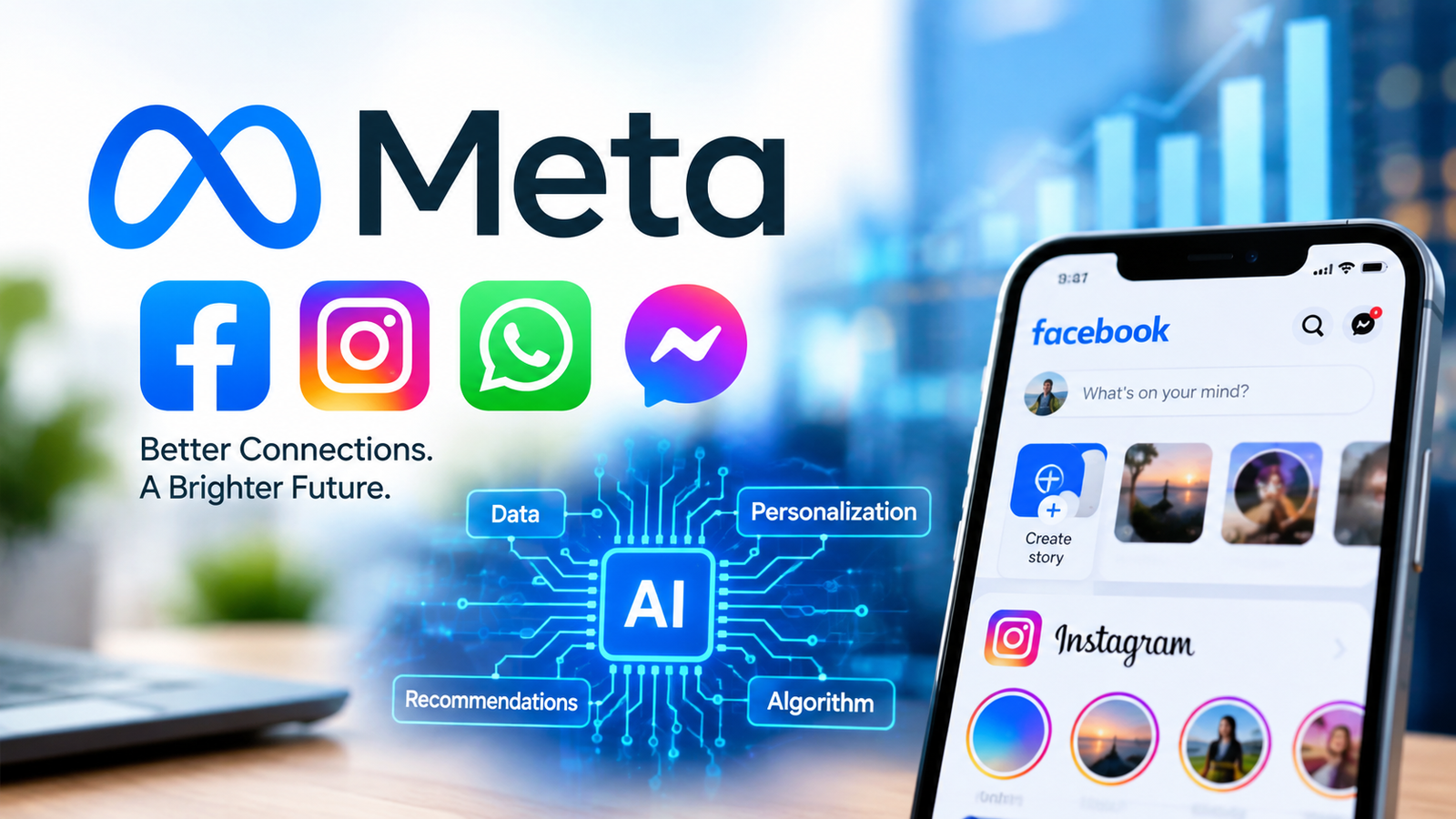
When people open Facebook or Instagram, they do not see the same internet.
Two people can open the same app at almost the same time and receive completely different posts, Reels, recommendations, advertisements and accounts.
That is not an accident.
Behind the experience is a large collection of artificial intelligence and machine-learning systems that Meta uses to predict what content may be relevant to each person.
For users, this can feel simple: open Facebook, scroll, watch a Reel, like a post and move on.
For Meta Platforms, the process is far more complicated.
The company uses signals from activity across its products and combines them with recommendation and ranking systems to personalize what people see.
This makes Meta Platforms one of the most important companies to understand if you want to understand the modern internet.
What Is Meta Platforms?
Meta Platforms is the technology company behind Facebook, Instagram, Messenger, WhatsApp, Threads and a growing collection of artificial-intelligence products.
Facebook and Instagram are especially important to Meta’s advertising business.
The company makes most of its revenue from advertising, while continuing to invest heavily in artificial intelligence, data centers, recommendation systems, messaging, virtual and augmented reality and AI-powered devices.
Meta said in January 2026 that AI was increasingly being used across its products to personalize experiences and improve business performance.
How Does the Facebook Algorithm Work?
There is not one simple “Facebook algorithm.”
Instead, Meta uses multiple ranking and recommendation systems across different surfaces.
A Facebook Feed, Reels recommendation, video recommendation, search result and advertisement can be evaluated using different systems.
Meta has previously explained that its AI systems make predictions about which content may be most relevant to an individual user.
In simple language, Facebook is constantly trying to answer a question:
“What is this person most likely to find useful, interesting or enjoyable right now?”
That prediction can be influenced by many types of activity.
Signals Can Include
- Posts a person interacts with
- Videos and Reels a person watches
- Accounts and Pages followed
- Topics a person repeatedly engages with
- Content shared with friends
- Comments and other interactions
- Previous viewing behavior
- Recommendations
- Searches and other activity
- Information used to personalize advertising
- Interactions with Meta AI, where applicable
Meta announced that interactions with its AI features would become another signal used to personalize content and advertising recommendations beginning in December 2025.
That means the personalization system is no longer based only on traditional social-media activity.
AI interactions can also help Meta understand what a person may be interested in.
Facebook Data Is More Than Likes and Comments
One of the biggest misunderstandings about social-media algorithms is that people often think a “like” is the entire story.
It isn’t.
Modern recommendation systems can look at patterns of behavior rather than a single action.
For example, imagine someone repeatedly watches videos about investing but rarely presses the Like button.
The system may still receive useful information from that viewing behavior.
Another person might follow financial pages, share market stories and spend time reading posts about the Federal Reserve.
Over time, those signals can contribute to a more personalized experience.
The important point is that recommendation systems learn from patterns of interaction.
Meta says its AI systems are designed to understand people’s interests and improve the relevance of recommendations.
Instagram Works Differently From Facebook
Instagram is part of the same company, but Instagram’s user experience is different.
The platform has several major discovery surfaces, including:
- Feed
- Reels
- Stories
- Explore
- Search
- Recommended content
Each surface can have different ranking considerations.
This is why an Instagram post that performs well in the Feed may not automatically perform equally well in Explore or Reels.
Creators therefore need to think about content format and audience intent, not simply posting frequency.
Why Instagram Reels Matter
Short-form video has become one of the most important discovery formats on Instagram.
Meta said that in Q4 2025, the prevalence of original content in U.S. Instagram recommendations increased by 10 percentage points, with 75% of recommendations coming from original posts.
That is important for creators and publishers.
It suggests that simply reposting someone else’s material is not necessarily the strongest strategy for building long-term discovery.
Original reporting, original commentary, original visuals and meaningful explanations can give a publisher more opportunities to build an identifiable content identity.
Meta’s Growing Focus on Original Content
Meta announced clearer original-content guidelines for Facebook in March 2026.
The company said it wants Facebook to better reward authentic creative work and help original creators stand out.
For publishers, that creates an important lesson:
Do not build a content business around copying other publishers.
Instead:
- Find the original source.
- Verify the information.
- Add your own reporting or analysis.
- Explain why the information matters.
- Use original headlines and visuals.
- Clearly identify sources.
- Give readers something they cannot get from simply reading the original announcement.
That strategy also fits much better with Google’s people-first approach.
Facebook Algorithm vs Google Search Algorithm
Facebook and Google are not trying to solve exactly the same problem.
Facebook and Instagram
The central question is closer to:
“What content should this person see next?”
Google Search
The central question is closer to:
“Which available result best answers this person’s search?”
Google says its systems are designed to prioritize helpful content and evaluate signals associated with experience, expertise, authoritativeness and trustworthiness.
Therefore, writing an article specifically to “trick the algorithm” is not a strong long-term strategy.
A better approach is to satisfy the reader.
What Google Wants From a Strong Article
For a global publisher, the article should demonstrate:
Experience
Show that the writer understands the subject rather than simply rewriting another article.
Expertise
Explain complicated subjects in a way that demonstrates genuine knowledge.
Use credible sources and clearly identify who is publishing the information.
Trust
Correct errors, disclose limitations, use reliable sources and avoid misleading claims.
Google specifically says trust is the most important aspect of E-E-A-T and that stronger E-E-A-T is particularly important for topics that can significantly affect people’s financial stability.
That is especially relevant to a finance publication.
What This Means for a Finance Publisher
Suppose you are writing an article about Meta stock.
A weak article might simply say:
“Meta stock is rising because investors like AI.”
A stronger article asks:
Why is Meta investing in AI?
How does Meta make money?
How important is advertising revenue?
What are the company’s major expenses?
How does AI affect recommendation systems?
What risks could investors face?
What does management say?
What do the company’s filings show?
That produces a much more useful article.
The Meta Data Story
Meta’s data ecosystem is enormous, but it is important not to describe it as if the company simply has one giant database containing everything about every user.
The reality is more complicated.
Meta operates multiple products, accounts, settings, privacy controls, recommendation systems and advertising systems.
The company also provides users with controls over some aspects of their experience.
Meta has published information about how its AI systems rank content and has released system cards explaining aspects of Facebook and Instagram ranking.
Why Recommendations Are Becoming More Personalized
Artificial intelligence is changing recommendation systems.
Instead of relying on a relatively simple set of rules, modern systems can analyze large amounts of behavioral information and make predictions about what someone may want to see.
Meta has said that AI is being used to make recommendations more personalized across its apps.
This creates a feedback loop.
A person watches something.
The system learns from that behavior.
The person receives more related recommendations.
The person interacts with some of those recommendations.
The system receives additional information.
The experience becomes more personalized.
That cycle can continue every time the person opens the application.
Why Creators Should Care
For creators, the lesson is not “find one secret algorithm trick.”
There is no permanent secret formula.
Platforms continuously change their systems.
Instead, creators should focus on signals they can actually influence:
Originality
Create something genuinely useful or entertaining.
Relevance
Make the subject clear so the right audience can understand it quickly.
Retention
Give people a reason to continue watching or reading.
Conversation
Create opportunities for meaningful discussion rather than artificial engagement.
Consistency
Build a recognizable publishing identity.
Accuracy
Avoid misleading claims simply because sensational headlines may generate clicks.
What NOT to Do
Creators and publishers should be careful with:
- Copied articles
- Recycled videos with little added value
- Misleading thumbnails
- False claims
- Fake engagement
- Engagement bait
- Keyword stuffing
- Mass-produced pages with little original value
- Misleading financial claims
- Artificially inflated statistics
These practices can create short-term attention without building long-term trust.
Facebook, Instagram and Google: Three Different Audiences
A global publisher should understand that one piece of content may need three different presentations.
Google Reader
The reader is actively searching.
They may type:
“How does Facebook algorithm work?”
The article needs to answer the question clearly.
Facebook User
The person may not be actively searching.
The headline needs to explain why the story is interesting.
Instagram User
The person may discover the story through a visual or Reel.
The first few seconds and the visual presentation become critical.
The underlying information can be the same.
The presentation should not necessarily be identical.
A Better Content Strategy for NYFT
For a finance publication such as New York Finance Think, a strong strategy would be:
Website Article
Publish the complete, source-backed explanation.
Create a concise summary with one strong question.
Turn the main findings into a carousel or Reel.
Threads
Use short factual observations and discussion points.
Google Search
Optimize the article around the actual questions readers ask.
This creates one reporting project with multiple distribution formats.
Example: Meta Stock
Instead of publishing five unrelated posts, a publisher could create one research package:
Main article:
“Meta Platforms: How Facebook and Instagram Use AI, Data and Algorithms”
Then create supporting articles:
“Meta Stock: How Advertising Drives Revenue”
“Why AI Spending Matters for Meta Investors”
“How Instagram Recommendations Work”
“Facebook Algorithm Explained”
“Meta’s AI Strategy and Business Model”
These pages can be internally linked.
That creates a stronger topical structure than publishing disconnected keyword articles.
Google SEO: Don’t Write for Robots
One of the most important lessons for publishers is simple:
Write for people first.
Google explicitly recommends creating helpful, reliable, people-first content rather than content primarily created to manipulate search rankings.
That means the primary keyword should appear naturally.
You do not need to repeat:
“Facebook algorithm”
20, 30 or 50 times.
Instead, answer related questions naturally.
For example:
- How Facebook ranking works
- How Instagram recommendations work
- What data influences recommendations
- How AI personalizes feeds
- Why original content matters
- How creators can improve content quality
This gives Google and readers a clear understanding of the article’s subject without keyword stuffing.
The Global Audience Opportunity
Facebook and Instagram are global platforms.
That means an international article should avoid assuming that every reader is American.
A good global article can explain:
- U.S. technology companies
- European privacy rules
- Indian digital users
- Asian technology markets
- Global advertising
- AI development
- Creator economics
- Digital privacy
- Social-media regulation
The writing should remain understandable to a reader whose first language may not be English.
Short sentences help.
Clear headings help.
Examples help.
Data tables help.
Source links help.
What Investors Should Watch
For investors following Meta Platforms, the algorithm story matters because recommendation quality can affect user engagement.
But investors should look beyond algorithms.
Important areas include:
- Advertising revenue
- User engagement
- AI investment
- Capital expenditure
- Data-center spending
- Operating margins
- Free cash flow
- Reality Labs losses
- Regulatory developments
- Competition
- AI product adoption
The algorithm is part of Meta’s business model, not the entire business model.
The Bigger Picture
Facebook and Instagram are moving toward a world where artificial intelligence plays an increasingly important role in deciding what people discover.
That does not mean humans have disappeared from the system.
It means machine-learning models are increasingly being used to process enormous amounts of information and make predictions about relevance.
Meta’s own 2026 updates show how heavily the company is investing in AI-driven recommendations, advertising and personalization.
For creators, the lesson is clear.
There is no single keyword, hashtag or posting time that guarantees success.
The strongest long-term strategy is to create original material that people genuinely want to consume.
For Google, that means building useful, trustworthy pages.
For Facebook and Instagram, it means creating content that earns genuine audience interest.
For a publisher, the two goals can work together.
Final Takeaway
Meta’s Facebook and Instagram algorithms are not simply popularity counters.
They are increasingly sophisticated recommendation systems designed to predict what individual users may find relevant.
The company is using artificial intelligence to improve personalization, recommendations and advertising performance.
At the same time, Google is emphasizing helpful, original, accurate and trustworthy content, especially for financial and other YMYL subjects.
For publishers, the best strategy is therefore not to chase a secret algorithm.
It is to build original reporting, strong sources, clear explanations, useful visuals and genuine reader value.
That approach can serve both search audiences and social-media audiences without sacrificing credibility.
This article is for informational and educational purposes only. It is not investment, financial, legal or privacy advice. Platform algorithms, policies and recommendation systems can change over time.
Sources
Meta Newsroom — AI and performance across Meta’s products.
Meta Newsroom — Improving recommendations with AI.
Meta Newsroom — Rewarding original creators on Facebook.
Google Search Central — Creating helpful, reliable, people-first content.
Meta — Transparency and AI ranking systems for Facebook and Instagram.
