
NVIDIA: How GPUs, AI and Robots Are Changing the Future 2026
Who Is NVIDIA?
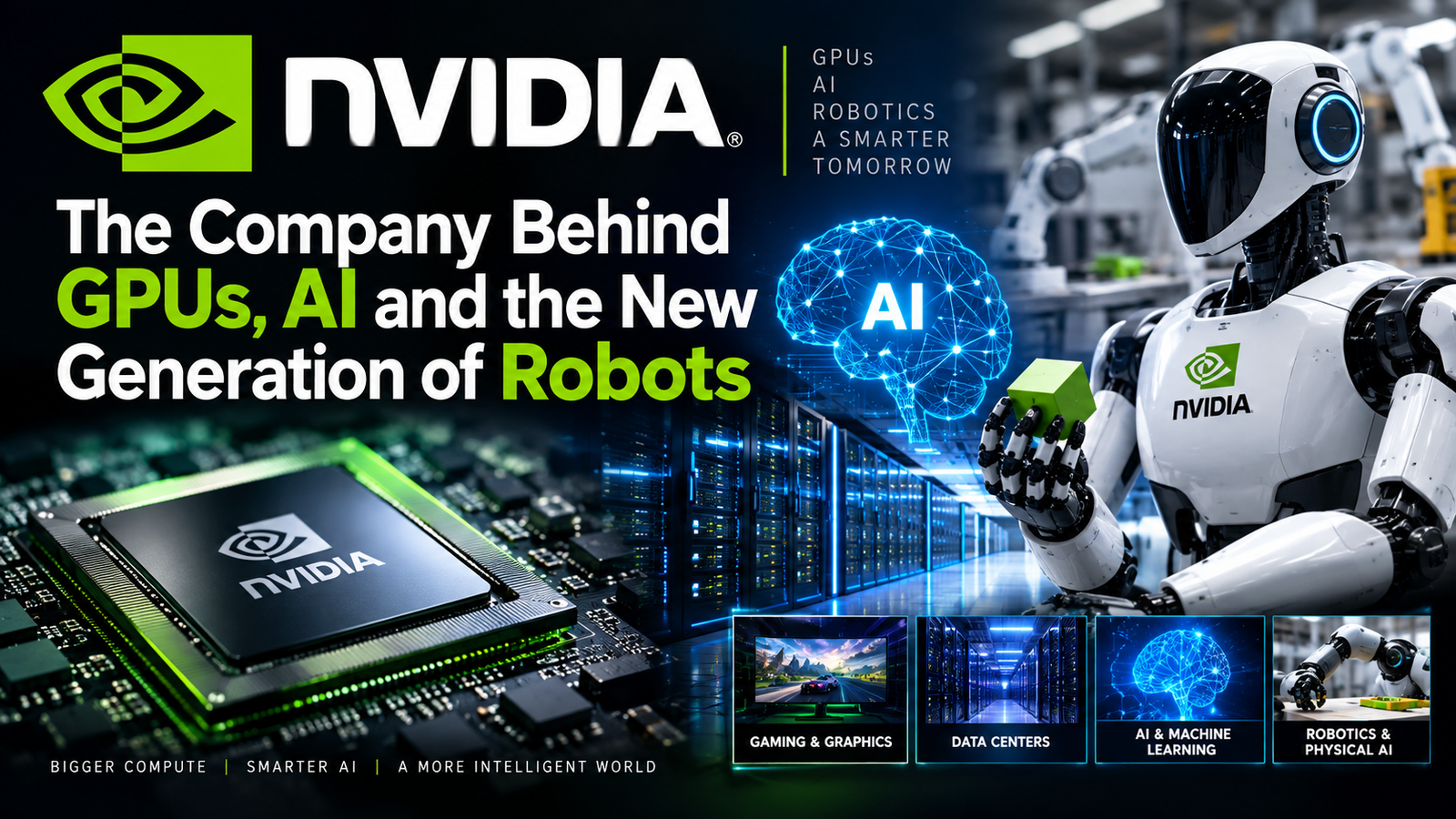
When most people hear the name NVIDIA, they think of artificial intelligence, powerful computer chips and the rapid growth of AI.
But NVIDIA’s story started long before today’s AI boom.
NVIDIA is an American technology company that was founded in 1993 in California by Jensen Huang, Chris Malachowsky and Curtis Priem. The founders originally focused on a technology problem that was becoming increasingly important: how computers could create much more advanced graphics for video games and multimedia applications.
Over the following three decades, NVIDIA changed from a graphics-chip company into one of the world’s most important accelerated-computing and AI infrastructure companies.
Its technology is now used in gaming computers, professional workstations, scientific research, cloud data centers, artificial intelligence systems, autonomous vehicles and robotics. NVIDIA describes itself as a pioneer in GPU-accelerated computing, with products and platforms spanning gaming, professional visualization, data centers and automotive applications.
When Was NVIDIA Founded?
NVIDIA was officially founded on April 5, 1993.
The three co-founders were:
Jensen Huang became the company’s president and chief executive officer and remains NVIDIA’s CEO today. NVIDIA was initially incorporated in California in April 1993 and later reincorporated in Delaware in 1998.
The company’s original vision was very different from the AI-focused company people know today.
The goal was to bring advanced 3D graphics to gaming and multimedia.
That decision turned out to be extremely important.
From Video Games to Artificial Intelligence
During the 1990s, computer graphics were becoming more sophisticated.
Video games needed faster graphics processing. Designers needed better visualization. Scientists increasingly needed computers to perform large amounts of mathematical calculations.
NVIDIA developed specialized graphics processors called GPUs — Graphics Processing Units.
The GPU was originally designed primarily to process graphics.
But researchers eventually discovered that GPUs could do something much bigger.
Because GPUs can perform huge numbers of calculations in parallel, they became extremely useful for scientific computing and, later, artificial intelligence.
NVIDIA says its invention of the GPU in 1999 helped transform computer graphics and eventually became a foundation for modern AI and parallel computing.
This was one of the biggest turning points in the company’s history.
What Does NVIDIA Actually Make?
A common misunderstanding is that NVIDIA simply makes computer chips.
The company is much broader than that.
NVIDIA develops a combination of:
- GPUs
- AI accelerators
- CPUs
- networking technology
- data-center systems
- AI software
- developer platforms
- robotics software
- simulation technology
- autonomous-driving platforms
- edge-AI computers
- AI models and development tools
In other words, NVIDIA increasingly operates as a full-stack computing company.
That means it tries to provide not just the chip, but also the software, networking, computing systems and development environment needed to build AI applications.
NVIDIA and Gaming
Gaming was one of NVIDIA’s original markets.
Its GeForce graphics processors became widely used in gaming PCs because GPUs can render complex 3D environments much faster than traditional processors designed for general-purpose computing.
Today, NVIDIA’s gaming business remains an important part of the company.
Its graphics technology is used for:
- PC gaming
- high-resolution graphics
- ray tracing
- AI-enhanced gaming
- game development
- creative applications
But gaming is no longer the only major story for NVIDIA.
The biggest transformation came from the growth of AI.
NVIDIA and the AI Revolution
Modern AI systems require enormous computing power.
Training an advanced AI model can involve processing huge amounts of data and performing massive numbers of mathematical operations.
GPUs are extremely effective at this type of parallel computing.
As AI research accelerated, NVIDIA’s GPUs became increasingly important for AI developers, universities, cloud providers and technology companies.
This helped NVIDIA move from being primarily known as a graphics company to becoming a major supplier of AI computing infrastructure.
Its technology now supports large-scale AI training and inference inside data centers around the world.
The Data Center Business
Today, data centers are at the center of NVIDIA’s business strategy.
Companies building AI systems need thousands of powerful processors, high-speed networking and specialized software.
NVIDIA sells much more than individual GPUs to these customers.
It provides complete computing platforms designed for AI and accelerated computing.
This includes:
- GPUs
- CPUs
- networking
- AI software
- computing systems
- developer tools
- AI libraries
- data-center platforms
NVIDIA’s fiscal 2026 results demonstrate the scale of this business. For the fourth quarter of fiscal 2026, NVIDIA reported $68.127 billion in revenue, with a 75% GAAP gross margin.
That financial transformation shows how dramatically NVIDIA has changed from its original gaming-focused identity.
NVIDIA’s Move Into Cars
NVIDIA is also working on automotive technology.
Its NVIDIA DRIVE platform is designed to provide computing and AI capabilities for vehicles, including autonomous-driving development.
The company’s automotive technology can support:
- autonomous vehicles
- driver-assistance systems
- in-car AI
- vehicle simulation
- robotics-style perception
- autonomous mobility
NVIDIA is therefore trying to put its computing technology into machines that interact with the physical world.
That leads directly to its next major opportunity:
Robotics.
NVIDIA Enters the Robotics Era
Robotics is one of the most important new areas of NVIDIA’s strategy.
The company believes that the next generation of robots will need powerful AI systems to see, understand, reason and act in the physical world.
This is often called Physical AI.
Traditional robots generally follow carefully programmed instructions.
A more advanced AI-powered robot could potentially:
- See its surroundings.
- Understand objects.
- Listen to human instructions.
- Interpret a demonstration.
- Plan a task.
- Move its arms and hands.
- Adapt when the environment changes.
This is where NVIDIA’s robotics platforms come into the picture.
What Is NVIDIA GR00T?
In 2024, NVIDIA announced Project GR00T, a foundation-model initiative for humanoid robots.
The idea is similar in principle to foundation models used in generative AI, but the target is the physical world.
Instead of simply generating text or images, a robotics foundation model can help a robot understand its environment and translate instructions into physical actions.
NVIDIA later introduced Isaac GR00T N1, describing it as an open humanoid robot foundation model designed to provide generalized skills and reasoning for humanoid robots.
This is an important change in robotics.
The robot is no longer just a mechanical machine.
The goal is to give it an AI-based “brain.”
Jetson Thor: The Computer Inside the Robot
One of NVIDIA’s most important robotics technologies is Jetson Thor.
Think of Jetson Thor as a powerful onboard computer designed for advanced robots.
A humanoid robot needs to process information while it is moving.
Its cameras may constantly see:
- people
- tools
- boxes
- doors
- machines
- floors
- obstacles
The robot must process that information quickly enough to make decisions.
Jetson Thor is designed to provide the computing power needed for this type of physical AI.
NVIDIA launched the Blackwell-powered Jetson Thor platform for robotics, with the company describing it as a major step toward general-purpose robotics and physical AI.
Can a Robot Learn by Watching a Human?
This is one of the most interesting developments in NVIDIA’s robotics strategy.
The goal is to move beyond robots that need every movement manually programmed.
Newer AI systems can use human demonstrations as learning information.
In 2026, NVIDIA highlighted robotics work involving Skild AI’s S1 model, where a robot can use a video demonstration as a guide for performing new multi-step physical tasks.
This represents an important idea:
Instead of programming every movement, show the robot what you want it to do.
That does not mean a robot can watch any random video and instantly become capable of performing everything a human can do.
Real-world robotics remains difficult.
Robots still have to deal with:
- unexpected objects
- changing environments
- safety
- balance
- speed
- physical contact
- limited battery power
- reliability
- cost
But the direction is significant.
NVIDIA Isaac: The Robot Training Environment
NVIDIA is also building software for developing and training robots.
The NVIDIA Isaac platform provides tools for robotics development, simulation and AI.
Simulation is extremely important because developers cannot safely test every possible robot behavior in the real world.
Instead, they can create virtual environments.
A robot can then be trained and tested inside a simulated factory, warehouse or other environment before developers move the system to a physical machine.
NVIDIA’s Isaac tools include simulation and learning frameworks designed to accelerate robotics development.
NVIDIA’s Humanoid Robot Reference Design
In May 2026, NVIDIA announced the Isaac GR00T Reference Humanoid Robot.
This is particularly important because NVIDIA is not simply providing software.
The reference design combines robotics hardware and NVIDIA’s computing and AI technologies.
The system uses Jetson Thor and is designed as an open reference platform for humanoid robotics developers.
NVIDIA said the reference humanoid robot is expected to become available from Unitree in late 2026.
This means NVIDIA is increasingly involved in the entire robotics development ecosystem:
AI model → simulation → computer → robot hardware → real-world deployment.
NVIDIA Is Not the Only Company Building the Robot
There is an important distinction to understand.
NVIDIA does not necessarily manufacture every humanoid robot that uses NVIDIA technology.
Instead, NVIDIA is building the computing and AI infrastructure that other robotics companies can use.
This is similar to the company’s role in AI data centers.
A company may build an AI application, while NVIDIA supplies some of the underlying computing infrastructure.
The same model is developing in robotics.
Robotics companies can build the physical robot while NVIDIA provides:
- AI computing
- robot foundation models
- simulation
- perception technology
- training tools
- edge computing
This could become a powerful business model if humanoid robots scale.
NVIDIA and U.S. Manufacturing
The robotics strategy is especially important for the United States.
American manufacturers face pressure to increase productivity while dealing with labor shortages, rising costs and international competition.
AI-powered robots could eventually perform some repetitive, dangerous or physically demanding tasks.
NVIDIA has specifically worked with U.S. manufacturing and robotics companies on physical AI, digital twins and collaborative robotics. The company’s stated vision is to use physical AI and digital-twin technology to increase productivity and competitiveness across the U.S. industrial base.
The potential impact could extend across:
- factories
- warehouses
- logistics
- automotive production
- electronics manufacturing
- construction
- healthcare
- agriculture
But the economic impact should not be overstated.
Robots may replace some tasks while creating new demand for engineers, technicians, AI specialists and robot-maintenance workers.
NVIDIA’s Bigger Vision
NVIDIA’s story can be understood in four major stages.
Stage 1 — Graphics
1990s
NVIDIA helped make computer graphics faster and more realistic.
Stage 2 — GPU Computing
2000s
The GPU became useful for more than graphics.
Stage 3 — Artificial Intelligence
2010s–2020s
GPUs became critical infrastructure for modern AI.
Stage 4 — Physical AI
2020s–2030s
NVIDIA is now trying to bring AI into the physical world through:
robots + autonomous vehicles + simulation + AI computers + physical AI models.
This fourth stage could be the next major chapter of the company.
Why NVIDIA Is Different From a Traditional Robot Company
A traditional robotics company may focus primarily on building the physical machine.
NVIDIA is approaching the market from the computing side.
Its strategy is closer to:
“Build the brain and the development ecosystem that many robots can use.”
If that strategy works, NVIDIA does not need to manufacture every robot.
It could potentially supply the technology underneath many different robots made by different companies.
That is one reason NVIDIA’s robotics strategy deserves attention.
The Big Question for America
The biggest question is not whether NVIDIA can build another powerful computer chip.
It already has a strong position in accelerated computing.
The bigger question is whether NVIDIA can help create an entirely new computing market around Physical AI.
If robots become capable of learning tasks, understanding instructions and operating safely around humans, the demand for computing could expand beyond data centers.
It could move into:
Factories → Warehouses → Cars → Hospitals → Homes → Cities
That would represent a very different type of AI economy.
Final Perspective
NVIDIA began in 1993 as a company focused on bringing advanced 3D graphics to computers.
It became famous for GPUs.
Those GPUs later became powerful tools for scientific computing.
Then AI transformed the company’s business.
Now NVIDIA is trying to take another step:
from AI that lives inside computers to AI that can operate in the physical world.
Its GR00T robotics models, Jetson Thor computing platform, Isaac simulation ecosystem and Physical AI technologies are part of that strategy.
The robot revolution is still developing.
NVIDIA has not created a machine that can replace a human at every job.
But it is building some of the computing infrastructure that could allow future robots to see, reason, learn and act.
For the United States, that makes NVIDIA more than a chip company.
It makes NVIDIA a potential infrastructure company for the next generation of AI, automation and robotics.
Official Sources
- NVIDIA — About NVIDIA
https://www.nvidia.com/en-us/about-nvidia/ - NVIDIA — Corporate Timeline and Company History
https://www.nvidia.com/en-us/about-nvidia/corporate-timeline/ - NVIDIA — Isaac Robotics Platform
https://developer.nvidia.com/isaac/ - NVIDIA — Isaac GR00T
https://developer.nvidia.com/isaac/gr00t - NVIDIA — Humanoid Robots
https://www.nvidia.com/en-us/use-cases/humanoid-robots/ - NVIDIA Newsroom — Official Company News
https://nvidianews.nvidia.com/ - NVIDIA — Investor Relations
https://investor.nvidia.com/ - NVIDIA — Annual Reports and SEC Filings
https://investor.nvidia.com/financial-info/financial-reports-and-filings/default.aspx - NVIDIA Developer — AI and Robotics Resources
https://developer.nvidia.com/ - NVIDIA — Data Center and AI
https://www.nvidia.com/en-us/data-center/
