
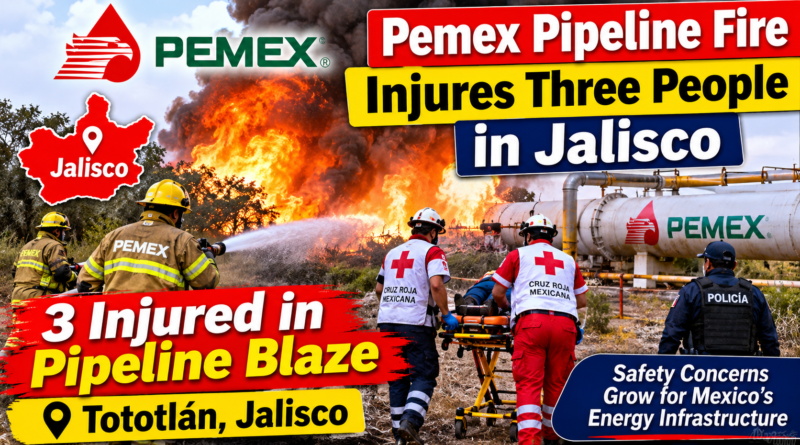
Pemex Pipeline Fire in Jalisco Injures Four Workers During Maintenance Operation
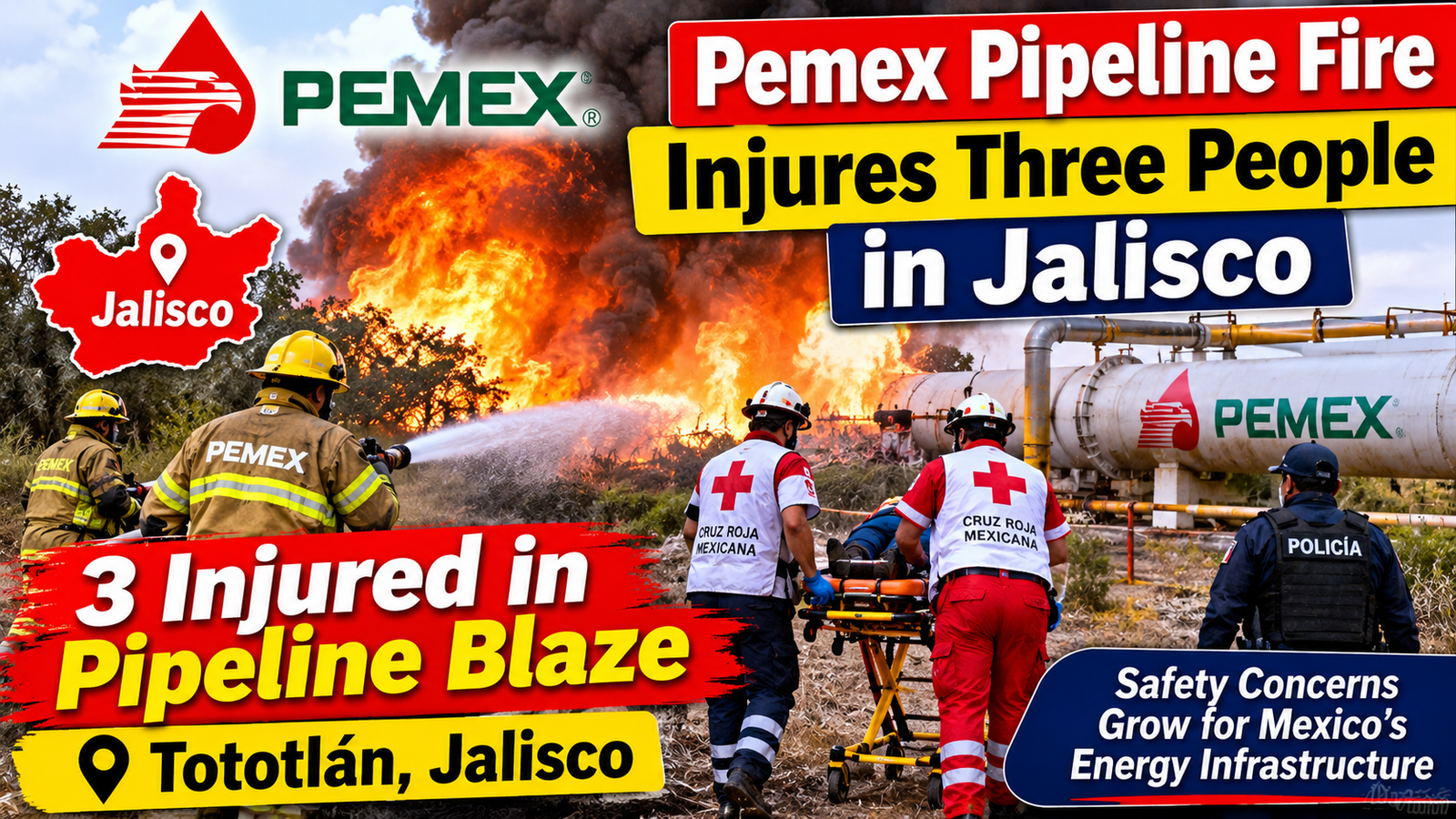
TOTOTLÁN, JALISCO, Mexico — November 6, 2026 — A fire involving a petroleum pipeline operated by Mexico’s state-owned oil company Petróleos Mexicanos (Pemex) has raised fresh concerns about industrial safety and the condition of the country’s energy infrastructure after an incident in Tototlán, Jalisco, left four workers injured.
The fire broke out on the evening of Thursday, November 5, near kilometre 1 of the Tototlán–Ocotlán highway. Emergency services were alerted at approximately 7:15 p.m. after a hydrocarbon-related incident developed into a fire at the pipeline site.
The emergency triggered a coordinated response involving Jalisco’s State Civil Protection and Fire Department, municipal emergency personnel and Pemex workers.
Initial reports indicated that three people had suffered serious burns. However, Pemex subsequently reported that four workers were affected. Three received medical attention at hospitals, while another was treated at the scene.
The incident has placed renewed attention on the safety procedures surrounding Mexico’s petroleum transportation network, particularly during maintenance and cleaning operations.
What Happened at the Pemex Pipeline in Tototlán?
The incident occurred along the Tototlán–Ocotlán highway in the municipality of Tototlán, located in Jalisco’s Ciénaga region.
According to initial emergency reports, authorities received information about a hydrocarbon leak at approximately 7:15 p.m. on November 5. The release was followed by a fire involving Pemex pipeline infrastructure.
Emergency crews arrived to assess the situation and support the company’s personnel in controlling the flames.
The location of the incident was particularly important because it was close to a public road. Authorities needed to secure the surrounding area, manage potential exposure to fire and prevent members of the public from entering the emergency perimeter.
The incident involved the Salamanca–Guadalajara petroleum pipeline, according to subsequent reporting on Pemex’s explanation.
The exact technical sequence that caused the fire has not been independently established.
Four Workers Affected: What We Know About the Injuries
The number of injured workers became clearer as authorities and the company provided further information.
Initial reports from emergency responders described three people with serious burns. Two men were reported to have burns covering approximately 40% of their bodies, while a woman was reported to have burns affecting approximately 90% of her body.
The two men were transported to a hospital in Guadalajara. The woman was taken to a medical facility in Ocotlán for treatment.
Pemex later reported that four workers had been injured during the incident. According to the company’s statement, two were transported to Clínica San Javier in Guadalajara, another was taken to the Mexican Social Security Institute facility in Ocotlán, and the fourth received medical attention at the scene.
The difference between the initial reports and the later company statement illustrates why early casualty figures in industrial emergencies can change as medical assessments and official updates become available.
The identities of the affected workers and their latest medical conditions were not fully established in the information available at publication time.
Pemex Says the Incident Occurred During Pipeline Cleaning
One of the most important developments concerns the circumstances surrounding the fire.
In a statement reported after the incident, Pemex said its personnel were carrying out cleaning and sediment-removal work on the Salamanca–Guadalajara pipeline near Tototlán when an incident occurred that resulted in fire.
The company said its emergency response plan was activated immediately.
Pemex also reported that the fire had been extinguished through coordination with state and municipal Civil Protection authorities and firefighters.
This explanation is significant because it places the incident in the context of maintenance activity rather than establishing that the pipeline was operating normally when the fire began.
Some local reporting indicated that the pipeline section was not carrying fuel at the time. However, the precise technical circumstances, including how the incident developed during the cleaning operation, require further clarification.
A full technical investigation would be needed to establish the precise cause and determine whether equipment failure, residual hydrocarbons, pressure conditions or another factor contributed to the event.
It would be premature to identify a definitive cause without the findings of that investigation.
Emergency Response and Safety Measures
The response involved several organisations working together to contain the emergency.
Jalisco’s State Civil Protection and Fire Department coordinated with the municipal Civil Protection and Fire Department of Tototlán, while Pemex personnel provided technical support at the site.
The emergency response focused on controlling the fire, protecting workers, securing the surrounding area and reducing the possibility of further incidents.
Reports also described the presence of security personnel, including members of the Mexican Army, National Guard and Pemex’s physical security teams.
The area was placed under a security perimeter to limit access while emergency and technical operations continued.
Pemex said the fire had been extinguished and that the incident did not represent a risk to the general population.
Residents and motorists were nevertheless advised through local reporting to avoid the immediate area and follow instructions from emergency authorities.
Why Pipeline Safety Matters for Mexico
Mexico depends heavily on its petroleum infrastructure to transport fuels and other hydrocarbon products between production, storage, refining and distribution facilities.
Pipelines are an important part of that system because they can move large quantities of petroleum products over long distances.
However, pipeline infrastructure requires continuous inspection, maintenance, monitoring and emergency planning.
A fire involving a pipeline can create serious risks even when the affected section is not actively transporting fuel. Residual hydrocarbons, equipment conditions and maintenance activities can all require specialised safety controls.
The Tototlán incident demonstrates that maintenance operations also carry potential hazards.
Cleaning and sediment-removal work can involve specialised equipment and procedures. Depending on the pipeline’s condition and the materials present, workers may face risks associated with combustible substances, pressure, confined spaces and unexpected releases.
Companies operating such infrastructure must therefore ensure that work permits, isolation procedures, gas monitoring, emergency equipment and worker-protection systems are appropriate for the conditions at the site.
The investigation into the Jalisco incident will be important in determining whether existing procedures operated as intended.
The Importance of Maintenance and Inspection
Pipeline maintenance is essential to the safe operation of energy infrastructure.
Over time, pipelines can accumulate sediment and other materials that may affect their performance. Inspection and cleaning activities help operators assess internal conditions and maintain the reliability of the network.
However, maintenance must be conducted under controlled conditions.
Before work begins, operators generally need to assess the pipeline’s operating status, isolate the relevant section where required, identify residual substances and evaluate potential ignition sources.
Emergency procedures must also be ready in case an unexpected release or fire occurs.
The incident in Tototlán raises questions about the circumstances in which the cleaning work was being carried out. Those questions should be answered through technical reviews rather than speculation.
A transparent account of the incident could help establish whether additional safeguards are necessary and whether similar maintenance operations elsewhere require closer review.
Potential Impact on Nearby Communities
Industrial incidents can affect nearby communities even when authorities successfully prevent the fire from spreading.
Residents may face temporary road restrictions, emergency vehicle movements, noise and uncertainty about possible environmental or safety consequences.
The Tototlán–Ocotlán highway is an important local route, making access management an essential part of the emergency response.
Authorities and Pemex will also need to assess whether the incident caused damage to the pipeline or surrounding land.
At the time of publication, there was no confirmed report of widespread disruption to fuel supplies or a major environmental impact. The absence of such a report should not be treated as proof that no local effects occurred.
Any assessment of soil, air or water contamination would require appropriate monitoring and official findings.
What Happens Next?
The next stage will involve determining the exact cause of the incident, assessing the condition of the affected pipeline section and reviewing the safety procedures used during the maintenance operation.
Several questions remain important:
- What specific event caused the fire during the cleaning and sediment-removal work?
- What was the condition of the pipeline before the operation began?
- Were all required isolation and safety procedures followed?
- What damage, if any, occurred to the pipeline infrastructure?
- Will additional inspections or maintenance be required?
- What is the latest medical condition of the injured workers?
Pemex and the relevant authorities will need to provide further information to clarify these issues.
The findings could also help determine whether additional safety measures should be introduced for similar operations across the company’s pipeline network.
Conclusion: Jalisco Pipeline Fire Highlights the Importance of Industrial Safety
The Pemex pipeline fire in Tototlán has become a serious reminder of the risks associated with maintaining and operating petroleum infrastructure.
Four workers were affected, according to the company’s later statement, while emergency services and Pemex personnel worked together to extinguish the fire and secure the area.
The company’s explanation that the incident occurred during cleaning and sediment-removal work makes the investigation particularly important. Maintenance is essential to pipeline reliability, but it must be carried out with strict safety controls and effective emergency planning.
For residents, workers and Mexico’s energy sector, the priority now is to establish exactly what happened, support the injured employees and ensure that any lessons from the incident are applied to future operations.
The incident does not by itself establish a wider failure across Mexico’s pipeline network. However, it underlines why inspection, maintenance standards, worker protection and transparent reporting remain central to energy infrastructure safety.
Editorial note: This article is based on information available as of November 6, 2026. Initial reports listed three injured people; Pemex later reported four affected workers, including one treated at the scene. The precise cause of the fire remains subject to further technical clarification. The medical conditions described above reflect preliminary reporting and may change.
About New York Finance Think: Follow our international coverage of energy, business, infrastructure, industry, markets and economic developments.
