
ISIS, Iraq, Syria and the Oil Shock: How the Islamic State Rose, Captured Territory and Changed the Middle East 2014
By Dr. Abhishek Bhatt, PhD
New York Finance Think
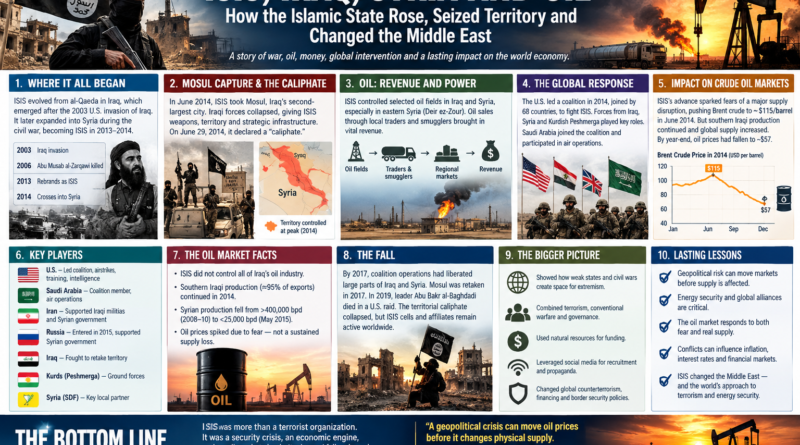
The rise of the Islamic State of Iraq and Syria, widely known as ISIS or ISIL, was one of the most consequential security and economic developments of the 21st century. Its story was not simply about terrorism, and it was not simply about a war between armies. It was also a story about the collapse of state institutions, sectarian conflict, the Syrian civil war, captured military equipment, control of territory, oil production, illegal trade and an international military campaign that eventually dismantled the group’s territorial caliphate.
For Americans watching the conflict from thousands of miles away, one question remains particularly important: how did a militant organization that emerged from the Iraq insurgency become powerful enough to seize major cities, control oil-producing areas and threaten governments across the Middle East?
The answer developed over more than a decade.
ISIS grew out of the violent insurgency that followed the 2003 U.S.-led invasion of Iraq. The organization’s predecessor, al-Qaeda in Iraq, was led by Abu Musab al-Zarqawi. According to United Nations records, the organization later evolved through several stages before becoming the Islamic State. In 2013 and 2014, the group expanded across the Iraq-Syria border, taking advantage of the Syrian civil war and political instability in Iraq.
By June 2014, the crisis had reached a dramatic turning point.
ISIS fighters entered Mosul, Iraq’s second-largest city, and Iraqi security forces collapsed with surprising speed. The fall of Mosul gave ISIS access to territory, weapons, money, government facilities and strategic infrastructure. Later that month, the group announced the creation of what it called a caliphate.
But territory alone was not enough. ISIS needed money to maintain its military organization and administer the territory it controlled.
That is where oil became important.
Chapter 1: Where Did ISIS Come From?
ISIS did not suddenly appear in 2014.
Its roots went back to the Iraq insurgency after the fall of Saddam Hussein’s government in 2003. Abu Musab al-Zarqawi became one of the most important extremist leaders operating in Iraq. His organization became known as al-Qaeda in Iraq, or AQI.
The United Nations has described ISIS as a direct descendant of AQI. Zarqawi was killed in 2006, but the organization survived and reorganized.
The group later became associated with the Islamic State of Iraq.
The Syrian civil war, which began in 2011, created another opening. The breakdown of government control in parts of Syria allowed extremist organizations and armed opposition groups to establish territory.
The Iraqi organization expanded into Syria and eventually became known as ISIS or ISIL.
This cross-border expansion was critical.
The Iraq-Syria border was no longer an effective barrier for a group that was operating across both countries.
Chapter 2: Why Did ISIS Grow So Quickly?
ISIS benefited from several conditions at the same time.
Iraq was struggling with political and security problems. Syria was experiencing a devastating civil war. Government institutions were weak in many areas, armed groups controlled territory and large numbers of civilians were displaced.
ISIS also developed local networks.
It did not have to build everything from zero. It inherited personnel, battlefield experience, weapons, money and organizational knowledge from earlier insurgent networks.
The organization also used intimidation and propaganda to weaken opponents and attract recruits.
The result was a militant organization capable of combining terrorism with conventional battlefield operations.
That combination made ISIS particularly dangerous.
Chapter 3: The Fall of Mosul
The capture of Mosul in June 2014 became the defining moment of ISIS’s rise.
Mosul was strategically important because of its population, location, economic resources, government institutions and proximity to important military and energy infrastructure.
The collapse of Iraqi security forces was not simply a matter of ISIS having more soldiers.
Command failures, weak morale, poor leadership, corruption, local political tensions and the psychological impact of ISIS’s advance all contributed to the collapse.
When units abandoned positions, ISIS gained access to weapons, vehicles and military equipment.
This created a powerful cycle.
More territory provided more resources.
More resources provided greater military capability.
Greater military capability allowed ISIS to attack more territory.
The capture of Mosul therefore changed the organization from a dangerous insurgent group into a territorial power.
Chapter 4: ISIS Declares a Caliphate
On June 29, 2014, ISIS announced the creation of a so-called Islamic State and declared Abu Bakr al-Baghdadi its caliph.
The United Nations later documented that ISIS controlled large areas of Iraq and Syria and that millions of people were living in territory under its control.
This was more than a propaganda announcement.
ISIS attempted to operate government-like structures in areas it controlled.
It collected taxes and extorted businesses. It controlled checkpoints and imposed its own rules. It seized property and financial assets. It exploited natural resources.
The organization also used brutal violence against civilians and minorities.
The U.S. State Department documented ISIS abuses including killings, kidnappings, forced displacement and persecution of communities.
Chapter 5: How ISIS Made Money
A terrorist organization controlling territory needs money for weapons, fighters, transportation, communications and administration.
ISIS obtained money from several sources.
These included:
- Extortion
- Forced taxation
- Bank and asset seizures
- Smuggling
- Criminal activity
- Ransom
- Sale of natural resources
- Oil production and illegal oil trading
Oil became one of the most discussed sources of ISIS revenue.
But it is important not to misunderstand the scale.
ISIS did not control Iraq’s entire oil industry.
It controlled selected fields and infrastructure in areas where it had territorial control.
Chapter 6: When ISIS Entered the Oil Business
ISIS expanded into oil-producing regions during its territorial expansion in Iraq and Syria.
Eastern Syria was especially important.
The Deir ez-Zour region contained important oil infrastructure, including the Omar field.
As the Syrian state lost control over large areas, ISIS gained access to some oil-producing assets.
Syria’s overall oil industry, however, was already suffering from the civil war and international sanctions.
The U.S. Energy Information Administration reported that Syrian crude production, which had averaged more than 400,000 barrels per day between 2008 and 2010, fell below 25,000 barrels per day by May 2015.
That decline illustrates an important point.
ISIS affected regional oil production, but the Syrian oil collapse was the result of the broader war, sanctions, damaged infrastructure and loss of state control—not ISIS alone.
Chapter 7: ISIS and Iraqi Oil
The situation in Iraq was different.
Iraq remained a major global oil producer.
When ISIS launched its offensive in northern Iraq in June 2014, northern production and refinery operations were disrupted.
But Iraq’s most important southern oil production continued.
According to the U.S. Energy Information Administration, southern Iraqi production and exports represented approximately 95% of Iraq’s total crude oil exports in 2014 and were not affected by the ISIS offensive.
This fact is critical to understanding the global oil market.
ISIS could capture oil infrastructure without controlling the majority of Iraq’s export system.
That limited the group’s ability to create a sustained global oil supply shock.
Chapter 8: How Did ISIS Sell Oil?
ISIS did not operate a conventional international oil company.
Oil from territory under its control could enter an informal network involving local traders, smugglers, transport operators and intermediaries.
The basic structure could look like this:
Oil field → local extraction → intermediary → tanker transport → regional market → fuel buyer
The trade was complicated by the fact that oil could be blended, moved across borders and sold through intermediaries.
It is therefore inaccurate to claim without evidence that a particular national government directly purchased ISIS oil.
There were allegations and political accusations involving regional actors, but allegations should not be presented as established fact without documentary evidence.
The international response increasingly focused on cutting ISIS’s access to financing and targeting its energy infrastructure.
The U.S. State Department described disrupting ISIS financing as one of the central lines of the international campaign.
Chapter 9: Did Saudi Arabia Support ISIS?
This question requires a clear distinction between allegations about individuals, historical regional financing networks and the Saudi government’s documented position.
Saudi Arabia became a founding member of the Global Coalition to Defeat ISIS.
The Saudi government hosted the coalition’s inaugural conference in Jeddah in September 2014 and participated in military action against ISIS. U.S. State Department records identify Saudi Arabia as a coalition member and document its participation in military action against ISIS.
Saudi aircraft participated in coalition operations against ISIS in Syria.
Therefore, the documented position of the Saudi government during the international campaign was opposition to ISIS, not military support for the organization.
That does not eliminate every historical allegation concerning private individuals or regional networks. But government policy and individual activity are separate questions and should not be treated as the same thing.
Chapter 10: Why Did the United States Enter the Fight?
The United States became directly involved after ISIS’s rapid territorial expansion in 2014.
The Obama administration announced the formation of a broad international coalition in September 2014.
The coalition strategy was not limited to bombing.
The five major lines of effort included military support, blocking foreign fighters, disrupting ISIS financing, addressing humanitarian crises and countering ISIS propaganda and ideology.
This was important because ISIS was not only a battlefield problem.
It was simultaneously:
- A terrorist organization
- An insurgent force
- A territorial organization
- A financial network
- A propaganda operation
- A regional security threat
Chapter 11: How Many Countries Fought ISIS?
The answer depends on what “fought” means.
Many countries joined the Global Coalition, but not every member sent combat forces.
Some provided aircraft.
Others supplied weapons.
Others trained local forces.
Others provided intelligence, logistics, humanitarian assistance or financial controls.
By March 2017, the U.S. State Department described the coalition as a 68-member international coalition, with 23 coalition partners having more than 9,000 troops in Iraq and Syria supporting the counter-ISIS mission.
This demonstrates why simply counting coalition members does not provide an accurate count of countries conducting direct combat operations.
Chapter 12: The Ground Forces Against ISIS
The fight against ISIS depended heavily on forces operating inside Iraq and Syria.
In Iraq, the Iraqi Security Forces and Kurdish Peshmerga played major roles.
In Syria, the Syrian Democratic Forces became an important U.S.-backed local partner.
The United States and other coalition members provided air support, intelligence, training and other assistance.
The strategy increasingly became:
Local ground forces + international air power + intelligence + financial pressure
That combination gradually reduced ISIS’s territorial control.
Chapter 13: The Role of Iran
Iran also opposed ISIS, but it was not part of the U.S.-led coalition in the same way.
Iran supported Iraqi Shia militias and the Syrian government during the conflict.
Iran’s involvement therefore reflected its own regional security interests and alliances.
This created a complicated battlefield.
The United States, Iran, Russia, Turkey, Gulf states, Iraqi forces, Kurdish forces and Syrian forces were not all pursuing identical objectives.
Some were fighting ISIS while simultaneously competing over Syria’s future, Iraq’s politics or regional influence.
Chapter 14: Russia’s Role
Russia entered the Syrian battlefield directly in 2015 in support of the Syrian government.
Russia conducted air operations in Syria and targeted a range of armed groups.
The Russian military campaign was therefore broader than simply fighting ISIS.
This distinction matters because the Syrian war involved multiple armed organizations and competing international interests.
ISIS was one major actor, but it was not the only military organization operating in Syria.
Chapter 15: The United States and ISIS Oil Infrastructure
Oil became a military target because it generated revenue.
The U.S.-led coalition targeted ISIS-controlled energy infrastructure as part of the effort to reduce the group’s financial capacity.
The U.S. State Department reported that coalition airstrikes targeted energy assets, command facilities and financial resources.
The objective was not simply to destroy oil for its own sake.
The broader goal was to reduce ISIS’s ability to convert territory and natural resources into military financing.
Chapter 16: Did ISIS Cause the 2014 Oil Price Spike?
This is where the history becomes especially important for American investors.
ISIS did affect oil-market psychology.
When ISIS advanced through Iraq in June 2014, traders feared that the conflict could threaten a much larger portion of Iraqi oil production.
That fear created geopolitical risk.
EIA records show that crude oil prices peaked in June 2014, with the Brent benchmark reaching approximately $115 per barrel. EIA said the price peak was primarily associated with news about the internal conflict in Iraq.
But there is an important second half to the story.
The feared disruption to Iraq’s southern oil production did not materialize on the scale initially feared.
Iraq’s overall crude production averaged nearly 3.4 million barrels per day in 2014, about 330,000 barrels per day above the previous year.
That prevented the ISIS conflict from becoming a prolonged global oil-supply shock.
Chapter 17: Why Oil Prices Later Fell
The second half of 2014 tells a very different story.
Oil prices declined sharply.
Rising U.S. production, increasing global supply, weaker expectations for demand and fewer major supply disruptions all put downward pressure on crude prices.
The EIA’s historical review shows that the geopolitical premium associated with the Iraq conflict faded as markets became more confident that southern Iraqi production would continue.
This produced an important market lesson.
Geopolitical risk does not automatically equal a long-term oil shortage.
Markets react not only to headlines but also to actual barrels available to consumers.
Chapter 18: What Happened to Iraq’s Oil Production?
Despite the security crisis, Iraq became one of the major contributors to global oil supply growth in 2014.
EIA data show that production recovered strongly after the summer.
From August through December 2014, Iraqi production increased by almost 600,000 barrels per day.
By December, production reached approximately 3.75 million barrels per day.
That is a remarkable contrast.
At the same time ISIS was expanding territorially in northern Iraq, the country’s southern oil industry was increasing production.
For oil traders, that difference mattered enormously.
Chapter 19: What Happened to Syria’s Oil Industry?
Syria experienced a much more severe collapse.
The civil war destroyed infrastructure and disrupted production.
International sanctions also made investment and exports extremely difficult.
ISIS captured some eastern oil fields, but the overall Syrian oil industry was already in a state of collapse.
By May 2015, Syrian production had fallen below 25,000 barrels per day, compared with more than 400,000 barrels per day before the war.
The result was devastating for the Syrian economy.
The country became increasingly dependent on imported fuel and external support.
Chapter 20: Why ISIS Was Difficult to Defeat
ISIS had several advantages during its peak.
It controlled territory.
It had captured military equipment.
It had access to financial resources.
It had experienced fighters.
It operated across an international border.
It used propaganda effectively.
And it exploited weaknesses in the governments it fought.
But the organization also had structural weaknesses.
It depended heavily on territorial control.
Once it began losing cities, oil fields, tax bases and transportation routes, its financial model became much harder to sustain.
This is why the international strategy increasingly focused on destroying the group’s territorial infrastructure.
Chapter 21: The Battle for Mosul Revisited
The eventual campaign to retake Mosul was very different from the city’s collapse in 2014.
By then, ISIS faced Iraqi forces supported by international air power, intelligence and other assistance.
The battle was long and destructive.
Iraqi forces eventually retook the city in 2017.
The fall of Mosul marked the destruction of one of ISIS’s most important urban strongholds.
The organization was losing the territory that had made its “caliphate” possible.
Chapter 22: The Decline of the Territorial Caliphate
The international campaign gradually reduced ISIS-controlled territory.
By 2017, the U.S. State Department reported that coalition operations had liberated significant portions of the territory previously controlled by ISIS in both Iraq and Syria.
The territorial model eventually collapsed.
That did not mean the organization disappeared completely.
Instead, ISIS increasingly relied on insurgent tactics, underground networks and affiliates outside its former core territory.
Chapter 23: What Happened to Abu Bakr al-Baghdadi?
Abu Bakr al-Baghdadi remained the most recognizable ISIS leader during the organization’s territorial peak.
In 2019, he died during a U.S. special operations raid in Syria.
His death was a major leadership blow.
But ISIS had already developed decentralized structures and affiliated organizations, making it difficult to eliminate the broader network simply by removing one leader.
Chapter 24: ISIS Beyond Iraq and Syria
The organization also developed affiliates and associated networks outside its original Iraqi-Syrian core.
These included branches and networks in parts of:
- Libya
- Egypt’s Sinai
- Afghanistan
- Pakistan
- West Africa
- Central Africa
- Mozambique
- Somalia
- South Asia
The geographic spread should not be confused with the territorial “caliphate” that ISIS controlled at its peak.
A branch claiming allegiance to ISIS is not automatically equivalent to ISIS controlling that country’s government or territory.
Chapter 25: What Did ISIS Do to the Oil Market?
The impact on oil markets can be divided into three stages.
Stage One: Fear
The ISIS offensive in Iraq created fears of a larger disruption to Iraqi oil supplies.
That contributed to an increase in geopolitical risk and helped push crude prices higher in June 2014.
Stage Two: Reality
Southern Iraqi production continued.
The majority of Iraq’s crude exports came from the south, outside ISIS control.
Therefore, the expected global supply shock was smaller than feared.
Stage Three: Oversupply
Global oil supply continued to grow.
U.S. production was rising rapidly.
Other producers were also contributing barrels.
As supply expanded and demand expectations weakened, the geopolitical premium faded.
The result was a major oil-price decline later in 2014.
Chapter 26: The Lesson for American Investors
For investors, the ISIS oil story offers a broader lesson.
A geopolitical crisis can move financial markets before it changes physical supply.
Traders often price the possibility of future disruption.
That is why oil can rise when an important producing region comes under threat—even before a single major export terminal stops operating.
But if the feared disruption does not occur, that risk premium can disappear.
This distinction is important for anyone following:
- Crude oil futures
- Energy stocks
- Inflation
- Treasury yields
- Airline stocks
- Transportation costs
- Consumer prices
- Federal Reserve policy
- Global equity markets
Oil is not just an energy commodity.
It is an economic input that connects geopolitics to inflation and financial markets.
Chapter 27: The Oil-to-Inflation Connection
When crude oil rises sharply, gasoline, diesel, transportation and some industrial costs can rise as well.
That can increase inflation pressure.
Higher inflation can complicate monetary policy.
For the Federal Reserve, the key question is not simply whether oil prices rise for a few days.
The bigger question is whether an energy shock becomes persistent enough to influence broader inflation expectations and consumer spending.
The ISIS-related oil shock of 2014 demonstrated why traders watch geopolitical developments even when actual supply losses remain limited.
Chapter 28: What ISIS Changed Permanently
ISIS changed the security architecture of the Middle East.
It demonstrated that a terrorist organization could temporarily operate as a territorial power.
It showed how civil wars and weak institutions can create space for extremist organizations.
It also demonstrated how social media and propaganda could be integrated into warfare.
And it showed that natural resources can become part of a terrorist organization’s financial system when governments lose control of territory.
The international response also changed.
Countries increasingly focused on terrorist financing, foreign fighters, intelligence sharing, border controls and online recruitment.
Chapter 29: The Saudi-U.S. Connection
Saudi Arabia’s participation in the anti-ISIS campaign was an important part of the regional response.
Saudi Arabia hosted the coalition’s first meeting in Jeddah in September 2014 and participated in coalition military operations.
The United States and Saudi Arabia had broader security cooperation beyond ISIS, but the anti-ISIS campaign provided another area of cooperation.
This cooperation should be understood separately from other disagreements between Washington and Riyadh over regional policy.
Chapter 30: The Bigger Picture
The ISIS conflict cannot be explained by a single cause.
It was the product of multiple crises interacting with one another.
The Iraq War created a new political and security environment.
The insurgency produced extremist networks.
The Syrian civil war opened another battlefield.
Sectarian conflict deepened political divisions.
Weak state institutions created opportunities.
ISIS captured territory and weapons.
Oil and taxation provided revenue.
Propaganda helped recruitment.
And international military intervention eventually destroyed much of the organization’s territorial structure.
That chain of events explains why ISIS became so powerful—and why it eventually lost its territorial caliphate.
Conclusion: ISIS Was a Security Crisis, an Economic Story and an Oil-Market Shock
The rise of ISIS was not simply a story about a terrorist organization attacking Iraq and Syria.
It was a story about what happens when political instability, civil war, weak institutions, armed insurgency and control of natural resources converge.
ISIS emerged from the Iraq insurgency, expanded through the Syrian civil war and captured major territory in 2014. The fall of Mosul gave the organization access to weapons, money and strategic infrastructure. Its control of oil-producing areas added another source of revenue.
But ISIS never controlled Iraq’s entire oil industry.
That distinction is essential.
The U.S. Energy Information Administration found that southern Iraqi oil production and exports—which represented about 95% of Iraq’s crude exports in 2014—continued despite the ISIS offensive. Iraq’s total production actually increased during the year.
For the oil market, the immediate impact was therefore driven more by fear of disruption than by a sustained loss of global supply.
Brent crude reached about $115 per barrel in June 2014 as the Iraq conflict intensified, but the expected large-scale disruption did not occur. As global supply continued to expand, the geopolitical premium faded and oil prices subsequently fell sharply.
The broader lesson remains relevant to American investors today:
A geopolitical crisis can move oil prices before it changes physical supply.
The market first prices the risk.
Then it watches the barrels.
And ultimately, the physical balance between supply and demand determines whether that risk premium survives.
For the United States, the ISIS experience also demonstrated why energy security, military strategy, financial sanctions, intelligence cooperation and international alliances can become closely connected.
ISIS lost its territorial caliphate, but the economic and security lessons of its rise remain important.
For anyone following crude oil, inflation, Treasury yields, energy stocks or geopolitical risk, the ISIS period provides a clear historical example of how a conflict in the Middle East can travel from the battlefield to the oil market—and eventually into the broader global economy.
Primary Sources
- U.S. Energy Information Administration (EIA) — Iraq was second-leading contributor to global oil supply growth during 2014
EIA — Iraq Oil Production and ISIS Impact - U.S. Energy Information Administration (EIA) — 2014 Crude Oil Prices
EIA — 2014 Crude Oil Price Review - U.S. Department of State — Global Coalition to Defeat ISIS
U.S. Department of State — Global Coalition to Defeat ISIS - U.S. Department of State — U.S. Security Cooperation with Saudi Arabia
U.S. Department of State — Saudi Arabia and Counter-ISIS Cooperation - U.S. Department of State — Country Reports on Terrorism 2014
U.S. State Department — Country Reports on Terrorism 2014 - United Nations Security Council — ISIS/ISIL Financing and Oil Revenue
United Nations — ISIL Financing Report - United Nations — Iraq Security Situation and ISIS Expansion
United Nations Digital Library — Iraq Security Report
Key Sources Used for This Article:
U.S. Energy Information Administration, U.S. Department of State and United Nations Security Council records.
