
Hyde Park Hit-and-Run Raises Questions About Street Safety, Police Investigation and Accountability 2026
Los Angeles, California — October 1, 2026
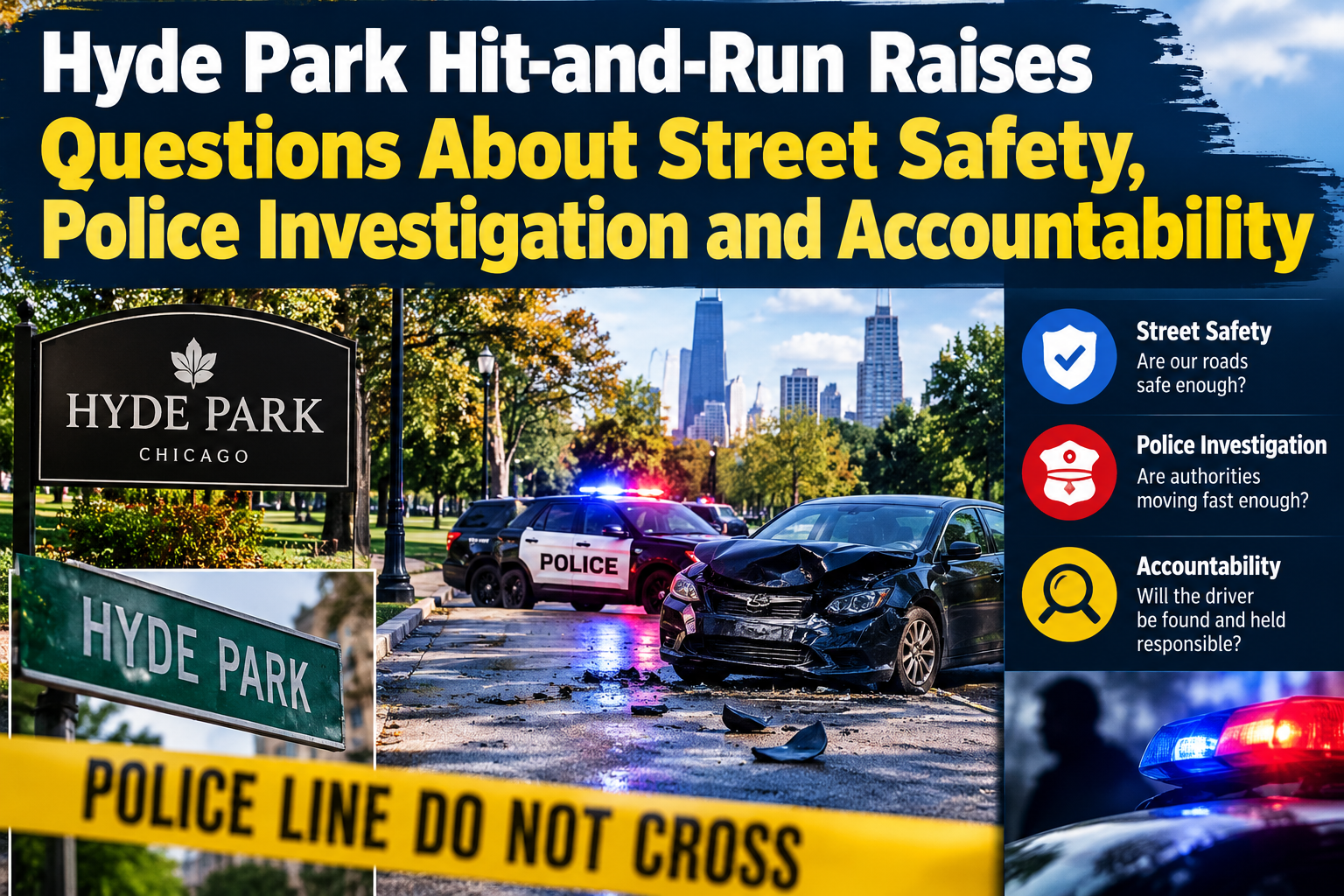
The death of 16-year-old Hernan Martinez in a hit-and-run crash in Los Angeles‘ Hyde Park neighborhood has become more than a tragic traffic story. It has raised difficult questions about pedestrian safety, street design, enforcement, community trust and the ability of authorities to identify suspects after a fatal collision.
Hernan was killed on the night of September 22 while walking with his mother and younger sister near West 60th Street and 10th Avenue. His sister, Vicky Martinez, was seriously injured and hospitalized. Los Angeles police said the driver of a blue Nissan sedan struck the siblings before crashing into a parked vehicle. The female driver and a male passenger then left the disabled vehicle and fled on foot. As of the latest reports reviewed for this article, authorities had not publicly announced an arrest of either person.
That unresolved investigation has intensified frustration in the neighborhood. For residents, the question is not only who was driving the Nissan that night, but also why a fatal crash can happen at an intersection that residents and pedestrian-safety advocates say has presented safety concerns for years.
At the same time, it is important to distinguish between confirmed facts and broader accusations. The available reporting confirms that a teenager died, his sister was injured, the driver and passenger fled, the vehicle was left behind and police were searching for them. It does not establish that a particular city official or police officer caused the crash or intentionally failed to investigate it.
Still, the circumstances have created a legitimate public debate about whether enough was done before the tragedy and whether the response afterward has been fast enough.
A Family Crossing the Street
The crash occurred at approximately 9:30 p.m. on September 22, according to police and local news reports. A blue Nissan sedan was traveling eastbound on 60th Street when it struck the two siblings as they crossed with their mother near 10th Avenue. The mother was not struck. Hernan died at the scene, while his younger sister was transported to a hospital with serious injuries.
Reports have differed on Vicky’s exact age, with some early reports describing her as 13 and others as 14. Her family identified her as Vicky Martinez, and reports said she suffered a fractured pelvis and required surgery. Because of those discrepancies, this article refers to her simply as Hernan’s younger sister unless a source is specifically being quoted.
For the Martinez family, the aftermath has been devastating. Family members told reporters that Vicky was initially not told that her brother had died because she was recovering from her own injuries.
Hernan had recently celebrated his 16th birthday. Relatives described him as a talented and creative teenager who enjoyed baking, cooking and arts and crafts. His death has therefore become not simply a statistic in a traffic report, but a personal loss that has affected an entire family and neighborhood.
The Driver Did Not Remain at the Scene
One of the central facts in the investigation is what happened immediately after the collision.
Police said the Nissan continued after striking the siblings and then crashed into a parked vehicle. The vehicle became disabled. The female driver and male passenger exited the car and ran away instead of remaining at the scene.
That decision transformed a devastating collision into a criminal investigation centered on a hit-and-run.
Surveillance video reportedly captured the vehicle traveling through the area before the crash. Some reports said the vehicle appeared to travel at high speed and appeared to run a stop sign. Those details remain part of the reported evidence surrounding the crash; investigators would ultimately determine what violations occurred and what role speed or other factors played.
The vehicle itself was left behind.
That fact is particularly important. Investigators did not face a situation in which the vehicle disappeared without a trace. A damaged Nissan was recovered at the scene, providing investigators with a physical object that could potentially contain evidence about the vehicle, its registered owner, its occupants and what happened inside it.
Yet the public question remains: who was driving?
Why the Lack of an Arrest Is Drawing Attention
As of the latest reporting reviewed for this article, the LAPD was still searching for the driver and passenger. Authorities had not publicly announced that either suspect had been arrested.
That does not automatically mean the investigation has failed.
Fatal hit-and-run investigations can involve multiple stages. Investigators may need to establish who owned or possessed the vehicle, determine who was driving, review surveillance footage, interview witnesses, examine physical evidence and develop sufficient evidence to support an arrest and later prosecution.
A vehicle’s presence at a crash scene does not by itself prove who was behind the wheel.
Nevertheless, the continuing absence of an identified suspect is understandably frustrating for the victim’s family and the community. The public sees a damaged vehicle, surveillance footage and witnesses describing the flight from the scene. From that perspective, the unanswered question can be difficult to understand: why has no suspect been publicly identified?
That is where the case raises an important accountability issue.
Police departments are expected to investigate serious crimes, particularly cases involving a fatality. When a suspect remains unidentified, the public naturally wants to know what investigative steps are being taken and whether investigators have exhausted available leads.
At the same time, investigators generally cannot disclose every detail of an active case. Releasing too much information can potentially compromise witness interviews, evidence collection or efforts to locate suspects.
The appropriate question, therefore, is not simply whether an arrest has happened. It is whether investigators are actively pursuing the available evidence and whether the public is receiving enough information to understand the status of the investigation.
The Nissan Could Be a Critical Piece of Evidence
The abandoned Nissan is one of the most significant elements of the case.
Reports described the vehicle as a blue Nissan sedan, with some identifying it as a Nissan Sentra. It was heavily damaged after the collision and was left at the scene after the occupants fled.
A vehicle left behind after a fatal crash can potentially provide investigators with multiple investigative leads.
Those may include registration information, ownership records, physical evidence, fingerprints, DNA or other forensic material, surveillance images showing the vehicle before the crash, and evidence about the condition of the vehicle.
However, investigators still have to connect those clues to the person actually driving the vehicle.
This distinction matters. The registered owner of a car is not automatically the driver in every collision. A vehicle may be borrowed, rented or driven by another person. Establishing the driver’s identity requires evidence.
That may explain why the public has not yet received an arrest announcement even though the vehicle was recovered.
The Rental-Car Question
Some public discussion around the case has focused on whether the Nissan was a rental vehicle and whether rental records could help investigators identify the occupants.
That is an understandable investigative question, but it should not be assumed that a rental record automatically identifies the person who committed the alleged offense.
If investigators establish that the vehicle was rented, rental documentation could potentially provide a lead about who obtained the vehicle or who was authorized to use it. Investigators would still need to determine who actually had possession of the car and who was driving when the crash occurred.
That distinction is especially important in responsible crime reporting.
The fact that investigators have not yet publicly identified the driver should not be turned into an unsupported claim that police have ignored obvious evidence. What can be stated is that the vehicle was recovered, the occupants fled, and authorities had not announced an arrest in the latest reporting reviewed.
The Baby Account Adds Another Layer to the Investigation
Another disturbing detail emerged through witness accounts after the crash.
Some witnesses told local media that a baby or young child was left inside the wrecked vehicle after the driver and passenger fled. A witness also said another person later arrived and removed the child from the vehicle.
The Los Angeles Times reported that neighbors described such a scene, while also noting that an LAPD spokesperson could not immediately confirm that a child had been inside the vehicle. ABC7 separately reported a witness account involving a man arriving to retrieve a baby.
Because police had not immediately confirmed those details, they should be treated as witness allegations rather than established facts.
If confirmed, however, the circumstances could become another important part of the investigation.
The key journalistic point is simple: a witness account can generate an investigative lead, but it is not the same thing as a verified police finding.
A Community Already Worried About Street Safety
The investigation is only one part of the story.
Residents and pedestrian-safety advocates have argued that the intersection had safety problems before Hernan was killed.
People’s Vision Zero, a pedestrian-safety advocacy organization, has said that its analysis found nine pedestrian crashes within a three-block stretch of 60th Street between 2015 and 2025, with seven described by the organization as felony hit-and-runs. Those numbers were reported by local media as the organization’s analysis and have not been independently verified by this article.
That distinction matters.
The figures are being used by advocates to argue that the location deserves greater attention. They should not automatically be presented as an official city or LAPD database finding unless the underlying data are independently confirmed.
Nevertheless, the existence of repeated community complaints is itself significant.
Residents have told local media that drivers frequently speed through the area and fail to obey stop signs. Those are residents’ observations, not a determination that such behavior caused the September 22 crash.
The tragedy has therefore turned a local traffic concern into a broader public-safety debate.
When Residents Paint Their Own Crosswalk
Perhaps the clearest symbol of the community’s frustration came several days after Hernan’s death.
On September 27, volunteers led by People’s Vision Zero painted a crosswalk at the intersection of West 60th Street and 10th Avenue. The action was not simply a street-maintenance project. It was a public demonstration over pedestrian safety and what advocates described as a lack of immediate city action after the fatal crash.
Jonathan Hale, founder of People’s Vision Zero, told CBS Los Angeles that he had contacted the City Council office and offered to delay the project if the city committed to installing physical safety infrastructure.
The advocacy group proceeded with the painting after saying that commitment had not been made.
This action highlights a deeper problem in public administration: residents sometimes judge government performance not by policy documents but by what they can physically see on the street.
If a pedestrian sees no crosswalk, no traffic-calming treatment and drivers regularly ignoring traffic controls, the existence of a long-term transportation plan may not feel meaningful.
That does not prove the city intentionally neglected the neighborhood.
But it does explain why residents may become frustrated when safety improvements appear to take longer than the danger itself.
What the City Has Said
The criticism should also be considered alongside the response from city officials.
CBS Los Angeles reported that the office of Council President Marqueece Harris-Dawson acknowledged problems at the intersection and said officials were looking into ways to slow drivers and make the area safer.
That means the situation is not accurately described simply as “the city did nothing.”
A more precise description is that residents and advocates believed immediate action was necessary, while city officials said they were evaluating ways to improve safety.
That difference in timing is at the heart of the controversy.
For residents, a dangerous intersection is an immediate problem.
For government agencies, infrastructure changes can require design work, engineering review, funding, approvals and coordination.
The policy question is whether that process is moving quickly enough when a location has a history of serious crashes.
The Difference Between an Accident and a Preventable Traffic Death
The word “accident” is often used for traffic collisions, but the Hyde Park case illustrates why the language can be complicated.
The death involved a vehicle striking pedestrians. Police are investigating the driver’s conduct, and reports indicate that the vehicle continued after the impact and the occupants fled.
If investigators determine that traffic violations, reckless driving or other unlawful conduct contributed to the crash, the legal characterization could extend beyond an ordinary traffic accident.
But until investigators establish the facts, journalists should avoid declaring a legal conclusion.
The broader concept of “traffic violence” used by pedestrian-safety organizations is a policy and advocacy framework. It reflects the belief that roadway deaths can sometimes be reduced through street design, enforcement and safer driving behavior.
That is different from saying that every individual crash was intentionally caused.
What the Police Have and What They Still Need
The investigation appears to have several potential evidence sources.
First, police have the damaged vehicle.
Second, surveillance footage reportedly captured the vehicle before the crash.
Third, witnesses were present.
Fourth, the physical crash scene may provide evidence about the vehicle’s movement, impact and condition.
Fifth, investigators may be able to identify the vehicle’s ownership or use history.
Sixth, investigators can potentially compare information from witnesses and video with other evidence.
These pieces do not necessarily produce an immediate arrest.
The most important investigative challenge is connecting the evidence to the actual driver and passenger.
If police identify a person who had access to the Nissan, investigators may still need additional evidence establishing that the person was driving at the time of the collision.
That is why the absence of an arrest should be reported as an unresolved investigative status rather than automatically characterized as proof of police incompetence.
But Accountability Still Matters
There is, however, a legitimate accountability question.
A police investigation can be technically ongoing while the family and public still deserve meaningful information about its progress.
In a fatal hit-and-run, accountability has at least three levels.
The first is individual accountability: identifying the driver and determining whether criminal charges are warranted.
The second is institutional accountability: determining whether investigators responded appropriately and whether available evidence was pursued.
The third is transportation accountability: examining whether the roadway itself can be made safer so another family does not experience the same tragedy.
These are separate questions.
An arrest would address only the first.
It would not automatically solve the street-safety problem.
Likewise, painting a crosswalk would not solve the criminal investigation.
The Hyde Park tragedy demonstrates why both law enforcement and transportation policy matter.
The Question of Administrative Failure
Critics of Los Angeles’ response have described the situation as a failure of government.
That criticism should be attributed rather than presented as an established fact.
There is evidence supporting concern about the speed of the city’s response: community advocates painted their own crosswalk days after the fatal collision and said they had not received the immediate commitment they wanted from city officials. City representatives, however, said they were aware of problems and were examining safety improvements.
The more precise criticism is therefore about responsiveness.
Could safety improvements have happened earlier?
Could the city have acted more quickly after previous crashes?
Was the existing traffic-control system adequate?
Were there opportunities to reduce vehicle speeds?
Were pedestrian crossings sufficiently visible?
These are questions that transportation officials can answer with engineering studies, crash data and project records.
The death of a teenager makes those questions much harder for the public to ignore.
Why Residents Are Losing Patience
Government credibility is built slowly but can disappear quickly after repeated tragedies.
When residents repeatedly report speeding, dangerous crossings or drivers ignoring stop signs, they expect visible action.
When a teenager is then killed at the same location, the previous complaints acquire a new urgency.
The community response in Hyde Park reflects that frustration.
Instead of waiting indefinitely for another government process, volunteers physically painted a crossing.
That action does not mean residents have conclusively proven government negligence.
It does demonstrate that some community members believe the existing pace of change is unacceptable.
For a city preparing for major international events and continuing to invest in transportation infrastructure, pedestrian safety remains a visible test of how quickly public policy can translate into street-level improvements.
The Human Cost Behind the Investigation
Statistics cannot capture what happened to the Martinez family.
Hernan was 16.
His sister survived but suffered serious injuries.
His mother witnessed the collision.
His relatives are now trying to mourn one child while supporting another who is recovering in a hospital.
Reports said the family had moved into the neighborhood only about a week before the crash.
That detail makes the tragedy particularly painful.
The family was not expecting to become part of a national conversation about hit-and-run enforcement or pedestrian infrastructure.
They were simply walking together.
Now their lives have been divided into before and after September 22.
What Should Happen Next?
There are several questions authorities and city officials will need to address.
First, investigators need to identify the driver and passenger.
Second, authorities need to establish exactly what happened before, during and immediately after the collision.
Third, investigators should determine whether the vehicle’s ownership or rental history provides a useful lead.
Fourth, authorities should continue reviewing surveillance footage and witness information.
Fifth, transportation officials should examine the intersection and surrounding roadway using crash data and engineering standards.
Sixth, the city should communicate clearly with residents about what safety changes are being considered and what timetable is realistic.
None of these steps should be confused with determining guilt before an arrest or trial.
The suspects remain suspects until authorities identify them and the legal process establishes responsibility.
A Case That Is Still Unfinished
As of October 1, 2026, the most important fact is that the investigation remains unresolved.
His sister is recovering from serious injuries.
The vehicle involved was recovered.
The driver and passenger fled.
And the public has not yet been told that either person has been arrested.
That unresolved status is why the case continues to matter.
For the Martinez family, justice means finding out who was responsible for the death of their son and brother.
For residents, justice also means knowing whether the street where the teenager was killed will become safer.
For police, the challenge is to turn physical evidence, video and witness accounts into a case that can withstand legal scrutiny.
For city officials, the challenge is to determine whether the roadway needs changes and, if so, how quickly those changes can be implemented.
And for the public, the case raises a basic question about modern urban life: how many warnings should a community need before a dangerous intersection receives attention?
Conclusion: Accountability Cannot Stop With the Arrest
The Hyde Park hit-and-run is ultimately about more than one damaged Nissan or one unresolved police investigation.
It is about a teenager who lost his life while walking with his family.
It is about a younger sister who survived a devastating collision and now has to recover physically and emotionally.
It is about a mother and family members who witnessed a tragedy that cannot be reversed.
It is about a neighborhood that says it has been worried about traffic safety for years.
And it is about a police investigation that, as of the latest publicly reported information reviewed for this article, has not yet produced a publicly announced arrest.
The failure to make an arrest quickly should not automatically be described as proof that LAPD investigators are negligent. Active investigations can take time, and the public does not have access to every piece of evidence.
But the absence of an arrest does make transparency important.
The family deserves answers.
The community deserves information.
And the city deserves a serious examination of whether the intersection can be made safer.
If investigators eventually identify and arrest the driver, that will address one part of the tragedy. It will not answer every question about pedestrian safety.
Likewise, if the city installs a new crosswalk, traffic-calming infrastructure or other safety measures, those changes will not replace the need for accountability in the criminal investigation.
The lasting lesson from Hyde Park should therefore be broader than simply finding one driver.
A safe city needs effective law enforcement after a crime, responsive transportation planning before another crash, and clear communication with residents throughout the process.
Until the driver and passenger are identified and the circumstances of the crash are fully established, the case remains open.
For the Martinez family and the Hyde Park community, the search for answers continues.
Sources — Ready to Copy
Primary news sources for the Hyde Park hit-and-run article:
- Los Angeles Times — Hyde Park fatal crash report
- ABC7 Los Angeles — Hyde Park hit-and-run investigation
- CBS Los Angeles — Hit-and-run investigation
- CBS Los Angeles — Community crosswalk and street-safety response
- NBC Los Angeles — Family mourns 16-year-old killed in South L.A. crash
- ABC7 Los Angeles — Additional witness account and investigation update
Suggested source line for your article
Sources: Los Angeles Times, ABC7 Los Angeles, CBS Los Angeles and NBC Los Angeles, with information attributed to the Los Angeles Police Department and family/witness accounts. (Los Angeles Times)
Editorial note: The article should distinguish LAPD statements from witness accounts and community criticism. For example, residents’ claims about longstanding speeding problems are reported claims, while the fact that police were searching for the driver and passenger is attributed to LAPD. (Los Angeles Times)
