

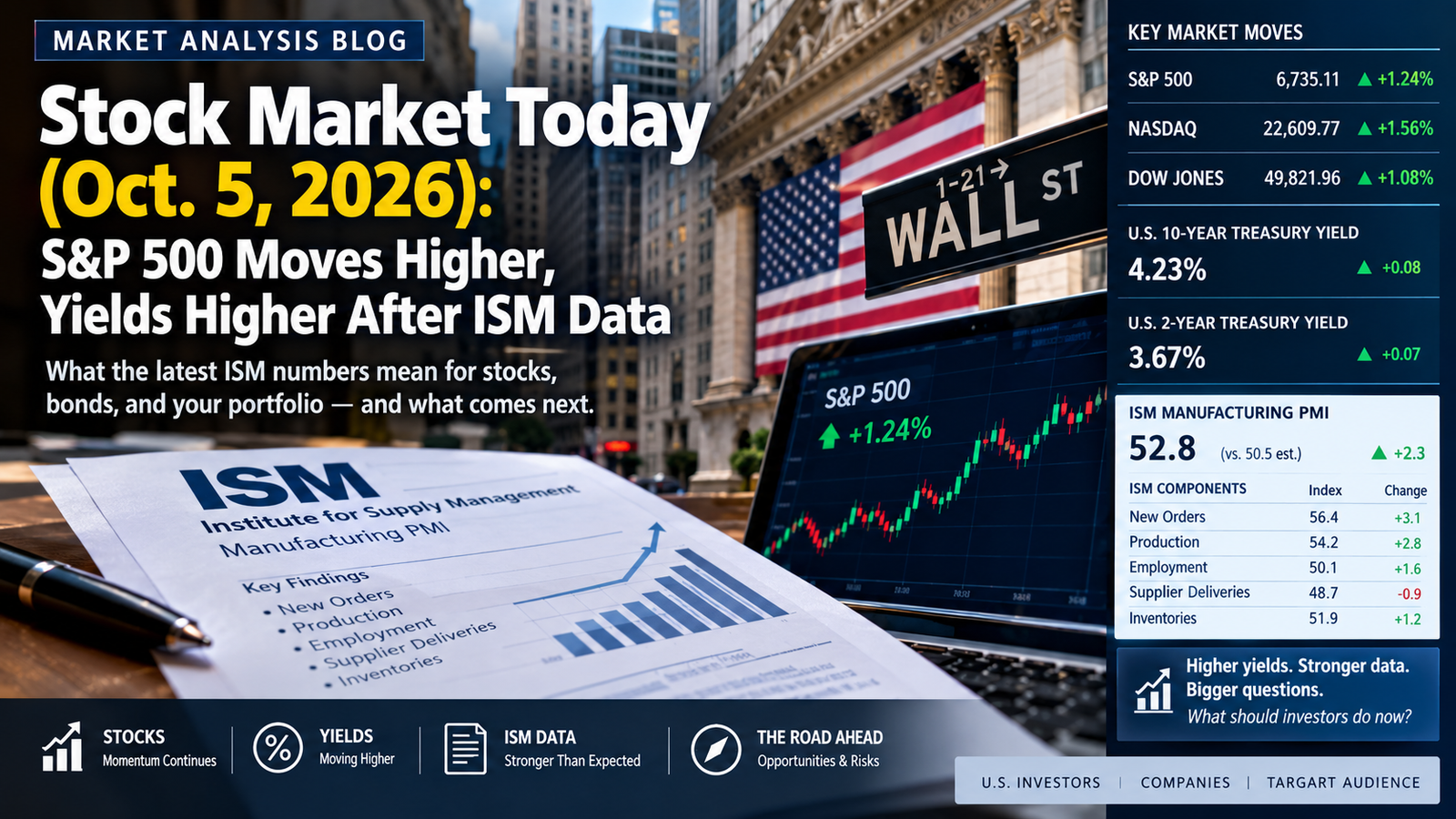
Stock Market Today (Oct. 5, 2026): S&P 500 Moves Higher, Yields Rise After ISM Data
By New York Finance Think | Updated October 5, 2026, after the U.S. market close
U.S. Stock Market Today: Wall Street Rises Even as Treasury Yields Climb
Wall Street started the new week with an unusual combination: stocks moved higher while longer-term U.S. Treasury yields also climbed.
The Nasdaq Composite delivered the strongest performance among the major U.S. indexes on Monday, October 5, closing at a new record high. The S&P 500 also advanced, moving closer to its previous record, while the Dow Jones Industrial Average posted a smaller gain.
The market’s performance showed that investors were still willing to buy technology, artificial intelligence and other growth-oriented stocks even as borrowing costs remained elevated.
The Nasdaq Composite gained 1.05% to close at 27,477.31. The S&P 500 rose 0.66% to 7,773.95, while the Dow Jones Industrial Average added 0.18% to 51,267.90.
The move was especially notable because Treasury yields were moving in the opposite direction.
The U.S. Treasury’s official daily yield data showed the 10-year Treasury yield at 5.31% on October 5, compared with 5.28% on October 2. The 30-year Treasury yield reached 5.66%, up from 5.63% on the previous trading day.
That creates one of the most important questions for investors heading into the rest of the week:
How long can stocks, particularly high-growth technology stocks, continue rising if long-term Treasury yields remain above 5%?
Monday’s answer from Wall Street was simple: for now, investors are prioritizing earnings potential, artificial-intelligence growth and expectations for a less aggressive Federal Reserve over the pressure created by higher bond yields.
But the bond market is sending a different message.
The September ISM Services report added to that tension. U.S. services activity remained firmly in expansion territory, but the prices-paid component jumped to its highest level since July 2022. The combination of strong economic demand and rising input costs could make the Federal Reserve’s inflation problem more complicated.
For investors, October 5 was therefore not simply another green day.
It was a battle between strong corporate growth, AI enthusiasm and softer labor-market expectations on one side, and high Treasury yields and renewed inflation pressure on the other.
KEY TAKEAWAYS
- Nasdaq Composite: 27,477.31, up 1.05%, a record closing high.
- S&P 500: 7,773.95, up 0.66%.
- Dow Jones: 51,267.90, up 0.18%.
- 10-year Treasury yield: 5.31%, according to U.S. Treasury daily data.
- 30-year Treasury yield: 5.66%.
- ISM Services PMI: 54.9 in September, down from 55.4 in August but still showing expansion.
- ISM Services Prices Index: 74.0, the highest reading since July 2022.
- ISM New Orders: 59.8.
- ISM Employment: 50.1, returning to expansion territory.
- ISM Supplier Deliveries: 53.2, signaling slower deliveries.
- Nvidia: gained 2.1% and closed at a record, according to Reuters.
- Microsoft: gained 1.5%.
- Meta Platforms: gained about 2%.
- Tesla: gained about 2%.
- PTC: surged roughly 33% after Schneider Electric announced a $22.6 billion acquisition.
- Investors are now watching the Federal Reserve’s September meeting minutes, scheduled for release October 7.
- The biggest market question remains whether strong AI-driven earnings can continue to outweigh elevated long-term interest rates.
MARKET DATA TABLE: OCTOBER 5, 2026
| Market Indicator | October 5 Close / Reading | Change | What It Means |
|---|---|---|---|
| S&P 500 | 7,773.95 | +0.66% | Broad U.S. stocks moved higher |
| Nasdaq Composite | 27,477.31 | +1.05% | Record closing high |
| Dow Jones Industrial Average | 51,267.90 | +0.18% | More modest gain |
| 10-Year Treasury | 5.31% | Higher | Long-term borrowing costs remain elevated |
| 30-Year Treasury | 5.66% | Higher | Long-duration pressure remains significant |
| 2-Year Treasury | 4.84% | Around prior levels | Sensitive to Fed expectations |
| ISM Services PMI | 54.9 | Down from 55.4 | Services economy still expanding |
| ISM Prices | 74.0 | Up from 72.6 | Stronger inflation pressure |
| ISM New Orders | 59.8 | Down from 60.9 | Demand remains strong |
| ISM Employment | 50.1 | Up from 47.8 | Services employment returned to expansion |
| ISM Supplier Deliveries | 53.2 | Up from 51.3 | Delivery performance slowed |
The Treasury figures above come from the U.S. Department of the Treasury’s official daily yield-curve data, while the ISM figures come from the Institute for Supply Management’s September Services PMI release.
What Happened on Wall Street?
Monday’s session was initially more complicated than the final numbers suggested.
Investors entered the session after a major shift in interest-rate expectations caused by Friday’s weaker-than-expected U.S. employment report.
The softer labor-market data reduced expectations that the Federal Reserve would raise interest rates again at its October meeting. Reuters reported that traders were pricing a 24% chance of an October rate hike, down sharply from about 70% a week earlier.
That was an important development for stocks.
When investors expect the Fed to be less aggressive, high-growth companies can become more attractive because their future earnings are discounted at a less restrictive expected policy path.
But Monday’s ISM Services report complicated that story.
The services economy remained strong.
A PMI reading above 50 indicates expansion. September’s reading of 54.9 therefore showed that the U.S. services economy was still growing at a healthy pace.
At the same time, the prices index jumped to 74.
That is where the market’s story became more complicated.
A strong economy is good for corporate earnings, but strong demand combined with rising input prices can keep inflation elevated.
That could make it harder for the Fed to cut rates quickly.
So investors were effectively balancing two opposing ideas:
The labor market is cooling, which could reduce pressure on the Fed to tighten policy.
At the same time:
The services economy remains strong and price pressures are increasing, which could keep the Fed cautious.
Stocks ultimately responded positively.
S&P 500: Broad Market Moves Higher
The S&P 500 rose 0.66% to 7,773.95.
That left the index approximately 0.3% below its August 13 record closing high, according to Reuters.
That is an important detail.
The S&P 500 was not simply rallying from a deep correction. It was trading very close to record territory.
For investors, that changes the risk calculation.
When an index is close to an all-time high, the question is no longer only whether the economy is growing.
The bigger question becomes:
How much good news is already reflected in stock prices?
The S&P 500 contains companies from technology, financials, healthcare, industrials, consumer sectors, communication services, energy, utilities and other parts of the American economy.
A rise in the index therefore suggests broader investor confidence.
However, the performance was still heavily influenced by large technology companies.
That is increasingly important because the largest companies carry substantial weight in the index.
If technology earnings remain strong, the S&P 500 can continue rising even while other parts of the market struggle.
But if the largest technology stocks experience a sharp valuation correction, the impact on the broader index can be much larger than a normal decline in a smaller company.
That is why investors should not look at the S&P 500 alone.
They should also monitor market breadth, small-cap stocks, equal-weighted indexes and sector participation.
Nasdaq: The Clear Winner of the Day
The Nasdaq Composite was the standout performer.
The index gained 1.05%, closing at 27,477.31, its highest closing level on record. Reuters reported that Nvidia and Microsoft were among the major drivers.
The Nasdaq’s performance is especially significant because technology stocks are typically more sensitive to interest rates.
In a normal environment, rising Treasury yields can put pressure on growth stocks.
The reason is straightforward.
A technology company may generate a large share of its expected profits several years into the future.
Investors calculate the present value of those future profits.
When interest rates rise, the discount rate rises as well.
That can reduce the theoretical value of future earnings.
Yet that relationship did not dominate trading on Monday.
Why?
Because investors were focused on the actual growth potential of major technology companies.
Artificial intelligence remains one of the biggest investment themes in global markets.
Companies are spending enormous amounts on data centers, chips, networking equipment, software and energy infrastructure.
Investors are betting that this spending will translate into higher revenue and profits for the companies supplying the AI ecosystem.
That is helping technology stocks withstand interest-rate pressure.
But it also creates a risk.
If earnings eventually fail to justify the valuations investors are paying today, higher Treasury yields could become much more important.
Dow Jones: A Smaller Gain Tells a Different Story
The Dow Jones Industrial Average gained just 0.18%, closing at 51,267.90.
The difference between the Dow and Nasdaq was meaningful.
The Nasdaq rose more than five times as much on a percentage basis.
That tells us that Monday’s rally was not simply a broad-based bet on every type of American company.
It was heavily connected to growth, technology and AI-related optimism.
The Dow has a very different composition.
It contains large established companies across industrial, consumer, financial and healthcare businesses.
Those companies can benefit from economic growth, but they do not necessarily receive the same valuation premium associated with AI and technology.
For investors, the divergence between the Nasdaq and Dow is worth watching.
If the Nasdaq continues outperforming while the Dow remains relatively weak, the market could be signaling that investors still prefer long-term growth stories.
If the Dow begins catching up, it could suggest that investors are becoming more comfortable with the broader economic cycle.
Treasury Yields: The Biggest Warning Signal
The bond market was arguably more important than the stock-market headline.
The U.S. Treasury reported the 10-year yield at 5.31% on October 5, up from 5.28% on October 2.
The 30-year yield rose to 5.66%, from 5.63%.
These are very high levels compared with the ultra-low interest-rate environment that investors became accustomed to during much of the 2010s and early 2020s.
The 10-year Treasury is particularly important because it influences borrowing costs throughout the economy.
Mortgage rates are affected by Treasury yields.
Corporate borrowing costs are affected.
Commercial real estate financing is affected.
Consumer loans can be indirectly affected.
And equity valuations are affected because investors compare expected stock returns with the risk-free rate.
This is why a 5%-plus 10-year Treasury yield creates a difficult environment for high-growth stocks.
Investors can earn a relatively high return from government debt without taking equity-market risk.
That creates competition for capital.
Yet Monday’s market showed that investors were not abandoning stocks.
Instead, they were becoming more selective.
Why Did Stocks Rise Despite Higher Yields?
There were several reasons.
1. Fed Rate-Hike Expectations Fell
The weaker September employment report changed the short-term interest-rate debate.
According to Reuters, traders saw the probability of an October rate hike fall to 24%, compared with 70% one week earlier.
That matters because the Federal Reserve’s policy rate affects the short end of the yield curve and shapes expectations for future financial conditions.
Even if long-term yields remain high, a reduced probability of another immediate Fed hike can support stocks.
Investors may conclude that the central bank has less reason to tighten policy aggressively.
2. AI Growth Remains Powerful
Nvidia was one of the strongest major technology names.
The company gained 2.1%, reaching another record closing high, while its market value reached approximately $5.76 trillion, according to Reuters.
Microsoft rose 1.5%.
Meta Platforms and Tesla gained approximately 2% each.
These companies represent different parts of the technology and AI ecosystem.
Nvidia is central to AI computing infrastructure.
Microsoft is building AI into enterprise software and cloud services.
Meta is investing heavily in AI recommendation systems and infrastructure.
Tesla remains connected to automation, robotics and AI expectations in addition to electric vehicles.
The market is therefore treating AI not as a short-lived technology trend but as a potentially massive investment cycle.
3. Oil Prices Eased
Energy prices have become another major variable for investors.
Reuters reported that oil prices declined on Monday as Middle Eastern crude exports increased and the Group of Seven pledged to boost supplies.
Lower oil prices can help the stock market in several ways.
First, cheaper energy can reduce inflation pressure.
Second, transportation companies can benefit from lower fuel costs.
Third, consumers may have more disposable income if gasoline and energy expenses fall.
Fourth, lower energy costs can reduce some of the pressure on the Federal Reserve.
But investors should be careful.
Oil prices remain highly sensitive to geopolitical developments.
A sudden disruption to global energy supplies could reverse the move quickly.
4. Investors Are Looking Toward Earnings
The third-quarter earnings season is becoming increasingly important.
Large U.S. banks are scheduled to begin reporting next week.
Reuters reported that analysts were expecting S&P 500 earnings to rise more than 30% year over year, driven substantially by AI-related companies.
That is a major expectation.
A 30%-plus earnings-growth environment can support elevated equity valuations.
But it also creates a high bar.
If companies beat expectations, investors could continue paying premium prices for growth.
If earnings disappoint, the market could react sharply because valuations already reflect strong growth assumptions.
This is particularly relevant for technology companies.
Investors should therefore focus less on whether a company simply beats earnings estimates and more on:
- Revenue growth
- AI-related revenue
- Capital spending
- Free cash flow
- Operating margins
- Cloud growth
- Data-center demand
- Forward guidance
- Customer spending
- Management’s outlook
ISM SERVICES PMI: What the Data Actually Said
The September ISM Services PMI was one of the most important economic releases of Monday.
The headline reading came in at 54.9, down from 55.4 in August.
The report marked the 27th consecutive month of expansion in the services sector.
That means the services economy was still growing.
For investors, the headline number was not recessionary.
In fact, it was consistent with continued economic growth.
But the internal components were more important.
ISM Services Data Table
| Component | September 2026 | August 2026 | Direction |
|---|---|---|---|
| Services PMI | 54.9 | 55.4 | Lower |
| Business Activity | 56.5 | 61.7 | Lower |
| New Orders | 59.8 | 60.9 | Lower |
| Employment | 50.1 | 47.8 | Higher |
| Supplier Deliveries | 53.2 | 51.3 | Higher/slower deliveries |
| Prices | 74.0 | 72.6 | Higher |
| Inventories | 57.8 | 56.7 | Higher |
| Backlog of Orders | 56.6 | 55.6 | Higher |
The ISM report showed business activity slowing from 61.7 to 56.5, while new orders declined from 60.9 to 59.8.
However, employment improved from 47.8 to 50.1.
Most importantly for inflation watchers, prices increased from 72.6 to 74.0.
The prices index reached its highest level since July 2022.
Why the ISM Prices Index Matters
This may have been the most important number inside the entire report.
The services sector represents more than two-thirds of U.S. economic activity.
When prices paid by service businesses rise, companies can eventually attempt to pass those costs on to customers.
That creates a potential inflation problem.
A business might face higher costs for:
- Labor
- Transportation
- Fuel
- Insurance
- Equipment
- Technology
- Logistics
- Professional services
- Materials
If companies raise prices to protect profit margins, inflation can remain sticky.
That is why the Federal Reserve pays close attention to a wide range of inflation indicators.
The ISM Prices Index is not the same thing as the Consumer Price Index or Personal Consumption Expenditures index.
But it provides an important business-side signal.
And Monday’s signal was clear:
Cost pressure is not completely under control.
Services Employment Improves
Another important detail was the employment index.
The ISM Services Employment Index rose to 50.1 from 47.8.
A reading above 50 indicates expansion.
This meant services employment returned to expansion territory after three months below 50.
That creates an interesting contrast with the weaker September payrolls report.
The broader labor market has been losing momentum, but the services survey suggests some businesses are still hiring or replacing workers.
The ISM report included comments from businesses about filling positions vacated by promotions or retirements and restructuring as companies gain efficiencies from AI tools.
That last point is particularly interesting for investors.
AI is not only creating demand for chips and data centers.
It may also be changing the way companies manage labor.
Companies that can increase productivity with AI may eventually produce higher profits without increasing headcount at the same rate.
That could become a major theme during the next several earnings seasons.
What Does This Mean for the Federal Reserve?
The Fed is now dealing with a difficult combination.
The labor market has weakened enough to reduce pressure for another immediate rate hike.
But the economy remains resilient.
And inflation pressure has not completely disappeared.
The September ISM Services report reinforces that problem.
The Federal Reserve’s September meeting minutes are scheduled for release on October 7 at 2:00 p.m. ET, according to the Federal Reserve calendar. The next scheduled FOMC meeting is October 27-28.
Those minutes could give investors a clearer idea of how policymakers viewed the balance between inflation and employment.
For markets, the Fed’s language may be just as important as the actual interest-rate decision.
Investors will be watching for clues about:
- Inflation risks
- Labor-market weakness
- Future rate hikes
- Possible rate cuts
- Long-term inflation expectations
- Financial conditions
- Economic growth
- Balance-sheet policy
The Big Question: Can the Fed Ignore Rising Long-Term Yields?
This is one of the most important questions in the market right now.
The Federal Reserve controls short-term monetary policy.
It does not directly set the 10-year or 30-year Treasury yield.
Those longer-term yields are determined by market forces.
Investors demand higher yields when they believe they need greater compensation for inflation, fiscal risk, economic uncertainty, term risk or competing investment opportunities.
That means the Fed can potentially hold or cut short-term rates while long-term yields continue rising.
That is exactly the kind of environment that creates problems for financial markets.
Imagine a company that expects to generate billions of dollars in profits five or ten years from now.
If the long-term risk-free rate rises substantially, the present value of those future profits falls.
That does not necessarily mean the company is fundamentally weaker.
But it can mean investors are willing to pay a lower valuation multiple.
For expensive technology stocks, that distinction matters.
Why Nvidia Matters So Much
Nvidia has become one of the most important stocks in the global market.
On October 5, Nvidia gained 2.1% and reached a record closing high, with a market value of about $5.76 trillion, according to Reuters.
That is an extraordinary valuation.
It also means Nvidia’s stock movement can influence major indexes.
Investors are effectively using Nvidia as a proxy for the AI investment cycle.
When Nvidia rises, the market may interpret it as a signal that demand for AI computing remains strong.
When Nvidia falls sharply, investors may begin questioning:
- AI infrastructure spending
- Data-center growth
- Semiconductor demand
- Capital expenditure
- Customer concentration
- Valuation
- Competitive pressure
For this reason, Nvidia will remain one of the most important stocks to watch during the October earnings season.
Microsoft: The Enterprise AI Story
Microsoft gained 1.5% on Monday.
The company represents another part of the AI story.
Unlike semiconductor companies, Microsoft monetizes AI through cloud computing, enterprise software and productivity tools.
The key question for investors is not simply whether Microsoft is using AI.
It is whether customers are willing to pay more for AI-powered products.
That means investors will be watching cloud growth, enterprise demand, AI-related revenue and capital expenditures.
If Microsoft can show that AI spending is translating into recurring revenue, the broader AI investment thesis could remain strong.
Meta and Tesla Add to the Growth Rally
Meta Platforms and Tesla each gained about 2% on Monday, according to Reuters.
Meta’s AI strategy is closely connected to advertising, recommendation systems and infrastructure spending.
Tesla’s story is broader.
Investors continue to consider electric vehicles, automation, autonomy, robotics and AI when valuing the company.
The important point is that Monday’s rally was not limited to one semiconductor company.
Several large technology and growth names moved higher together.
That suggests investor appetite for the growth theme remains strong.
PTC: A Major M&A Signal
One of Monday’s most dramatic individual stock moves came from PTC.
PTC shares jumped roughly 33% after Schneider Electric announced a deal to acquire the industrial software company for approximately $22.6 billion in equity value.
The agreement calls for Schneider Electric to pay $205 per share in cash for PTC, representing a 42.3% premium to PTC’s previous closing price.
This matters beyond one company.
The deal shows that strategic buyers are still willing to make large investments in technology and industrial software.
It also highlights the intersection of software, industrial automation, energy management and AI.
Schneider Electric described the transaction as part of a broader move toward energy and industrial intelligence.
For investors, M&A can be a useful signal.
When companies are willing to pay large premiums for software businesses, it suggests that strategic buyers see long-term value in digital transformation and automation.
Other Stocks in Focus
Monday’s market action included several notable moves beyond the largest technology companies.
According to market coverage, PTC surged after the Schneider Electric transaction.
RXO also moved sharply after an agreement involving C.H. Robinson’s Global Forwarding business.
C.H. Robinson shares fell after the transaction announcement.
Intel declined as investors considered developments involving TSMC and a potential chip manufacturing venture in Texas.
GlobalFoundries also fell.
These moves show that the market is becoming increasingly focused on corporate strategy, mergers, semiconductor competition and AI infrastructure.
Market Breadth: A Critical Question for Investors
A market rally is healthier when many companies participate.
A rally driven by only a handful of mega-cap technology companies is more fragile.
This does not mean the current rally must fail.
It means investors should look beyond headline indexes.
A useful checklist includes:
- How many S&P 500 stocks are rising?
- Are small-cap stocks participating?
- Are banks participating?
- Are industrial stocks participating?
- Are consumer companies participating?
- Is the equal-weighted S&P 500 rising?
- Are cyclical sectors improving?
- Are defensive sectors outperforming?
- Is the dollar strengthening?
- Are Treasury yields rising faster than earnings expectations?
The answers can tell investors whether the market is experiencing broad economic optimism or a concentrated technology rally.
What Higher Treasury Yields Mean for American Companies
Higher yields are not automatically negative for every business.
Banks can potentially benefit from certain changes in interest-rate spreads.
Insurance companies may benefit from higher yields on investment portfolios.
Financial institutions with large cash balances can earn more income.
But other businesses face higher financing costs.
Companies with heavy debt loads may need to pay more when refinancing.
Small businesses can be particularly sensitive to higher borrowing costs.
Real estate companies can face higher capitalization rates.
Homebuilders can face pressure because mortgage rates influence housing demand.
Utilities can also be affected because they are capital-intensive and often compete with bonds for income-oriented investors.
This is why rising Treasury yields create different winners and losers.
What Higher Yields Mean for American Consumers
For ordinary Americans, Treasury yields may sound like a Wall Street issue.
They are not.
Interest rates affect everyday financial decisions.
Higher borrowing costs can influence:
- Mortgage rates
- Auto loans
- Credit cards
- Business loans
- Home construction
- Commercial real estate
- Student lending
- Savings accounts
- Certificates of deposit
- Money-market funds
Consumers with large savings balances may benefit from higher interest income.
Borrowers, however, may face higher financing costs.
The most important point is that the effect is not uniform.
A saver and a borrower can experience the same interest-rate environment very differently.
What Higher Treasury Yields Mean for Investors
Investors should think about Treasury yields as the baseline against which many other investments are compared.
Suppose a Treasury security offers a high risk-free yield.
An investor buying a risky stock wants sufficient expected return to justify taking additional risk.
If Treasury yields rise, the required return on stocks may also rise.
That can pressure valuations.
This is especially relevant for companies whose profits are expected far in the future.
It is less important for companies with strong current cash flow, large cash balances and stable earnings.
This is one reason the market can sometimes favor profitable mega-cap technology companies over smaller speculative growth companies.
What the ISM Report Means for Corporate America
The ISM data suggests that corporate America is still dealing with strong demand.
New orders remained well above 50 at 59.8.
Backlog of orders increased to 56.6.
Business activity remained at 56.5.
That is not a recessionary picture.
But the prices index at 74.0 is a warning.
Companies may face a difficult operating environment in which demand remains strong but costs are rising.
For investors, that makes margins critical.
A company that can raise prices without losing customers may protect margins.
A company that cannot pass higher costs to consumers may see profits squeezed.
That distinction will become increasingly important in earnings reports.
Sector Analysis: Where Investors Should Look
Technology
Technology remains the center of the market’s growth story.
AI spending, cloud computing, chips and software remain major themes.
But valuations are elevated, so earnings execution matters.
Investor focus: Nvidia, Microsoft, Meta, semiconductor companies, cloud infrastructure and AI software.
Financials
Banks are entering the spotlight as third-quarter earnings season approaches.
Investors will watch:
- Net interest income
- Loan growth
- Credit losses
- Investment banking
- Trading revenue
- Consumer credit
- Commercial real estate exposure
- Deposit costs
The combination of strong economic activity and high yields can create both opportunities and risks for banks.
Industrials
Industrials could benefit from continued business investment and infrastructure spending.
However, higher borrowing costs can affect capital-intensive projects.
The PTC-Schneider transaction also highlights the growing connection between industrial companies and software.
Energy
Energy remains heavily influenced by geopolitical developments and global supply.
Lower oil prices helped Monday’s equity sentiment.
But investors should not assume the decline will continue.
Energy prices can move rapidly when supply routes or geopolitical conditions change.
Consumer Stocks
Consumers remain central to the U.S. economy.
The services sector continues to expand, which is positive for consumer-facing companies.
But inflation and borrowing costs can pressure household budgets.
Investors should watch consumer spending, credit-card balances, employment and wage growth.
Healthcare
Healthcare companies can be less sensitive to some economic cycles but are exposed to policy, drug pricing, insurance and earnings-specific risks.
In a market dominated by AI and technology, healthcare can lag even when fundamentals remain stable.
Small-Cap Stocks: A Different Story
Small-cap stocks are important because they are generally more sensitive to domestic financing conditions.
Many smaller companies rely more heavily on bank lending and refinancing.
If long-term yields remain elevated, small-cap valuations may face greater pressure.
That means investors should monitor the Russell 2000.
A sustained small-cap rally alongside the Nasdaq would be a stronger signal of broad market confidence.
If the Nasdaq keeps reaching records while small caps remain weak, investors should recognize that the rally may be concentrated.
The Dollar and Global Markets
The U.S. dollar also matters.
A stronger dollar can create headwinds for multinational American companies because overseas revenue translates into fewer dollars.
A weaker dollar can have the opposite effect.
Currency movements also influence commodity prices and international capital flows.
With Treasury yields elevated, U.S. assets can remain attractive to global investors.
But foreign investors must also consider currency risk.
This makes the dollar another important variable for the October market outlook.
Oil and Inflation
Oil is one of the fastest ways for financial markets to react to geopolitical risk.
Higher crude prices can raise transportation and production costs.
Those costs can move through supply chains and eventually reach consumers.
The September ISM report specifically highlighted fuel-related concerns among businesses.
Reuters reported that complaints about higher fuel prices were prominent in the survey responses.
That means investors should not treat the decline in oil prices on October 5 as a permanent solution.
The market needs to see whether energy prices remain contained.
What Investors Should Watch on October 6
The next trading session will provide an important test.
Investors will want to see whether the Nasdaq can maintain its record level.
The key questions include:
- Do Treasury yields continue rising?
- Does the 10-year yield remain above 5.3%?
- Does oil remain below recent highs?
- Does Nvidia continue leading technology?
- Does the S&P 500 move through its previous record?
- Do small caps participate?
- Does the dollar strengthen?
- Are financial stocks gaining?
- Does market breadth improve?
A continuation of the Nasdaq rally despite high yields would indicate that investors remain strongly committed to the AI-growth story.
A sharp reversal accompanied by another jump in Treasury yields would tell a different story.
October 7 Fed Minutes Could Become the Next Big Catalyst
The Federal Reserve’s September meeting minutes are scheduled for Wednesday, October 7 at 2 p.m. ET.
Investors will read the minutes for clues about disagreement among policymakers.
The central question is whether officials are more concerned about inflation or employment.
A dovish interpretation could support stocks.
A hawkish interpretation could push Treasury yields higher and put pressure on technology valuations.
Investors should therefore expect potentially larger market moves around the release.
Earnings Season Is Coming
The third-quarter earnings season is likely to become the dominant stock-specific driver.
Large U.S. banks are among the companies preparing to report.
The market is expecting strong earnings growth.
Reuters reported that analysts expected S&P 500 earnings to rise more than 30% year over year, with AI-related companies playing an important role.
That expectation is powerful.
But expectations can also become a risk.
If earnings grow 30% but guidance disappoints, stocks can still fall.
Investors should therefore focus on forward guidance rather than backward-looking earnings alone.
The AI Trade: Opportunity or Concentration Risk?
The biggest debate in the market is no longer whether AI is important.
It clearly is.
The debate is whether investors have already priced too much future AI growth into the stock market.
Nvidia’s enormous market value illustrates the scale of the expectations.
Microsoft, Meta and other major companies are also spending heavily to build AI infrastructure.
The bullish argument is that AI could create a productivity boom comparable to earlier technological revolutions.
The bearish argument is that companies are spending enormous amounts of capital before the full economic return is proven.
Both arguments can be true.
AI investment can be transformative while some AI-related stocks can still become overvalued.
That is why investors should focus on cash flow, earnings and return on invested capital rather than simply buying a stock because it has an AI label.
What This Means for Long-Term Investors
For long-term investors, one day’s market move should not determine an entire investment strategy.
The more important question is whether the underlying companies continue producing earnings and cash flow.
A record Nasdaq is not automatically a reason to sell.
A 5.3% 10-year Treasury yield is not automatically a reason to abandon stocks.
Instead, investors should evaluate their portfolio based on:
- Valuation
- Earnings growth
- Balance-sheet strength
- Cash flow
- Debt
- Competitive advantage
- Dividend policy
- Economic sensitivity
- Interest-rate sensitivity
- Portfolio concentration
The current market rewards quality.
Companies with strong balance sheets and genuine earnings growth may be better positioned to handle high rates than highly leveraged speculative businesses.
What This Means for New Investors
If you are a beginner investor, Monday’s market can look confusing.
You might reasonably ask:
If interest rates are high, why are stocks rising?
The answer is that stock prices depend on more than interest rates.
Investors are also considering:
- Future earnings
- Economic growth
- AI demand
- Corporate profits
- Inflation
- Federal Reserve policy
- Oil prices
- Geopolitical risks
- Investor sentiment
Sometimes these factors point in different directions.
That is exactly what happened on October 5.
The bond market was sending a warning about inflation and long-term rates.
The stock market was responding to AI growth, earnings optimism and reduced expectations for another immediate Fed hike.
Neither market is necessarily “wrong.”
They are pricing different risks.
What Could Go Right for Stocks?
The bullish scenario is relatively straightforward.
If inflation cools, Treasury yields stabilize, oil prices remain controlled and corporate earnings remain strong, stocks could continue moving higher.
Technology companies would likely remain market leaders.
The S&P 500 could challenge new records.
Small-cap stocks could begin catching up.
Financial conditions could stabilize.
The Federal Reserve could avoid additional tightening.
That combination would create a favorable environment for equities.
What Could Go Wrong?
The bearish scenario is also clear.
If the 10-year Treasury yield continues rising substantially above 5.3%, equity valuations could come under pressure.
If the ISM prices index remains elevated, inflation expectations could rise.
If oil prices jump again, inflation could become more difficult to control.
If the Fed adopts a more hawkish tone, technology stocks could decline.
And if third-quarter earnings fail to meet high expectations, investors may begin questioning whether current valuations are justified.
The biggest risk is not necessarily a recession.
It could simply be valuation compression.
In other words, companies could continue growing earnings while investors become willing to pay less for each dollar of those earnings.
That can still produce a market correction.
Bull Case vs. Bear Case
| Factor | Bull Case | Bear Case |
|---|---|---|
| Treasury yields | Stabilize or fall | Continue sharply higher |
| Inflation | Cools | Remains sticky |
| Oil | Remains controlled | Surges again |
| Fed | Less hawkish | More hawkish |
| AI earnings | Beat expectations | Disappoint |
| S&P 500 | Breaks records | Corrects |
| Nasdaq | Continues leadership | Valuation pressure |
| Small caps | Join rally | Remain weak |
| Consumer | Spending stays strong | Credit stress increases |
| Corporate profits | Strong growth | Margin pressure |
Investor Watchlist
Nvidia (NVDA)
Watch AI demand, data-center growth, margins and forward guidance.
Microsoft (MSFT)
Watch cloud growth, enterprise AI adoption and capital expenditures.
Meta Platforms (META)
Watch advertising demand, AI infrastructure spending and monetization.
Tesla (TSLA)
Watch vehicle demand, margins, autonomy and AI-related initiatives.
PTC (PTC)
Watch the Schneider Electric acquisition process and regulatory developments.
Major U.S. Banks
Watch net interest income, credit quality, loan growth and investment-banking activity as earnings season begins.
Frequently Asked Questions
Why did the S&P 500 rise on October 5, 2026?
The S&P 500 gained 0.66% as investors bought technology and growth stocks, while weaker employment data reduced expectations for another immediate Federal Reserve rate hike. Lower oil prices also supported sentiment.
What happened to the Nasdaq?
The Nasdaq Composite rose 1.05% to 27,477.31 and reached a record closing high. Nvidia, Microsoft, Meta and Tesla were among the technology names helping drive the advance.
Why were Treasury yields rising?
The bond market remained concerned about strong economic demand, inflation pressure and the need for higher compensation on longer-duration debt. The September ISM Services report showed the prices index rising to 74, its highest level since July 2022.
What was the September ISM Services PMI?
The ISM Services PMI was 54.9 in September, down from 55.4 in August. A reading above 50 indicates expansion.
Was the ISM report good or bad for stocks?
It was mixed.
The 54.9 headline showed continued economic growth, which is positive for corporate earnings. But the 74.0 prices index showed significant inflation pressure, which could make Federal Reserve policy more difficult.
Why is the 10-year Treasury yield important?
The 10-year Treasury is a major benchmark for financial markets. Higher yields can increase borrowing costs and reduce the present value investors assign to future corporate earnings.
Why are technology stocks rising despite higher yields?
Investors remain highly optimistic about AI-related growth and corporate earnings. Nvidia, Microsoft, Meta and other major technology companies are benefiting from expectations of strong AI investment and revenue growth.
What is the next major market event?
The Federal Reserve’s September meeting minutes are scheduled for release on October 7 at 2 p.m. ET.
Should investors buy stocks after the Nasdaq hits a record?
A record high by itself is not a buy or sell signal. Investors should consider valuation, earnings growth, risk tolerance, diversification and investment horizon.
Are high Treasury yields always bad for stocks?
No. Higher yields can reflect stronger economic growth and can benefit some financial institutions. The problem becomes greater when yields rise because of inflation or fiscal concerns while equity valuations remain very high.
The Bottom Line
October 5, 2026 was a good day for U.S. stocks, but it was not a simple risk-on session.
The Nasdaq reached a record.
The S&P 500 moved closer to its own record.
The Dow also finished higher.
Nvidia, Microsoft, Meta and Tesla helped drive the technology rally.
Oil prices eased.
Expectations for an immediate Federal Reserve rate hike fell sharply after the weaker September jobs report.
All of those developments helped equities.
But the bond market told a more cautious story.
The 10-year Treasury yield remained above 5.3%.
The 30-year yield stood near 5.7%.
And the ISM Services Prices Index jumped to 74, its highest level since July 2022.
That combination means investors cannot simply assume that the Fed will become aggressively dovish because employment growth has weakened.
The economy is still producing strong services demand.
Businesses are still receiving new orders.
The services sector remains in expansion.
But companies are also reporting higher costs.
For Wall Street, that creates a delicate balance.
The economy is not weak enough to remove inflation concerns, but the labor market is soft enough to reduce expectations for immediate Fed tightening.
That is the environment in which the Nasdaq is reaching records despite very high Treasury yields.
For investors, the next phase of the market will likely come down to three things:
Treasury yields, Federal Reserve policy and corporate earnings.
If yields stabilize and earnings remain strong, the stock rally could continue.
If yields rise sharply and earnings expectations weaken, the market could become much more volatile.
The October 7 Fed minutes will provide the next important policy clue, while upcoming bank and corporate earnings will begin testing whether today’s optimistic stock prices are supported by actual business results.
For now, Wall Street is choosing growth over fear.
But the bond market is reminding investors that the inflation story is not finished.
That tension—not simply the Nasdaq’s record—is the most important story in the U.S. stock market right now.
Sources and Data
Top 10 Source Links —
- Reuters
- U.S. Department of the Treasury
- Federal Reserve
- Nasdaq
- New York Stock Exchange (NYSE)
- S&P Dow Jones Indices
- Institute for Supply Management (ISM)
- Federal Reserve Bank of New York
- Associated Press (AP News)
- Investopedia
Financial Disclaimer: This article is for news and educational purposes only. It is not investment, financial, tax or legal advice. Market prices can change rapidly, and investors should conduct their own research or consult a qualified financial professional before making investment decisions.
