
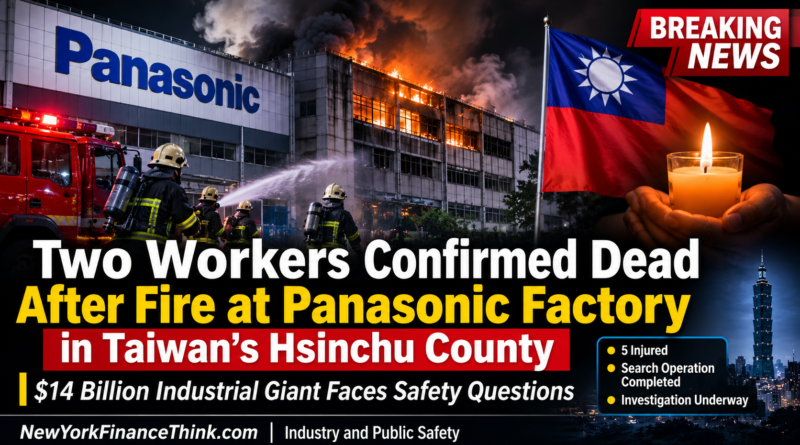
Two Workers Confirmed Dead After Fire at Panasonic Factory in Taiwan’s Hsinchu County
By NewYorkFinanceThink.com Editorial Desk
Date: November 5, 2026
Category: Industry and Public Safety | Taiwan | Global Manufacturing
Two workers have been confirmed dead following a major fire and explosion at a Panasonic-operated factory in Hsinchu County, Taiwan. The two employees had initially been reported missing after the incident on Wednesday, November 4. Local authorities confirmed on Thursday that rescue teams had located both workers during an extensive search of the damaged factory building. Their deaths have turned an already serious industrial accident into a tragedy for the families involved and raised renewed questions about workplace safety in facilities that handle industrial chemicals and manufacture materials used by the electronics sector.
The fire broke out at a five-story factory operated by Panasonic Industrial Devices Materials Taiwan in Hukou Township, Hsinchu County. According to local reporting, the incident began at approximately 2 a.m. on Wednesday, when an explosion was reported in the production area. More than 20 employees were working on production lines at the time. The explosion was followed by a major fire that spread through parts of the facility and caused structural damage, making rescue operations difficult.
The Hsinchu County Fire Bureau confirmed that five employees were injured in the incident. The injured workers included three Taiwanese employees and two Vietnamese employees. They were taken to hospital for treatment. At the same time, two Taiwanese employees remained unaccounted for, prompting emergency teams to continue searching through the damaged structure.
On Thursday morning, firefighters returned to the site with heavy machinery to move debris and search for the missing employees. The operation involved 12 emergency vehicles and 23 firefighters, according to local authorities. Both missing workers were eventually found dead. Officials have not released all details concerning the victims, and further identification procedures may be required.
The incident has drawn attention to the risks faced by workers in industrial facilities where manufacturing operations, chemical materials and complex production equipment operate within the same environment. It also raises broader questions about emergency preparedness, fire prevention, chemical storage and the protection of employees working in Taiwan’s important technology manufacturing sector.
How the Panasonic factory fire unfolded
The incident occurred at a Panasonic-operated facility on Guangfu Road in Hukou Township. The factory is associated with research and development and the production of printed circuit boards and semiconductor packaging materials. These materials form part of the supply chain supporting modern electronic products and components.
Reports from local authorities indicate that an explosion occurred in the factory’s production area during the early hours of November 4. The fire spread through the building, while parts of the structure were damaged or collapsed. Emergency responders faced difficult conditions as they worked to control the remaining fire, assess structural hazards and locate employees who could not initially be accounted for.
The first priority for emergency personnel was to prevent the fire from spreading to nearby industrial facilities. The factory is located close to other businesses, making the response particularly important for the surrounding industrial area. Firefighters deployed protective water lines and worked to contain the incident within the affected site.
The fire was brought under control after an extended firefighting operation. However, the damage inside the building complicated the search for the two missing employees. Heavy machinery was later used to move debris and allow rescue teams to inspect areas that could not safely be reached earlier.
The confirmation of both deaths on November 5 marked the most tragic development in the response. Authorities have continued examining the site as part of the investigation into the explosion and fire.
Five employees injured as rescue teams searched the damaged building
Five workers were injured during the incident and transported to hospital. Local reports identified the injured group as three Taiwanese employees and two Vietnamese employees. Initial information from the authorities indicated that the injured workers were conscious when they were taken for medical treatment.
The two employees who were later confirmed dead had been reported missing after the explosion. Their absence led to a continuing search operation involving firefighters, heavy equipment and safety measures intended to protect emergency personnel from further hazards.
Industrial rescue operations can become particularly complicated after explosions because the damage may extend beyond the area where the fire first began. Debris, unstable structures, damaged machinery and the possibility of remaining chemical hazards can all create additional risks. Emergency teams must therefore balance the urgency of locating missing people with the need to avoid exposing rescuers to further danger.
The deaths are a painful reminder that industrial accidents affect more than production schedules or company operations. Behind every workplace emergency are employees, families and communities whose lives may be permanently changed.
Chemical solvents among the possible factors under investigation
Authorities have indicated that flammable chemical solvents inside the factory may be relevant to the investigation. Initial information mentioned substances including methanol and methyl ethyl ketone, also known as MEK. These materials are used in certain industrial and manufacturing processes and require appropriate handling, storage, ventilation and fire-prevention controls.
However, the precise cause of the explosion and fire has not been established. The mention of chemical solvents should therefore be treated as an initial investigative lead, not as a final finding about what caused the accident.
Investigators will need to examine the factory’s production processes, chemical storage arrangements, equipment condition, electrical systems, ventilation, emergency procedures and the sequence of events leading to the explosion. Determining whether a leak, equipment failure, ignition source or another factor contributed to the incident will require technical examination and official findings.
The distinction matters because industrial fires can have several contributing factors. A chemical may be present at a site without necessarily being the direct cause of an explosion. Investigators must establish how the incident began, how the fire spread and whether any safety systems failed to operate as intended.
A complete investigation should also consider whether employees had adequate emergency instructions, whether evacuation routes remained accessible and whether workers could respond effectively when the explosion occurred.
Factory safety inspection and questions about industrial risk
Local authorities reported that the factory had passed a fire safety inspection in August 2026. That information is relevant to the investigation, but it does not by itself establish why the November incident occurred or whether every workplace safety requirement was being met at the time of the fire.
A successful inspection represents an assessment at a particular point in time and under specific conditions. Industrial facilities can contain changing production arrangements, equipment, chemicals and maintenance requirements. Safety systems must therefore be maintained continuously, rather than treated as a one-time administrative requirement.
The investigation may need to examine inspection records, maintenance documents, chemical inventories, staff training, emergency drills and the factory’s procedures for managing hazardous materials. Authorities may also need to determine whether the facility’s safety arrangements were appropriate for the specific processes taking place in the affected production areas.
The wider lesson is that workplace safety must be measured not only by inspection certificates but also by the ability of a facility to prevent foreseeable accidents and protect workers when an emergency occurs.
Why the incident matters to Taiwan’s electronics industry
The factory’s operations connect the incident to Taiwan’s broader electronics manufacturing ecosystem. Panasonic Industrial Devices Materials Taiwan conducts research and development and manufactures printed circuit boards and semiconductor packaging materials. These products support manufacturers producing components used in a wide range of electronic equipment.
Printed circuit boards are essential parts of computers, servers, telecommunications equipment and many other electronic products. Semiconductor packaging materials also play an important role in the production and protection of semiconductor components. As demand for artificial intelligence infrastructure, data centers and advanced computing continues to grow, reliable materials suppliers remain important to the global technology industry.
A serious factory accident can create operational uncertainty for the affected company, its employees, suppliers and customers. The actual commercial impact of this particular incident will depend on the extent of the damage, the condition of production equipment, the availability of alternative capacity and the time required to restore operations.
It would be premature to conclude that the fire will cause a major disruption to global semiconductor or electronics supply chains. The factory’s exact production losses and the wider effect on customers have not been fully established in the available reports. Nevertheless, the incident illustrates how safety events at specialized industrial facilities can become relevant to international manufacturing networks.
Companies that depend on advanced materials often operate within complex supply chains. A disruption at one facility may require production adjustments, alternative sourcing or revised delivery schedules. Businesses therefore have an interest in understanding not only their direct suppliers but also the operational resilience of the facilities supporting those suppliers.
The importance of protecting workers in high-risk manufacturing
The deaths of the two employees bring the human consequences of industrial risk into sharp focus. Manufacturing facilities are essential to modern economies, but production targets and operational efficiency must never take priority over the safety of the people working inside them.
Factories that use flammable solvents or other hazardous materials need effective chemical management systems. These include appropriate storage conditions, clear labeling, controlled handling procedures, ventilation, equipment maintenance and safeguards against accidental ignition. Emergency exits and evacuation routes must remain accessible, while employees should understand how to respond when alarms, explosions or fires occur.
Training is especially important in facilities where workers perform different tasks or work around specialized equipment. Employees need to know how to recognize warning signs, report unsafe conditions and follow emergency procedures. Contractors, temporary workers and employees from different language backgrounds must also receive safety information they can understand.
The presence of Taiwanese and Vietnamese employees among those affected highlights the importance of making workplace safety instructions accessible to every worker. Emergency communication should not depend on employees speaking only one language or already knowing the layout of a facility.
For companies operating internationally, safety standards must be consistently applied across all locations. Workers should receive the same commitment to protection regardless of the country in which a factory operates.
The next stage will depend on the findings of the official investigation. Authorities will need to determine the origin of the explosion, the circumstances that allowed the fire to spread and the reasons the two employees could not escape or be located before the search operation concluded.
Several questions are likely to be important:
- What caused the initial explosion?
- Did chemical substances contribute to the incident, and if so, how?
- Were storage, ventilation and fire-prevention systems functioning properly?
- Did the factory’s emergency procedures operate as intended?
- Were evacuation routes accessible during the emergency?
- What caused the structural damage that complicated rescue operations?
- What steps are required before any affected production activity can safely resume?
These questions should be answered through technical evidence and official findings rather than speculation. The investigation may also determine whether additional safety measures, regulatory action or changes to industrial procedures are necessary.
Panasonic has confirmed that an explosion occurred at its Taiwan facility and that it is investigating the details and cause of the accident. Further information from the company and local authorities will be important in understanding the incident’s full operational and safety implications.
The wider challenge of industrial safety in technology manufacturing
Taiwan’s technology sector has become a major part of the global manufacturing system. Its industrial facilities support electronics, semiconductor production, computing and advanced technology supply chains. Maintaining that position requires not only investment in equipment and research but also strong protection for the people who operate factories and handle industrial materials.
The growth of advanced manufacturing can introduce complex safety challenges. Production facilities may use specialized chemicals, high-temperature processes, electrical systems and equipment that requires careful maintenance. As factories expand and production becomes more sophisticated, safety management must evolve alongside operational demands.
Industrial safety is not simply a matter of meeting minimum regulatory requirements. It is an ongoing responsibility involving company leadership, engineers, safety professionals, supervisors, employees and government regulators. Every part of the system has a role in identifying hazards before they become emergencies.
The Panasonic factory fire is a reminder that even facilities operating within a highly developed manufacturing environment can face serious industrial risks. A reported safety inspection earlier in the year will be one part of the wider picture, but the final investigation must establish what happened and whether additional safeguards could have prevented the tragedy.
Editorial analysis: Worker safety must come before production pressure
The deaths of two employees in the Panasonic factory fire are a human tragedy that deserves attention beyond the immediate headlines. The five injured workers, the families of the deceased and the colleagues who witnessed the emergency are at the center of this incident. Their experiences should remain the most important consideration as authorities investigate the cause.
The factory also has a place in a much larger industrial story. Taiwan is deeply connected to global electronics and semiconductor manufacturing, and specialized materials facilities support industries that increasingly depend on reliable production. Yet no supply-chain requirement, commercial deadline or manufacturing target can justify accepting preventable risks to workers.
The investigation must establish the facts carefully. Initial references to flammable solvents should not be treated as proof of the cause, and the August fire safety inspection should not be treated as proof that every safety measure was adequate. Both are relevant pieces of information that need to be assessed alongside the physical evidence, company records and expert findings.
For the manufacturing industry, the broader message is clear: workplace safety must be built into daily operations. Chemical handling, equipment maintenance, emergency planning, worker training and evacuation procedures must function together. Inspections are important, but prevention depends on continuous attention and accountability.
As Taiwan’s authorities continue examining the damaged facility, families and employees deserve clear information about what happened. The industry also needs to learn from the findings so that similar incidents can be prevented.
NewYorkFinanceThink.com Editorial Note: This report is based on publicly available information reported on November 5, 2026. The cause of the explosion and fire remains under investigation. Any reference to chemical solvents describes preliminary information reported by local authorities and does not establish a confirmed cause.
- Reuters — Reporting on the two confirmed deaths following the Panasonic factory fire in Taiwan.
- Central News Agency (CNA), Taiwan — Local reporting on the rescue operation and the Hsinchu County Fire Bureau’s statements.
- Focus Taiwan — Reporting on the five injured employees, factory operations and the ongoing investigation.
- Hsinchu County Fire Bureau — Emergency response and investigation information as reported by local media.
