
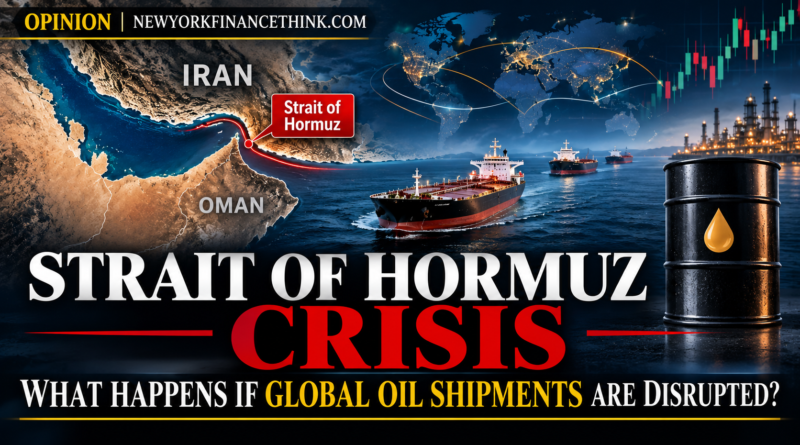
Strait of Hormuz Crisis: What Happens If Global Oil Shipments Are Disrupted?
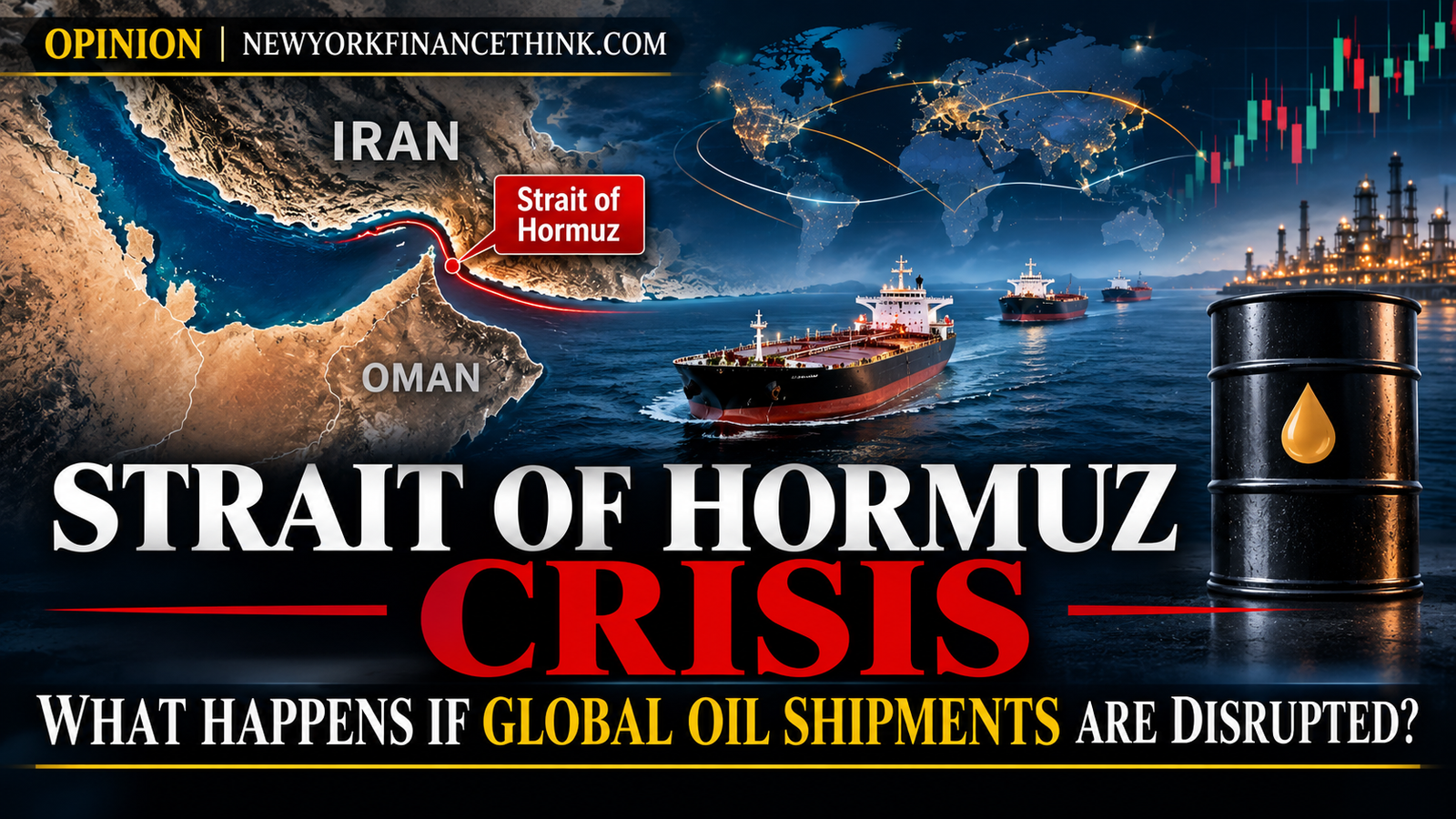
An In-Depth Editorial on Global Energy Security, Oil Prices, International Trade and the Economic Consequences for American Families
Published: November 5, 2026
Publisher: NewYorkFinanceThink.com
topics : World News | Energy Markets | Global Economy
Reporting Desk: NewYorkFinanceThink Editorial Team
1. Why the Strait of Hormuz Matters to the Entire World
The Strait of Hormuz occupies a relatively small space on the world map, but its influence on the international economy is enormous. Located between Iran and Oman, this narrow waterway connects the Persian Gulf with the Gulf of Oman and the Arabian Sea. It serves as a major export route for oil and petroleum products produced by several important energy suppliers in the Middle East. For countries that depend on imported energy, the uninterrupted movement of tankers through this passage is closely connected to economic stability, industrial production and national energy security.
The importance of this route becomes clearer when we consider the amount of energy that normally travels through it. According to the U.S. Energy Information Administration, oil flows through the Strait averaged approximately 20.9 million barrels per day during the first half of 2025. That represented roughly one-fifth of global petroleum liquids consumption and approximately one-quarter of internationally traded maritime oil. These figures explain why even a temporary interruption can create concern among energy companies, governments, shipping operators and financial markets.
The waterway is not simply a route used by oil-producing countries. It is part of a much larger international supply chain. A tanker leaving the Persian Gulf may be carrying crude oil for a refinery in Asia, petroleum products for an industrial market, or energy supplies that will eventually support transportation, electricity generation and manufacturing. Once a shipment is delayed, the consequences can travel through multiple industries before reaching the final consumer.
For this reason, the Strait of Hormuz is often described as one of the world’s most important energy chokepoints. Its significance is not measured only by geography. It is measured by the economic activity that depends on the reliable movement of ships through it.
2. November 2026: Shipping Security Becomes a Major Market Concern
The situation around the Strait of Hormuz has become particularly important during the continuing Middle East conflict. On November 5, 2026, Reuters reporting indicated that commercial shipping through the waterway had slowed sharply following attacks on tankers and difficulties in U.S.–Iran negotiations. Ship-tracking information cited in that reporting showed only five commodity vessels passing through on Saturday, with no tracked commodity-vessel transits recorded on Sunday, compared with 31 during the preceding weekend.
There are important limitations to these numbers. Ship-tracking systems do not necessarily capture every vessel, particularly when ships switch off their automatic identification systems or use alternative navigation arrangements. Nevertheless, the reported decline illustrates how security concerns can discourage commercial operators from using a strategically important route.
Separate reporting on November 5 described fires involving two tankers and a tugboat. Those particular accounts were attributed to statements from Iran’s Islamic Revolutionary Guard Corps. The circumstances and responsibility for the incidents should not be treated as independently established simply because an official party has described them.
For the international shipping industry, uncertainty itself can become a serious economic problem. Shipowners must consider whether vessels can complete their journeys safely, whether crews will accept assignments, whether insurers will provide coverage and whether ports can handle cargoes arriving through alternative routes.
A waterway does not have to be formally declared closed for commercial traffic to experience significant disruption. If insurance becomes expensive, security risks increase and vessel operators decide to delay departures, the practical effect can resemble a partial shutdown.
This distinction matters because oil markets respond not only to barrels physically lost from production but also to uncertainty about whether future deliveries will arrive on schedule.
3. What Happens to Oil Prices When Shipments Are Interrupted?
Oil prices are influenced by supply, demand, inventories, production capacity, transportation costs and expectations about future market conditions. A disruption around the Strait of Hormuz can affect several of these factors simultaneously.
When traders believe that fewer barrels may reach international buyers, they begin reassessing the balance between available supply and expected demand. Refiners may seek alternative crude grades, importing countries may compete for available cargoes, and energy companies may adjust purchasing schedules. This competition can place upward pressure on benchmark prices.
The reaction can begin before a physical shortage appears at a refinery. Oil is traded in a global market where expectations are important. If a major shipping route becomes unreliable, traders may price in the possibility of future supply problems.
On November 5, Reuters reported that Brent crude had fallen to approximately $93.82 per barrel and U.S. West Texas Intermediate to approximately $86.92, following substantial declines in the previous session. The decline reflected changing expectations about the possibility of reducing the conflict and restoring regional energy flows. It did not establish that shipping risks had disappeared.
This is an important lesson for readers following oil prices. A falling benchmark price does not necessarily mean that every tanker is moving normally, that insurance costs have returned to previous levels or that every refinery has regained access to its preferred supplies.
The price of crude oil is only one part of the energy market. Diesel, gasoline, jet fuel and other refined products can respond differently depending on refinery capacity, inventories, regional demand and transportation availability.
If disruptions continue, the market could experience renewed volatility. If diplomatic progress and improved security restore confidence, prices could stabilize. Neither outcome should be assumed in advance.
4. Why Alternative Pipelines Cannot Fully Replace the Strait
One common question during an energy crisis is whether oil producers can simply send their shipments through another route.
There are alternatives, but they have limitations.
Saudi Arabia operates the East-West Pipeline system, which transports crude oil from the country’s eastern production areas toward the Red Sea. The United Arab Emirates operates the Abu Dhabi Crude Oil Pipeline, which connects inland oil facilities with the export terminal at Fujairah on the Gulf of Oman.
These routes can help move some crude oil without requiring tankers to pass through the Strait of Hormuz. However, available pipeline capacity, port facilities, storage arrangements and export logistics limit how much additional oil can be redirected.
The International Energy Agency’s 2026 Strait of Hormuz factsheet estimated that approximately 3.5 million to 5.5 million barrels per day of capacity might be available through alternative Saudi and UAE routes, depending on operational conditions.
That is meaningful capacity, but it is not enough to replace all the oil that normally moves through the waterway.
There is also a practical difference between theoretical pipeline capacity and the amount of oil that can actually be delivered consistently. Producers must coordinate pumping facilities, storage terminals, tanker availability, export schedules and receiving refineries. A pipeline cannot independently solve every problem created by a regional shipping crisis.
Alternative routes can reduce the damage, but they cannot make the Strait irrelevant.
5. The Natural Gas Problem: Why LNG Deserves Equal Attention
Discussions about the Strait of Hormuz frequently focus on crude oil, but natural gas is another important part of the story.
Liquefied natural gas, commonly known as LNG, is transported in specialized vessels that carry gas in a cooled liquid form. It supports electricity generation, industrial operations, heating and other energy needs in countries that depend on imported gas.
Qatar is a major LNG exporter, and its export infrastructure is closely connected to the Persian Gulf shipping system. If commercial navigation becomes restricted, LNG deliveries can face serious difficulties.
For importing countries, the consequences may include greater competition for available cargoes, higher spot-market prices and pressure on electricity and industrial costs.
The impact can extend beyond countries that directly purchase Gulf LNG. International gas markets are interconnected. If one group of buyers loses access to expected shipments, those buyers may compete for cargoes from other exporters. That can increase prices in other regions even when their own shipping routes remain open.
Natural gas also plays a role in fertilizer manufacturing, chemicals, industrial heating and electricity generation. A prolonged shortage or increase in gas prices could therefore affect agricultural input costs and manufacturing expenses.
The Strait of Hormuz should consequently be viewed as an energy-security issue involving both oil and natural gas.
6. How an Oil Shipping Crisis Could Affect American Families
The United States produces substantial amounts of oil and natural gas, which gives its energy system a different position from that of countries that rely heavily on imported Middle Eastern supplies.
However, domestic production does not completely protect American consumers from international oil-price movements.
Crude oil is traded in a global marketplace. U.S. producers, refiners and consumers operate within that broader system. If international supply becomes more expensive, domestic fuel markets can also experience upward pressure.
The first place many families may notice a change is the gasoline station.
For households that depend on cars for commuting, school transportation, shopping and work, even a relatively small increase in fuel prices can become an additional monthly expense. The impact can be particularly difficult for families living in areas with limited public transportation or long commuting distances.
Diesel costs matter as well. Trucks transport food, building materials, consumer products and industrial supplies across the country. Higher diesel expenses can increase transportation costs for distributors and businesses. Some of those expenses may eventually be reflected in the prices paid by consumers.
However, it is important not to assume that every increase in grocery prices is caused by the Strait of Hormuz. Food prices are influenced by weather, agricultural production, wages, fertilizer, processing costs, domestic transportation, trade policy and many other factors.
A shipping disruption could add pressure to an already complicated cost environment, but it would not explain every movement in household expenses.
7. The Impact on Grocery Stores and Food Supply Chains
Modern food distribution depends on a complicated network of farmers, processors, packaging companies, warehouses, trucking businesses, shipping operators and retailers.
Energy is involved at almost every stage.
Farm equipment requires fuel. Agricultural products are transported to processing facilities. Food is refrigerated and packaged. Trucks deliver products to distribution centers and supermarkets. Large retailers operate warehouses and refrigeration systems that consume energy.
If oil and diesel prices rise, businesses may face higher transportation and operating expenses. Their ability to absorb those increases depends on profit margins, competition, contracts and consumer demand.
Some companies may absorb additional costs temporarily. Others may adjust prices, reduce promotional discounts or renegotiate supplier agreements.
The effects may appear gradually rather than immediately. Existing contracts, inventories and transportation schedules can delay the transmission of higher energy costs.
For American families already managing rent, insurance, groceries, utilities and debt payments, another source of cost pressure can make budgeting more difficult.
The important point is that energy security is not separate from food security. Reliable transportation and affordable fuel are part of the system that allows food to reach consumers.
8. Why Asia Could Face a Particularly Difficult Situation
Although the economic effects of a Hormuz disruption would be global, Asian energy-importing countries have particularly important exposure.
A substantial share of the oil transported through the Strait is destined for Asian markets. China, India, Japan and South Korea are among the economies that have significant interests in the uninterrupted movement of Gulf energy supplies.
For these countries, the consequences depend on domestic production, import diversification, strategic inventories, refinery arrangements and the ability to obtain replacement cargoes.
India, for example, is a major energy-importing economy. Higher international crude prices can increase the cost of importing petroleum, influence the finances of oil companies and place pressure on the country’s external trade balance.
The eventual effect on Indian consumers depends on currency movements, government policy, fuel pricing decisions, taxes and the timing of changes in international prices.
China’s large industrial economy also has extensive energy requirements. Higher oil and gas costs can influence manufacturing, transportation, petrochemicals and other energy-intensive activities.
Japan and South Korea rely heavily on imported energy, making the reliability of international shipping routes an important part of their economic planning.
A disruption therefore has the potential to create competition among major importing economies for alternative supplies. Even countries that do not receive most of their oil through Hormuz may feel the consequences through higher international prices.
9. Could the Crisis Affect Inflation and Interest Rates?
Inflation is another important channel through which an energy disruption can affect the global economy.
When fuel prices rise, households may pay more for transportation. Businesses may face higher delivery expenses, and manufacturers may experience increased costs for energy-intensive operations.
If these increases spread across multiple industries, they can contribute to broader inflationary pressure.
Central banks must then consider whether higher energy costs are temporary or whether they are becoming part of a more persistent increase in prices.
A central bank generally cannot produce more oil or reopen a shipping route by changing interest rates. Its responsibility is to manage monetary conditions and keep inflation expectations under control.
If an energy shock raises inflation while weakening economic activity, policymakers face a difficult situation. Reducing interest rates too quickly could allow inflationary pressures to persist, while maintaining restrictive rates could make borrowing more expensive for households and businesses already dealing with higher costs.
For the Federal Reserve, the important questions would include the scale of the energy-price increase, how long it lasts, whether it spreads to other prices and whether inflation expectations change.
Mortgage rates do not move automatically whenever oil prices rise. They are influenced by Treasury yields, inflation expectations, monetary policy expectations, credit conditions and other financial factors.
Nevertheless, a sustained energy shock could affect the wider interest-rate environment and influence borrowing conditions.
10. The Effect on Airlines, Shipping Companies and Tourism
The transportation industry is particularly exposed to changes in energy costs.
Airlines purchase large quantities of jet fuel, and fuel is an important operating expense. When fuel prices rise, airlines may experience pressure on profitability and may respond through fare adjustments, route changes, capacity decisions or other cost-control measures.
The effect on ticket prices is not always immediate. Airlines may use fuel hedging arrangements, existing contracts and pricing strategies that delay or reduce the impact.
Shipping companies face a different set of problems. They must consider fuel expenses, insurance premiums, vessel availability, crew safety and route length.
If ships avoid a dangerous maritime corridor, they may have to travel longer distances. Longer voyages can require more fuel, additional crew time and greater working capital. They can also reduce the number of trips a vessel can complete during a given period.
Tourism businesses may face indirect pressure as well. More expensive flights and transportation can affect travel demand, while higher household expenses may encourage consumers to postpone discretionary spending.
The crisis could therefore affect industries that do not directly purchase crude oil from Gulf producers.
One of the most important but less visible consequences of a shipping crisis is the cost of insurance.
Commercial ships operating in areas considered dangerous may face higher war-risk insurance premiums. Insurers assess the probability of damage, the value of the vessel and cargo, the security environment and the availability of reliable information.
If the perceived risk rises, insurance costs can increase sharply.
For shipowners, this creates a difficult commercial calculation. A vessel may technically be able to travel through a particular waterway, but the combined cost of insurance, security arrangements and possible delays may make the voyage financially unattractive.
Some operators may wait for better conditions. Others may request additional compensation before accepting a journey. Cargo owners may seek alternative suppliers or routes.
This means that the return of safe commercial shipping requires more than a political announcement. Vessel operators, insurers, port authorities, crews and energy companies must regain confidence in the route.
The restoration of traffic is therefore an operational and commercial process as well as a diplomatic one.
12. How the Stock Market Could Respond
Financial markets generally react to uncertainty because investors must estimate how geopolitical developments could affect future profits, inflation and economic growth.
An escalation around the Strait of Hormuz could influence several sectors differently.
Energy producers may benefit from higher selling prices if production and export operations remain uninterrupted. However, companies with facilities or transportation networks exposed to regional security risks could face operational difficulties.
Airlines and transportation companies may experience higher fuel expenses. Industrial manufacturers may face pressure from energy and shipping costs. Retailers could experience weaker consumer demand if household budgets become more restricted.
Oil-price volatility can also influence expectations for inflation and interest rates. This may affect bond yields, currency markets and valuations across the stock market.
It would be misleading to suggest that every oil-price increase automatically causes a stock-market decline. The impact depends on the wider economic environment, the duration of the disruption and how investors interpret the available information.
For long-term investors, the more useful approach is to examine company fundamentals, earnings exposure, debt levels and the ability to manage higher operating costs rather than making decisions based entirely on a single day’s geopolitical headlines.
13. Could the United States Release Emergency Oil Reserves?
Governments have several tools available when energy supplies are threatened.
One important mechanism is the release of emergency petroleum stocks. The United States maintains a Strategic Petroleum Reserve, which is intended to provide a buffer during major supply interruptions.
Other countries also maintain government-controlled or industry-held inventories.
A coordinated release can help supply additional barrels to the market and reduce immediate pressure on physical availability. However, emergency reserves are not a permanent replacement for normal production and transportation.
Their effectiveness depends on the amount of oil available, the speed at which it can be delivered, the type of crude stored and the duration of the crisis.
If the disruption continues for an extended period, governments may have to balance immediate market stabilization against the need to preserve reserves for future emergencies.
Emergency stock releases can provide valuable time, but they cannot independently restore a major shipping corridor.
14. Why the Strait Cannot Be Replaced Easily
The global energy industry has spent decades building production facilities, pipelines, ports, refineries and shipping networks around established trade routes.
Changing those arrangements during a crisis is difficult.
A producer may have oil available but lack sufficient alternative pipeline capacity. A refinery may be designed to process a particular crude grade. A shipping company may have vessels committed to existing routes. An importing country may not have enough storage or infrastructure to accept replacement supplies quickly.
Alternative suppliers may also be operating near capacity.
Even when replacement barrels are available, they may not be located where they are most urgently needed. Transporting them can take time and increase costs.
This is why the Strait of Hormuz remains strategically important despite the existence of alternative pipelines and export terminals.
The challenge is not simply finding another road on a map. It is reorganizing an international energy system that depends on established infrastructure and commercial relationships.
15. Three Possible Scenarios for the Global Economy
Scenario One: Shipping Confidence Gradually Returns
In this scenario, diplomatic progress and improved security conditions encourage shipowners and insurers to resume normal operations.
Tanker movements gradually increase, export schedules become more predictable and energy companies regain confidence in regional supply arrangements.
Oil prices could stabilize as the market becomes more confident that physical supplies will reach buyers.
However, the return to normal conditions may take time. Insurance contracts, vessel schedules, port operations and cargo arrangements cannot all be restored instantly.
Scenario Two: A Prolonged Period of Restricted Shipping
In this scenario, the Strait remains technically accessible, but security concerns continue to discourage commercial traffic.
Some vessels may use alternative routes, while others wait for improved conditions. Insurance premiums remain elevated, and energy companies compete for available transportation capacity.
Oil and gas markets could remain volatile. Importing economies may increase their use of inventories, seek alternative suppliers and introduce measures to protect domestic consumers.
Businesses could face higher costs even without a complete closure of the waterway.
Scenario Three: A Major Escalation and Severe Disruption
A more serious scenario would involve a substantial interruption to commercial shipping, damage to important energy infrastructure or a prolonged inability to move large volumes of oil and gas.
In that situation, the global market could face a major supply shock.
Alternative pipelines and emergency reserves could provide partial relief, but their capacity would be limited. Importing countries might compete more aggressively for available cargoes, and prices could experience significant upward pressure.
The consequences would depend on how long the disruption lasted and whether diplomatic and security arrangements allowed normal trade to resume.
These scenarios are analytical possibilities, not predictions of what will happen.
16. What Investors and Businesses Should Watch
For investors, business owners and financial analysts, several indicators deserve close attention.
First: Actual tanker movements. Vessel traffic data can help determine whether commercial shipping is recovering or whether delays are continuing.
Second: Brent and WTI crude prices. These benchmarks provide important information about international and U.S. oil-market expectations.
Third: Diesel and jet fuel prices. These products can reveal pressure on transportation and industrial supply chains.
Fourth: War-risk insurance costs. Higher premiums can discourage shipping even when the waterway remains physically navigable.
Fifth: Pipeline exports. Additional shipments through Saudi Arabia’s East-West Pipeline and the UAE’s Abu Dhabi pipeline can help reduce pressure on the Strait.
Sixth: Strategic reserve decisions. Government announcements about emergency inventories may influence expectations for short-term supply availability.
Seventh: Diplomatic developments. Negotiations, security agreements and official statements can change expectations about the duration of the disruption.
Eighth: Refinery operations and inventories. These indicators help establish whether crude supply problems are translating into shortages of usable petroleum products.
Looking at several indicators together provides a more complete picture than following oil prices alone.
17. What American Families Can Do During an Energy Shock
Households cannot control international shipping routes or geopolitical decisions, but they can take practical steps to manage their exposure to higher energy expenses.
Families can review their monthly transportation costs, compare fuel prices, plan trips more efficiently and maintain vehicles properly. Where practical, combining errands and reducing unnecessary journeys may help limit fuel consumption.
Households can also review their overall budgets rather than assuming that every increase in living expenses will be temporary. Transportation, food, utilities and insurance should be considered together when planning monthly spending.
For people carrying credit-card debt or other high-interest obligations, maintaining a manageable repayment plan may be particularly important during a period of uncertain household expenses.
Investors should avoid making major portfolio decisions based solely on alarming headlines. A geopolitical event can create volatility, but individual companies and sectors may have very different levels of exposure.
The goal is not to predict every possible market movement. It is to remain financially prepared for uncertainty.
18. The Larger Lesson: Energy Security Is Economic Security
The Strait of Hormuz demonstrates how closely connected the modern global economy has become.
A shipping problem in one region can influence fuel prices in another. Higher energy costs can affect manufacturing, transportation and food distribution. Those expenses can influence inflation, business investment and household purchasing power.
The crisis also highlights the importance of energy diversification. Countries that rely heavily on a limited number of suppliers or transportation routes may be more vulnerable when geopolitical conditions deteriorate.
Investment in alternative infrastructure, strategic reserves, renewable energy, electricity networks and diversified supply agreements can improve resilience over time. None of these measures eliminates geopolitical risk, but together they can reduce dependence on a single route or source.
For businesses, supply-chain resilience has become an important part of financial planning. For governments, energy security is connected to national security, economic stability and international diplomacy.
For ordinary families, the connection is much simpler: the cost of energy can influence the cost of everyday life.
19. Final Editorial Perspective: The World Cannot Ignore Hormuz
The Strait of Hormuz is more than a narrow waterway between Iran and Oman. It is a critical connection in the international energy system, linking major producers with some of the world’s largest importing economies.
When shipping becomes uncertain, the effects can spread far beyond the Persian Gulf. Oil prices, natural gas deliveries, insurance costs, transportation expenses, manufacturing and financial markets may all become exposed to the same underlying risk.
The November 2026 developments demonstrate why the distinction between a formally closed waterway and a commercially disrupted one matters. Even when some vessels can still pass, security concerns and rising operational costs can reduce the willingness of shipping companies to use the route.
The next stage will depend on the actual movement of commercial vessels, the condition of regional energy infrastructure, insurance availability and the progress of diplomatic efforts.
For the United States, domestic energy production provides an important source of resilience, but it does not remove the country’s connection to global oil markets. For Asian importing economies, the stakes can be even more direct because of their reliance on Gulf energy shipments.
Ultimately, the Strait of Hormuz crisis is a reminder that energy security is not only about producing enough oil. It is also about transporting it safely, maintaining reliable trade relationships and protecting the economic systems that depend on affordable energy.
The world will be watching the waterway not simply to count how many ships pass through it, but to understand what their movement means for the global economy.
About This Report
This editorial was prepared by the NewYorkFinanceThink Editorial Team for readers interested in international energy markets, global economic developments, financial risks and the potential effects of geopolitical tensions on households and businesses.
The article distinguishes reported developments from economic analysis and hypothetical scenarios. Shipping conditions and market prices can change rapidly. Readers should consult updated official information and reliable reporting before making financial or business decisions.
Publisher: NewYorkFinanceThink.com
Editorial Desk: World News and Global Economy
Reporting Date: November 5, 2026
