
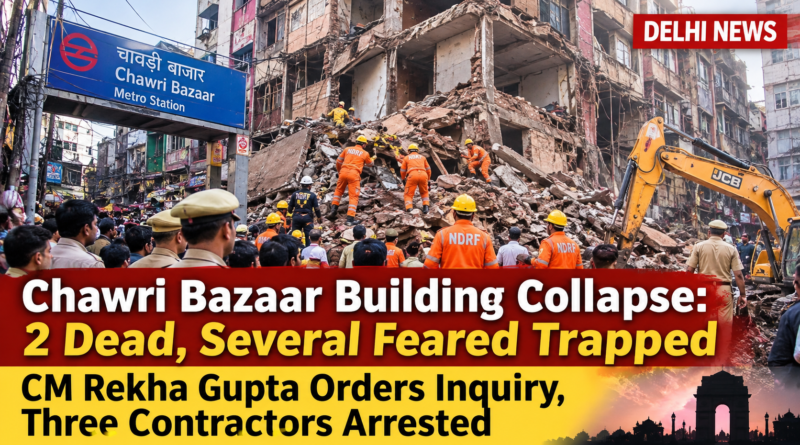
Chawri Bazaar Building Collapse: Two Dead, Several Feared Trapped as Three Contractors Are Arrested; Delhi Orders High-Level Inquiry
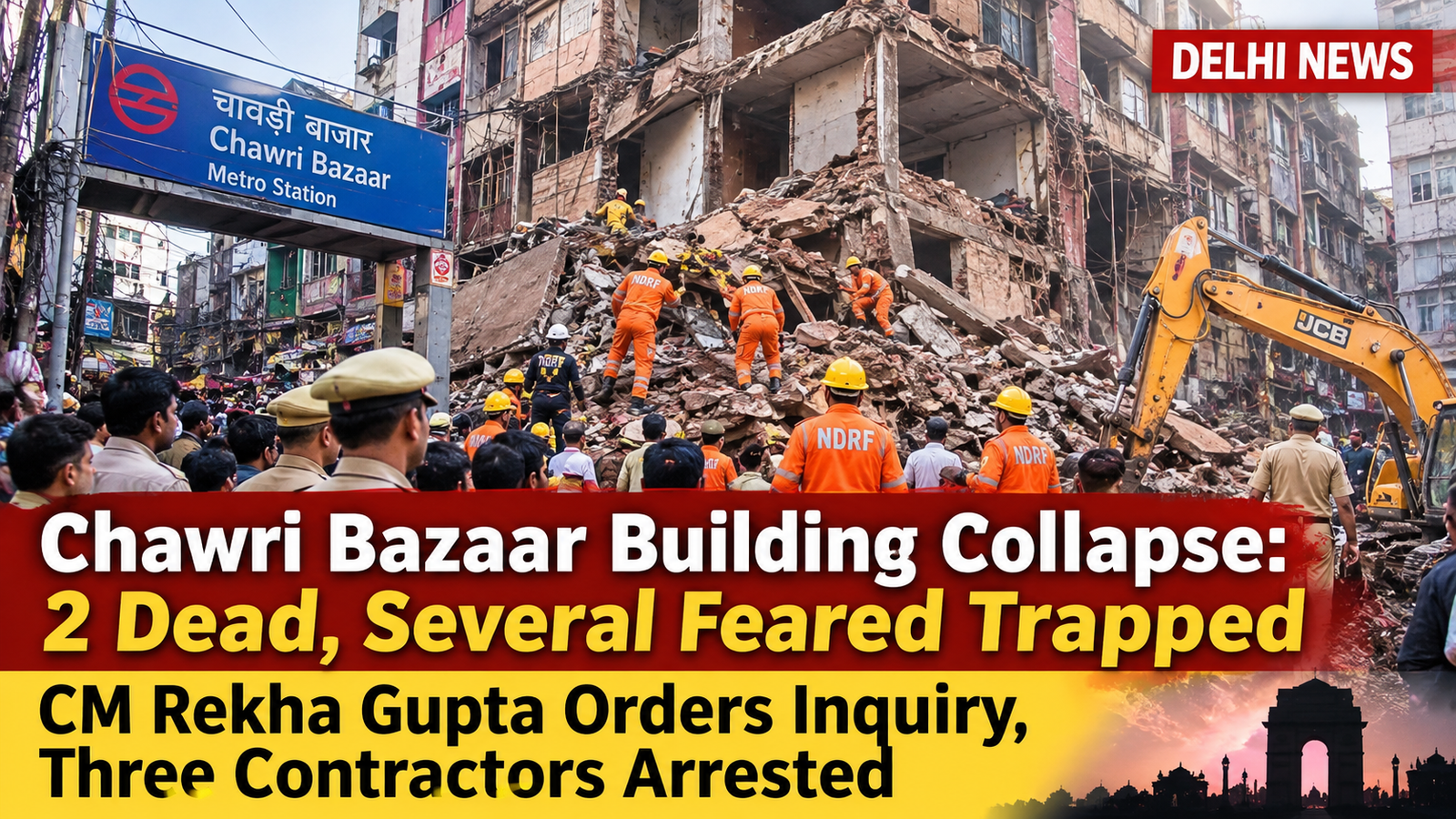
New Delhi | November 6, 2026
A devastating building collapse in Old Delhi’s crowded Chawri Bazaar area has once again raised serious questions about construction safety, civic oversight and the protection of workers in some of the capital’s most densely populated neighbourhoods. A three-storey building under construction near Chawri Bazaar Metro Station came crashing down on Thursday morning, November 5, killing two workers and leaving several people feared trapped beneath a massive pile of concrete, bricks and construction material.
The incident triggered an extensive rescue operation involving the Delhi Police, Delhi Fire Services, the National Disaster Response Force (NDRF) and the Municipal Corporation of Delhi (MCD). Emergency personnel worked through the day and night in an effort to locate survivors and remove debris from the collapsed structure. The operation was particularly difficult because the building was located inside a narrow and congested lane, where the movement of large rescue vehicles and heavy machinery was severely restricted.
By Friday, November 6, the investigation had moved into a more serious phase. Delhi Police arrested three contractors in connection with the collapse. The accused were identified as Siraj, Tajuddin and Furkan, who were reportedly apprehended from Sirohi village in Haryana’s Faridabad district. Police said the case had been registered under Section 105 of the Bharatiya Nyaya Sanhita, which concerns culpable homicide not amounting to murder. Their arrest does not establish guilt; the allegations will be examined through the legal process.
The deaths have intensified pressure on the authorities to establish how a building that was undergoing construction could collapse so suddenly and whether the required safety and regulatory procedures were followed. Delhi Chief Minister Rekha Gupta ordered an inquiry, directed officials to register an FIR against the contractor and instructed the suspension of the area’s concerned Junior Engineer and Assistant Engineer. The government has also directed officials to ensure proper medical treatment for the injured and provide financial assistance to affected families.
The Morning the Building Came Down
The collapse was reported at approximately 9:50 am on Thursday in the Gali Sitara and Sheesh Mahal area near Chawri Bazaar Metro Station in Old Delhi. The building was reportedly under construction, and workers were present at the site when the structure gave way.
The sudden collapse created panic among residents and people working in the surrounding market. Chawri Bazaar is one of Old Delhi’s busiest commercial neighbourhoods, characterised by closely packed buildings, narrow streets, shops, warehouses and residential properties. A structural failure in such an area can create danger not only for people inside the affected building but also for residents and businesses in neighbouring structures.
The sound of the collapse reportedly brought people rushing into the lane. Residents and passers-by attempted to understand what had happened as dust and debris covered the surrounding area. Emergency services were alerted, and fire department units were dispatched to the location.
Officials confirmed that two people had died. The deceased were identified in subsequent police reporting as Kishori, aged 40, and Sanjeet, aged 45. Both were labourers. Other people were rescued and taken for medical treatment. Police and rescue officials continued searching the debris because several people were initially feared trapped.
The loss of two workers has brought attention to the vulnerability of construction labourers, particularly those employed at small building sites where safety arrangements, supervision and emergency access may not receive adequate attention.
Rescue Teams Face a Difficult Operation
The rescue operation in Chawri Bazaar presented challenges that extended beyond the weight and volume of the collapsed building material. The location itself made the work unusually difficult.
The building stood inside a narrow lane in a densely populated part of Old Delhi. Reports from the site described the approach as extremely restricted, leaving little room for large rescue vehicles and heavy equipment. Firefighters, police personnel, disaster-response teams and municipal workers had to coordinate their movements in difficult conditions.
The agencies involved included the Delhi Fire Services, NDRF, Delhi Police and MCD. Rescue personnel used available equipment and manual methods to remove debris and search for people who might still be alive beneath the collapsed structure. Floodlights were also deployed as the operation continued into the night.
The difficulty of reaching the site highlights a wider problem for emergency planning in older urban neighbourhoods. Narrow lanes and closely connected buildings are part of the physical character of many historic markets, but they can become serious obstacles when a fire, building collapse or other major emergency occurs.
In a disaster involving a collapsed building, time is critical. Rescuers must locate possible survivors while carefully removing debris to avoid causing further structural movement. They must also consider the stability of adjoining buildings, since damage to one structure can affect neighbouring properties.
Authorities have therefore faced two connected responsibilities: continuing the search for anyone trapped and ensuring that rescue workers and nearby residents are not exposed to additional danger.
Three Contractors Arrested as Police Investigation Expands
The arrest of three contractors on Friday marked a significant development in the case. Delhi Police identified the accused as Siraj, Tajuddin and Furkan. They were reportedly arrested in Faridabad in connection with the building collapse.
The police case has been registered under Section 105 of the Bharatiya Nyaya Sanhita, relating to culpable homicide not amounting to murder. Investigators will need to examine the construction work, the responsibilities of the contractors, the condition of the building and whether any safety requirements were ignored.
A criminal investigation into a building collapse must establish more than the fact that a structure fell. Investigators need to determine who was responsible for the work, whether the construction was legally authorised, what materials and methods were used, whether structural support was adequate and whether officials or private parties failed to act despite warning signs.
The arrests represent an investigative step, not a final determination of responsibility. Evidence, technical assessments, official records and witness statements will be important in establishing the circumstances of the collapse.
The case also raises questions about the relationship between property owners, contractors, engineers and municipal authorities. Construction projects involve several responsibilities, and accountability cannot be determined simply by identifying the person supervising work at the site. The investigation must establish the role of every relevant party.
Chief Minister Rekha Gupta Orders Inquiry and Suspension of Engineers
Delhi Chief Minister Rekha Gupta expressed concern over the tragedy and ordered an inquiry into the incident. She directed the authorities to take action against those found responsible and instructed officials to register an FIR against the contractor.
The Municipal Corporation of Delhi also suspended the concerned Junior Engineer and Assistant Engineer pending further examination of the incident. These suspensions are administrative measures and should not be treated as proof that the officials were responsible for the collapse. The inquiry will need to establish whether there were failures in inspection, enforcement or supervision.
The Chief Minister also directed officials to ensure the best possible medical treatment for injured people and provide immediate ex-gratia assistance to affected families. Such support is important because a construction accident can leave families facing not only the loss of a relative but also an immediate financial crisis.
For families of daily-wage labourers, the death or serious injury of an earning member can have long-term consequences. Medical expenses, lost wages, housing costs and the absence of regular financial protection can make recovery particularly difficult.
The government’s response will therefore be judged not only by the inquiry and arrests but also by the speed and adequacy of relief, medical assistance and compensation.
Questions Over Construction Permissions and Safety Standards
One of the most serious aspects of the Chawri Bazaar collapse concerns the regulatory status of the building and the construction work being carried out there.
Subsequent reporting has raised questions about whether the construction had the necessary approvals. MCD-related information cited in reports indicated that no sanctioned building plan application had been submitted for the work. Preliminary accounts also raised concerns about possible unauthorised construction and the condition of the building.
However, the precise cause of the collapse has not been conclusively established. Officials have referred to construction activity involving the upper floor and the removal of support or shuttering. Technical investigators will need to determine whether the failure resulted from inadequate structural design, improper construction methods, premature removal of supports, poor-quality material, overloading or a combination of factors.
A building collapse rarely has a single explanation that can be established from initial observations alone. Engineers must examine the remaining structure, the material recovered from the site, the construction sequence and the design documents, if available.
The inquiry should also examine whether the building owner or contractor obtained the necessary permissions and whether the municipal authorities had received earlier information about the property or the construction activity.
The public deserves a clear explanation of what happened. If illegal construction or serious safety violations are established, the authorities must identify the individuals and institutions responsible and explain why preventive action did not stop the work.
A Warning for Old Delhi’s Crowded Neighbourhoods
Chawri Bazaar is not an isolated case in the broader debate over construction safety in Delhi. Large parts of Old Delhi contain buildings that have developed over decades, sometimes with multiple floors, mixed residential and commercial use, ageing structural elements and limited access for emergency services.
The pressure on available space can encourage property owners to expand buildings vertically or modify existing structures. Such changes may create additional living or commercial space, but they can also increase structural risks when they are carried out without proper engineering assessment and regulatory approval.
In a tightly packed neighbourhood, the consequences of unsafe construction can extend beyond one property. A collapsing wall, falling slab or structural failure can damage adjoining buildings, block narrow access routes and put residents, shopkeepers, customers and workers at risk.
The Chawri Bazaar tragedy should therefore prompt a wider review of vulnerable buildings and construction activity in similar neighbourhoods. Inspections should not be limited to properties where an accident has already occurred. Authorities need a systematic approach to identifying buildings that show visible signs of structural distress or are undergoing potentially unsafe alterations.
Such inspections should be based on engineering assessments rather than assumptions about the age or appearance of a building. Where immediate danger is identified, officials must have clear procedures for restricting access, evacuating occupants and requiring corrective work.
The Human Cost Behind Construction Accidents
The two confirmed deaths are the most painful part of this incident. The workers who lost their lives were part of a construction workforce that helps maintain and expand the city’s buildings, shops and infrastructure. Their work often takes place in difficult conditions, and their families may depend heavily on daily earnings.
Construction safety is sometimes discussed mainly through building permissions, engineering standards and administrative procedures. Those issues are essential, but the human consequences must remain at the centre of the discussion.
Workers should not have to depend on luck to return home safely after a day’s work. Construction sites need adequate supervision, appropriate protective equipment, stable temporary supports and safe procedures for every stage of building activity. Contractors and property owners must ensure that work does not proceed when the structure or working conditions are unsafe.
Employers and contractors also have responsibilities to inform workers about risks and ensure that they are not asked to perform dangerous tasks without suitable protection. Labourers should have access to emergency medical support and the benefits available under applicable laws.
When a building collapses, the investigation must examine whether the people working there were exposed to risks that could have been prevented.
Emergency Access Is Another Major Concern
The rescue operation has also exposed the importance of emergency access in historic and densely populated parts of Delhi.
Fire engines, ambulances and rescue vehicles require sufficient space to reach an incident quickly. In narrow market lanes, parked vehicles, temporary structures, construction material and crowded pedestrian movement can delay emergency response.
Authorities cannot redesign every historic street, but they can improve emergency preparedness. This includes identifying access routes, preventing unauthorised obstruction, mapping vulnerable buildings, maintaining emergency contact systems and training local responders.
Residents and traders can also play a role by keeping access routes clear and following evacuation instructions during emergencies. However, responsibility for planning and enforcement rests primarily with the relevant public authorities.
The Chawri Bazaar collapse demonstrates why emergency access should be considered before a disaster occurs, rather than becoming a subject of discussion only after people are trapped.
What the Investigation Must Establish
The inquiry into the collapse should answer several important questions. Was the construction properly authorised? Were approved structural plans available? Did the contractor follow the required construction sequence? Were temporary supports removed at the appropriate stage? Was the building capable of carrying the load placed on it? Were inspections conducted, and did officials receive earlier warnings about the property’s condition?
Investigators should also examine whether neighbouring structures have suffered damage and whether residents need temporary relocation while safety assessments are carried out.
The authorities should publish the findings of the inquiry in a manner that allows the public to understand the technical and administrative reasons behind the accident. If violations are confirmed, action should extend to every responsible party, regardless of position or influence.
The arrest of contractors and suspension of engineers are important developments, but they cannot substitute for a complete investigation. The goal must be to establish the truth, provide justice to the victims and prevent similar incidents.
A Larger Test of Urban Safety and Accountability
The Chawri Bazaar building collapse is a reminder that urban development cannot be measured only by the number of buildings constructed, commercial spaces created or properties renovated. Development must also be measured by whether people can live and work safely inside those structures.
Delhi’s older neighbourhoods face complicated challenges involving limited space, ageing buildings, growing commercial demand and regulatory enforcement. These challenges require coordination between municipal authorities, engineers, property owners, contractors and residents.
A meaningful response will require more than temporary inspections or action against a few individuals after a tragedy. It will require consistent enforcement of building rules, transparent approval processes, independent structural assessments where necessary and a system that responds quickly when unsafe construction is identified.
For the families who lost loved ones in Chawri Bazaar, accountability and assistance are urgent needs. For those still waiting for information about people feared trapped, the rescue operation remains the immediate priority. For the wider city, the incident should serve as a warning that construction safety and emergency preparedness cannot be treated as secondary concerns.
The final findings of the investigation will determine the precise causes and responsibilities behind the collapse. Until then, the focus must remain on rescue, medical care, support for affected families and a transparent examination of the decisions that allowed this tragedy to occur.
The central question is no longer simply how a three-storey building collapsed in Old Delhi. It is whether the systems designed to prevent unsafe construction and protect workers were effective — and what must change to ensure that another family does not face the same loss.
