D.G. Scofield to Supertankers: Saudi Oil Shipping History
By New York Finance Think | September 16, 2026
For most people, Saudi Arabia’s oil story starts with one simple fact: the country has a huge amount of crude oil.
But having oil underground is only the beginning.
The bigger question is simple: How do you take millions of barrels of crude from an oil field and get them safely to customers around the world?
Saudi Arabia has spent nearly 90 years building the answer.
The story started with a small number of oil wells, pipelines and an early tanker called the D.G. Scofield.
Today, the system is much bigger. It includes giant oil fields, long pipelines, storage facilities, export terminals, modern Very Large Crude Carriers, or VLCCs, and shipping routes connecting Saudi crude with customers in Asia, Europe and other parts of the world.
But the current Middle East oil conflict is showing something important.
Even a very large oil-export system can face problems when pipelines, ports and major shipping routes are under pressure at the same time.
The story began with D.G. Scofield
Saudi Arabia’s commercial oil story changed in 1938 when oil was discovered in commercial quantities at Dammam Well No. 7.
The next challenge was getting that oil out of the country.
Oil had to move from the producing area to the coast. From there, it had to be loaded onto ships and taken to buyers.
That is where Ras Tanura became extremely important.
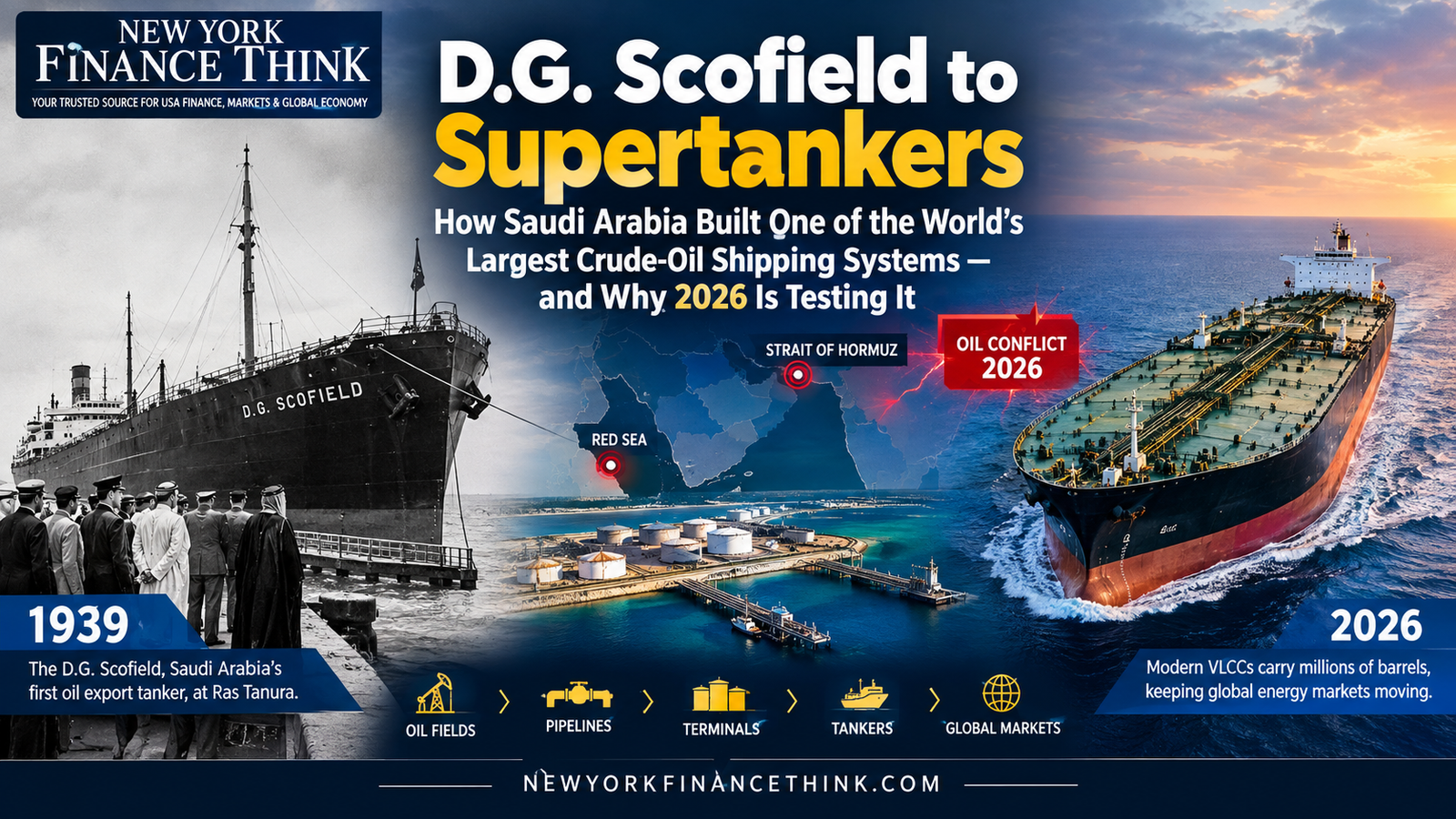
On May 1, 1939, the tanker D.G. Scofield was at Ras Tanura for a historic loading.
King Abdulaziz opened the valve that started the loading of Saudi Arabia’s first export shipment of crude oil from Ras Tanura.
It was a small beginning compared with today’s oil trade.
But the basic idea was already there:
Oil field → pipeline → export terminal → tanker → customer
That basic chain still exists today.
The difference is the size.
The D.G. Scofield could carry roughly 81,000 barrels of crude.
A modern VLCC can carry more than two million barrels.
That is a huge change.
From one tanker to a complete oil network
The D.G. Scofield was not important simply because it was a ship.
It was important because it was part of a new system.
Saudi Arabia needed pipelines to move crude.
It needed storage tanks to hold crude.
It needed terminals where tankers could safely load.
It needed ships large enough to carry crude over long distances.
And it needed buyers.
As Saudi oil production increased, all of these parts had to grow together.
This is one reason the history of Saudi oil is also a history of transportation.
Finding oil was only the first step.
Moving it was the second.
Selling it to the world was the third.
Ras Tanura became a major gateway
Ras Tanura became one of the most important parts of Saudi Arabia’s oil export system.
The location mattered because it connected Saudi Arabia’s huge Eastern Province oil-producing area with the sea.
Over the decades, the facilities became much larger and more sophisticated.
Storage capacity increased.
Pipelines became larger.
Loading facilities improved.
And tankers became much bigger.
The result was an oil export machine capable of moving enormous quantities of crude.
This is why Ras Tanura remains such an important name in the global oil market.
When a tanker loads crude there, that oil is not just leaving a Saudi port.
It is entering the international energy market.
The tanker became much bigger
The easiest way to understand the change is to compare the old tanker with today’s VLCC.
| Tanker | Approximate crude capacity |
|---|---|
| D.G. Scofield, 1939 | 81,000 barrels |
| Modern VLCC | About 2.3 million barrels |
The difference is enormous.
A modern VLCC can carry roughly 28 times as much crude as the D.G. Scofield could carry.
Why does size matter?
Because transporting oil is expensive.
A tanker has to pay for fuel, crew, maintenance, insurance, port services and other operating costs.
When a large ship carries more barrels on one voyage, those costs can be spread across a much larger cargo.
That does not mean a bigger ship is always cheaper.
Shipping prices depend on many things, including vessel availability, route length, fuel costs, insurance, port conditions and geopolitical risk.
But the basic economic idea is easy to understand:
More barrels per voyage can make large-scale oil transportation more efficient.
Saudi Arabia did not depend only on tankers
There is another important part of this story.
Saudi Arabia also built pipelines.
One of the major examples was the Trans-Arabian Pipeline, commonly known as Tapline.
It gave Saudi crude another path toward the Mediterranean.
The reason was simple.
If oil can move through more than one route, the exporter has more options.
This became even more important as Saudi Arabia’s oil production increased.
The country was no longer dealing with a few thousand barrels.
It was dealing with millions of barrels.
That required a much bigger transportation network.
The East-West Pipeline changed the map
One of Saudi Arabia’s most important oil transportation projects was the East-West Pipeline.
The pipeline crosses Saudi Arabia from the Eastern Province toward Yanbu on the Red Sea.
The idea is easy to understand.
Instead of sending every barrel through the Persian Gulf and the Strait of Hormuz, some crude can move across Saudi Arabia by pipeline and reach the Red Sea.
From Yanbu, tankers can then carry the crude toward international customers.
This gave Saudi Arabia another export option.
It also became extremely important during periods of tension around the Strait of Hormuz.
The pipeline was essentially another door.
If one door became difficult to use, another door could potentially remain available.
Why Hormuz matters so much
The Strait of Hormuz is one of the most important oil shipping routes in the world.
It is a narrow waterway between the Persian Gulf and the Gulf of Oman.
Millions of barrels of oil and petroleum products pass through it.
According to the International Energy Agency, around 20 million barrels of oil per day passed through the Strait in 2025.
That was about one-quarter of global seaborne oil trade.
So when shipping through Hormuz is disrupted, the problem is not limited to Saudi Arabia.
It can affect the global oil market.
Asian countries are particularly important because much of the oil moving through Hormuz goes toward Asia.
China, India, Japan and South Korea are major consumers of Middle Eastern oil.
That is why a problem in the Gulf can quickly become a problem for refineries thousands of miles away.
Then came the era of giant tankers
As Saudi Arabia’s oil trade grew, the ships became bigger.
The industry developed the Very Large Crude Carrier, or VLCC.
A VLCC is essentially a giant floating oil tank.
It can carry millions of barrels in one voyage.
Saudi Arabia’s national shipping company, Bahri, became an important part of this system.
Bahri Oil currently reports a fleet of 50 VLCCs, with about 2.3 million barrels of capacity per vessel.
The company says its VLCCs operate on major international routes and load crude from ports including Ras Tanura and Yanbu.
This is a very different world from 1939.
The D.G. Scofield represented the beginning of Saudi Arabia’s crude export story.
A fleet of 50 VLCCs represents an industrial-scale global shipping operation.
What Bahri means for Saudi oil
It is important to understand one point clearly.
Saudi Arabia does not simply own 50 giant ships.
Bahri is a Saudi national shipping company that operates the VLCC fleet.
Bahri Oil says it is the exclusive provider of VLCC transportation for Saudi Aramco’s CIF crude sales.
This creates a close connection between Saudi crude production, shipping and international customers.
The system works roughly like this:
Saudi oil field
↓
Pipeline
↓
Storage
↓
Ras Tanura / Yanbu / other export facilities
↓
VLCC
↓
International shipping route
↓
Asian, European or other refinery
↓
Fuel and petroleum products
The final products can include gasoline, diesel, jet fuel, chemicals and many other materials used by modern economies.
Imagine that one barrel of Saudi crude is produced in the Eastern Province.
A barrel of oil has a long journey
The barrel does not magically appear at an American, European or Asian refinery.
It has to travel.
First, the crude moves through gathering systems.
Then it may move through a pipeline.
It can enter storage.
Later it can be loaded onto a tanker.
The tanker then travels hundreds or thousands of miles.
Eventually the crude reaches a refinery.
The refinery processes it.
Only after all of that does the crude become part of the fuel and products people use.
This is why oil transportation matters so much.
Oil underground has value. Oil delivered to a refinery has a much more immediate economic use.
What happens when a route is attacked?
This is where the current conflict becomes important.
In September 2026, Saudi Arabia’s oil transportation system has come under serious pressure.
Reuters reported that Saudi Arabia shut its East-West Pipeline after an aerial attack damaged the route.
That was significant because the pipeline had been helping move crude toward the Red Sea while shipping through the Strait of Hormuz was heavily disrupted.
The problem was therefore not simply about one pipeline.
It was about the loss of an alternative route at a time when another major route was already under pressure.
The alternative route was also tested
This is the most important part of the current story.
Saudi Arabia built the East-West Pipeline partly because having another route is useful.
But in September 2026, that alternative route itself was damaged.
Reuters reported that Saudi Arabia subsequently began offering additional crude cargoes to Asian buyers through ship-to-ship transfers off Sohar, Oman.
That location is outside the Strait of Hormuz.
The move shows how quickly the oil industry can change its logistics when a normal route becomes difficult.
It also shows why modern oil transportation is not simply about owning tankers.
It is about having options.
Saudi Arabia is now using more than one solution
When a normal route becomes difficult, the industry can look for another route.
That can mean:
- Using another export terminal
- Using another tanker
- Moving crude by pipeline
- Changing the destination
- Using ship-to-ship transfers
- Changing the loading schedule
- Storing crude temporarily
- Rerouting cargoes
- Using another regional port
None of these solutions is simple.
Every additional step can increase cost and risk.
But they can help keep crude moving.
What does ship-to-ship transfer mean?
The term sounds complicated, but the idea is simple.
Instead of one tanker going directly to a final destination, crude can be transferred from one ship to another at sea or near a suitable port.
The second tanker then continues the journey.
It is similar to changing trucks during a long road trip.
The cargo stays the same.
The transportation arrangement changes.
In the current situation, Reuters reported that Saudi Arabia was offering some crude to Asian buyers for loading through ship-to-ship transfers near Oman’s Sohar.
This is an example of the industry trying to find another path when normal routes are under pressure.
Why this matters for oil prices
Oil prices are not determined only by how much oil exists underground.
Markets also care about how much oil can actually reach buyers.
Suppose the world has plenty of crude underground.
But imagine that several important pipelines and shipping routes are blocked.
The oil still exists.
But buyers may not be able to get it when they need it.
That can create a supply shortage in the market.
When traders become worried about supply, prices can rise.
This is called a risk premium.
It is one reason geopolitical events can move oil prices even before a physical shortage becomes widespread.
The 2026 conflict shows the connection
The current conflict provides a clear example.
A pipeline is damaged.
A major shipping route is already under pressure.
Red Sea shipping faces security concerns.
Tanker operators face higher risks.
Insurance becomes more important.
Voyages may become longer.
Customers may receive delays or changes to scheduled cargoes.
All of these things can affect the cost and availability of crude.
And when the global oil market becomes nervous, prices can react quickly.
On September 16, Reuters reported that Brent crude settled at $105.83 a barrel, down $2.92, while U.S. West Texas Intermediate settled at $102.43.
The decline came after reports that Saudi Arabia was offering additional crude through Oman, which eased some concerns about supply disruption.
The important point is not one day’s price move.
The important point is what caused traders to change their view.
A new transportation route can reduce supply fears.
That is how important logistics has become.
From one tanker to a global system
Look at the journey over almost 90 years.
In 1939:
One historic tanker
Today:
Dozens of giant VLCCs
In 1939:
A developing export terminal
Today:
Large export terminals, storage facilities and complex marine infrastructure
In 1939:
A young pipeline network
Today:
A large network connecting oil fields, refineries, storage facilities and ports
In 1939:
A new oil exporter
Today:
One of the world’s most important oil suppliers
That is the scale of the transformation.
But bigger does not mean invulnerable
This may be the biggest lesson from the current conflict.
Saudi Arabia has spent decades building a huge oil transportation system.
The country has multiple ports.
It has pipelines.
It has storage.
It has tankers.
It has international customers.
It has experience dealing with shipping disruptions.
All of these things make the system more flexible.
But flexibility has limits.
If several parts of the network are affected at the same time, the problem becomes much harder.
For example:
Hormuz disruption
plus
East-West Pipeline damage
plus
Red Sea security problems
can create a much bigger transportation problem than any one event alone.
This is why oil traders watch shipping routes almost as closely as they watch production numbers.
The tanker is only one part of the story
It is tempting to think that the oil market is mainly about tankers.
It is not.
A tanker is only one piece.
A modern oil-export system needs:
- Oil production
- Gathering pipelines
- Long-distance pipelines
- Storage tanks
- Export terminals
- Loading facilities
- Tankers
- Ports and waterways
- Insurance
- Security
- Refineries
- Buyers
If one part becomes difficult, the entire chain can feel the pressure.
That is why a pipeline attack can influence oil prices even though no oil well has been destroyed.
Why this matters to Americans
An American consumer may never see a Saudi oil tanker.
But the global oil market can still affect everyday life in the United States.
Crude oil is used to make gasoline and diesel.
Fuel is needed by trucks.
Trucks move food and consumer goods.
Airlines use jet fuel.
Factories use petroleum products and chemicals.
Shipping companies depend on fuel.
Petroleum is also used in many industrial materials.
So when the cost of moving crude rises, the effects can eventually spread through the economy.
The impact is not always immediate.
And a rise in crude oil does not automatically mean every household will see the same increase.
But prolonged high oil prices can increase costs across transportation and manufacturing.
That can add pressure to inflation.
The Federal Reserve connection
This is where the oil story eventually connects with the U.S. economy.
The Federal Reserve watches inflation closely.
If energy prices rise sharply and stay high, businesses can face higher costs.
Consumers can also pay more for fuel.
The effect can spread through transportation and other parts of the economy.
That does not mean higher oil prices automatically force the Federal Reserve to change interest rates.
The Fed looks at many economic indicators.
But energy prices can become part of the broader inflation picture.
That is why Wall Street traders watch the Middle East even when the conflict is thousands of miles from New York.
The bigger lesson from D.G. Scofield
The D.G. Scofield was just one tanker.
Today, Saudi Arabia has a massive oil logistics system.
But the basic question has not changed.
In 1939, Saudi Arabia needed to answer:
How do we get our oil to the world?
In 2026, the question is more complicated:
How do we keep oil moving when several major routes are under pressure?
That is the real story behind the evolution from D.G. Scofield to modern supertankers.
The ships became bigger.
The pipelines became longer.
The terminals became larger.
The storage system became more sophisticated.
The customer network became global.
But the basic challenge remained the same:
Move the oil safely from the producer to the customer.
D.G. Scofield vs today’s oil system
| Category | 1939 | 2026 |
|---|---|---|
| Main shipping symbol | D.G. Scofield | Modern VLCC fleet |
| Tanker capacity | About 81,000 barrels | About 2.3 million barrels per VLCC |
| Export system | Early-stage | Global network |
| Main infrastructure | Early pipelines and Ras Tanura | Pipelines, storage and multiple terminals |
| Shipping scale | Small compared with today | Millions of barrels per voyage |
| Major alternative route | Limited | East-West Pipeline and other routes |
| Major shipping concern | Building an export system | Security, chokepoints and geopolitical risk |
| Customers | Emerging international market | Global refiners, especially major Asian markets |
| Main challenge | Establishing exports | Keeping exports moving during disruptions |
The road ahead
The current crisis will not be judged only by the price of oil.
The bigger question will be how quickly the international oil system can adjust when transportation routes are disrupted.
Saudi Arabia’s experience shows why diversification matters.
A country with one export route is more exposed than a country with several.
A country with one port is more exposed than one with multiple terminals.
A shipping company with one type of vessel is more exposed than one with a diversified fleet.
The same principle applies to the global oil market.
More options generally mean more flexibility.
But those options are not unlimited.
Final word
The history of Saudi Arabia’s oil industry can be told through one ship.
The D.G. Scofield arrived at Ras Tanura in 1939 and became part of the first major chapter of Saudi crude exports.
Nearly nine decades later, the picture is completely different.
Modern VLCCs can carry millions of barrels.
Pipelines cross the country.
Huge terminals load crude for international customers.
Saudi oil moves toward Asia, Europe and other markets.
Bahri operates a fleet of 50 VLCCs, according to the company’s current information.
But the events of 2026 have brought the story back to a very old question:
Can the oil get from the field to the customer?
That question matters because oil is not useful to the global economy simply because it exists underground.
It has to move.
It has to cross pipelines, ports and seas.
And when those routes come under pressure, the entire world oil market can feel it.
The D.G. Scofield represented the beginning of Saudi Arabia’s journey into the global oil trade.
The modern VLCC represents the enormous scale that journey eventually reached.
The current conflict is testing what comes next: whether a huge network of pipelines, terminals and tankers can continue to keep global oil moving when several important routes are under pressure at the same time.
That is why the story of Saudi oil shipping is no longer just a story about ships.
It is a story about global energy security.
Sources
- Aramco — Saudi Arabia’s Oil History / D.G. Scofield, May 1, 1939
Aramco Historical Archive — 80 Years of Saudi Aramco - Bahri — Crude Oil Transportation & VLCC Fleet
Bahri Oil — VLCC Fleet and Crude Transportation - IEA — Strait of Hormuz Oil Transit Data
International Energy Agency — Strait of Hormuz - Reuters — Saudi East-West Pipeline Disruption
Reuters — Saudi pipeline outage and global oil supply risks - Reuters — Saudi Oil Pipeline Shutdown and Red Sea Shipping
Reuters — Saudi East-West pipeline and Red Sea shipping disruption - Reuters — Yanbu Export Disruption
Reuters — Oil prices and Saudi Yanbu disruption - IEA — Global Oil Supply Response to Hormuz Shock
International Energy Agency — Global oil supplies and alternative routes - IEA — Middle East Conflict and Oil Supply Disruption
International Energy Agency — Oil security and Middle East conflict